


What is the Automotive Pedestrian Protection System Market Size and Growth Rate?
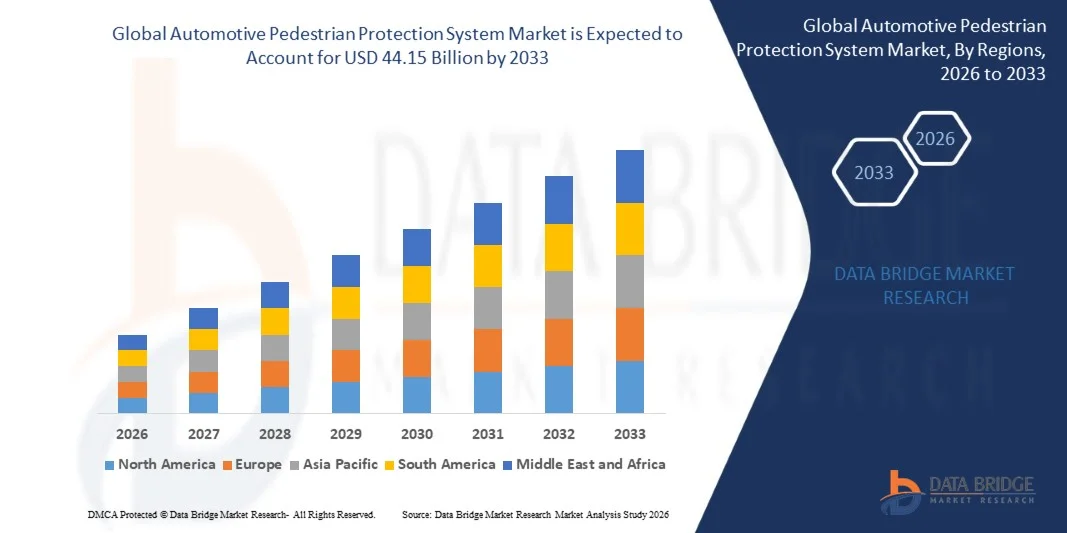
- As per Data Bridge Market Research analysis, the automotive pedestrian protection system market was valued at USD 15.05 billion in 2025 and is projected to reach USD 44.15 billion by 2033, growing at a CAGR of 14.40% from 2026 to 2033.
- The market is experiencing consistent growth driven by increasing demand for advanced vehicle safety technologies, rising adoption of pedestrian detection and automatic emergency braking systems, and growing integration of cameras, radar, LiDAR, and other sensing technologies across modern vehicles.
- The increasing focus on pedestrian and vulnerable road-user safety, combined with stricter vehicle safety regulations and the expanding adoption of advanced driver-assistance systems (ADAS), is compelling automotive manufacturers to integrate pedestrian protection technologies. Active systems such as automatic emergency braking, pedestrian detection, and external airbags are increasingly being combined with advanced sensors and real-time processing to reduce collision risks and severity.
Market Size & Forecast
- Global Market Value (2025): USD 15.05 Billion
- Expected Market Value (2033): USD 44.15 Billion
- Forecast CAGR (2026–2033): 14.40%
- Leading Region in 2025: North America
- Fastest Growing Region: Asia Pacific
What are the Major Takeaways of the Automotive Pedestrian Protection System Market?
- North America dominated the automotive pedestrian protection system market with the largest revenue share of 38.5% in 2025, supported by stringent vehicle safety regulations, high ADAS adoption, and strong investments in advanced pedestrian safety technologies.
- Asia-Pacific is expected to be the fastest-growing region at a CAGR of 12.5% from 2026 to 2033, fueled by rising vehicle production, increasing adoption of ADAS, growing road-safety initiatives, and expanding automotive manufacturing and autonomous-vehicle development across China, Japan, South Korea, and India.
- The automatic braking and collision avoidance segment led the market with a 40% share in 2025, driven by increasing adoption of pedestrian detection and automatic emergency braking technologies.
- External airbags are the fastest-growing type, projected to register a CAGR of 11%, reflecting the surge in emphasis on reducing pedestrian injuries during unavoidable collisions.
- The internal combustion engine (ICE) vehicles segment dominated the vehicle type category with a 60% revenue share in 2025, led by the large global production and installed base of conventional vehicles
- Sensor accounted for 35% of the market share in 2025, preferred by automakers due to their critical role in accurately detecting pedestrians, measuring distance and movement, and enabling timely collision avoidance and safety interventions
- The passive pedestrian protection segment is the fastest-growing technology category, with a CAGR of 9.2%, driven by increasing emphasis on reducing injury severity when collisions cannot be avoided.
Report Scope and Automotive Pedestrian Protection System Market Segmentation
|
Attributes |
Automotive Pedestrian Protection System Key Market Insights |
|
Segments Covered |
|
|
Countries Covered |
North America
Europe
Asia-Pacific
Middle East and Africa
South America
|
|
Key Market Players |
|
|
Market Opportunities |
|
|
Value Added Data Infosets |
In addition to the market insights such as market value, growth rate, market segments, geographical coverage, market players, and market scenario, the market report curated by the Data Bridge Market Research team includes in-depth expert analysis, import/export analysis, pricing analysis, production consumption analysis, and pestle analysis. |
What is the Key Trend in the Automotive Pedestrian Protection System Market?
- Automotive manufacturers are increasingly integrating AI-enabled pedestrian detection, automatic emergency braking (AEB), and multi-sensor systems to improve vulnerable-road-user protection across complex urban, nighttime, and turning scenarios.
- For instance, in January 2025, Goodyear unveiled its SightLine smart-tire technology developed with TNO at CES 2025, using embedded sensors to detect rain, snow, and ice and provide road-friction information to improve the timing and effectiveness of automatic emergency braking, including systems designed to protect pedestrians and other vulnerable road users.
- Advanced sensor fusion combining cameras, radar, LiDAR, and ultrasonic sensors is enabling vehicles to identify pedestrians more accurately across different speeds, directions, lighting conditions, and traffic environments.
- Vehicle manufacturers are also increasingly combining active collision avoidance with passive impact protection, including pedestrian-friendly front-end structures and deployable bonnet technologies, to reduce injury severity when collisions cannot be avoided.
- For instance, in May 2026, NHTSA expanded its New Car Assessment Program (NCAP) with enhanced Advanced Driver Assistance System testing, including pedestrian automatic emergency braking, and the 2026 Tesla Model Y became the first vehicle to pass the agency’s new ADAS tests, demonstrating the increasing emphasis on automated pedestrian detection and braking technologies.
- As safety-assessment programs and regulations increasingly emphasize pedestrian and cyclist protection, automotive OEMs are expected to accelerate the integration of advanced sensing, AI-based perception, and automated braking technologies, reinforcing pedestrian protection as a core component of vehicle safety systems.
What are the Key Drivers of the Automotive Pedestrian Protection System Market?
- The increasing adoption of mandatory pedestrian-capable automatic emergency braking (PAEB) and stricter vehicle safety requirements is significantly increasing demand for automotive pedestrian protection systems worldwide.
- For instance, in January 2025, NHTSA’s PARTS program released real-world findings showing that pedestrian automatic emergency braking (PAEB) reduced single-vehicle frontal crashes involving non-motorists by 9%, supporting the growing adoption of pedestrian detection and automatic braking technologies to improve road safety.
- Automotive OEMs are integrating pedestrian protection technologies into ADAS platforms to meet regulatory requirements, improve safety ratings, and reduce pedestrian collision severity through automated detection and braking.
- For instance, in January 2025, the Alliance for Automotive Innovation filed a lawsuit challenging the U.S. requirement for advanced automatic emergency braking systems, following NHTSA’s rule requiring nearly all new cars and trucks to incorporate AEB by 2029. NHTSA estimated the regulation could save at least 360 lives and prevent 24,000 injuries annually, reinforcing regulatory pressure for wider deployment of pedestrian and vehicle detection systems
- With regulators and safety-assessment organizations increasingly prioritizing vulnerable-road-user protection, pedestrian detection, automated braking, and impact-mitigation technologies will remain essential to next-generation vehicle safety development.
Which Factors are Challenging the Growth of the Automotive Pedestrian Protection System Market?
- Advanced pedestrian protection systems require significant integration and validation costs because cameras, radar, LiDAR, control units, braking systems, and safety-critical software must operate reliably as a coordinated system.
- For instance, in December 2025, AAA testing found that newer pedestrian automatic emergency braking (PAEB) systems still showed limitations at night, despite substantial improvements over earlier systems. The 2024–2025 model-year vehicles avoided simulated pedestrian collisions in 60% of nighttime tests, compared with 90% during daytime testing, highlighting the challenge of reliable pedestrian detection under low-light conditions
- These high costs can limit adoption in entry-level and price-sensitive vehicles, particularly where manufacturers must balance advanced safety content against vehicle affordability and other technology investments.
- System performance can also deteriorate under rain, fog, snow, glare, low-light conditions, and dense urban traffic, increasing the risk of false positives or missed pedestrian detections and requiring extensive validation.
- For instance, in October 2025, a study published in Accident Analysis & Prevention found that pedestrian AEB detection rates fell from 98% during daytime to 87% at night using low beams, while crashes occurred in 23% of low-beam nighttime cases despite pedestrian detection. These findings demonstrate that lighting conditions and sensor performance remain important technical restraints for pedestrian protection systems.
- The combination of high integration costs, complex calibration requirements, extensive testing, and variable sensor performance continues to challenge widespread adoption, particularly in cost-sensitive vehicle segments and emerging automotive markets.
How is the Automotive Pedestrian Protection System Market Segmented?
The automotive pedestrian protection system market is segmented on the basis of type, vehicle type, component, technology, and distribution channel
- By Type
On the basis of type, the automotive pedestrian protection system market is segmented into automatic braking and collision avoidance, brake assist, external airbags, and pop-up bonnets. The automatic braking and collision avoidance segment dominated the market with an estimated 40% share in 2025, owing to increasing adoption of pedestrian detection and automatic emergency braking technologies. These systems identify pedestrians in the vehicle's path and automatically initiate braking when a collision becomes imminent. Integration with cameras, radar, and advanced driver assistance systems is strengthening their deployment across modern vehicles. Increasing regulatory emphasis on automatic emergency braking is further supporting adoption. Automakers are also incorporating these functions into broader ADAS packages to improve vehicle safety ratings.
The external airbags segment is projected to register the fastest growth at an estimated CAGR of 11% from 2026 to 2033, driven by increasing emphasis on reducing pedestrian injuries during unavoidable collisions. External airbags are designed to deploy around the bonnet and windshield area following detection of an impending pedestrian impact. They create an additional cushioning zone between pedestrians and rigid vehicle structures. Increasing attention to pedestrian head protection is encouraging automakers to develop more sophisticated impact-mitigation technologies. Improvements in sensors, actuators, and deployment mechanisms are supporting their technological development. Integration with active detection systems can enable deployment based on real-time collision assessments.
- By Vehicle Type
On the basis of vehicle type, the automotive pedestrian protection system market is segmented into internal combustion engine (ICE) vehicles, electric vehicles, and hybrid vehicles. The internal combustion engine (ICE) vehicles segment dominated the market with an estimated 60% share in 2025, supported by the large global production and installed base of conventional vehicles. ICE vehicles increasingly incorporate pedestrian detection, automatic braking, and other ADAS functions. Automakers are integrating pedestrian protection technologies into established ICE vehicle platforms to meet increasingly stringent safety requirements. The large production volumes of conventional vehicles also provide significant opportunities for suppliers of sensors, actuators, and control units. Existing vehicle architectures enable manufacturers to integrate these technologies across multiple models.
The electric vehicles segment is projected to register the fastest growth at an estimated CAGR of 12% from 2026 to 2033, supported by increasing EV production and the rapid adoption of electronically controlled safety systems. Electric vehicles increasingly feature advanced cameras, radar, sensors, and centralized electronic control architectures. These technologies enable pedestrian detection systems to communicate efficiently with vehicle braking and other ADAS functions. EV manufacturers are also emphasizing advanced safety technologies to differentiate their vehicles in competitive markets. Growing regulatory requirements and consumer expectations for high safety ratings are supporting additional adoption. The increasing development of autonomous and semi-autonomous driving capabilities is creating further demand for pedestrian detection.
- By Component
On the basis of component, the automotive pedestrian protection system market is segmented into sensor, actuator, control unit, cameras, and others. The sensor segment dominated the market with an estimated 35% share in 2025, because accurate sensing is fundamental to pedestrian detection and collision prevention. Sensors provide information about pedestrian position, distance, movement, and collision probability. Radar, ultrasonic, LiDAR, and other sensing technologies can operate together with cameras to improve environmental perception. Increasing adoption of multi-sensor architectures is consequently supporting demand for advanced sensing components. Sensors are also essential for coordinating active braking and other pedestrian protection functions. Improvements in sensing accuracy, detection range, and environmental performance are further strengthening their role.
The cameras segment is projected to register the fastest growth at an estimated CAGR of 12% from 2026 to 2033, driven by increasing use of computer vision for pedestrian recognition and classification. Cameras provide detailed visual information that allows systems to identify pedestrians and distinguish them from other roadside objects. Artificial intelligence and machine-learning algorithms are improving the ability of camera-based systems to interpret complex traffic environments. Increasing integration of cameras with radar and other sensors is also improving detection reliability. Declining camera component costs are supporting adoption across a wider range of vehicle models. Improvements in low-light and high-dynamic-range imaging are further enhancing operational performance.
- By Technology
On the basis of technology, the automotive pedestrian protection system market is segmented into active pedestrian protection system and passive pedestrian protection system. The active pedestrian protection system segment dominated the market with 59% share in 2025, supported by its ability to detect pedestrians and initiate preventive safety measures before or during a potential collision. Active systems combine sensing technologies, electronic control units, and braking functions to provide real-time collision avoidance. Their preventive capabilities provide an important advantage over systems that primarily mitigate injuries after impact. Increasing integration with automatic emergency braking is strengthening adoption across modern vehicles. Regulatory requirements are also encouraging manufacturers to improve active pedestrian detection and intervention capabilities
The passive pedestrian protection system segment is projected to register the fastest growth at estimated CAGR of 9.2% from 2026 to 2033, driven by increasing emphasis on reducing injury severity when collisions cannot be avoided. Passive systems include technologies such as deployable bonnet mechanisms and external airbags that provide additional protection during an impact. Their relatively straightforward integration with vehicle structures supports adoption across different vehicle platforms. Increasing pedestrian safety requirements are encouraging automakers to combine passive protection with active collision avoidance technologies. Improvements in actuators and impact-detection mechanisms are further supporting technological development. Passive systems also remain relevant where complete collision avoidance cannot be achieved.
- By Distribution Channel
On the basis of distribution channel, the automotive pedestrian protection system market is segmented into OEM and aftermarket. The OEM segment dominated the market with 72% share in 2025, supported by the advantages of factory-level integration and vehicle-specific calibration. OEM installation allows pedestrian protection systems to be integrated directly with cameras, sensors, braking systems, actuators, and electronic control units. Factory integration also enables manufacturers to optimize sensor positioning and system performance during vehicle development. Safety testing and regulatory validation can be completed before vehicles reach consumers. Increasing regulatory requirements are further encouraging automakers to install pedestrian protection technologies during original vehicle production.
The aftermarket segment is projected to register the fastest growth at a CAGR of 11.3% during the forecast period, supported by increasing demand for safety upgrades for existing vehicles. Retrofit solutions provide an opportunity to equip older vehicles with pedestrian detection and warning technologies that were not available when they were manufactured. Fleet operators represent an important potential customer group because safety technologies can be deployed across large vehicle fleets. Improvements in cameras, sensors, wireless connectivity, and installation technologies are making some retrofit solutions increasingly accessible. Growing awareness of pedestrian safety is also encouraging vehicle owners to consider additional safety equipment. However, integration with vehicle braking and electronic systems can make aftermarket installation more complex.
Which Region Holds the Largest Share of the Automotive Pedestrian Protection System Market?
- North America dominated the automotive pedestrian protection system market with the largest revenue share of 38.5% in 2025, supported by stringent vehicle safety regulations, high ADAS adoption, and strong investments in advanced pedestrian safety technologies.
- The region also benefits from advanced automotive manufacturing capabilities, widespread integration of ADAS technologies, and increasing regulatory emphasis on pedestrian automatic emergency braking. The United States represents the primary demand center, supported by NHTSA safety requirements and growing adoption of sensor-based pedestrian detection systems. Increasing pedestrian safety concerns and continued investments in vehicle safety innovation further strengthen North America's position in the global market.
U.S. Automotive Pedestrian Protection System Market Insight
The U.S. automotive pedestrian protection system market is witnessing strong growth due to rising adoption of advanced driver assistance systems, pedestrian automatic emergency braking, and stringent vehicle safety requirements. The country’s mature automotive ecosystem, along with increasing deployment of camera-, radar-, and sensor-based pedestrian detection technologies, is driving demand across passenger and commercial vehicles. In addition, growing emphasis on reducing pedestrian fatalities and improving vehicle safety performance is accelerating the integration of active pedestrian protection systems across automotive manufacturers.
Asia-Pacific Automotive Pedestrian Protection System Market Insight
The Asia-Pacific automotive pedestrian protection system market is expected to witness rapid growth, driven by increasing vehicle production, urbanization, and rising investments in advanced automotive safety technologies across countries such as China, Japan, and India. Growing awareness regarding pedestrian safety, increasing adoption of ADAS technologies, and expanding electric vehicle production are supporting regional market expansion. Additionally, the growing presence of automotive technology manufacturers and increasing implementation of advanced sensing systems are accelerating pedestrian protection adoption across passenger and commercial vehicles.
Japan Automotive Pedestrian Protection System Market Insight
The Japan automotive pedestrian protection system market is witnessing consistent growth due to rising investments in advanced vehicle safety technologies, pedestrian detection systems, and intelligent mobility solutions. Automotive manufacturers are increasingly adopting cameras, radar, automatic emergency braking, and other advanced systems to improve pedestrian safety and vehicle performance. Moreover, increasing integration of active and passive pedestrian protection technologies and Japan’s focus on reducing road accidents are further contributing to market growth.
China Automotive Pedestrian Protection System Market Insight
The China automotive pedestrian protection system market is growing rapidly, driven by expanding vehicle production, increasing urbanization, and rising government emphasis on road safety and intelligent vehicles. Growing adoption of AI-enabled pedestrian detection, automatic emergency braking, and camera- and radar-based safety systems across passenger vehicles is significantly boosting market demand. In addition, rapid electric vehicle development, increasing automotive technology investments, and growing consumer awareness regarding vehicle safety are positioning China as one of the fastest-growing markets for automotive pedestrian protection systems globally.
U.K. Automotive Pedestrian Protection System Market Insight
The U.K. automotive pedestrian protection system market is experiencing steady growth, supported by rising adoption of ADAS technologies, pedestrian automatic emergency braking, and advanced vehicle safety systems. Increasing investments in pedestrian detection technologies and growing demand for safer mobility solutions are contributing to market growth. Furthermore, integration of cameras, radar, artificial intelligence, and automated braking technologies is improving pedestrian detection and collision avoidance performance, positioning the U.K. as an important market for advanced automotive safety technologies.
Germany Automotive Pedestrian Protection System Market Insight
The Germany automotive pedestrian protection system market is expanding steadily due to the country’s strong automotive manufacturing base, advanced vehicle technology capabilities, and increasing adoption of next-generation safety systems. Automotive manufacturers and suppliers are increasingly utilizing pedestrian detection, automatic emergency braking, active bonnets, and other protection technologies to improve vehicle safety. Continuous advancements in sensor fusion, artificial intelligence, and ADAS integration, along with strong emphasis on road safety and vehicle testing, are further driving market growth in Germany.
Which are the Top Companies in Automotive Pedestrian Protection System Market?
The automotive pedestrian protection system industry is primarily led by well-established companies, including:
- Robert Bosch GmbH (Germany)
- ZF Friedrichshafen AG (Germany)
- Continental AG (Germany)
- Autoliv, Inc. (Sweden)
- Magna International Inc. (Canada)
- Valeo (France)
- DENSO CORPORATION (Japan)
- HYUNDAI MOBIS (South Korea)
- Aptiv (Ireland)
- FORVIA (France)
- Ningbo Joyson Electronic Corp. (China)
- AISIN CORPORATION (Japan)
- Hitachi Astemo, Ltd. (Japan)
- Mobileye Technologies Limited (Israel)
- NXP Semiconductors (Netherlands)
- Texas Instruments Incorporated (U.S.)
- Autoneum (Switzerland)
- HL Mando (South Korea)
- Mitsubishi Electric Corporation (Japan)
- Panasonic Holdings Corporation (Japan)
What are Latest Developments in Automotive Pedestrian Protection System Market?
- In January 2025, Goodyear and TNO demonstrated SightLine smart-tire technology at CES, using tire-based sensing to identify road-surface conditions such as rain, snow, and ice and provide information that can support automatic emergency braking decisions. The technology illustrates the industry's movement toward combining additional vehicle data with existing safety systems to improve braking performance. Such sensor-enhanced approaches can support more responsive collision-avoidance systems under changing road conditions.
- In January 2025, WIRED reported growing debate around the implementation of the U.S. automatic emergency braking mandate, which requires systems to detect pedestrians in both daylight and darkness and automatically brake when necessary. The regulation is pushing automakers toward more capable pedestrian detection and braking technologies while also highlighting challenges involving system performance, testing, and implementation. This development reinforces the increasing importance of reliable pedestrian protection as a standard vehicle-safety capability.
- In November 2024, NHTSA announced updates to its New Car Assessment Program (NCAP) that introduced pedestrian automatic emergency braking among the advanced driver-assistance technologies to be evaluated in vehicle safety ratings. The updated program also strengthened assessment procedures for existing automatic emergency braking systems. The change increases the importance of pedestrian detection and collision-avoidance performance in vehicle safety evaluations and is expected to encourage manufacturers to improve pedestrian protection technologies.
- In June 2024, a coalition of major automakers represented by the Alliance for Automotive Innovation asked NHTSA to reconsider its new automatic emergency braking requirements. The industry group argued that the mandated performance levels, including pedestrian detection and braking requirements, would be difficult to achieve with current technology. The development highlighted the increasing technical and engineering demands placed on pedestrian AEB systems and demonstrated the industry's efforts to address implementation challenges associated with advanced pedestrian protection.
- In April 2024, the U.S. National Highway Traffic Safety Administration (NHTSA) finalized FMVSS No. 127, requiring automatic emergency braking systems on new passenger cars and light trucks to include pedestrian detection capabilities. The regulation requires pedestrian AEB to operate in daylight and darker nighttime conditions, strengthening the role of active pedestrian protection technologies in vehicle safety. The rule is expected to encourage automakers to improve pedestrian detection, sensing, and automatic braking capabilities as part of standard vehicle safety systems.

- Interactive Data Analysis Dashboard
- Company Analysis Dashboard for high growth potential opportunities
- Research Analyst Access for customization & queries
- Competitor Analysis with Interactive dashboard
- Latest News, Updates & Trend analysis
- Harness the Power of Benchmark Analysis for Comprehensive Competitor Tracking
Data collection and base year analysis are done using data collection modules with large sample sizes. The stage includes obtaining market information or related data through various sources and strategies. It includes examining and planning all the data acquired from the past in advance. It likewise envelops the examination of information inconsistencies seen across different information sources. The market data is analysed and estimated using market statistical and coherent models. Also, market share analysis and key trend analysis are the major success factors in the market report. To know more, please request an analyst call or drop down your inquiry.
The key research methodology used by DBMR research team is data triangulation which involves data mining, analysis of the impact of data variables on the market and primary (industry expert) validation. Data models include Vendor Positioning Grid, Market Time Line Analysis, Market Overview and Guide, Company Positioning Grid, Patent Analysis, Pricing Analysis, Company Market Share Analysis, Standards of Measurement, Global versus Regional and Vendor Share Analysis. To know more about the research methodology, drop in an inquiry to speak to our industry experts.
Data Bridge Market Research is a leader in advanced formative research. We take pride in servicing our existing and new customers with data and analysis that match and suits their goal. The report can be customized to include price trend analysis of target brands understanding the market for additional countries (ask for the list of countries), clinical trial results data, literature review, refurbished market and product base analysis. Market analysis of target competitors can be analyzed from technology-based analysis to market portfolio strategies. We can add as many competitors that you require data about in the format and data style you are looking for. Our team of analysts can also provide you data in crude raw excel files pivot tables (Fact book) or can assist you in creating presentations from the data sets available in the report.













