


What is the Bag-in-Box Container Market Size and Growth Rate?
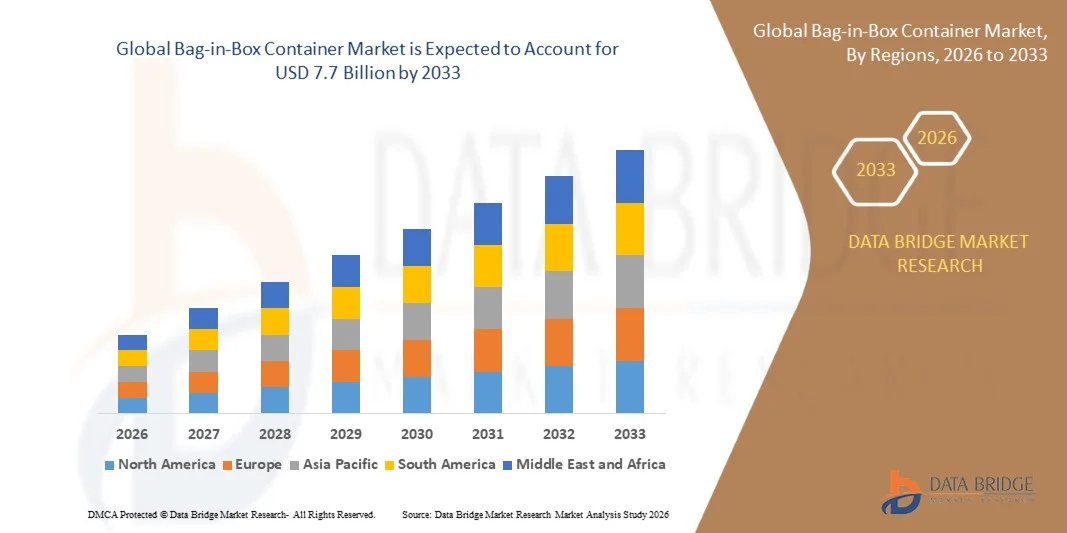
- As per Data Bridge Market Research analysis, the bag-in-box container market was valued at USD 4.79 billion in 2025 and is projected to reach USD 7.7 billion by 2033, growing at a CAGR of 6.20% from 2026 to 2033.
- The market is experiencing consistent growth driven by rising demand for convenient, lightweight, and cost-effective liquid packaging solutions, increasing adoption of flexible packaging across food and beverages, and growing demand for extended shelf life, efficient transportation, and reduced packaging waste. Bag-in-box containers are gaining traction across applications such as wine, juices, dairy products, sauces, edible oils, and industrial liquids due to their space-efficient design, ease of dispensing, and lower packaging material requirements.
- The increasing shift toward sustainable and efficient packaging solutions, combined with growing demand for bulk liquid packaging, is encouraging food and beverage manufacturers, industrial liquid suppliers, and other end users to adopt bag-in-box containers. Flexible bags combined with protective corrugated boxes provide efficient storage and transportation while reducing material usage and packaging waste compared with conventional rigid containers.
Market Size & Forecast
- Global Market Value (2025): USD 4.79 Billion
- Expected Market Value (2033): USD 7.7 Billion
- Forecast CAGR (2026–2033): 6.20%
- Leading Region in 2025: North America
- Fastest Growing Region: Asia Pacific
What are the Major Takeaways of the Bag-in-Box Container Market?
- North America dominated the Bag-in-Box Container market with the largest revenue share of 34.8% in 2025, supported by strong demand for convenient liquid packaging, established food and beverage processing industries, and increasing adoption of flexible packaging solutions across wine, beverages, sauces, and industrial liquids.
- Asia-Pacific is expected to be the fastest-growing region at a CAGR of 6.2% from 2026 to 2033, fueled by expanding food and beverage production, rising consumption of packaged liquids, growing urbanization, and increasing adoption of lightweight and space-efficient packaging solutions across China, India, Japan, and Southeast Asia.
- The bags segment led the market with a 61.5% share in 2025, driven by the growing use of flexible inner bags for liquid containment, efficient product dispensing, reduced packaging weight, and improved transportation efficiency.
- Fittings & accessories are the fastest-growing component type, projected to register a CAGR of 5.6%, reflecting increasing demand for convenient dispensing systems, improved closures, taps, spouts, and specialized fittings that enhance product handling and consumer convenience.
- The plastic material segment dominated the material type category with a 68.2% revenue share in 2025, supported by its lightweight properties, flexibility, durability, moisture resistance, and suitability for a wide range of liquid packaging applications.
- Paperboard is expected to be the fastest-growing material type, with a CAGR of 5.3%, driven by increasing demand for recyclable and fiber-based secondary packaging and growing sustainability requirements across packaging applications.
- Industrial liquids are expected to be the fastest-growing end-user segment, registering a CAGR of 5.1%, driven by increasing demand for efficient bulk packaging of chemicals, lubricants, cleaning solutions, and other liquid products.
Report Scope and Bag-in-Box Container Market Segmentation
|
Attributes |
Bag-in-Box Container Key Market Insights |
|
Segments Covered |
|
|
Countries Covered |
North America
Europe
Asia-Pacific
Middle East and Africa
South America
|
|
Key Market Players |
|
|
Market Opportunities |
|
|
Value Added Data Infosets |
In addition to the insights on market scenarios such as market value, growth rate, segmentation, geographical coverage, and major players, the market reports curated by the Data Bridge Market Research also include import export analysis, production capacity overview, production consumption analysis, price trend analysis, climate change scenario, supply chain analysis, value chain analysis, raw material/consumables overview, vendor selection criteria, PESTLE Analysis, Porter Analysis, and regulatory framework. |
What is the Key Trend in the Bag-in-Box Container Market?
- The increasing shift toward lightweight, recyclable, and resource-efficient liquid packaging is emerging as a key trend in the bag-in-box container market, as manufacturers and brand owners seek packaging formats that reduce material consumption while maintaining product protection, dispensing convenience, and transportation efficiency. Bag-in-box formats combine flexible inner bags with protective outer boxes, enabling efficient storage and transportation across food, beverages, dairy, wine, water, and industrial liquid applications.
- For instance, in February 2024, Aran Group introduced its second-generation Premium Flex Bag-in-Box solution for long-distance transportation of liquid foods, emphasizing recyclability, food safety, and improved logistical efficiency. The solution was designed for applications where lightweight packaging and efficient transportation are important considerations.
- The development of recycle-ready films and improved material structures is further supporting the transition toward more sustainable bag-in-box packaging. Manufacturers are increasingly working on mono-material and recyclable film structures that can improve end-of-life recovery while retaining the barrier properties required for liquid products.
- For instance, in 2024, SIG reported the expansion of its recycle-ready bag-in-box solutions, including the use of its Terra OptiTap 2300 solution with RecShield film for water applications in Australia and New Zealand, while wine customers were preparing to transition to recycle-ready bag-in-box formats.
- The growing emphasis on packaging circularity, reduced plastic use, lightweight construction, and efficient product evacuation is expected to accelerate the adoption of advanced bag-in-box formats across food and beverage and industrial liquid applications. The combination of recyclable materials, improved dispensing systems, and efficient transportation characteristics is reinforcing bag-in-box as an increasingly attractive alternative to conventional rigid liquid containers.
What are the Key Drivers of the Bag-in-Box Container Market?
- The growing demand for lightweight and space-efficient packaging is a major driver of the bag-in-box container market, particularly across beverages, wine, dairy, liquid foods, edible oils, detergents, chemicals, and other liquid products. The combination of a flexible inner bag and protective outer box allows manufacturers to reduce packaging weight and transportation volume while maintaining product protection during storage and distribution.
- For instance, in July 2025, Rawlings introduced a Bag-In-Box range designed for still liquids such as water, juices, oils, cider, and ready-to-drink beverages. The company highlighted reduced environmental impact, lower plastic consumption, recyclability, and cost effectiveness as key benefits of the format.
- The expansion of bag-in-box applications beyond traditional wine and beverage packaging is also creating new growth opportunities. Manufacturers are increasingly developing larger-format and specialized systems for dairy products, liquid eggs, industrial liquids, chemicals, cleaning products, motor oils, and other applications requiring efficient bulk liquid handling.
- For instance, in March 2025, TRICOR and EVOPACK launched a bag-in-box solution designed for 1,000-liter liquid products, targeting industrial applications and emphasizing product protection, recyclability, reduced transportation and storage volume, and supply-chain efficiency.
- The increasing focus on reducing packaging material, improving transportation efficiency, extending product shelf life, and minimizing product waste is expected to continue supporting demand for bag-in-box containers. These advantages are encouraging food and beverage manufacturers as well as industrial liquid suppliers to shift toward flexible packaging formats that provide efficient filling, storage, dispensing, and transportation
What Factors are Challenging the Growth of the Bag-in-Box Container Market?
- The recyclability and end-of-life management of multilayer flexible films and fitments remain key challenges for the bag-in-box container market. While the corrugated outer box is generally recyclable through established paper-recycling systems, the inner bag, films, taps, and other components can require separate collection and specialized recycling infrastructure, creating challenges for achieving complete packaging circularity
- For instance, in December 2024, SIG reported efforts to expand recycle-ready bag-in-box solutions across relevant markets, including the development and commercialization of packaging structures designed to improve recyclability while maintaining the performance required for liquid products.
- The technical requirements for barrier protection, product compatibility, leak prevention, and reliable dispensing can also increase the complexity of bag-in-box packaging compared with simpler rigid containers. Liquid products such as wine, dairy, juices, sauces, chemicals, and oils can require specialized films, fitments, closures, and filling systems to maintain product quality and prevent leakage throughout the supply chain. Smurfit Westrock
- For instance, in September 2025, Smurfit Westrock launched its Bag-in-Box Powergrip solution for cleaning materials, oils, and agrochemical products. The design uses a cardboard casing and integrated handle and was developed to replace certain HDPE bottles and jerrycans, while reducing plastic consumption by up to 75% compared with the referenced HDPE alternatives.
- The need for specialized recycling infrastructure, advanced film structures, compatible fitments, and dedicated filling equipment can increase conversion complexity and costs for manufacturers and packaging users. These factors, together with differences in recycling infrastructure across countries, continue to challenge the broader adoption of bag-in-box packaging, particularly in applications where packaging performance and end-of-life recovery must be addressed simultaneously.
How is the Bag-in-Box Container Market Segmented?
The bag-in-box container market is segmented on the basis of component type, material type, capacity, closure type, and end user.
- By Component Type
On the basis of component type, the bag-in-box container market is segmented into bags, boxes, and fittings & accessories. The bags segment dominated the market with 61.5% share in 2025, owing to the increasing use of flexible inner bags for liquid containment, efficient dispensing, reduced packaging weight, and improved transportation efficiency. Bags serve as the primary product-contact component in bag-in-box packaging and provide flexibility that allows products to be efficiently filled, stored, transported, and dispensed. Increasing adoption of bag-in-box formats for beverages, wine, dairy products, sauces, edible oils, and industrial liquids is supporting demand for high-performance flexible bags. Improvements in multilayer films and barrier structures are further enhancing protection against oxygen, moisture, and other external factors, supporting wider application across sensitive liquid products.
The fittings & accessories segment is projected to register the fastest growth at a CAGR of 5.6% from 2026 to 2033, driven by increasing demand for convenient dispensing systems, improved closures, taps, spouts, and specialized fittings. Fittings play an important role in maintaining package integrity while enabling controlled product dispensing and reducing leakage during storage and transportation. Growing demand for consumer-friendly packaging is encouraging the development of improved taps, fitments, handles, and dispensing mechanisms. Increasing adoption of bag-in-box packaging across beverages, foodservice, household products, and industrial liquids is further creating demand for specialized accessories. Advances in fitment design are also improving compatibility with automated filling and dispensing systems, supporting segment growth.
- By Material Type
On the basis of material type, the bag-in-box container market is segmented into plastic, paperboard, and aluminum. The plastic segment dominated the market with 68.2% share in 2025, supported by its lightweight properties, flexibility, durability, moisture resistance, and suitability for a wide range of liquid packaging applications. Plastic films are extensively used for manufacturing the inner bags because they can provide the flexibility and barrier properties required to protect liquid products during storage and distribution. Different film structures can be designed according to product sensitivity, shelf-life requirements, and filling conditions. Increasing demand for lightweight packaging is further supporting the use of plastic materials in bag-in-box systems. However, growing sustainability requirements are encouraging manufacturers to develop recyclable and resource-efficient plastic film structures.
The paperboard segment is projected to register the fastest growth at a CAGR of 5.3% from 2026 to 2033, driven by increasing demand for recyclable and fiber-based secondary packaging and growing sustainability requirements across packaging applications. Paperboard provides structural strength and protection to the flexible inner bag while supporting efficient stacking, handling, and transportation. Increasing efforts to reduce reliance on conventional rigid packaging are encouraging the use of fiber-based outer packaging solutions. Improvements in coatings, board strength, printing, and structural design are further expanding the application of paperboard in bag-in-box packaging. Growing consumer and brand-owner preference for packaging materials with improved recyclability is expected to support demand for paperboard-based solutions.
- By Capacity
On the basis of capacity, the bag-in-box container market is segmented into up to 5 liters, 5 to 20 liters, 20 to 50 liters, and above 50 liters. The 5 to 20 liters segment dominated the market with 38.7% share in 2025, supported by its suitability for household, foodservice, beverage, wine, and commercial liquid applications. This capacity range provides a balance between portability, storage efficiency, and sufficient product volume for frequent-use applications. Bag-in-box packages within this range are increasingly used for juices, wine, water, sauces, dairy products, and other liquid food products. Their compact design also enables efficient storage and transportation compared with several conventional rigid containers. Growing demand for convenient bulk packaging among households, restaurants, foodservice operators, and small commercial users is supporting the segment.
The above 50 liters segment is projected to register the fastest growth at a CAGR of 5.8% from 2026 to 2033, driven by increasing demand for bulk liquid transportation and storage across industrial and commercial applications. Large-capacity bag-in-box systems allow manufacturers and distributors to transport substantial volumes while reducing packaging material and storage requirements. These formats are increasingly applicable to industrial liquids, edible oils, food ingredients, chemicals, cleaning solutions, and other bulk products. Their efficient use of warehouse and transportation space can also reduce handling requirements across supply chains. Increasing demand for cost-efficient bulk liquid packaging is expected to further support adoption of larger-capacity formats.
- By Closure Type
On the basis of closure type, the bag-in-box container market is segmented into spouts, caps, and taps. The taps segment dominated the market with 47.6% share in 2025, supported by their widespread use in beverage, wine, water, foodservice, and other liquid applications requiring convenient and controlled dispensing. Taps allow users to dispense products directly from the package while limiting exposure to external air and contaminants. Their compatibility with different bag sizes and dispensing requirements has supported broad adoption across consumer and commercial applications. Increasing demand for convenient packaging that minimizes product handling and reduces spillage is further supporting the use of taps.
The spouts segment is projected to register the fastest growth at a CAGR of 5.5% from 2026 to 2033, driven by increasing demand for controlled dispensing and user-friendly packaging formats. Spouts can support precise pouring and dispensing across applications such as sauces, beverages, dairy products, edible oils, and household liquids. Improvements in closure design and compatibility with different flexible bag structures are expanding their application across various product categories. Growing preference for resealable and convenient packaging is also encouraging manufacturers to introduce improved spout systems. Increasing emphasis on reducing product waste and improving consumer handling is expected to support segment growth.
- By End User
On the basis of end user, the bag-in-box container market is segmented into food & beverages, industrial liquids, household products, cosmetics & personal care, and other end users. The food & beverages segment dominated the market with 55.7% share in 2025, supported by widespread use of bag-in-box packaging for wine, juices, dairy products, sauces, edible oils, water, and other liquid food products. The format provides efficient transportation, convenient dispensing, and effective use of storage space, making it suitable for both consumer and foodservice applications. Increasing demand for extended shelf life and reduced packaging weight is also supporting adoption across beverage and food applications. Growing preference for flexible packaging among food and beverage manufacturers is further contributing to segment expansion.
The industrial liquids segment is projected to register the fastest growth at a CAGR of 5.1% from 2026 to 2033, driven by increasing demand for efficient bulk packaging of chemicals, lubricants, cleaning solutions, agricultural liquids, and other industrial products. Bag-in-box systems can provide efficient handling and transportation of liquid products while reducing the space occupied by conventional rigid containers. Larger-capacity formats are particularly suitable for industrial environments where substantial quantities of liquid products are consumed or transferred. Increasing focus on reducing packaging material, transportation requirements, and handling costs is encouraging industrial users to evaluate flexible bulk packaging solutions. Growing development of specialized films, fitments, and protective outer boxes is further supporting adoption across industrial liquid applications.
Which Region Holds the Largest Share of the Bag-in-Box Container Market?
- North America dominated the bag-in-box container market with the largest revenue share of 34.8% in 2025, supported by strong demand for flexible liquid packaging across food and beverage, wine, industrial liquids, and household product applications.
- The region also benefits from well-established food processing and beverage industries, increasing adoption of lightweight packaging, and growing emphasis on recyclable and resource-efficient packaging solutions. Rising demand for convenient dispensing formats, efficient transportation, and bulk liquid packaging continues to strengthen North America's position in the global market.
U.S. Bag-in-Box Container Market Insight
The U.S. bag-in-box container market is witnessing steady growth due to increasing adoption of flexible packaging across beverages, wine, foodservice, dairy products, sauces, edible oils, and industrial liquids. The country's established food and beverage industry, combined with growing demand for lightweight and space-efficient packaging, is driving adoption across consumer and commercial applications. In addition, increasing emphasis on packaging sustainability, recyclable materials, convenient dispensing, and reduced transportation requirements is supporting demand for bag-in-box solutions.
Asia-Pacific Bag-in-Box Container Market Insight
The Asia-Pacific bag-in-box container market is expected to witness rapid growth, driven by expanding food and beverage production, increasing consumption of packaged liquids, and rising adoption of flexible packaging across countries such as China, India, Japan, and South Korea. Growing urbanization, expansion of foodservice channels, and increasing demand for convenient and lightweight packaging are supporting regional market expansion. Additionally, rising sustainability initiatives and growing investments in modern packaging technologies are accelerating adoption across beverage manufacturers, food processors, and industrial liquid suppliers.
Japan Bag-in-Box Container Market Insight
The Japan bag-in-box container market is witnessing consistent growth due to increasing demand for efficient and convenient liquid packaging across beverages, food products, wine, sauces, and industrial applications. Food and beverage manufacturers are increasingly adopting lightweight and space-efficient packaging formats to improve storage and transportation efficiency. Moreover, Japan's emphasis on packaging quality, resource efficiency, recyclable materials, and advanced dispensing systems is further contributing to market growth.
China Bag-in-Box Container Market Insight
The China bag-in-box container market is growing rapidly, driven by expanding food and beverage manufacturing, increasing consumption of packaged beverages, and rising demand for flexible and lightweight packaging solutions. Growing adoption of bag-in-box formats for beverages, edible oils, sauces, dairy products, and industrial liquids is significantly supporting market demand. In addition, increasing focus on packaging waste reduction, material efficiency, and modern filling and dispensing technologies is positioning China as a major market within the Asia-Pacific bag-in-box container industry.
U.K. Bag-in-Box Container Market Insight
The U.K. bag-in-box container market is experiencing steady growth, supported by strong demand for flexible packaging across wine, beverages, food products, and industrial liquids. The country's established wine and beverage packaging industry and increasing consumer preference for convenient and space-efficient formats are contributing to market expansion. Furthermore, growing emphasis on recyclable packaging structures, reduced plastic consumption, efficient transportation, and improved dispensing systems is strengthening demand for bag-in-box solutions in the U.K.
Germany Bag-in-Box Container Market Insight
The Germany bag-in-box container market is expanding steadily due to the country's strong food and beverage manufacturing base, advanced packaging industry, and increasing adoption of resource-efficient packaging formats. Food processors, beverage manufacturers, and industrial users are increasingly utilizing bag-in-box systems for liquid products requiring efficient storage, transportation, and dispensing. Continuous development of recyclable film structures, improved fitments, lightweight packaging, and sustainable paperboard solutions is further driving market growth in Germany.
Which are the Top Companies in Bag-in-Box Container Market?
The bag-in-box container industry is primarily led by well-established companies, including:
- Amcor plc (Switzerland)
- Smurfit Westrock (Ireland/U.S.)
- DS Smith Plc (U.K.)
- SIG Group AG (Switzerland)
- Liquibox (U.S.)
- Scholle IPN (Switzerland)
- Sealed Air Corporation (U.S.)
- CDF Corporation (U.S.)
- Mondi plc (U.K.)
- Aran Group (Israel)
- Goglio S.p.A. (Italy)
- Fujimori Kogyo Co., Ltd. (Japan)
- AstraPouch (U.S.)
- Optopack Ltd. (Israel)
- Parish Manufacturing, Inc. (U.S.)
- TPS Rental Systems Ltd. (U.K.)
- Great Northern Corporation (U.S.)
- Peak Liquid Packaging (U.S.)
- Hangzhou Hansin New Packing Material Co., Ltd. (China)
- Yantai Fushan Nanhua Packaging Factory (China)
What are Latest Developments in Bag-in-Box Container Market?
- In September 2025, Smurfit Westrock launched Bag-in-Box Powergrip, a new format designed to replace traditional 2- to 5-liter high-density polyethylene bottles and jerrycans for cleaning materials, oils, and agrochemical products. The solution combines a cardboard casing with an integrated handle and vacuum bag and uses up to 75% less plastic than the referenced HDPE alternative. This development highlights the expansion of bag-in-box packaging into industrial liquids and household chemical applications while supporting lightweight and lower-plastic packaging requirements.
- In May 2025, SIG introduced a recycle-ready bag-in-box solution for wine, which was recognized by the Association of Plastic Recyclers (APR). The development represents an advancement in recyclable flexible packaging structures for wine and demonstrates the industry's focus on improving the end-of-life recyclability of bag-in-box formats. This innovation supports the growing adoption of bag-in-box packaging as an alternative to conventional rigid wine containers.
- In April 2025, Evopack, Ringmetall, and Tricor brought their Boxli 1000 bag-in-box solution for the chemical industry to market maturity. The 1,000-liter system combines a flexible liner with a rigid industrial container and is designed for the safe storage and transportation of chemical liquids while reducing material use. The solution uses an integrated liner system that protects contents from oxygen and is designed to support biocide-free product preservation. This development demonstrates the expansion of large-format bag-in-box packaging into industrial chemical applications.
- In November 2024, Smurfit Westrock launched its EasySplit Bag-in-Box design to address upcoming European packaging regulations and improve recyclability. The patented design enables the flexible bag and corrugated box to be separated more easily after use, allowing the individual components to enter their respective recycling streams. This development highlights the increasing importance of design-for-recycling and material separation in the bag-in-box container market.
- In February 2024, Aran Group launched the second-generation Premium Flex Bag-in-Box solution for the long-distance transportation of liquid foods. The solution was developed with a focus on recyclability, food safety, and improved logistics for liquid food products. This development demonstrates the increasing use of bag-in-box systems for transporting liquid foods over longer distances while reducing packaging and logistics requirements.
- In February 2024, Aran Group expanded its bag-in-box applications for dairy products and liquid eggs, offering packaging formats in 5-, 10-, 15-, and 20-liter capacities for wholesale customers such as restaurants, hotels, and large kitchens. The solutions were designed for products including milk, yogurt, cream, butter, and liquid eggs, demonstrating the growing adoption of bag-in-box formats in bulk foodservice and dairy applications.
- In April 2023, SIG opened its second bag-in-box and spouted-pouch manufacturing plant in Palghar, India. The facility included equipment for blown-film extrusion, injection molding, bag-in-box manufacturing, and production of packaging fitments and closures. The new capacity was intended to support applications including aseptic processed fruits, beverage concentrates, fruit puree, and aseptic dairy across India and South Asia. This expansion demonstrates the increasing regional manufacturing capacity and adoption of bag-in-box packaging in the Asia-Pacific market.

- Interactive Data Analysis Dashboard
- Company Analysis Dashboard for high growth potential opportunities
- Research Analyst Access for customization & queries
- Competitor Analysis with Interactive dashboard
- Latest News, Updates & Trend analysis
- Harness the Power of Benchmark Analysis for Comprehensive Competitor Tracking
Global Bag In Box Container Market, Supply Chain Analysis and Ecosystem Framework
To support market growth and help clients navigate the impact of geopolitical shifts, DBMR has integrated in-depth supply chain analysis into its Global Bag In Box Container Market research reports. This addition empowers clients to respond effectively to global changes affecting their industries. The supply chain analysis section includes detailed insights such as Global Bag In Box Container Market consumption and production by country, price trend analysis, the impact of tariffs and geopolitical developments, and import and export trends by country and HSN code. It also highlights major suppliers with data on production capacity and company profiles, as well as key importers and exporters. In addition to research, DBMR offers specialized supply chain consulting services backed by over a decade of experience, providing solutions like supplier discovery, supplier risk assessment, price trend analysis, impact evaluation of inflation and trade route changes, and comprehensive market trend analysis.
Data collection and base year analysis are done using data collection modules with large sample sizes. The stage includes obtaining market information or related data through various sources and strategies. It includes examining and planning all the data acquired from the past in advance. It likewise envelops the examination of information inconsistencies seen across different information sources. The market data is analysed and estimated using market statistical and coherent models. Also, market share analysis and key trend analysis are the major success factors in the market report. To know more, please request an analyst call or drop down your inquiry.
The key research methodology used by DBMR research team is data triangulation which involves data mining, analysis of the impact of data variables on the market and primary (industry expert) validation. Data models include Vendor Positioning Grid, Market Time Line Analysis, Market Overview and Guide, Company Positioning Grid, Patent Analysis, Pricing Analysis, Company Market Share Analysis, Standards of Measurement, Global versus Regional and Vendor Share Analysis. To know more about the research methodology, drop in an inquiry to speak to our industry experts.
Data Bridge Market Research is a leader in advanced formative research. We take pride in servicing our existing and new customers with data and analysis that match and suits their goal. The report can be customized to include price trend analysis of target brands understanding the market for additional countries (ask for the list of countries), clinical trial results data, literature review, refurbished market and product base analysis. Market analysis of target competitors can be analyzed from technology-based analysis to market portfolio strategies. We can add as many competitors that you require data about in the format and data style you are looking for. Our team of analysts can also provide you data in crude raw excel files pivot tables (Fact book) or can assist you in creating presentations from the data sets available in the report.













