


Banti’s Syndrome Treatment Market Size
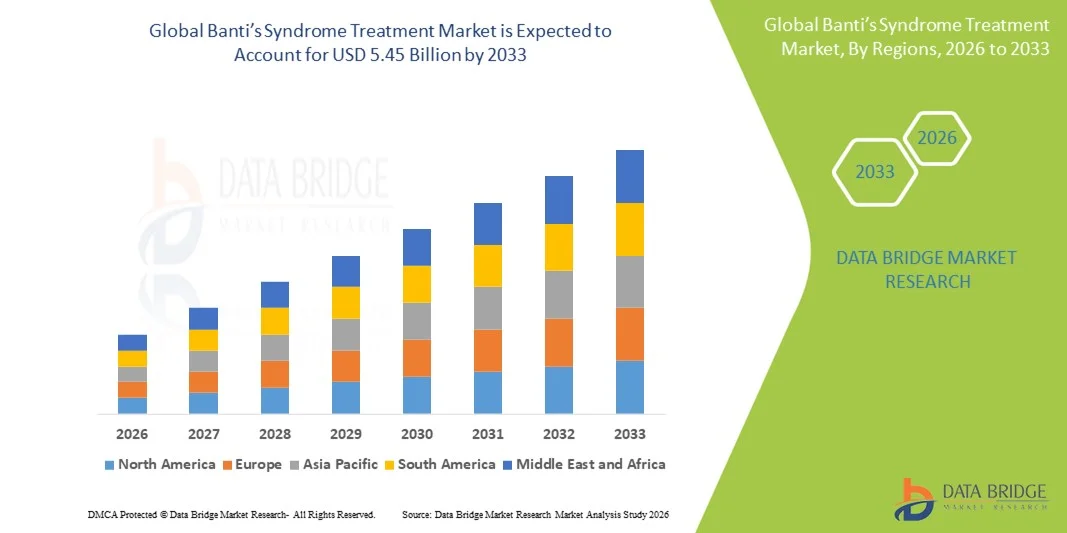
- The global Banti’s Syndrome treatment market size was valued at USD 3.80 billion in 2025 and is expected to reach USD 5.45 billion by 2033, at a CAGR of 4.60% during the forecast period
- The market growth is largely fueled by increasing awareness of Banti’s Syndrome, improved diagnostic capabilities, and rising demand for effective therapeutic regimens
- Furthermore, ongoing advances in treatment modalities such as surgical interventions, medical management, and lifestyle are making care more effective and patient centric. These converging factors growing disease recognition, therapeutic innovation, and expanded healthcare infrastructure are accelerating adoption of Banti’s Syndrome treatments, thereby significantly boosting the market’s growth.
Banti’s Syndrome Treatment Market Analysis
- Banti’s Syndrome treatments, encompassing management of symptoms such as weakness, fatigue, anemia, and abnormal enlargement of the spleen, are increasingly vital for improving patient outcomes and quality of life in both clinical and hospital settings
- The escalating demand for Banti’s Syndrome treatments is primarily fueled by growing awareness of the disorder, improvements in diagnostic capabilities, rising prevalence of portal hypertension, and the need for effective symptom management
- North America dominated the Banti’s Syndrome treatment market with the largest revenue share of 38.9% in 2025, characterized by advanced healthcare infrastructure, higher disease diagnosis rates, and strong presence of key pharmaceutical and medical device players, with the U.S. witnessing substantial adoption of therapies targeting symptoms such as anemia and splenomegaly
- Asia-Pacific is expected to be the fastest growing region in the Banti’s Syndrome treatment market during the forecast period due to rising healthcare investments, increasing awareness, and improved access to diagnostic and therapeutic facilities in countries such as India and China
- Banti's Disease segment dominated the Banti’s Syndrome treatment market with a market share of 45.2% in 2025, driven by its wide recognition among healthcare providers and patients, facilitating timely diagnosis and treatment
Report Scope and Banti’s Syndrome Treatment Market Segmentation
|
Attributes |
Banti’s Syndrome Treatment Key Market Insights |
|
Segments Covered |
|
|
Countries Covered |
North America
Europe
Asia-Pacific
Middle East and Africa
South America
|
|
Key Market Players |
|
|
Market Opportunities |
|
|
Value Added Data Infosets |
In addition to the insights on market scenarios such as market value, growth rate, segmentation, geographical coverage, and major players, the market reports curated by the Data Bridge Market Research also include in-depth expert analysis, patient epidemiology, pipeline analysis, pricing analysis, and regulatory framework |
Banti’s Syndrome Treatment Market Trends
Advancements in Targeted Symptom Management
- A significant and accelerating trend in the global Banti’s Syndrome treatment market is the development of therapies targeting specific symptoms such as anemia, fatigue, and splenomegaly, improving patient outcomes and quality of life
- For instance, new pharmacological interventions focusing on hematologic support and spleen size management are being increasingly integrated into treatment protocols to reduce complications and hospitalizations
- These targeted therapies, combined with personalized treatment plans, enable clinicians to optimize care for individual patients based on symptom severity and disease progression
- Furthermore, integration of digital health tools, such as patient monitoring apps and teleconsultations, supports ongoing symptom tracking and adherence to treatment regimens, enhancing overall management efficiency
- This trend towards more precise, patient-centric therapies is reshaping treatment approaches and elevating expectations among clinicians and patients, leading pharmaceutical companies to focus on symptom-specific innovations
- The demand for advanced symptom-targeted therapies is growing rapidly across hospitals and specialty clinics, as healthcare providers increasingly prioritize patient-centered outcomes in chronic and rare disease management. For instance, collaborations between biotech firms and hospitals to develop AI-assisted monitoring systems for anemia and splenomegaly are enhancing treatment personalization and follow-up care
- Increased focus on research and clinical trials exploring novel drug candidates and minimally invasive interventions is expected to further accelerate innovation and improve patient prognosis
Banti’s Syndrome Treatment Market Dynamics
Driver
Increasing Awareness and Improved Diagnostic Capabilities
- The growing awareness of Banti’s Syndrome among healthcare providers and patients, coupled with improvements in diagnostic technologies, is a significant driver for the heightened demand for effective treatments
- For instance, in April 2025, leading hospitals introduced advanced imaging and hematologic testing protocols to better identify portal hypertension and splenomegaly in patients, driving early intervention strategies
- As healthcare providers become more adept at diagnosing the disorder, demand for targeted treatment options, including pharmacologic and supportive therapies, increases substantially
- Furthermore, the rising prevalence of related complications such as anemia and fatigue is making treatment adoption critical to improving patient outcomes and reducing long-term morbidity
- The emphasis on early detection and proactive disease management in healthcare systems worldwide is accelerating the adoption of Banti’s Syndrome treatments in both outpatient and hospital settings
- For instance, partnerships between diagnostic companies and specialty clinics to expand screening programs are improving early detection rates and driving treatment uptake
- Increasing investments by pharmaceutical companies in research, awareness campaigns, and patient education programs are fostering broader acceptance and adoption of Banti’s Syndrome therapies
Restraint/Challenge
Limited Awareness and High Treatment Costs
- Lack of widespread awareness about Banti’s Syndrome among general physicians and patients poses a significant challenge to market growth, delaying timely diagnosis and intervention
- For instance, many patients in developing regions are diagnosed late due to insufficient screening and limited access to specialized healthcare facilities, reducing treatment effectiveness
- In addition, the high cost of targeted therapies and supportive care can restrict adoption, particularly in regions with constrained healthcare budgets or for uninsured patients
- Addressing these challenges through educational programs, improved healthcare infrastructure, and cost-effective treatment solutions is essential for wider adoption of Banti’s Syndrome therapies
- While some progress is being made in lowering therapy costs and improving access, limited awareness and financial barriers continue to constrain market expansion
- For instance, advocacy by rare-disease organizations and patient support groups is gradually improving awareness but adoption remains slow in low-income regions
- Regulatory hurdles and limited availability of advanced treatment options in emerging markets further challenge the scalability of Banti’s Syndrome therapies
Banti’s Syndrome Treatment Market Scope
The market is segmented on the basis of synonyms and symptoms.
- By Synonyms
On the basis of synonyms, the Banti’s Syndrome treatment market is segmented into Banti's disease, hypersplenism, idiopathic congestive splenomegaly, and idiopathic portal hypertension. The Banti's Disease segment dominated the market with the largest revenue share of 44.2% in 2025, driven by its wide recognition among healthcare providers and patients, which facilitates early diagnosis and treatment adoption. Clinicians are more familiar with this terminology, leading to standardized treatment protocols and better patient management outcomes. The segment’s dominance is further strengthened by extensive research focus on therapies targeting anemia and splenomegaly, which are common complications associated with Banti’s Disease. Hospitals and specialty clinics prefer established therapeutic pathways under this segment, ensuring consistent treatment efficacy. In addition, patient awareness campaigns often use this synonym, increasing demand for related treatment solutions. The Banti’s Disease segment also benefits from better insurance coverage and reimbursement policies in North America and Europe, contributing to its market share leadership.
The Hypersplenism segment is anticipated to witness the fastest growth rate of 18.2% from 2026 to 2033, fueled by increasing clinical recognition of isolated spleen disorders and advancements in minimally invasive interventions such as splenectomy and pharmacologic management. Rising prevalence of symptomatic hypersplenism in emerging markets, coupled with improved healthcare infrastructure, is accelerating adoption. For instance, hospitals are increasingly investing in diagnostic tools such as Doppler imaging and blood tests to monitor spleen size and function. Growing awareness among patients regarding fatigue and anemia symptoms linked to hypersplenism is also contributing to market growth. Pharmaceutical companies are focusing on targeted therapies to manage hematologic complications, boosting segment expansion. In addition, the trend of telemedicine and digital patient monitoring enables timely follow-ups, further supporting the rapid growth of this segment.
- By Symptoms
On the basis of symptoms, the Banti’s Syndrome treatment market is segmented into weakness, fatigue, anemia, and abnormal enlargement of the spleen. The Abnormal Enlargement Of The Spleen (Splenomegaly) segment dominated the market with the largest revenue share of 46.3% in 2025, as splenomegaly is one of the most critical and recognizable symptoms prompting medical intervention. This segment drives higher demand for diagnostic imaging, surgical interventions, and supportive therapies, making it a key revenue contributor. Clinicians prioritize treatments that reduce spleen size to prevent complications such as hypersplenism and portal hypertension. The segment’s dominance is reinforced by established treatment protocols, insurance reimbursements, and clinical familiarity. Hospitals and specialty centers actively manage splenomegaly through a combination of medication, surgical, and lifestyle interventions. Increased patient awareness about the risks of untreated splenomegaly also contributes to early diagnosis and higher adoption rates. Furthermore, ongoing research and clinical trials focusing on novel therapies to control spleen enlargement support continuous market growth.
The Anemia segment is expected to witness the fastest growth rate of 19.5% from 2026 to 2033, driven by rising prevalence of hematologic complications associated with Banti’s Syndrome and the development of innovative pharmacologic interventions. Growing awareness among clinicians about the need for early anemia management in these patients is driving treatment adoption. For instance, targeted therapies such as iron supplementation, erythropoiesis-stimulating agents, and combination therapies are increasingly prescribed. Expansion of diagnostic labs and telehealth monitoring of hemoglobin levels is also supporting the segment’s growth. In addition, educational campaigns and rare-disease initiatives are informing patients about symptom management, accelerating market uptake. The segment benefits from increasing government initiatives in emerging markets to improve access to anemia treatments in chronic and rare disease populations.
Banti’s Syndrome Treatment Market Regional Analysis
- North America dominated the Banti’s Syndrome treatment market with the largest revenue share of 38.9% in 2025, characterized by advanced healthcare infrastructure, higher disease diagnosis rates, and strong presence of key pharmaceutical and medical device players
- Patients and healthcare providers in the region highly value early diagnosis, targeted therapies for anemia and splenomegaly, and access to specialized treatment centers that improve patient outcomes and quality of life
- This widespread adoption is further supported by strong government healthcare initiatives, well-established insurance coverage for rare diseases, and ongoing research programs, establishing Banti’s Syndrome treatments as a preferred choice in both hospital and outpatient settings
U.S. Banti’s Syndrome Treatment Market Insight
The U.S. Banti’s Syndrome treatment market captured the largest revenue share of 82% in 2025 within North America, fueled by advanced healthcare infrastructure, high disease awareness, and well-established rare-disease treatment facilities. Patients and healthcare providers increasingly prioritize early diagnosis and targeted therapies for anemia, splenomegaly, and fatigue. The growing adoption of specialized hematology and gastroenterology clinics, combined with strong insurance coverage for rare diseases, further propels the market. Moreover, ongoing research initiatives and clinical trials in the U.S. are significantly contributing to the expansion of treatment options and improving patient outcomes.
Europe Banti’s Syndrome Treatment Market Insight
The Europe Banti’s Syndrome treatment market is projected to expand at a substantial CAGR throughout the forecast period, primarily driven by increasing awareness among physicians and patients, and well-established healthcare systems. Rising prevalence of non-cirrhotic portal hypertension and related complications is fostering the adoption of treatments. European patients are also drawn to hospitals and specialty centers offering multidisciplinary care and advanced symptom management. The region is experiencing significant growth across residential clinics, hospitals, and research institutions, with treatment options being incorporated into both newly diagnosed and long-term patient care programs.
U.K. Banti’s Syndrome Treatment Market Insight
The U.K. Banti’s Syndrome treatment market is anticipated to grow at a noteworthy CAGR during the forecast period, driven by increased awareness of rare liver and spleen disorders and a growing demand for specialized care. Concerns regarding anemia, fatigue, and spleen enlargement are encouraging early medical intervention by both patients and clinicians. The U.K.’s robust healthcare infrastructure, advanced diagnostic facilities, and strong clinical research environment are expected to continue to stimulate market growth. In addition, government programs supporting rare disease management further reinforce adoption.
Germany Banti’s Syndrome Treatment Market Insight
The Germany Banti’s Syndrome treatment market is expected to expand at a considerable CAGR during the forecast period, fueled by increasing awareness of rare hematologic and hepatic conditions and demand for advanced therapies. Germany’s well-developed healthcare system, combined with its emphasis on medical innovation, promotes the adoption of Banti’s Syndrome treatments in both hospitals and specialty clinics. Integration of multidisciplinary approaches for symptom management, including anemia and splenomegaly, is becoming increasingly prevalent, with patients preferring technologically advanced diagnostic and treatment solutions.
Asia-Pacific Banti’s Syndrome Treatment Market Insight
The Asia-Pacific Banti’s Syndrome treatment market is poised to grow at the fastest CAGR of 23% during the forecast period of 2026 to 2033, driven by increasing awareness of rare diseases, improving healthcare infrastructure, and rising investment in medical diagnostics in countries such as China, Japan, and India. The region’s growing inclination towards early diagnosis and access to advanced treatment modalities is driving adoption. Furthermore, as APAC emerges as a hub for rare-disease research and clinical trials, the availability and accessibility of treatments are expanding to a wider patient base.
Japan Banti’s Syndrome Treatment Market Insight
The Japan Banti’s Syndrome treatment market is gaining momentum due to the country’s advanced healthcare system, aging population, and strong focus on preventive and rare disease care. Early detection and treatment of anemia, splenomegaly, and fatigue are becoming priorities in clinical practice. Integration of Banti’s Syndrome treatments with digital health monitoring and patient follow-up programs is fueling growth. Moreover, the country’s culture of adopting innovative medical solutions supports the adoption of new therapies in both hospital and outpatient settings.
India Banti’s Syndrome Treatment Market Insight
The India Banti’s Syndrome treatment market accounted for the largest market revenue share in Asia-Pacific in 2025, attributed to increasing awareness among patients and physicians, improving healthcare access, and expanding specialty clinics. India is witnessing growing demand for diagnostic and treatment solutions for anemia and spleen-related complications. The push towards better rare-disease management programs, coupled with availability of affordable treatment options and increasing domestic pharmaceutical support, are key factors propelling the market in India.
Banti’s Syndrome Treatment Market Share
The Banti’s Syndrome Treatment industry is primarily led by well-established companies, including:
- Novartis AG (Switzerland)
- Gilead Sciences, Inc. (U.S.)
- Merck & Co., Inc. (U.S.)
- AstraZeneca (U.K.)
- Bayer AG (Germany)
- Conatus Pharmaceuticals, Inc. (U.S.)
- Galectin Therapeutics, Inc. (U.S.)
- Boryung Co., Ltd. (South Korea)
- Cumberland Pharmaceuticals, Inc. (U.S.)
- Sanofi (France)
- GSK plc (U.K.)
- Johnson & Johnson Services, Inc. (U.S.)
- Amgen Inc. (U.S.)
- SOBI AB (Sweden)
- Histogen, Inc. (U.S.)
- Medtronic (Ireland)
- W. L. Gore & Associates, Inc. (U.S.)
- Cook (U.S.)
- Onyx Therapeutics, Inc. (U.S.)
What are the Recent Developments in Global Banti’s Syndrome Treatment Market?
- In January 2025, a review article was published highlighting evolving pharmacological therapies for portal hypertension including new adjunct or alternative treatments beyond non‑selective beta‑blockers and underscoring the importance of pharmacogenetics in tailoring therapy for patients with non‑cirrhotic portal hypertension
- In October 2023, a clinical case was reported of porto‑sinusoidal vascular disease (PSVD) a modern reclassification of idiopathic non-cirrhotic portal hypertension in a 69-year-old woman with JAK2-positive essential thrombocythemia, underlining evolving understanding of disease mechanisms and comorbidities
- In February 2024, a study demonstrated that Transjugular Intrahepatic Portosystemic Shunt (TIPS) is an effective and safe option in patients with non‑cirrhotic portal hypertension due to portosinusoidal vascular disorder (PSVD), expanding interventional treatment strategies for this rare condition
- In May 2021, the same study on lanifibranor was formally published in the Journal of Hepatology, presenting strong mechanistic data on how it improves liver sinusoidal endothelial cell function, reduces angiogenesis, and lowers portal hypertension supporting its further development for portal‑hypertensive disorders
- In April 2021, researchers from IDIBAPS (Barcelona) reported preclinical evidence that lanifibranor, a pan‑PPAR agonist, reduces portal pressure and liver fibrosis in animal models of advanced chronic liver disease, suggesting its potential as a novel therapy for portal hypertension

- Interactive Data Analysis Dashboard
- Company Analysis Dashboard for high growth potential opportunities
- Research Analyst Access for customization & queries
- Competitor Analysis with Interactive dashboard
- Latest News, Updates & Trend analysis
- Harness the Power of Benchmark Analysis for Comprehensive Competitor Tracking
Data collection and base year analysis are done using data collection modules with large sample sizes. The stage includes obtaining market information or related data through various sources and strategies. It includes examining and planning all the data acquired from the past in advance. It likewise envelops the examination of information inconsistencies seen across different information sources. The market data is analysed and estimated using market statistical and coherent models. Also, market share analysis and key trend analysis are the major success factors in the market report. To know more, please request an analyst call or drop down your inquiry.
The key research methodology used by DBMR research team is data triangulation which involves data mining, analysis of the impact of data variables on the market and primary (industry expert) validation. Data models include Vendor Positioning Grid, Market Time Line Analysis, Market Overview and Guide, Company Positioning Grid, Patent Analysis, Pricing Analysis, Company Market Share Analysis, Standards of Measurement, Global versus Regional and Vendor Share Analysis. To know more about the research methodology, drop in an inquiry to speak to our industry experts.
Data Bridge Market Research is a leader in advanced formative research. We take pride in servicing our existing and new customers with data and analysis that match and suits their goal. The report can be customized to include price trend analysis of target brands understanding the market for additional countries (ask for the list of countries), clinical trial results data, literature review, refurbished market and product base analysis. Market analysis of target competitors can be analyzed from technology-based analysis to market portfolio strategies. We can add as many competitors that you require data about in the format and data style you are looking for. Our team of analysts can also provide you data in crude raw excel files pivot tables (Fact book) or can assist you in creating presentations from the data sets available in the report.












