


What is the Co-Packaged Optics Market Size and Growth Rate?
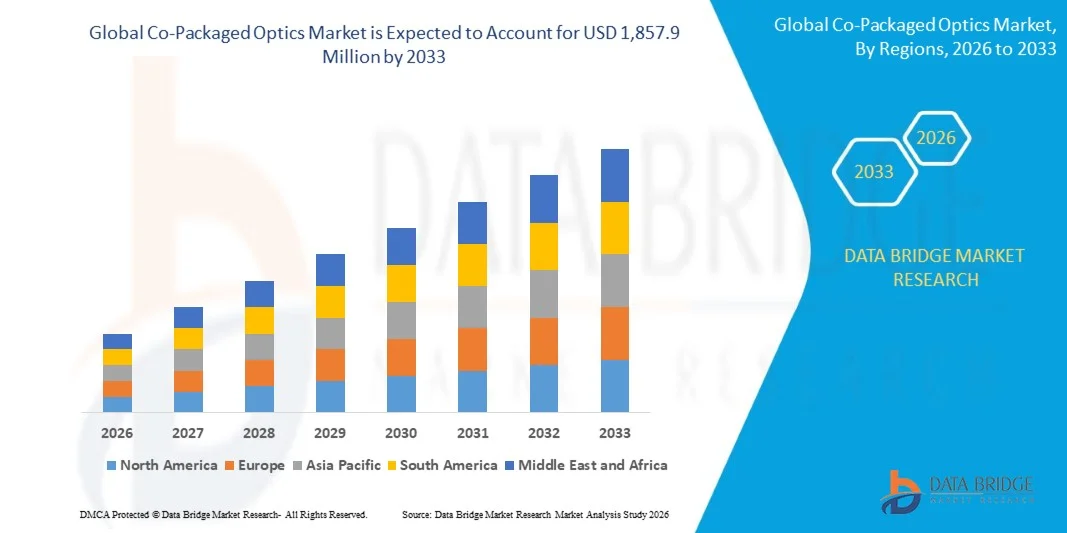
- As per Data Bridge Market Research analysis, the co-packaged optics market was valued at USD 163.5 million in 2025 and is projected to reach USD 1,857.9 million by 2033, growing at a CAGR of 35.50% from 2026 to 2033.
- The market is experiencing rapid growth driven by the exponential bandwidth and power demands of AI clusters, the physical limits of electrical signaling and pluggable optics at 200G-per-lane speeds, and the first commercial deployments of co-packaged optics switches by leading networking and semiconductor companies.
- The shift toward higher-radix, 100 Tb/s-class switch ASICs, the push to cut network power consumption in hyperscale facilities, and advances in silicon photonics, external laser sources, and advanced packaging are supporting market adoption. Co-packaged optics are being applied across silicon photonics platforms, data center networking fabrics, and optical transceiver replacement, offering lower power per bit, higher bandwidth density, and shorter electrical paths.
Market Size & Forecast
- Global Market Value (2025): USD 163.5 million
- Expected Market Value (2033): USD 1,857.9 million
- Forecast CAGR (2026–2033): 35.50%
- Leading Region in 2025: North America
- Fastest Growing Region: Asia-Pacific
What are the Major Takeaways of the Co-Packaged Optics Market?
- North America dominated the co-packaged optics market with the largest revenue share of 49.61% in 2025, supported by the concentration of hyperscale cloud operators, AI accelerator and switch silicon designers, and silicon photonics developers in the United States.
- Asia-Pacific is expected to be the fastest-growing region at a CAGR of 38.20% from 2026 to 2033, fueled by large-scale AI data center build-outs, advanced packaging capacity in Taiwan, and optical component manufacturing across China, Japan, and South Korea.
- The optical engines segment led the component category with a 46.89% share in 2025, supported by their central role in electro-optical conversion within the switch package.
- External laser sources is the fastest-growing component segment, projected to register a CAGR of 38.90% from 2026 to 2033, driven by the shift toward external, replaceable laser sources for reliability and serviceability.
- The 800G segment led the data rate category with a 58.46% share in 2025, supported by early 51.2 Tb/s-class co-packaged switch platforms and hyperscaler pilots.
- The scale-out network switching segment led the application category with a 71.48% share in 2025, supported by the first commercial co-packaged Ethernet and InfiniBand switches.
- Scale-up XPU interconnect is the fastest-growing application segment, projected to register a CAGR of 52.60% from 2026 to 2033, driven by the need to interconnect large numbers of GPUs and accelerators.
Report Scope and Co-Packaged Optics Market Segmentation
|
Attributes |
Co-Packaged Optics Key Market Insights |
|
Segments Covered |
|
|
Countries Covered |
North America
Europe
Asia-Pacific
Middle East and Africa
South America
|
|
Key Market Players |
|
|
Market Opportunities |
|
|
Value Added Data Infosets |
In addition to the insights on market scenarios such as market value, growth rate, segmentation, geographical coverage, and major players, the market reports curated by the Data Bridge Market Research also include in-depth expert analysis, geographically represented company-wise production and capacity, network layouts of distributors and partners, detailed and updated price trend analysis and deficit analysis of supply chain and demand. |
What is the Key Trend in the Co-Packaged Optics Market?
- Co-packaged optics are moving from research prototypes to commercial products, as switch makers integrate silicon photonics engines directly into the ASIC package and replace pluggable transceivers and electrical retimers.
- For instance, in March 2025, according to Fiber Optics Online, NVIDIA unveiled silicon photonics co-packaged optics switches, with the Quantum-X photonic switch delivering 115.2 Tb/s of throughput and up to 3.5x lower power consumption versus traditional technologies.
- Architectures are converging on external laser sources, detachable fiber connectors, and liquid cooling to address reliability and serviceability concerns while preserving the power benefits of integration.
- For instance, in March 2026, according to NADDOD, Broadcom announced that its standard Tomahawk 6 switch ASIC had entered volume production, while its Tomahawk 6-Davisson co-packaged optics version had been shipping since October 2025, as 1.6T and co-packaged optics move from roadmaps into products.
- A hybrid model combining pluggable, near-package, and co-packaged optics is emerging, with co-packaged optics targeted first at the highest-bandwidth AI fabrics.
- As switch capacity scales beyond 100 Tb/s and lane speeds reach 200G and above, co-packaged optics are expected to expand from switch ports into accelerator-to-accelerator and processor-integrated optical I/O.
What are the Key Drivers of the Co-Packaged Optics Market?
- The rapid scaling of AI training and inference clusters has sharply increased network bandwidth and power requirements, making interconnect energy a central constraint on data center growth.
- For instance, in March 2025, according to Fiber Optics Online, NVIDIA estimated that replacing pluggable transceivers with co-packaged optics could reduce data center power consumption by about 40 megawatts for large AI deployments.
- Eliminating electrical retimers and shortening signal paths from centimeters to millimeters lowers power per bit and improves signal integrity, which is increasingly valuable at 200G-per-lane speeds.
- For instance, in July 2026, according to NADDOD, NVIDIA announced that its Spectrum-6 platform, including Spectrum-X Ethernet Photonics co-packaged optics systems, was arriving in gigascale AI factories, with one system combining co-packaged optics to scale throughput to 409.6 Tb/s.
- Growing investment in silicon photonics foundry capability, advanced packaging, and laser supply is improving manufacturability and supporting the commercialization of co-packaged optics.
What Factors Are Challenging the Growth of the Co-Packaged Optics Market?
- Serviceability is a core challenge, as a failed optical engine or laser integrated with a switch package is harder to replace than a pluggable transceiver, raising concerns about downtime and scrap cost.
- For instance, in September 2026, according to Datacentres.com, early co-packaged optics pilots at hyperscalers were reported to show field failure rates for optical engines 1.5–2x higher than mature pluggable optics, although vendors attribute this to first-generation yield issues.
- Thermal management is complex because lasers, photonic chips, and high-power switch ASICs operate in close proximity, increasing thermal coupling and affecting wavelength stability and reliability.
- For instance, in June 2026, according to Lumentum, laser source reliability is foundational to co-packaged optics because integrating lasers near a high-power ASIC creates a hostile thermal environment, driving demand for external, reliability-focused laser platforms.
- Pluggable optics remain entrenched, and some hyperscalers continue to specify pluggable 800G optics as the primary fabric in new facilities while evaluating co-packaged optics for later phases, which may moderate near-term volumes.
- Ecosystem standardization, test methodologies, and supply chain readiness across lasers, fiber connectors, and advanced packaging are still maturing, adding cost and qualification time.
How is the Co-Packaged Optics Market Segmented?
The co-packaged optics market is segmented on the basis of component, data rate, application, and end user.
- By Component
On the basis of component, the co-packaged optics market is segmented into optical engines, external laser sources, fiber & optical connectors, and others. The optical engines segment dominated the market with a 46.89% share in 2025, supported by their central role in converting electrical signals to optical signals within the switch package. Silicon photonics-based engines using micro-ring or Mach-Zehnder modulators are being integrated directly next to switch ASICs, and early production programs are concentrating value in this component.
The external laser sources segment is projected to register the fastest growth at a CAGR of 38.90% from 2026 to 2033, driven by the architectural choice of moving lasers away from the hot switch package to improve reliability and serviceability. Each co-packaged switch requires many high-power continuous-wave lasers, so scaling deployments translate directly into laser volume demand, supporting investment by laser and photonic component suppliers.
- By Data Rate
On the basis of data rate, the co-packaged optics market is segmented into 800G, 1.6T, and 3.2T and above. The 800G segment dominated the market with a 58.46% share in 2025, supported by early co-packaged switch platforms built on 51.2 Tb/s-class ASICs and initial pilot deployments at hyperscalers. Established 100G-per-lane optical engines and mature supply chains underpin early volumes.
The 3.2T and above segment is projected to register the fastest growth at a CAGR of 58.60% from 2026 to 2033, driven by the move to 200G-per-lane signaling, 102.4 Tb/s switch ASICs, and next-generation AI scale-up fabrics. At these speeds, electrical reach and power constraints make co-packaged architectures increasingly attractive compared with pluggable modules.
- By Application
On the basis of application, the co-packaged optics market is segmented into scale-out network switching, scale-up XPU interconnect, and others. The scale-out network switching segment dominated the application category with a 71.48% share in 2025, supported by the first commercial co-packaged Ethernet and InfiniBand switches for AI data centers. Switch-based deployments are earlier and more standardized than processor-integrated optics.
The scale-up XPU interconnect segment is projected to register the fastest growth at a CAGR of 52.60% from 2026 to 2033, driven by the need to connect large numbers of GPUs and accelerators into a single high-bandwidth domain. Integrating optical I/O directly with processors can raise bandwidth density and reduce energy per bit, creating long-term demand as accelerator architectures evolve.
- By End User
On the basis of end user, the co-packaged optics market is segmented into hyperscale cloud providers, AI & HPC cloud providers, telecom operators, and enterprises. The hyperscale cloud providers segment dominated the end-user category with a 58.91% share in 2025, supported by their scale of AI cluster investment and their ability to validate new network architectures. Power constraints in large facilities are pushing hyperscalers to evaluate co-packaged optics early.
The AI & HPC cloud providers segment is projected to register the fastest growth at a CAGR of 41.20% from 2026 to 2033, driven by dedicated GPU cloud operators and supercomputing centers building very large, tightly coupled clusters. Their focus on performance per watt and rapid deployment of new architectures supports early adoption of co-packaged switches.
Which Region Holds the Largest Share of the Co-Packaged Optics Market?
- North America dominated the co-packaged optics market with the largest revenue share of 49.61% in 2025, supported by the concentration of hyperscale cloud operators, AI accelerator and switch silicon designers, and silicon photonics developers in the United States.
- The region also benefits from heavy capital expenditure by hyperscalers on AI clusters, early commercial deployments of co-packaged optics switches, and strong venture and corporate investment in photonic integration. Close collaboration between chip designers, foundries, and optical suppliers continues to strengthen North America’s position in the global market.
U.S. Co-Packaged Optics Market Insight
The U.S. co-packaged optics market is witnessing strong growth due to the concentration of hyperscale cloud operators, AI accelerator and networking chip designers, and silicon photonics startups. Large-scale AI cluster investment is driving evaluation and early deployment of co-packaged switches. In addition, government support for domestic semiconductor and advanced packaging capacity is strengthening the local ecosystem for photonic integration.
Asia-Pacific Co-Packaged Optics Market Insight
The Asia-Pacific co-packaged optics market is expected to witness rapid growth, driven by large AI data center build-outs and a deep manufacturing base for optical components and advanced packaging across countries such as China, Japan, and India. Regional foundries and packaging houses are developing silicon photonics and co-packaging capability, while cloud operators are scaling AI infrastructure. Growing demand for higher-speed networking is accelerating regional market expansion.
Japan Co-Packaged Optics Market Insight
The Japan co-packaged optics market is witnessing consistent growth due to the country’s strength in optical components, photonic integration research, and precision materials. Japanese suppliers participate in fiber, connector, laser, and packaging materials for next-generation optical interconnects. Government-backed initiatives for AI and data center infrastructure are supporting development and adoption.
China Co-Packaged Optics Market Insight
The China co-packaged optics market is growing rapidly, driven by large-scale AI data center investment and a major optical transceiver manufacturing base. Domestic suppliers are developing silicon photonics and co-packaged solutions to serve local cloud and AI operators. Strong supply chain depth in optical modules and increasing focus on self-reliance in networking technology are positioning China as a key growth market in Asia-Pacific.
U.K. Co-Packaged Optics Market Insight
The U.K. co-packaged optics market is experiencing steady growth, supported by strong university and industry research in photonics and compound semiconductors, and by a growing number of AI and cloud data center projects. Specialist photonic integration companies and research programs are contributing to technology development. Public investment in compute infrastructure is also supporting demand for advanced interconnects.
Germany Co-Packaged Optics Market Insight
The Germany co-packaged optics market is expanding steadily due to the country’s strength in photonics, precision manufacturing, and research institutes working on photonic integration. Growth of data center capacity in Frankfurt and expanding AI and high-performance computing infrastructure are increasing demand for energy-efficient interconnects. Germany’s emphasis on energy efficiency and sustainable data center operations further supports adoption.
Which are the Top Companies in Co-Packaged Optics Market?
The co-packaged optics industry is primarily led by well-established companies, including:
- Broadcom Inc. (U.S.)
- NVIDIA Corporation (U.S.)
- Marvell Technology, Inc. (U.S.)
- Intel Corporation (U.S.)
- Cisco Systems, Inc. (U.S.)
- Taiwan Semiconductor Manufacturing Company Limited (Taiwan)
- Advanced Micro Devices, Inc. (U.S.)
- IBM Corporation (U.S.)
- Ayar Labs, Inc. (U.S.)
- Lightmatter, Inc. (U.S.)
- Ranovus Inc. (Canada)
- Coherent Corp. (U.S.)
- Lumentum Holdings Inc. (U.S.)
- Corning Incorporated (U.S.)
- Fabrinet (Thailand)
- Innolight Technology Corporation (China)
- Eoptolink Technology Inc., Ltd. (China)
- Sumitomo Electric Industries, Ltd. (Japan)
- Arista Networks, Inc. (U.S.)
- Jabil Inc. (U.S.)
What are Latest Developments in Co-Packaged Optics Market?
- In September 2026, Meta was reported to be evaluating co-packaged optics for the next expansion phase of its Louisiana AI campus while specifying pluggable 800G optics as the primary fabric, according to Datacentres.com.
- In July 2026, NVIDIA announced that its Spectrum-6 platform, including Spectrum-X Ethernet Photonics co-packaged optics systems, was arriving in gigascale AI factories, according to NADDOD.
- In March 2026, Broadcom announced that its standard Tomahawk 6 switch ASIC had entered volume production, according to NADDOD.
- In October 2025, Broadcom announced that its Tomahawk 6-Davisson co-packaged optics switch was shipping, according to NADDOD.
- In March 2025, NVIDIA unveiled its Quantum-X and Spectrum-X silicon photonics co-packaged optics switches at GTC, with Quantum-X delivering 115.2 Tb/s and 144 MPO fiber connectors, according to Fiber Optics Online.

- Interactive Data Analysis Dashboard
- Company Analysis Dashboard for high growth potential opportunities
- Research Analyst Access for customization & queries
- Competitor Analysis with Interactive dashboard
- Latest News, Updates & Trend analysis
- Harness the Power of Benchmark Analysis for Comprehensive Competitor Tracking
Global Co Packaged Optics Market, Supply Chain Analysis and Ecosystem Framework
To support market growth and help clients navigate the impact of geopolitical shifts, DBMR has integrated in-depth supply chain analysis into its Global Co Packaged Optics Market research reports. This addition empowers clients to respond effectively to global changes affecting their industries. The supply chain analysis section includes detailed insights such as Global Co Packaged Optics Market consumption and production by country, price trend analysis, the impact of tariffs and geopolitical developments, and import and export trends by country and HSN code. It also highlights major suppliers with data on production capacity and company profiles, as well as key importers and exporters. In addition to research, DBMR offers specialized supply chain consulting services backed by over a decade of experience, providing solutions like supplier discovery, supplier risk assessment, price trend analysis, impact evaluation of inflation and trade route changes, and comprehensive market trend analysis.
Data collection and base year analysis are done using data collection modules with large sample sizes. The stage includes obtaining market information or related data through various sources and strategies. It includes examining and planning all the data acquired from the past in advance. It likewise envelops the examination of information inconsistencies seen across different information sources. The market data is analysed and estimated using market statistical and coherent models. Also, market share analysis and key trend analysis are the major success factors in the market report. To know more, please request an analyst call or drop down your inquiry.
The key research methodology used by DBMR research team is data triangulation which involves data mining, analysis of the impact of data variables on the market and primary (industry expert) validation. Data models include Vendor Positioning Grid, Market Time Line Analysis, Market Overview and Guide, Company Positioning Grid, Patent Analysis, Pricing Analysis, Company Market Share Analysis, Standards of Measurement, Global versus Regional and Vendor Share Analysis. To know more about the research methodology, drop in an inquiry to speak to our industry experts.
Data Bridge Market Research is a leader in advanced formative research. We take pride in servicing our existing and new customers with data and analysis that match and suits their goal. The report can be customized to include price trend analysis of target brands understanding the market for additional countries (ask for the list of countries), clinical trial results data, literature review, refurbished market and product base analysis. Market analysis of target competitors can be analyzed from technology-based analysis to market portfolio strategies. We can add as many competitors that you require data about in the format and data style you are looking for. Our team of analysts can also provide you data in crude raw excel files pivot tables (Fact book) or can assist you in creating presentations from the data sets available in the report.













