Farm Automated Weather Stations Market Size
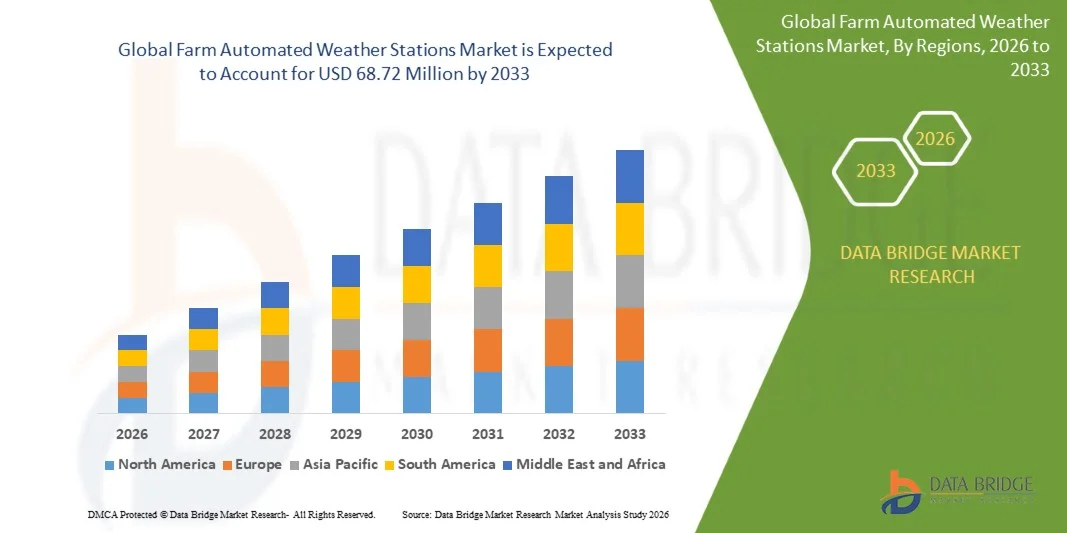
- As per Data Bridge Market Research Analysis the global farm automated weather stations market size was valued at USD 39.99 million in 2025 and is expected to reach USD 68.72 million by 2033, at a CAGR of 7.00% during the forecast period
- The market growth is largely fuelled by increasing adoption of precision agriculture, rising demand for real-time weather data, and the need to optimise crop yield and resource utilisation
- In addition, technological advancements in IoT-enabled weather stations, integration with farm management systems, and the growing focus on climate-resilient agriculture are supporting market expansion
Market Size & Forecast
- Global Market Value (2025): USD 39.99 million
- Expected Market Value (2033): USD 68.72 million
- Forecast CAGR (2026–2033): 7.00%
Farm Automated Weather Stations Market Analysis
- The market is driven by the need for accurate and timely weather information to improve farming decisions, reduce crop losses, and enhance productivity
- Adoption of automated weather stations is rising due to benefits such as real-time data monitoring, remote accessibility, and predictive analytics for climate and irrigation management
- North America dominated the farm automated weather stations (AWS) market with the largest revenue share of 38.75% in 2025, driven by the increasing adoption of precision agriculture technologies, rising demand for efficient farm management, and growing awareness of climate impact on crop yields
- Asia-Pacific region is expected to witness the highest growth rate in the global farm automated weather stations market, driven by rapid agricultural modernization, government support for smart farming initiatives, and increasing adoption of automated weather monitoring systems across plantations and large-scale farms
- The battery-based segment held the largest market revenue share in 2025 driven by its ease of installation, flexibility in deployment across remote fields, and low dependency on external power sources. Battery-based AWS devices are widely preferred by farmers for monitoring weather parameters in real time, providing accurate data for irrigation, pest control, and crop management decisions
Report Scope and Farm Automated Weather Stations Market Segmentation
|
Attributes |
Farm Automated Weather Stations Key Market Insights |
|
Segments Covered |
|
|
Countries Covered |
North America
Europe
Asia-Pacific
Middle East and Africa
South America
|
|
Key Market Players |
|
|
Market Opportunities |
|
|
Value Added Data Infosets |
In addition to the insights on market scenarios such as market value, growth rate, segmentation, geographical coverage, and major players, the market reports curated by the Data Bridge Market Research also include import export analysis, production capacity overview, production consumption analysis, price trend analysis, climate change scenario, supply chain analysis, value chain analysis, raw material/consumables overview, vendor selection criteria, PESTLE Analysis, Porter Analysis, and regulatory framework. |
Farm Automated Weather Stations Market Trends
“Rising Adoption of Precision Agriculture and Smart Farming Technologies”
- The growing focus on data-driven farming is significantly shaping the farm automated weather stations market, as farmers increasingly prefer accurate, real-time weather information to optimise crop management and irrigation. Automated weather stations are gaining traction due to their ability to provide precise, continuous monitoring of temperature, rainfall, humidity, and wind, supporting better decision-making and risk mitigation. This trend strengthens their adoption across large-scale farms, agribusinesses, and agricultural research, encouraging manufacturers to innovate with advanced sensor technologies and IoT integration
- Increasing awareness around climate-resilient agriculture, crop protection, and resource efficiency has accelerated the demand for automated weather stations. Farmers and agronomists are actively seeking solutions that provide early warnings for extreme weather events, enabling timely interventions. This has also led to collaborations between technology providers, agricultural equipment manufacturers, and service platforms to enhance data analytics, predictive insights, and farm management capabilities
- Precision agriculture and sustainability trends are influencing purchasing decisions, with farmers prioritising high-accuracy, reliable, and connected weather monitoring solutions. These factors help suppliers differentiate their products in a competitive market, while also driving the adoption of IoT-enabled, solar-powered, and automated weather stations. Companies are increasingly using marketing campaigns and demonstrations to highlight operational efficiency and ROI benefits to reinforce brand positioning and appeal to tech-savvy and progressive farmers
- For instance, in 2024, Davis Instruments in the U.S. and Pessl Instruments in Austria expanded their product portfolios by launching IoT-connected weather stations with automated alert systems for farms. These solutions were introduced in response to growing demand for real-time, actionable weather data, with distribution across retail, online, and specialised agricultural channels. The products were also marketed as precision agriculture tools, improving farm productivity and resource optimisation
- While demand for farm automated weather stations is growing, sustained market expansion depends on cost-effective production, ease of installation, and reliable connectivity. Manufacturers are also focusing on developing scalable solutions, improving sensor accuracy, and integrating predictive analytics to support broader adoption
Farm Automated Weather Stations Market Dynamics
Driver
“Rising Adoption of Precision Agriculture and Data-Driven Farming”
- Increasing need for accurate, real-time weather data is a major driver for the farm automated weather stations market. Farmers and agribusinesses are increasingly adopting automated systems to enhance decision-making, reduce crop losses, and optimise irrigation, fertilisation, and pesticide application
- Expanding applications in crop management, soil monitoring, and climate-resilient farming are influencing market growth. Automated weather stations help track environmental parameters continuously, providing actionable insights that improve yield, reduce resource wastage, and mitigate risks from extreme weather conditions. Growing adoption of smart farming globally further reinforces this trend
- Agriculture technology providers are actively promoting weather stations through innovations in IoT integration, solar power, cloud-based analytics, and mobile applications. These efforts are supported by the growing demand for efficient and sustainable farming practices, encouraging collaborations between device manufacturers, farm management platforms, and agronomic consultants
- For instance, in 2023, Pessl Instruments in Austria and Davis Instruments in the U.S. reported increased adoption of automated weather stations among commercial farms and research farms. This expansion followed higher demand for precise weather monitoring, enabling predictive analytics, timely interventions, and efficient farm management. Both companies also highlighted smart farming integration and sustainability benefits in marketing campaigns to strengthen trust and adoption
- Although rising precision agriculture trends support growth, wider adoption depends on affordability, ease of use, and connectivity infrastructure. Investment in sensor technology, wireless networks, and scalable solutions will be critical for meeting global demand and maintaining competitive advantage
Restraint/Challenge
“High Cost And Connectivity Limitations in Rural Areas”
- The relatively high cost of automated weather stations compared to traditional weather monitoring methods remains a key challenge, limiting adoption among smallholder and cost-sensitive farmers. Higher device costs, installation expenses, and maintenance requirements contribute to limited penetration in emerging markets
- Connectivity and infrastructure limitations, particularly in remote and rural areas, restrict the effective use of real-time data and cloud-based analytics. Poor network coverage can affect data accuracy, timeliness, and decision-making, impacting adoption in regions with limited digital infrastructure
- Supply chain and service challenges also impact market growth, as automated weather stations require certified sensors, software integration, and timely technical support. Logistical complexities and maintenance requirements increase operational costs. Companies must invest in training, support services, and robust distribution networks to maintain product performance and reliability
- For instance, in 2024, distributors in rural India and Sub-Saharan Africa supplying farms with automated weather stations reported slower adoption due to high device costs, limited awareness, and poor connectivity. Maintenance and calibration requirements were additional barriers. These factors also prompted some local retailers to limit inventory for high-end devices, affecting accessibility and sales
- Overcoming these challenges will require cost-efficient production, expanded distribution networks, and focused educational initiatives for farmers. Collaboration with agricultural cooperatives, government extension services, and technology providers can help unlock the long-term growth potential of the global farm automated weather stations market. Furthermore, developing affordable, easy-to-install, and connected solutions will be essential for widespread adoption
Farm Automated Weather Stations Market Scope
The market is segmented on the basis of product type and crop type
• By Product Type
On the basis of product type, the global farm automated weather stations (AWS) market is segmented into battery-based farm AWS and cable-based farm AWS. The battery-based segment held the largest market revenue share in 2025 driven by its ease of installation, flexibility in deployment across remote fields, and low dependency on external power sources. Battery-based AWS devices are widely preferred by farmers for monitoring weather parameters in real time, providing accurate data for irrigation, pest control, and crop management decisions.
The cable-based segment is expected to witness the fastest growth rate from 2026 to 2033, driven by its stable power supply and continuous data transmission capabilities. Cable-based AWS systems are particularly suitable for large-scale farms and plantations where uninterrupted monitoring and high data accuracy are critical, offering reliable performance for long-term agricultural planning
• By Crop Type
On the basis of crop type, the market is segmented into tea, coffee, and others. The tea segment held the largest market revenue share in 2025 due to the high sensitivity of tea plantations to temperature, rainfall, and humidity variations, which necessitates precise weather monitoring for optimal yield and quality.
The coffee segment is expected to witness the fastest growth rate from 2026 to 2033, driven by the increasing adoption of automated weather stations in coffee plantations to mitigate risks from climate change and to enhance crop productivity and bean quality through precise environmental monitoring.
Farm Automated Weather Stations Market Regional Analysis
- North America dominated the farm automated weather stations (AWS) market with the largest revenue share of 38.75% in 2025, driven by the increasing adoption of precision agriculture technologies, rising demand for efficient farm management, and growing awareness of climate impact on crop yields
- Farmers and agribusinesses in the region highly value the accuracy, reliability, and real-time monitoring capabilities offered by AWS, enabling optimized irrigation, fertilization, and pest control practices
- This widespread adoption is further supported by high investment in smart farming solutions, government initiatives promoting digital agriculture, and the presence of technologically advanced agricultural infrastructure, establishing AWS as a crucial tool for modern farming operations
U.S. Farm AWS Market Insight
The U.S. farm AWS market captured the largest revenue share in 2025 within North America, driven by rapid adoption of precision farming practices and connected agricultural devices. Farmers are increasingly prioritizing real-time weather monitoring to enhance crop productivity and resource efficiency. The growing integration of IoT-enabled weather stations with farm management software, combined with demand for data-driven decision-making, further propels the AWS market. Government programs supporting smart agriculture and sustainability initiatives are also significantly contributing to market expansion.
Europe Farm AWS Market Insight
The Europe farm AWS market is expected to witness the fastest growth rate from 2026 to 2033, primarily driven by stringent environmental regulations and the rising need for sustainable farming practices. Increasing investments in smart agriculture and the adoption of connected devices are fostering AWS deployment across farms. European farmers are also drawn to the precision, efficiency, and predictive capabilities these systems offer. The market is experiencing growth across large-scale farms, plantations, and horticulture, with AWS being incorporated into both new and existing agricultural operations.
U.K. Farm AWS Market Insight
The U.K. farm AWS market is expected to witness the fastest growth rate from 2026 to 2033, driven by the growing trend of smart farming and precision agriculture. Concerns over climate variability and crop yield optimization are encouraging farmers to adopt automated weather monitoring systems. The U.K.’s strong focus on agri-tech innovation, coupled with accessible digital infrastructure, is expected to continue stimulating market growth.
Germany Farm AWS Market Insight
The Germany farm AWS market is expected to witness the fastest growth rate from 2026 to 2033, fueled by increasing awareness of sustainable farming and the demand for technologically advanced agricultural solutions. Germany’s well-developed infrastructure and emphasis on efficiency and innovation promote the adoption of AWS, particularly in large-scale crop and plantation operations. Integration of weather stations with farm management systems is becoming more prevalent, with farmers seeking accurate and actionable data for resource optimization.
Asia-Pacific Farm AWS Market Insight
The Asia-Pacific farm AWS market is expected to witness the fastest growth rate from 2026 to 2033, driven by rising agricultural modernization, government initiatives supporting digital farming, and increasing awareness of climate-smart agriculture in countries such as China, India, and Japan. The region’s growing adoption of smart farms, combined with affordability and improved accessibility of AWS systems, is driving market expansion.
Japan Farm AWS Market Insight
The Japan farm AWS market is expected to witness the fastest growth rate from 2026 to 2033 due to the country’s technologically advanced agricultural practices, emphasis on precision farming, and demand for high-quality crop management. The integration of AWS with other IoT-enabled farm equipment and smart farming solutions is fueling adoption. In addition, Japan’s focus on efficient resource use and adaptation to climate variability is expected to sustain growth in both crop and plantation segments.
China Farm AWS Market Insight
The China farm AWS market accounted for the largest market revenue share in Asia-Pacific in 2025, attributed to rapid urbanization, increasing farm mechanization, and government support for precision agriculture. China’s large-scale farming operations and emphasis on smart farming solutions are driving the adoption of automated weather stations. The growing middle class, push for food security, and availability of cost-effective AWS systems, alongside strong domestic manufacturers, are key factors propelling the market.
Farm Automated Weather Stations Market Share
The Farm Automated Weather Stations industry is primarily led by well-established companies, including:
- Aeron Systems Private Limited (India)
- Campbell Scientific, Inc. (U.S.)
- Cimel Electronique (France)
- Davis Instruments Corporation (U.S.)
- Delta-T Devices Ltd (U.K.)
- Kaizen Imperial (India)
- Komoline Aerospace Limited (U.K.)
- METER Group, Inc. (U.S.)
- Pessl Instruments (Austria)
- Vaisala (Finland)

- Interactive Data Analysis Dashboard
- Company Analysis Dashboard for high growth potential opportunities
- Research Analyst Access for customization & queries
- Competitor Analysis with Interactive dashboard
- Latest News, Updates & Trend analysis
- Harness the Power of Benchmark Analysis for Comprehensive Competitor Tracking
Data collection and base year analysis are done using data collection modules with large sample sizes. The stage includes obtaining market information or related data through various sources and strategies. It includes examining and planning all the data acquired from the past in advance. It likewise envelops the examination of information inconsistencies seen across different information sources. The market data is analysed and estimated using market statistical and coherent models. Also, market share analysis and key trend analysis are the major success factors in the market report. To know more, please request an analyst call or drop down your inquiry.
The key research methodology used by DBMR research team is data triangulation which involves data mining, analysis of the impact of data variables on the market and primary (industry expert) validation. Data models include Vendor Positioning Grid, Market Time Line Analysis, Market Overview and Guide, Company Positioning Grid, Patent Analysis, Pricing Analysis, Company Market Share Analysis, Standards of Measurement, Global versus Regional and Vendor Share Analysis. To know more about the research methodology, drop in an inquiry to speak to our industry experts.
Data Bridge Market Research is a leader in advanced formative research. We take pride in servicing our existing and new customers with data and analysis that match and suits their goal. The report can be customized to include price trend analysis of target brands understanding the market for additional countries (ask for the list of countries), clinical trial results data, literature review, refurbished market and product base analysis. Market analysis of target competitors can be analyzed from technology-based analysis to market portfolio strategies. We can add as many competitors that you require data about in the format and data style you are looking for. Our team of analysts can also provide you data in crude raw excel files pivot tables (Fact book) or can assist you in creating presentations from the data sets available in the report.