


Foodborne Trematodiases Disease Market Size
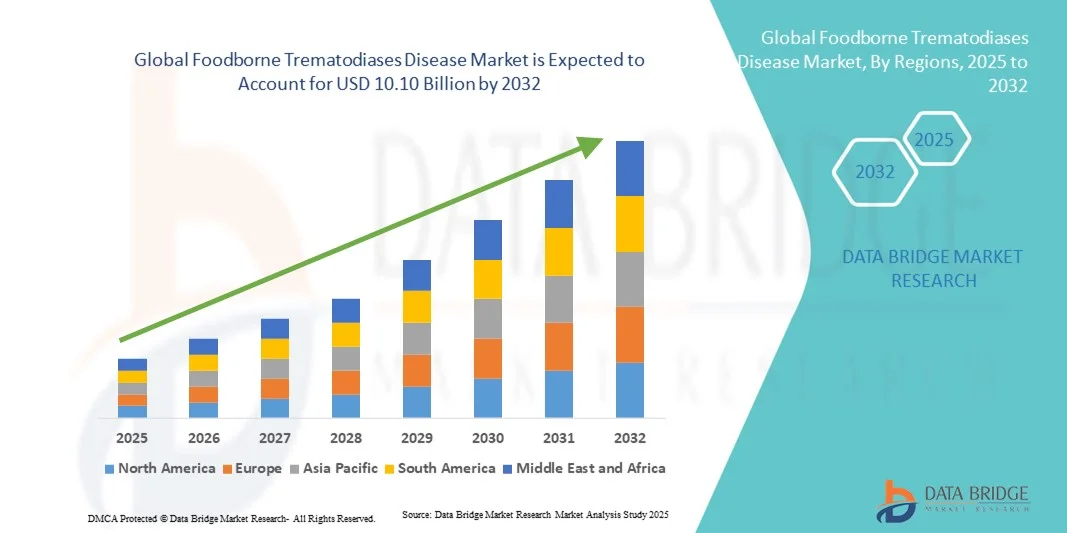
- The global foodborne trematodiases disease market size was valued at USD 6.84 billion in 2024 and is expected to reach USD 10.10 billion by 2032, at a CAGR of 5.00% during the forecast period
- The market growth is primarily driven by the increasing prevalence of foodborne parasitic infections, especially in developing regions with poor sanitation and food hygiene, coupled with rising awareness and diagnosis rates of trematode infections
- Moreover, advancements in antiparasitic drug development, government-led public health programs, and growing investments in tropical disease research are strengthening market expansion. These combined factors are accelerating the development and adoption of effective diagnostic and therapeutic solutions, thereby propelling the industry’s overall growth
Foodborne Trematodiases Disease Market Analysis
- Foodborne trematodiases, caused by parasitic flatworms transmitted through the consumption of contaminated aquatic foods such as fish, crustaceans, or aquatic plants, have emerged as a growing public health concern due to their chronic health effects and rising global incidence
- The market growth is primarily driven by the increasing prevalence of parasitic infections, heightened awareness of foodborne diseases, and advancements in diagnostic tools that enable early and accurate detection of trematode infections
- North America dominated the market with the largest revenue share of 41.6% in 2024, supported by advanced healthcare infrastructure, significant R&D investments, and robust surveillance programs focused on parasitic and foodborne diseases, particularly across the U.S. and Canada
- Asia-Pacific is expected to be the fastest-growing region during the forecast period owing to the high infection burden, improving healthcare access, and government-led prevention programs in endemic countries such as China, Thailand, and Vietnam
- The Immunological Techniques segment dominated the market with a share of 48.9% in 2024, driven by its growing use in detecting antibodies and antigens associated with trematode infections, offering faster and more reliable results compared to traditional parasitological methods
Report Scope and Foodborne Trematodiases Disease Market Segmentation
|
Attributes |
Foodborne Trematodiases Disease Key Market Insights |
|
Segments Covered |
|
|
Countries Covered |
North America
Europe
Asia-Pacific
Middle East and Africa
South America
|
|
Key Market Players |
|
|
Market Opportunities |
|
|
Value Added Data Infosets |
In addition to the insights on market scenarios such as market value, growth rate, segmentation, geographical coverage, and major players, the market reports curated by the Data Bridge Market Research also include in-depth expert analysis, patient epidemiology, pipeline analysis, pricing analysis, and regulatory framework |
Foodborne Trematodiases Disease Market Trends
Advancements in Molecular and Immunological Diagnostic Techniques
- A significant and accelerating trend in the global foodborne trematodiases disease market is the rapid advancement of molecular and immunological diagnostic techniques, enabling early, accurate, and large-scale detection of trematode infections across both clinical and field settings
- For instance, the integration of polymerase chain reaction (PCR)-based assays and ELISA testing methods is improving diagnostic precision, allowing healthcare professionals to identify specific trematode species with greater reliability and speed
- Molecular diagnostic advancements enable the detection of low parasite burdens, supporting timely intervention and reducing the risk of chronic disease complications. For instance, real-time PCR and next-generation sequencing are increasingly used in epidemiological surveillance programs to track disease prevalence and parasite resistance patterns
- The application of these diagnostic innovations in endemic regions facilitates mass screening and targeted treatment programs, helping public health agencies control outbreaks more effectively and allocate resources efficiently
- This trend toward more advanced, automated, and accessible diagnostic solutions is transforming disease management strategies. Consequently, companies and research institutions are collaborating to develop portable molecular test kits and AI-integrated diagnostic platforms to strengthen detection capabilities in low-resource regions
- The growing reliance on molecular and immunological diagnostics is driving the global shift toward precision-based parasitic disease management, supporting early treatment and improving long-term public health outcomes
Foodborne Trematodiases Disease Market Dynamics
Driver
Rising Prevalence and Government Initiatives for Disease Control
- The increasing prevalence of foodborne trematodiases in tropical and subtropical regions, coupled with growing public health awareness, is a major driver boosting market demand for effective diagnostic and treatment solutions
- For instance, in March 2024, the World Health Organization (WHO) expanded its Neglected Tropical Disease roadmap, emphasizing control and elimination programs for foodborne trematodiases through improved diagnostics and community education campaigns. Such global initiatives are expected to drive sustained market growth during the forecast period
- As infection rates rise due to changing dietary habits and aquaculture practices, governments are implementing mass drug administration (MDA) programs and improving surveillance systems to reduce disease burden and transmission rates
- Furthermore, the collaboration between public health agencies, research organizations, and pharmaceutical companies is accelerating the development of novel therapeutics and field-deployable diagnostic tools
- The emphasis on early detection, increased funding for research, and awareness campaigns by international health organizations are key factors driving the market, particularly in Asia-Pacific and Africa
- These coordinated efforts are transforming the foodborne trematodiases landscape, enabling earlier diagnosis, wider treatment access, and stronger preventive healthcare systems worldwide
Restraint/Challenge
Limited Diagnostic Access and Awareness in Endemic Regions
- Challenges related to limited diagnostic infrastructure, particularly in rural or low-income endemic regions, pose significant barriers to effective disease detection and management in the global foodborne trematodiases disease market
- For instance, many healthcare facilities in high-burden regions lack molecular diagnostic equipment or trained personnel, resulting in delayed or inaccurate diagnoses and underreported cases, which hinder disease surveillance efforts
- These infrastructural and resource limitations prevent the widespread adoption of advanced diagnostic technologies such as PCR or ELISA, restricting timely treatment and disease containment
- Furthermore, a lack of public awareness about the transmission and symptoms of trematodiases often leads to delayed healthcare-seeking behavior, worsening disease outcomes and perpetuating the infection cycle
- High costs associated with advanced molecular testing and insufficient funding for parasitic disease programs also impede adoption in developing countries, where the disease burden is highest
- Overcoming these challenges through increased healthcare funding, diagnostic capacity building, and awareness campaigns will be essential to expand disease control and achieve long-term global health improvement
Foodborne Trematodiases Disease Market Scope
The market is segmented on the basis of symptoms and diagnosis
- By Symptoms
On the basis of symptoms, the global foodborne trematodiases disease market is segmented into fever, right upper-quadrant pain, and high parasite burdens. The Fever segment dominated the market with the largest revenue share of 42.3% in 2024, as it remains one of the most prevalent and early indicators of trematode infection across endemic regions. Fever often prompts patients to seek medical attention, facilitating early diagnosis and treatment, thereby driving higher demand for diagnostic tests and antiparasitic drugs. Healthcare providers consider fever an essential screening symptom in trematodiases-endemic areas, especially among populations consuming raw or undercooked aquatic food. Moreover, the segment’s dominance is supported by increased public awareness and clinical recognition of fever as an early manifestation of infection, which strengthens diagnostic rates and treatment outcomes.
The Right Upper-Quadrant Pain segment is expected to witness the fastest growth rate of 21.2% from 2025 to 2032, as awareness of liver- and bile-related complications caused by chronic trematode infections continues to increase. This symptom reflects the progression of infection affecting hepatic and biliary systems, leading to a higher reliance on imaging and biochemical diagnostic tools. Growing investments in specialized hepatobiliary diagnostics and treatment programs in endemic regions are further driving this segment’s growth. In addition, clinical practitioners increasingly use this symptom as a diagnostic clue for early intervention, contributing to the expanding market potential of symptom-based testing and therapeutic care.
- By Diagnosis
On the basis of diagnosis, the global foodborne trematodiases disease market is segmented into parasitological techniques, immunological techniques, and molecular techniques. The Immunological Techniques segment dominated the market with the largest revenue share of 48.9% in 2024, attributed to its high sensitivity, rapid detection capability, and ability to identify active infections through antibody and antigen testing. Immunoassays such as ELISA and indirect hemagglutination tests are increasingly being adopted in public health programs for large-scale screening in endemic countries. These techniques offer cost-effective solutions for early detection and epidemiological studies, making them widely utilized in both clinical and field applications. Furthermore, ongoing improvements in assay design and reagent stability are enhancing their accuracy and usability, strengthening the segment’s leadership in the diagnostic landscape.
The Molecular Techniques segment is projected to witness the fastest growth rate of 23.5% from 2025 to 2032, driven by the increasing implementation of PCR-based methods and next-generation sequencing (NGS) for high-precision identification of trematode species. Molecular tools provide greater diagnostic specificity and are critical for detecting low parasite burdens that are often missed by traditional methods. Rising research funding, technological advancements, and collaborations between academic and healthcare institutions are fueling the segment’s expansion. In addition, the development of portable molecular diagnostic kits for use in low-resource settings is expected to significantly accelerate adoption, particularly in Asia-Pacific and Africa.
Foodborne Trematodiases Disease Market Regional Analysis
- North America dominated the market with the largest revenue share of 41.6% in 2024, supported by advanced healthcare infrastructure, significant R&D investments, and robust surveillance programs focused on parasitic and foodborne diseases, particularly across the U.S. and Canada
- Consumers and healthcare providers in the region place high importance on early detection, effective treatment, and preventive measures, supported by robust healthcare infrastructure and continuous public health initiatives aimed at reducing parasitic disease transmission
- This widespread progress is further reinforced by high research funding, the presence of leading diagnostic and pharmaceutical companies, and growing collaborations between public health agencies and research institutions, positioning North America as a leading hub for innovation and disease management in the foodborne trematodiases market
U.S. Foodborne Trematodiases Disease Market Insight
The U.S. foodborne trematodiases disease market captured the largest revenue share of 78.5% in 2024 within North America, driven by advanced diagnostic infrastructure, active surveillance programs, and high public awareness of foodborne parasitic infections. Growing emphasis on early disease detection and preventive healthcare initiatives by agencies such as the CDC are fueling demand for improved diagnostic tools and antiparasitic treatments. The U.S. market also benefits from significant investments in parasitology research and the presence of leading biotechnology companies developing molecular and immunological testing methods. Moreover, increasing international travel and food imports are prompting stronger monitoring and intervention strategies, contributing to continued market growth.
Europe Foodborne Trematodiases Disease Market Insight
The Europe foodborne trematodiases disease market is projected to expand at a substantial CAGR throughout the forecast period, primarily driven by strengthened public health frameworks, stringent food safety standards, and growing awareness of parasitic infections. Rising diagnostic efficiency and cross-border collaborations for surveillance under the European Centre for Disease Prevention and Control (ECDC) are fostering early detection and reporting. European consumers are increasingly conscious of food hygiene and water safety, driving the need for improved screening and treatment protocols. The region is witnessing strong growth in molecular and immunological diagnostic applications, particularly across hospital laboratories and public health institutions.
U.K. Foodborne Trematodiases Disease Market Insight
The U.K. foodborne trematodiases disease market is anticipated to grow at a noteworthy CAGR during the forecast period, supported by the country’s advanced diagnostic ecosystem and government initiatives for controlling foodborne and neglected tropical diseases. Increasing global travel and food imports are driving the need for precise diagnostic systems capable of detecting trematode infections. Public health authorities, including the UK Health Security Agency, are emphasizing enhanced food monitoring and public education campaigns. Moreover, the adoption of molecular and immunological testing methods in clinical laboratories is expected to accelerate, improving national disease surveillance and management capabilities.
Germany Foodborne Trematodiases Disease Market Insight
The Germany foodborne trematodiases disease market is expected to expand at a considerable CAGR during the forecast period, driven by high healthcare standards, strong emphasis on food safety, and rising awareness of parasitic zoonoses. Germany’s advanced laboratory infrastructure and focus on research innovation are promoting the adoption of molecular diagnostic technologies for parasite detection. Increasing collaboration between academic institutions, diagnostic manufacturers, and public health authorities supports knowledge exchange and technological advancement. Moreover, the country’s commitment to food quality assurance and import monitoring contributes to preventive measures against trematode infections, ensuring steady market growth.
Asia-Pacific Foodborne Trematodiases Disease Market Insight
The Asia-Pacific foodborne trematodiases disease market is poised to grow at the fastest CAGR of 24.3% during 2025–2032, driven by the high endemic prevalence of infections, rapid healthcare expansion, and rising investments in disease control programs. Countries such as China, Thailand, and Vietnam are implementing national elimination strategies with WHO support, emphasizing diagnostics, education, and sanitation improvements. Increasing availability of molecular diagnostic kits and mass drug administration programs are also driving market penetration. Furthermore, the region’s large patient pool, combined with growing government and NGO involvement in tropical disease prevention, continues to boost diagnostic and therapeutic demand.
Japan Foodborne Trematodiases Disease Market Insight
The Japan foodborne trematodiases disease market is gaining momentum due to the country’s advanced healthcare infrastructure, high diagnostic capacity, and commitment to food safety. The market is driven by early adoption of molecular testing technologies and nationwide surveillance for imported foodborne parasites. Japan’s aging population, coupled with rising awareness of liver and bile duct diseases, is increasing diagnostic volumes for trematodiases-related conditions. Moreover, collaborations between universities and diagnostic firms are supporting innovation in rapid testing methods, further strengthening Japan’s position as a leader in disease detection and prevention in the Asia-Pacific region.
India Foodborne Trematodiases Disease Market Insight
The India foodborne trematodiases disease market accounted for the largest revenue share in Asia-Pacific in 2024, attributed to high infection prevalence, expanding healthcare access, and increased government efforts to combat neglected tropical diseases. National programs focusing on sanitation improvement, safe food practices, and parasitic disease awareness are driving market growth. The country’s growing diagnostic industry and strong network of public health laboratories are enhancing testing capabilities. In addition, collaborations with global health organizations and the availability of affordable diagnostic solutions are further supporting the market’s expansion across both urban and rural populations.
Foodborne Trematodiases Disease Market Share
The Foodborne Trematodiases Disease industry is primarily led by well-established companies, including:
- Pfizer Inc. (U.S.)
- Merck & Co., Inc. (U.S.)
- GSK plc (U.K.)
- Novartis AG (Switzerland)
- Sanofi (France)
- Bayer AG (Germany)
- Johnson & Johnson Services Inc. (U.S.)
- F. Hoffmann-La Roche Ltd (Switzerland)
- Abbott (U.S.)
- Thermo Fisher Scientific Inc. (U.S.)
- QIAGEN (Netherlands)
- bioMérieux (France)
- Danaher (U.S.)
- BD (U.S.)
- Hologic, Inc. (U.S.)
- PerkinElmer (U.S.)
- IDEXX Laboratories, Inc. (U.S.)
- Eurofins Scientific (Luxembourg/France)
- Takeda Pharmaceutical Company Limited (Japan)
- Medicines for Malaria Venture (MMV) (Switzerland)
What are the Recent Developments in Global Foodborne Trematodiases Disease Market?
- In August 2024, a research initiative was announced in India titled “Mining the secretome of neglected food-borne zoonotic trematodes for diagnostic targets”. The project, led by researchers at Sikkim University in collaboration with national institutes, focuses on under-studied species such as Fasciolopsis buski and Artyfechinostomum sufrartyfex, aiming to identify novel antigenic proteins (“secretome”) as diagnostic biomarkers
- In January 2025, a study titled “Prevalence trend and burden of foodborne trematodiasis in China, Japan, and South Korea” was published (using data until 2021 and projecting to 2030) in Frontiers in Public Health. The research found that while global prevalence and DALYs for FBTs showed a downward trend (AAPC for prevalence approx. –2.18% from 1990-2021), the burden remains high in the Asia-Pacific region and the age/distribution patterns are shifting
- In May 2024, a study published in Infectious Diseases of Poverty provided updated global, regional and national estimates of the burden of food-borne trematodiases (FBTs) using the GBD 2021 database. Key findings included an estimate that over 99 species of foodborne trematodes can infect humans (15 liver flukes, 9 lung flukes, 75 intestinal flukes) underscoring the scope of species diversity in this category
- In April 2022, a review titled “Foodborne trematodes: old foes, new kids on the block” was published by researchers including M. W. Robinson. The review revisited well-known species (such as Clonorchis sinensis and Opisthorchis viverrini) but also highlighted newly emerging trematode infections and neglected species, pointing to changing epidemiology and host-parasite interactions
- In May 2021, WHO published a comprehensive fact sheet on foodborne trematode infections, noting that these diseases cause around 2 million life-years lost globally each year due to disability and death. The fact-sheet emphasised the complex zoonotic life-cycles of trematodes, involving snails and aquatic food items, and highlighted that most burden falls on East Asia and South America

- Interactive Data Analysis Dashboard
- Company Analysis Dashboard for high growth potential opportunities
- Research Analyst Access for customization & queries
- Competitor Analysis with Interactive dashboard
- Latest News, Updates & Trend analysis
- Harness the Power of Benchmark Analysis for Comprehensive Competitor Tracking
Data collection and base year analysis are done using data collection modules with large sample sizes. The stage includes obtaining market information or related data through various sources and strategies. It includes examining and planning all the data acquired from the past in advance. It likewise envelops the examination of information inconsistencies seen across different information sources. The market data is analysed and estimated using market statistical and coherent models. Also, market share analysis and key trend analysis are the major success factors in the market report. To know more, please request an analyst call or drop down your inquiry.
The key research methodology used by DBMR research team is data triangulation which involves data mining, analysis of the impact of data variables on the market and primary (industry expert) validation. Data models include Vendor Positioning Grid, Market Time Line Analysis, Market Overview and Guide, Company Positioning Grid, Patent Analysis, Pricing Analysis, Company Market Share Analysis, Standards of Measurement, Global versus Regional and Vendor Share Analysis. To know more about the research methodology, drop in an inquiry to speak to our industry experts.
Data Bridge Market Research is a leader in advanced formative research. We take pride in servicing our existing and new customers with data and analysis that match and suits their goal. The report can be customized to include price trend analysis of target brands understanding the market for additional countries (ask for the list of countries), clinical trial results data, literature review, refurbished market and product base analysis. Market analysis of target competitors can be analyzed from technology-based analysis to market portfolio strategies. We can add as many competitors that you require data about in the format and data style you are looking for. Our team of analysts can also provide you data in crude raw excel files pivot tables (Fact book) or can assist you in creating presentations from the data sets available in the report.












