


What is the Industrial DeNOx Systems Market Size and Growth Rate?
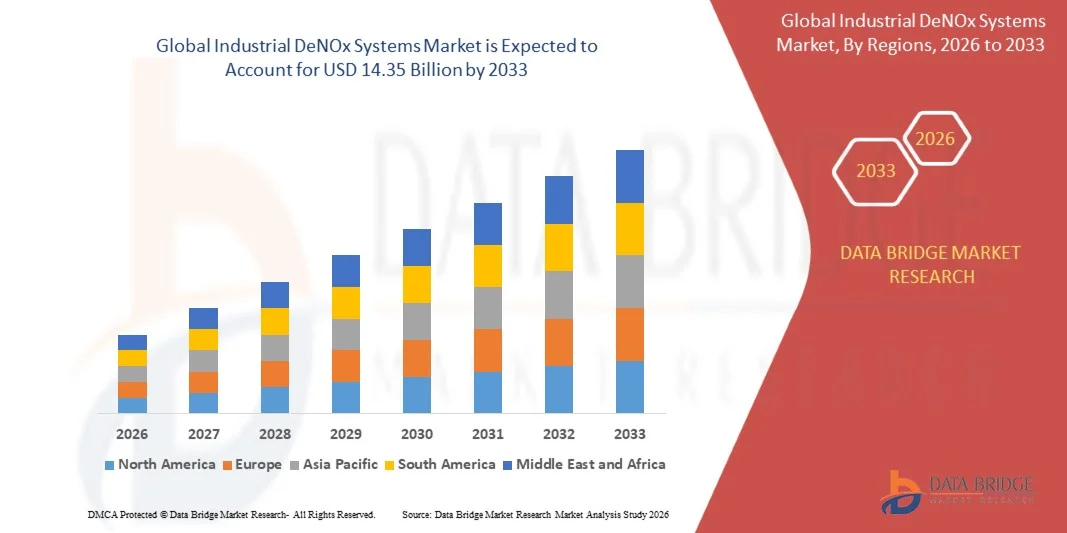
- As per Data Bridge Market Research analysis, the Industrial DeNOx Systems market was valued at USD 8.05 billion in 2025 and is projected to reach USD 14.35 billion by 2033, growing at a CAGR of 7.49% from 2026 to 2033.
- The market is experiencing consistent growth driven by the increasing demand for effective nitrogen oxide (NOx) emission control solutions across power plants, industrial boilers, gas turbines, cement plants, refineries, steel facilities, waste incineration plants, and other emission-intensive industrial operations, alongside the implementation of stringent environmental regulations and growing investments in industrial emission-control infrastructure.
- The growing emphasis on reducing NOx emissions, improving combustion efficiency, and meeting increasingly stringent air-quality standards is encouraging industrial operators to adopt advanced DeNOx technologies. Innovations in Selective Catalytic Reduction (SCR), Selective Non-Catalytic Reduction (SNCR), hybrid DeNOx systems, high-efficiency catalysts, ammonia and urea injection systems, and automated emission-monitoring technologies are increasingly being integrated into new and existing industrial facilities, supporting improved emission control, regulatory compliance, and operational efficiency.
Market Size & Forecast
- Global Market Value (2025): USD 8.05 Billion
- Expected Market Value (2033): USD 14.35 Billion
- Forecast CAGR (2026–2033): 7.49%
- Leading Region in 2025: Asia-Pacific
- Fastest Growing Region: Middle East and Africa
What are the Major Takeaways of the Industrial DeNOx Systems Market?
- Asia-Pacific dominated the industrial denox systems market with the largest revenue share of 40.2% in 2025, supported by rapid industrialization, expansion of power-generation capacity, large-scale cement and steel production, refinery investments, and increasing implementation of NOx-emission control systems across China, India, Japan, and South Korea.
- North America is expected to be the fastest-growing region at a CAGR of 6.4% from 2026 to 2033, driven by stringent NOx-emission regulations, replacement of aging emission-control equipment, increasing retrofit activity across power and industrial facilities, and continued investment in high-efficiency SCR systems. This regional growth outlook is consistent with sources identifying North America as a major established DeNOx market while Asia-Pacific benefits from faster industrial expansion.
- Selective catalytic reduction (SCR) dominated the industrial denox systems market with a 61.8% revenue share in 2025, supported by its high NOx-removal efficiency, established application across large combustion sources, and increasing adoption in power generation, cement, refinery, chemical, and other industrial facilities. Independent market sources also consistently identify SCR as the leading technology.
- Selective catalytic reduction (SCR) is projected to be the fastest-growing technology segment at a CAGR of 6.2% from 2026 to 2033, driven by increasingly stringent emission limits, demand for higher NOx-removal efficiency, development of advanced catalysts, and increasing retrofit requirements across existing industrial facilities.
- Utilities dominated the application segment with a 57.9% revenue share in 2025, supported by the extensive deployment of DeNOx systems in coal-fired and gas-fired power plants, stringent emissions regulations, and the need to maintain compliance across large-scale combustion facilities. Published market research similarly identifies utilities as the largest application category.
- Industrial applications are expected to be among the fastest-growing application categories at a CAGR of 6.0% from 2026 to 2033, driven by increasing DeNOx adoption across cement plants, refineries, chemical facilities, steel mills, industrial boilers, waste-to-energy facilities, and other emission-intensive manufacturing operations.
Report Scope and Industrial DeNOx Systems Market Segmentation
|
Attributes |
Industrial DeNOx Systems Key Market Insights |
|
Segments Covered |
|
|
Countries Covered |
North America
Europe
Asia-Pacific
Middle East and Africa
South America
|
|
Key Market Players |
|
|
Market Opportunities |
|
|
Value Added Data Infosets |
In addition to the insights on market scenarios such as market value, growth rate, segmentation, geographical coverage, and major players, the market reports curated by the Data Bridge Market Research also include import export analysis, production capacity overview, production consumption analysis, price trend analysis, climate change scenario, supply chain analysis, value chain analysis, raw material/consumables overview, vendor selection criteria, PESTLE Analysis, Porter Analysis, and regulatory framework. |
What is the Key Trend in the Industrial DeNOx Systems Market?
- Increasing adoption of advanced selective catalytic reduction (SCR) and Selective Non-Catalytic Reduction (SNCR) systems is supporting higher NOx reduction efficiency across power generation, cement, steel, chemical, waste management, and other industrial applications. SCR systems are increasingly being integrated with optimized catalyst configurations, reagent injection controls, and improved process monitoring to maintain stable NOx reduction under variable operating conditions.
- For instance, March 2026, Environmental Energy Services (EES) announced that its next-generation DeNOx SCR platform was achieving sub-2 ppm NOx performance for simple-cycle turbines, IC engines, and industrial energy systems, highlighting the increasing development of high-efficiency NOx control technologies for distributed industrial power applications.
- Increasing development of advanced catalyst formulations and low-temperature SCR technologies is supporting DeNOx applications where flue-gas temperatures, space limitations, and retrofit requirements restrict the use of conventional high-temperature systems. Low-temperature catalyst technologies are gaining attention in cement kilns and other industrial processes.
- For instance, September 2026, DAQI Technology highlighted low-temperature SCR technology for cement kiln applications, where flue-gas temperatures after heat recovery and downstream treatment can fall to around 150°C or lower, creating demand for catalysts designed for lower-temperature operating conditions.
- Industrial DeNOx systems are increasingly incorporating continuous emissions monitoring, automated reagent dosing, remote diagnostics, and digital process controls. These technologies support real-time monitoring of NOx concentrations, ammonia dosing, catalyst performance, and system operating conditions, helping industrial operators maintain emission compliance and optimize reagent consumption.
- For instance, June 2026, iFactory highlighted the use of continuous analytics for SCR and SNCR systems to monitor catalyst health, reagent injection, temperature profiles, and emissions compliance across power generation, cement manufacturing, industrial boilers, and chemical processing applications.
- Growing adoption of modular and retrofit-oriented DeNOx systems is supporting upgrades of existing industrial facilities without requiring complete replacement of combustion or process equipment. Retrofit solutions are becoming increasingly relevant as operators seek to meet tighter NOx limits while controlling capital expenditure and plant downtime.
What are the Key Drivers of the Industrial DeNOx Systems Market?
- Increasingly stringent environmental regulations and NOx emission limits are driving industrial facilities to install, upgrade, and retrofit DeNOx systems across power generation, cement, chemical, steel, oil and gas, and waste-treatment facilities.
- For instance, February 2025, Damen Shipyards Group completed the installation of five SCR systems on Van Oord's Nexus offshore carrier, with the systems reducing NOx emissions from the vessel by up to 80%, demonstrating the continued adoption of SCR technology where stringent emissions requirements apply.
- Increasing industrialization and expansion of energy-intensive manufacturing are supporting demand for NOx emission-control technologies. DeNOx systems enable industrial facilities to reduce nitrogen oxide emissions generated during combustion and industrial processes while supporting compliance with applicable environmental requirements.
- For instance, Fuel Tech's China Steel Corporation project combined SNCR and in-duct SCR with combustion-control technologies to address NOx emissions from a boiler operating with coal, coke oven gas, and blast furnace gas, demonstrating demand for integrated DeNOx solutions in energy-intensive steel production.
- Rising investment in modernization and retrofitting of aging industrial and power-generation assets is creating demand for SCR, SNCR, catalyst replacement, system upgrades, monitoring, and engineering services. Retrofit activity is particularly important where existing facilities need to meet tighter emission requirements without extensive modifications to the underlying production process.
- For instance, February 2025, ENGIE Laborelec reported SCR cleaning and upgrade solutions designed to address catalyst plugging, pressure-drop increases, reduced catalyst performance, and higher ammonia consumption across applications including coal, waste, glass, and oil facilities, highlighting the importance of retrofit and maintenance services in existing DeNOx installations.
- Growing demand for efficient NOx reduction in power generation and industrial combustion processes is supporting deployment of SCR, SNCR, and hybrid DeNOx configurations. Combined systems are particularly relevant where a single NOx-control technology cannot consistently achieve the required emission levels.
- For instance, August 2026, a rotary-kiln DeNOx project described the combination of urea-based SNCR and downstream mid-temperature SCR for an industrial lithium-battery-materials application, demonstrating the use of combined technologies to achieve higher overall NOx reduction while accommodating process temperature constraints.
- Growing focus on operational efficiency and lifecycle costs is encouraging industrial operators to adopt advanced catalysts, automated reagent dosing, continuous monitoring, and predictive maintenance. These technologies can support lower reagent consumption, improved catalyst utilization, reduced unplanned downtime, and more consistent emissions performance.
Which Factors are Challenging the Growth of the Industrial DeNOx Systems Market?
- High initial installation and ongoing maintenance costs remain a major challenge, particularly for smaller industrial facilities. SCR systems require investment in reactors, catalysts, reagent-handling equipment, injection systems, controls, installation, and integration with existing plant infrastructure.
- For instance, retrofit projects can require structural modifications, ductwork changes, flow-distribution improvements, instrumentation, and control-system integration, increasing the engineering complexity and capital requirements associated with upgrading existing industrial facilities.
- Catalyst replacement and reagent consumption can increase operating costs for DeNOx systems. Catalyst degradation, poisoning, plugging, thermal exposure, and changing flue-gas conditions can affect NOx conversion performance and require periodic inspection, cleaning, regeneration, replacement, or system optimization.
- For instance, ENGIE Laborelec identifies catalyst plugging as a recurring SCR challenge because it can increase pressure drop, catalyst costs, outage requirements, and ammonia consumption, encouraging operators to invest in catalyst cleaning, redesign, and maintenance solutions.
- Managing ammonia slip while achieving high NOx conversion remains a technical challenge for SCR and SNCR systems. Excessive reagent dosing can improve NOx reduction but may increase unreacted ammonia, requiring accurate dosing, monitoring, catalyst management, and process control.
- For instance, February 2025, Fuel Tech's China Steel Corporation retrofit combined SNCR, in-duct SCR, low-NOx burners, and over-fire air, illustrating the need to coordinate multiple NOx-control technologies and control systems when operating with different industrial fuel sources.
- Retrofitting DeNOx systems into existing industrial facilities can be technically complex because of limited installation space, existing ductwork, variable flue-gas temperatures, dust loading, corrosion considerations, pressure-loss constraints, and the need to minimize plant downtime.
- For instance, September 2026, DAQI Technology noted that cement-kiln retrofit projects can face low flue-gas temperatures after heat recovery and downstream treatment, creating a requirement for low-temperature SCR catalyst selection or additional thermal-management measures.
- Volatility in catalyst materials, reagents, metals, and other specialized components can create procurement and supply-chain challenges for system manufacturers and industrial operators. Long lead times for specialized catalysts and equipment can also affect project schedules and maintenance planning.
- Balancing NOx reduction efficiency, reagent consumption, pressure loss, catalyst life, maintenance requirements, and overall operating cost remains a key engineering challenge. Consequently, manufacturers and industrial operators are increasingly focusing on advanced catalysts, optimized reagent injection, modular retrofit designs, continuous emissions monitoring, and predictive diagnostics to improve DeNOx system performance and lifecycle economics.
How is the Industrial DeNOx Systems Market Segmented?
The industrial denox systems market is segmented on the basis of type, application, service, and end user.
- By Type
On the basis of type, the industrial DeNOx systems market is segmented into Selective Catalytic Reduction (SCR), Selective Non-Catalytic Reduction (SNCR), Hybrid DeNOx Systems, and Others. The Selective Catalytic Reduction (SCR) segment dominated the market with a 61.8% share in 2025, supported by its high NOx removal efficiency and widespread deployment across power generation, cement, chemical, refinery, and other industrial facilities. SCR systems use catalysts and ammonia- or urea-based reagents to convert NOx into nitrogen and water, making them suitable for applications requiring stringent emission control and consistent operating performance. Industry sources similarly identify SCR as the leading technology segment in the Industrial DeNOx Systems market.
The SCR segment is projected to witness strong growth at a CAGR of 6.2% during the forecast period, driven by increasingly stringent emission standards, modernization of existing industrial facilities, and growing adoption of high-efficiency NOx reduction technologies. Increasing deployment of advanced catalyst systems, optimized reagent injection, continuous emissions monitoring, and retrofit SCR solutions is further supporting segment growth.
- By Application
On the basis of application, the industrial DeNOx systems market is segmented into Power Plants, Gas Turbines, Waste Incineration Plants, Refineries, Cement Plants, Steel Plants, Chemical Plants, and Others. The Power Plants segment dominated the market with a 44.6% share in 2025, supported by the high NOx emissions generated by thermal power generation and the increasing requirement for emission-control systems to comply with environmental regulations. Power plants require continuous and high-efficiency NOx reduction solutions, particularly SCR and SNCR systems, to control emissions from boilers, turbines, and other combustion equipment. Industry research also identifies power generation as a leading application for Industrial DeNOx Systems.
The industrial applications segment is projected to witness strong growth at a CAGR of 6.0% during the forecast period, driven by increasing deployment of DeNOx systems across cement, steel, chemical, refinery, waste incineration, and other energy-intensive industries. Growing industrialization, expansion of manufacturing capacity, and tightening emission limits are encouraging industrial operators to install new DeNOx systems and retrofit existing emission-control infrastructure.
- By Service
On the basis of service, the industrial DeNOx systems market is segmented into New Installation, Retrofit, Maintenance and Repair, Monitoring and Compliance, and Others. The New Installation segment dominated the market with a 38.5% share in 2025, supported by the installation of new DeNOx systems in newly constructed power plants, industrial facilities, cement plants, refineries, and other combustion-intensive facilities. New installations allow operators to integrate emission-control equipment, reagent systems, catalysts, control systems, and monitoring technologies into facility designs from the initial engineering stage.
The Retrofit segment is projected to witness the fastest growth at a CAGR of 6.6% during the forecast period, driven by the modernization of aging industrial facilities, tightening emission regulations, catalyst replacement, and the need to upgrade existing NOx control systems. Retrofit projects enable operators to improve emission performance without replacing entire industrial assets, supporting demand for SCR, SNCR, hybrid systems, control upgrades, and advanced monitoring solutions. Industry sources identify replacement and retrofit services as an important component of the Industrial DeNOx Systems and Services market.
- By End User
On the basis of end user, the industrial denox systems market is segmented into Utilities, Power Generation Companies, Chemical and Petrochemical Industries, Cement Manufacturers, Metal and Steel Industries, Waste Management Companies, and Other Industrial Facilities. The Utilities segment dominated the market with a 57.9% share in 2025, supported by the extensive deployment of DeNOx systems across utility-scale power generation facilities and large combustion assets. Utilities operate high-capacity equipment for extended periods and therefore require reliable NOx reduction systems to meet emission requirements while maintaining stable plant operations.
The Power Generation Companies segment is projected to witness strong growth during the forecast period, driven by the modernization of thermal power assets, increasing investment in emission-control technologies, and the replacement or upgrading of aging NOx reduction systems. Growing adoption of advanced SCR, SNCR, continuous emissions monitoring, automated reagent dosing, and digital performance-monitoring solutions is further supporting demand across power generation facilities. Power generation remains a major end-use area for DeNOx technologies due to the significant NOx emissions associated with combustion-based electricity generation.
Which Region Holds the Largest Share of the Industrial DeNOx Systems Market?
- Asia-Pacific dominated the Industrial DeNOx Systems market with the largest revenue share of 40.2% in 2025, supported by rapid industrialization, large-scale power generation capacity, expansion of cement, steel, chemical, and petrochemical industries, and increasing investment in industrial emission-control technologies across China, India, Japan, and South Korea. Cross-source market research identifies Asia-Pacific as a leading regional market, while SCR-specific market data also places Asia-Pacific as the largest regional market.
- The region also benefits from stringent air-pollution control initiatives, modernization of thermal power plants, expansion of industrial production, and increasing adoption of SCR and SNCR technologies. In China, demand for denitrification catalysts is supported by emission-control requirements across thermal power and non-electric industries, including metallurgy, cement, waste incineration, biomass power generation, and gas-fired power generation.
U.S. Industrial DeNOx Systems Market Insight
The U.S. Industrial DeNOx Systems market is witnessing steady growth due to stringent NOx emission-control requirements, continued operation and modernization of thermal power facilities, and increasing adoption of advanced emission-control technologies across power generation and industrial applications. The U.S. Environmental Protection Agency reports that advanced post-combustion controls such as SCR and SNCR are used to control NOx emissions under federal air-pollution programs.
Asia-Pacific Industrial DeNOx Systems Market Insight
The Asia-Pacific Industrial DeNOx Systems market is experiencing strong growth, driven by rapid industrialization, expanding electricity demand, large-scale thermal power generation, and increasing investment in emission-control systems across China, India, Japan, and South Korea. The region accounted for 40.2% of the global Industrial DeNOx Systems market in 2025 on a cross-source working basis. China represents a major demand center due to its extensive thermal power and industrial base, while growing investment in cement, steel, chemical, petrochemical, and waste-treatment facilities is creating additional demand for SCR, SNCR, and denitrification catalysts. Current market research also identifies Asia-Pacific as the largest regional market for Industrial DeNOx Systems and Services.
Japan Industrial DeNOx Systems Market Insight
The Japan Industrial DeNOx Systems market is supported by stringent environmental requirements, advanced industrial emission-control infrastructure, and the continued modernization of power generation and industrial facilities. Demand is supported by the country's established power, chemical, steel, cement, and manufacturing sectors, where efficient NOx control is required to maintain compliance with environmental standards. Japan also has established expertise in SCR technology, including research and development related to catalyst- and ammonia-based NOx reduction systems.
China Industrial DeNOx Systems Market Insight
The China Industrial DeNOx Systems market is expanding strongly, supported by extensive thermal power generation, large-scale industrial production, and increasingly stringent emission-control requirements. Demand extends beyond thermal power into metallurgy, cement, waste incineration, biomass power generation, gas-fired power generation, and petrochemical applications. China's 2025 denitrification catalyst outlook specifically identifies non-electric industries such as metallurgy and cement as important areas for emission-reduction activity, while continued environmental compliance requirements are supporting demand for denitrification technologies.
U.K. Industrial DeNOx Systems Market Insight
The U.K. Industrial DeNOx Systems market is supported by stringent environmental requirements, industrial emission-control investments, and modernization of power, waste-treatment, chemical, and other combustion-intensive facilities. Demand for NOx-control systems is increasingly associated with efficient emission reduction, compliance monitoring, and upgrades to existing industrial emission-control infrastructure. The broader European market is also supported by continued investment in advanced industrial emission-control technologies and low-emission production processes.
Germany Industrial DeNOx Systems Market Insight
The Germany Industrial DeNOx Systems market is expanding steadily due to stringent environmental regulations, a strong industrial base, and continued investment in advanced emission-control technologies across cement, chemical, power, manufacturing, and other combustion-intensive industries. German industrial technology providers are deploying SCR-based solutions tailored to plant-specific process conditions. For example, Scheuch Industrial Solutions highlights integrated industrial exhaust-treatment systems combining regenerative thermal oxidation with low-dust SCR for simultaneous reduction of NOx and organic pollutants.
Which are the Top Companies in Industrial DeNOx Systems Market?
The Industrial DeNOx Systems industry is primarily led by well-established companies, including:
- Johnson Matthey (U.K.)
- Cormetech (U.S.)
- Babcock & Wilcox Enterprises, Inc. (U.S.)
- Mitsubishi Heavy Industries, Ltd. (Japan)
- General Electric Company (U.S.)
- Doosan Enerbility Co., Ltd. (South Korea)
- ANDRITZ AG (Austria)
- FLSmidth & Co. A/S (Denmark)
- Fuel Tech, Inc. (U.S.)
- Haldor Topsoe A/S (Denmark)
- Dürr AG (Germany)
- CECO Environmental Corp. (U.S.)
- Thermax Limited (India)
- Envirotherm GmbH (Germany)
- Hitachi, Ltd. (Japan)
- IHI Corporation (Japan)
- Kawasaki Heavy Industries, Ltd. (Japan)
- Doosan Lentjes GmbH (Germany)
- RJM Corporation (U.S.)
- SUEZ (France)
What are Latest Developments in Industrial DeNOx Systems Market?
- In March 2026, Environmental Energy Services (EES) announced that its next-generation DeNOx Selective Catalytic Reduction (SCR) platform was achieving sub-2 ppm NOx performance for simple-cycle turbines, IC engines, and industrial energy systems. The technology is being positioned for industrial and distributed power applications facing increasingly stringent NOx emission requirements, highlighting the growing development of high-efficiency DeNOx systems for industrial energy facilities.
- In 2025, Denox Environmental & Technology Holdings reported continued demand for DeNOx catalysts across China's power and industrial sectors, with the power industry remaining a principal market while demand from steel coking, alumina, biomass power generation, waste-to-energy, cement, glass, and papermaking applications also supported catalyst procurement. The company reported that newly built cement production lines in Henan, Guangdong, and other Chinese regions were equipped with denitrification facilities, demonstrating increasing adoption of NOx-control systems beyond conventional power-generation applications.
- In July 2025, Beijing Denox Environmental Protection Technology announced a contract to supply low-temperature honeycomb DeNOx catalysts for a No. 1 coke oven at Tanggang Meijin Coking, a subsidiary of HBIS Group. The project highlights increasing adoption of specialized low-temperature SCR catalyst technologies in steel and coke-production applications, where process conditions can differ significantly from conventional power-plant flue gases.
- In 2026, Scheuch Industrial Solutions highlighted the deployment of SCR-based NOx separation technologies across cement-industry applications, including high-dust, semi-dust, and low-dust SCR configurations. The technologies are designed to accommodate different cement-kiln exhaust-gas conditions, demonstrating increasing demand for application-specific DeNOx solutions and advanced catalyst configurations in energy-intensive industries.
- In February 2026, EES showcased its next-generation SCR DeNOx technology for AI-powered data centers and industrial energy systems, highlighting applications for simple-cycle turbines, internal-combustion engines, and industrial furnaces. The development reflects increasing demand for compact and high-performance NOx-control technologies as distributed and backup power generation expands across industrial facilities.

- Interactive Data Analysis Dashboard
- Company Analysis Dashboard for high growth potential opportunities
- Research Analyst Access for customization & queries
- Competitor Analysis with Interactive dashboard
- Latest News, Updates & Trend analysis
- Harness the Power of Benchmark Analysis for Comprehensive Competitor Tracking
Global Industrial Denox Systems Market, Supply Chain Analysis and Ecosystem Framework
To support market growth and help clients navigate the impact of geopolitical shifts, DBMR has integrated in-depth supply chain analysis into its Global Industrial Denox Systems Market research reports. This addition empowers clients to respond effectively to global changes affecting their industries. The supply chain analysis section includes detailed insights such as Global Industrial Denox Systems Market consumption and production by country, price trend analysis, the impact of tariffs and geopolitical developments, and import and export trends by country and HSN code. It also highlights major suppliers with data on production capacity and company profiles, as well as key importers and exporters. In addition to research, DBMR offers specialized supply chain consulting services backed by over a decade of experience, providing solutions like supplier discovery, supplier risk assessment, price trend analysis, impact evaluation of inflation and trade route changes, and comprehensive market trend analysis.
Data collection and base year analysis are done using data collection modules with large sample sizes. The stage includes obtaining market information or related data through various sources and strategies. It includes examining and planning all the data acquired from the past in advance. It likewise envelops the examination of information inconsistencies seen across different information sources. The market data is analysed and estimated using market statistical and coherent models. Also, market share analysis and key trend analysis are the major success factors in the market report. To know more, please request an analyst call or drop down your inquiry.
The key research methodology used by DBMR research team is data triangulation which involves data mining, analysis of the impact of data variables on the market and primary (industry expert) validation. Data models include Vendor Positioning Grid, Market Time Line Analysis, Market Overview and Guide, Company Positioning Grid, Patent Analysis, Pricing Analysis, Company Market Share Analysis, Standards of Measurement, Global versus Regional and Vendor Share Analysis. To know more about the research methodology, drop in an inquiry to speak to our industry experts.
Data Bridge Market Research is a leader in advanced formative research. We take pride in servicing our existing and new customers with data and analysis that match and suits their goal. The report can be customized to include price trend analysis of target brands understanding the market for additional countries (ask for the list of countries), clinical trial results data, literature review, refurbished market and product base analysis. Market analysis of target competitors can be analyzed from technology-based analysis to market portfolio strategies. We can add as many competitors that you require data about in the format and data style you are looking for. Our team of analysts can also provide you data in crude raw excel files pivot tables (Fact book) or can assist you in creating presentations from the data sets available in the report.













