Global Iron Deficiency Anemia Therapy Market
Market Size in USD Billion
CAGR :
% 
 USD
5.35 Billion
USD
11.46 Billion
2024
2032
USD
5.35 Billion
USD
11.46 Billion
2024
2032
 Forecast Period Forecast Period |
2025 –2032 |
 Market Size (Base Year) Market Size (Base Year) |
USD 5.35 Billion |
 Market Size (Forecast Year) Market Size (Forecast Year) |
USD 11.46 Billion |
 CAGR CAGR |
% |
| Major Markets Players |
|
Iron-Deficiency Anemia Therapy Market Analysis
The global iron-deficiency anemia therapy market is experiencing significant growth, driven by the rising incidences of iron deficiency anemia, introduction of novel drugs in the market, and inclination towards social healthcare on women health specifically anemia. The market is characterized by the presence of a large number of players offering a wide range of therapies tailored to meet the diverse needs of healthcare providers in the region.
Iron-Deficiency Anemia Therapy Market Size
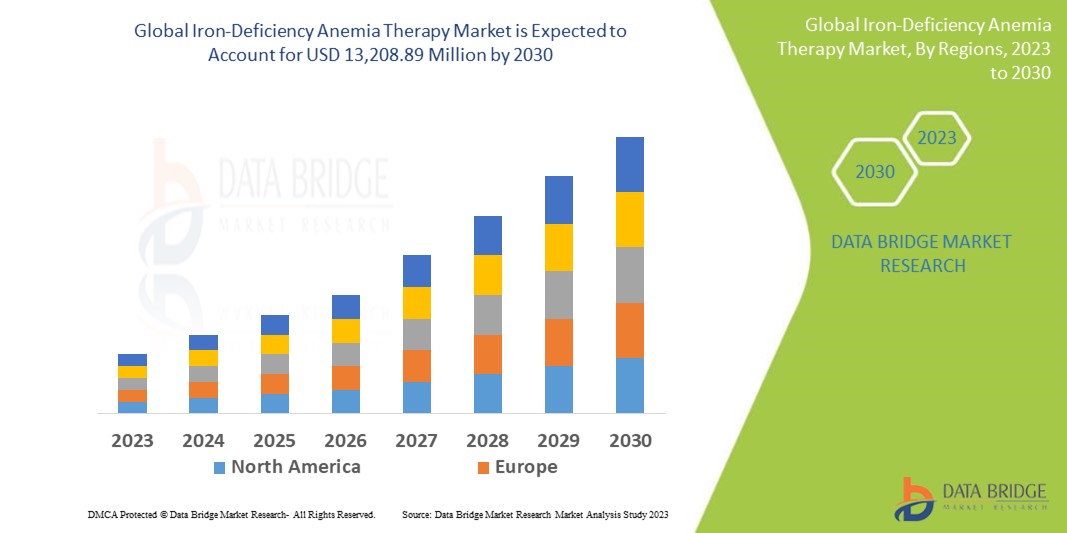
Global iron-deficiency anemia therapy market size was valued at USD 5.35 billion in 2024 and is projected to reach USD 11.46 billion by 2032, with a CAGR of 10.0% during the forecast period of 2025 to 2032. In addition to the insights on market scenarios such as market value, growth rate, segmentation, geographical coverage, and major players, the market reports curated by the Data Bridge Market Research also include depth expert analysis, patient epidemiology, pipeline analysis, pricing analysis, and regulatory framework.
Report Scope and Market Segmentation
|
Attributes |
Iron-Deficiency Anemia Therapy Key Market Insights |
|
Segmentation |
|
|
Countries Covered |
U.S., Canada, Mexico, Germany, France, U.K., Netherlands, Switzerland, Belgium, Russia, Italy, Spain, Turkey, Rest of Europe, China, Japan, India, South Korea, Singapore, Malaysia, Australia, Thailand, Indonesia, Philippines, Rest of Asia-Pacific, Saudi Arabia, U.A.E., South Africa, Egypt, Israel, Rest of Middle East and Africa, Brazil, Argentina, Rest of South America |
|
Key Market Players |
Vifor Pharma Ltd., DAIICHI SANKYO COMPANY, LIMITED, AFT Pharmaceuticals., Sanofi, Pfizer Inc., Fresenius Kabi AG, PHARMACOSMOS Therapeutics Inc, Thorne, Lupin, BLACKMORES, Shield Therapeutics plc, Aspen Pharmacare Australia Pty Ltd. Health Care |
|
Market Opportunities |
|
|
Value Added Data Infosets |
In addition to the insights on market scenarios such as market value, growth rate, segmentation, geographical coverage, and major players, the market reports curated by the Data Bridge Market Research also include depth expert analysis, patient epidemiology, pipeline analysis, pricing analysis, and regulatory framework. |
Iron-Deficiency Anemia Therapy Market Definition
Iron deficiency anemia therapy is a treatment approach aimed at replenishing iron stores and correcting anemia caused by iron deficiency. The primary goal of therapy is to restore normal iron levels and hemoglobin production, thereby improving symptoms such as fatigue, weakness, and shortness of breath. Therapy typically involves oral iron supplementation, which can be in the form of ferrous sulfate, ferrous gluconate, or ferric citrate, and may be administered alone or in combination with other medications to enhance absorption and efficacy. In severe cases, intravenous iron therapy may be necessary, and in some instances, blood transfusions may be required to rapidly increase hemoglobin levels.
Global Iron-Deficiency Anemia Therapy Market Dynamics
Drivers
- Rising Incidences of Iron Deficiency Anemia
Anemia is defined as a low concentration of blood hemoglobin. It is a health problem that affects all economical sections of world ranging from low-, middle- and high-income countries. Significant adverse health consequences of anemia along with worse impacts on economic and social development.
Anemia occurs due to various etiologies, with the most common contributor is iron deficiency. Approximately 50% of cases of anemia cases are caused due to iron deficiency, but the ratio probably varies due to various factors.
Other causes of anemia include other deficiencies of micronutrient (e.g. vitamins A, folate, riboflavin and B12), chronic and acute infections (e.g. cancer, tuberculosis, malaria, and HIV), and acquired or inherited disorders that affect synthesis of hemoglobin, red blood cell (RBC) production or survival.
Iron deficiency anemia is said to be the most common form of anemia found globally. In this condition, blood lacks sufficient healthy red blood cells (RBC’s) which functions to carry oxygen to the tissue of the body’s Iron deficiency anemia is caused due to insufficient iron.
The lack of proper nutrition and various inflammations in body, which renders the poor absorption of the iron, leads to increased prevalence of iron deficiency anemia.
For instance,
- According to a report by India Spend, published in 2016, 20% of maternal deaths in India were caused by anemia and was the associate cause in 50% of maternal deaths in October 2016. Low birth weight among babies and risking them for lifelong issues involving physical growth and cognitive development is caused by anemia. According to statistics, the efficiency of anemic children reduces to 2.5% as adults compared to their healthier peers.
- According to Global Nutrition Report 2017, it reported that just over half (51%) of women of reproductive age (15 to 49 years) are anemic in India and according to the report in the fourth National Family Health Survey (NFHS-IV) in 2015-16 it is estimated that 53% of the women were anemic in India in the reproductive age
Introduction of Novel Drugs in the Market
Innovation drives progress, the availability of novel drugs, lead products and biological products often means new hope and better treatment options for patients and advancement in health care for public worldwide. Some of the products are new and innovative with novel approach that have never been used in clinical practice and have potential benefits to cure the persisting ailment in the population worldwide. The various drugs and therapies are made with advanced research and development and thorough testing using subjects to check their efficiency.
For instance,
- In December 2023, according to an article published by FDA, the U.S. FDA approved two landmark treatments, Casgevy and Lyfgenia, as the first cell-based gene therapies for sickle cell disease (SCD) in patients 12 years and older. Notably, Casgevy is the first FDA-approved treatment to use novel genome editing technology, marking a significant advancement in gene therapy
- These breakthroughs will drive the global iron-deficiency anemia therapy market by highlighting the potential for innovative treatments and encouraging further research and development in anemia-related therapies
- In September 2023, according to an article published by GSK plc., GSK plc. announced FDA approval of Ojjaara (momelotinib) for treating intermediate or high-risk myelofibrosis, including primary and secondary myelofibrosis, in adults with anemia. Ojjaara, a once-daily oral JAK1/JAK2 and ACVR1 inhibitor, is the only approved treatment for both newly diagnosed and previously treated myelofibrosis patients with anemia, addressing anemia, constitutional symptoms, and splenomegaly.
Opportunity
- Increasing Research and Development Activities
Herbs, fungi and plants for curing anemia have been used in medicinal traditions indigenous for millennia. The increased prevalence of anemia worldwide is causing a social problem in the world leading to more rigorous research and development need in the respected field. After decades of persistent advocacy and education, rigorous research and development employing iron deficiency anemia as tools of healing and discovery are abundant.
Currently, various research studies are taking place in private practice sites and in research institutions supported by for-profit and non-profit organizations, along with individual research studies. This research includes clinical trials for intravenous therapy for the treatment of iron deficiency anemia associated with chronic heart disease, chronic kidney diseases dependent on dialysis or non-dependent of dialysis.
For instance,
- In March 2022, according to an article published by National Heart, Lung, and Blood Institute, NHLBI researchers have contributed to treatments for aplastic anemia, a rare condition where the bone marrow fails to produce enough blood cells. They developed immunosuppressant drugs to manage this disorder. NHLBI-funded research continues to explore the causes of anemia, investigating red blood cell production in healthy individuals and those with anemia. Additionally, the NHLBI and NCI launched the Blood and Marrow Transplant Clinical Trials Network in 2001 to advance transplantation therapies, potentially curing certain types of anemia
- These efforts present opportunities for the global iron-deficiency anemia therapy market by fostering innovation in treatment approaches, including genetic therapies, and supporting clinical trials that could lead to new, effective treatments for anemia worldwide
Restraint/Challenge
- Limitation in Diagnosing Iron Deficiency Anemia in Inflammatory Conditions
Iron deficiency anemia is a major health problem across globe, which represents one of the growing nonlethal disease situations across globe and is frequently seen in ordinary clinical practice. Timely prognosis and diagnosis are crucial because of the important role played by iron in the functioning of all organ systems. In spite of its prevalence, iron deficiency is generally overlooked, in patients with inflammatory conditions, mostly due to the mixture of symptoms and definitions provided in clinical preparation guidelines.
Usually, the most well-known risk groups for iron deficiency are the malnourished people, those who needs high iron inputs, such as adolescents or pregnant women, and individuals with chronic blood loss, for instance, from gastrointestinal bleeding or heavy uterine. The growing attention is now being shifted towards the iron status of patients associated with inflammatory conditions, which incline them to iron deficiency.
The most frequent of these are Chronic Kidney Disease (CKD), Chronic Heart Failure (CHF), and Inflammatory Bowel Disease (IBD). Estimation of iron deficiency in patients associated with inflammatory diseases is least diagnosed due to lack of diagnosing measures or markers.
For instance,
- In July 2022, according to an article published by PubMed Central, diagnosing and treating iron-deficiency anemia (IDA) relies on accurate detection of iron deficiency, which is complicated by factors like inflammation, diet, and metabolic variations. Current biomarkers such as hemoglobin (Hb), serum ferritin, and transferrin saturation levels are affected by these factors, making them unreliable in certain conditions. For instance, ferritin levels can rise during inflammation, masking true iron levels. The use of multiple markers like the sTfR-F index shows promise in overcoming these challenges, but there remains a need for more robust diagnostic tools
- This diagnostic complexity poses a significant challenge for the global iron-deficiency anemia therapy market, necessitating the development of more accurate and sensitive diagnostic methods that can reliably identify and monitor iron status in diverse patient populations, including those with underlying inflammatory conditions or specific genetic disorders like sickle cell anemia
- In 2018, according to a report published in the international journal of chronic diseases by Department of Medicine, Agaplesion Markus Hospital, Goethe University, Germany and Interdisciplinary Crohn Colitis Center Rhein-Main, Germany. The estimates of iron deficiency in groups of people having inflammatory conditions have changed a lot between studies due to contradictory definitions and diverse patient assortment criteria. They found that approximately 24–85% of patients with CKD, 50% of patients with CHF and 45% of patients with IBD are iron-deficient
This market report provides details of new recent developments, trade regulations, import-export analysis, production analysis, value chain optimization, market share, impact of domestic and localized market players, analyses opportunities in terms of emerging revenue pockets, changes in market regulations, strategic market growth analysis, market size, category market growths, application niches and dominance, product approvals, product launches, geographic expansions, technological innovations in the market. To gain more info on the market contact Data Bridge Market Research for an Analyst Brief, our team will help you take an informed market decision to achieve market growth.
Impact and Current Market Scenario of Raw Material Shortage and Shipping Delays
Data Bridge Market Research offers a high-level analysis of the market and delivers information by keeping in account the impact and current market environment of raw material shortage and shipping delays. This translates into assessing strategic possibilities, creating effective action plans, and assisting businesses in making important decisions.
Apart from the standard report, we also offer in-depth analysis of the procurement level from forecasted shipping delays, distributor mapping by region, commodity analysis, production analysis, price mapping trends, sourcing, category performance analysis, supply chain risk management solutions, advanced benchmarking, and other services for procurement and strategic support.
Expected Impact of Economic Slowdown on the Pricing and Availability of Products
When economic activity slows, industries begin to suffer. The forecasted effects of the economic downturn on the pricing and accessibility of the products are taken into account in the market insight reports and intelligence services provided by DBMR. With this, our clients can typically keep one step ahead of their competitors, project their sales and revenue, and estimate their profit and loss expenditures.
Global Iron-Deficiency Anemia Therapy Market Scope
The global iron-deficiency anemia therapy market is segmented into five notable segments based on therapy, therapy area, population, end user, and distribution channel. The growth amongst these segments will help you analyze major growth segments in the industries and provide the users with a valuable market overview and market insights to make strategic decisions to identify core market applications.
Therapy
- Parenteral Iron Therapy
- Oral Iron Therapy
Therapy Area
- Obstetrics and Gynecology
- Renal Diseases
- Congestive Heart Failure (CHF)
- Oncology
- Inflammatory Bowel Disease
- Others
Population
- Adults
- Geriatric
- Pediatric
End User
- Hospitals
- Specialty Clinics
- Home Care Setting
- Others
Distribution Channel
- Hospital Pharmacy
- Drug Stores and Retail Pharmacies
- Online Pharmacies
Global Iron-Deficiency Anemia Therapy Market Regional Analysis
The market is analyzed and market size insights and trends are provided by country, therapy, therapy area, population, end user, and distribution channel as referenced above.
The countries covered in the market are U.S., Canada, Mexico, Germany, France, U.K., Netherlands, Switzerland, Belgium, Russia, Italy, Spain, Turkey, rest of Europe, China, Japan, India, South Korea, Singapore, Malaysia, Australia, Thailand, Indonesia, Philippines, rest of Asia-Pacific, Saudi Arabia, U.A.E., South Africa, Egypt, Israel, rest of Middle East and Africa, Brazil, Argentina, and rest of South America.
North America is expected to dominate the global iron-deficiency anemia therapy market due to its advanced healthcare infrastructure, The U.S. is expected to dominate the North America region due to high prevalence of the condition, robust reimbursement policies, and significant investments in research and development. The U.K. is expected to dominate the Europe region due to government inclination towards social healthcare on women health specifically anemia. India is expected to dominate the Asia-Pacific iron-deficiency anemia therapy market.
The country section of the report also provides individual market impacting factors and changes in regulation in the market domestically that impacts the current and future trends of the market. Data points like down-stream and upstream value chain analysis, technical trends and porter's five forces analysis, case studies are some of the pointers used to forecast the market scenario for individual countries. Also, the presence and availability of global brands and their challenges faced due to large or scarce competition from local and domestic brands, impact of domestic tariffs and trade routes are considered while providing forecast analysis of the country data.
Global Iron-Deficiency Anemia Therapy Market Share
The market competitive landscape provides details by competitors. Details included are company overview, company financials, revenue generated, market potential, investment in research and development, new market initiatives, global presence, production sites and facilities, production capacities, company strengths and weaknesses, product launch, product width and breadth, application dominance. The above data points provided are only related to the companies' focus related to market.
Iron-Deficiency Anemia Therapy Market Leaders Operating in the Market Are:
- Vifor Pharma Ltd.
- DAIICHI SANKYO COMPANY, LIMITED
- AFT Pharmaceuticals.
- Sanofi
- Pfizer Inc.
- Fresenius Kabi AG
- PHARMACOSMOS Therapeutics Inc
- Thorne
- Lupin
- BLACKMORES
- Shield Therapeutics plc
- Aspen Pharmacare Australia Pty Ltd. Health Care
Latest Developments in Iron-Deficiency Anemia Therapy Market
- In June 2023, GSK has received a positive opinion from the Committee for Medicinal Products for Human Use (CHMP), recommending the authorization of daprodustat for the treatment of symptomatic anemia associated with chronic kidney disease (CKD) in adults undergoing chronic maintenance dialysis. This recommendation marks a significant step towards providing a new therapeutic option for managing anemia in CKD patients on long-term dialysis, addressing an important unmet medical need in this population
- In March 2024, Vafseo approved by the U.S. FDA for the treatment of anemia due to chronic kidney disease in dialysis-dependent adult patients. CSL Vifor is pleased that its partner Akebia Therapeutics, Inc. announced that the U.S. Food and Drug Administration (FDA) has approved Vafseo (vadadustat) tablets for the treatment of anemia due to chronic kidney disease (CKD) in adults who have been receiving dialysis for at least three months. Vafseo is an oral hypoxia-inducible factor prolyl hydroxylase inhibitor (HIF-PHI) developed by Akebia
- In February 2024, Lupin launched a Cyanocobalamin Nasal Spray, 500 mcg/spray (One Spray per Device), after having received an approval from the United States Food and Drug Administration (U.S. FDA)
- In December 2023, Novartis receives FDA approval for Fabhalta (iptacopan), offering superior hemoglobin improvement in the absence of transfusions as the first oral monotherapy for adults with PNH announced that the U.S. Food and Drug Administration (FDA) approved Fabhalta (iptacopan) as the first oral monotherapy for the treatment of adults with Paroxysmal Nocturnal Hemoglobinuria (PNH). Fabhalta is a Factor B inhibitor that acts proximally in the alternative complement pathway of the immune system, providing comprehensive control of red blood cell (RBC) destruction within and outside the blood vessels (intra- and extravascular hemolysis [IVH and EVH])
- In March 2024, Ferinject approved by Health Canada for the treatment of iron deficiency anemia in adult and pediatric patients and iron deficiency in adult patients with heart failure announced that Health Canada has authorized Ferinject (ferric carboxymaltose) for the intravenous (IV) treatment of iron deficiency anemia in adult and pediatric patients one year of age and older when oral iron preparations are not tolerated or are ineffective, as well as for the treatment of iron deficiency in adult patients with heart failure
SKU-
Get online access to the report on the World's First Market Intelligence Cloud
- Interactive Data Analysis Dashboard
- Company Analysis Dashboard for high growth potential opportunities
- Research Analyst Access for customization & queries
- Competitor Analysis with Interactive dashboard
- Latest News, Updates & Trend analysis
- Harness the Power of Benchmark Analysis for Comprehensive Competitor Tracking
Research Methodology
Data collection and base year analysis are done using data collection modules with large sample sizes. The stage includes obtaining market information or related data through various sources and strategies. It includes examining and planning all the data acquired from the past in advance. It likewise envelops the examination of information inconsistencies seen across different information sources. The market data is analysed and estimated using market statistical and coherent models. Also, market share analysis and key trend analysis are the major success factors in the market report. To know more, please request an analyst call or drop down your inquiry.
The key research methodology used by DBMR research team is data triangulation which involves data mining, analysis of the impact of data variables on the market and primary (industry expert) validation. Data models include Vendor Positioning Grid, Market Time Line Analysis, Market Overview and Guide, Company Positioning Grid, Patent Analysis, Pricing Analysis, Company Market Share Analysis, Standards of Measurement, Global versus Regional and Vendor Share Analysis. To know more about the research methodology, drop in an inquiry to speak to our industry experts.
Customization Available
Data Bridge Market Research is a leader in advanced formative research. We take pride in servicing our existing and new customers with data and analysis that match and suits their goal. The report can be customized to include price trend analysis of target brands understanding the market for additional countries (ask for the list of countries), clinical trial results data, literature review, refurbished market and product base analysis. Market analysis of target competitors can be analyzed from technology-based analysis to market portfolio strategies. We can add as many competitors that you require data about in the format and data style you are looking for. Our team of analysts can also provide you data in crude raw excel files pivot tables (Fact book) or can assist you in creating presentations from the data sets available in the report.