


Magnetic Beads Market Size
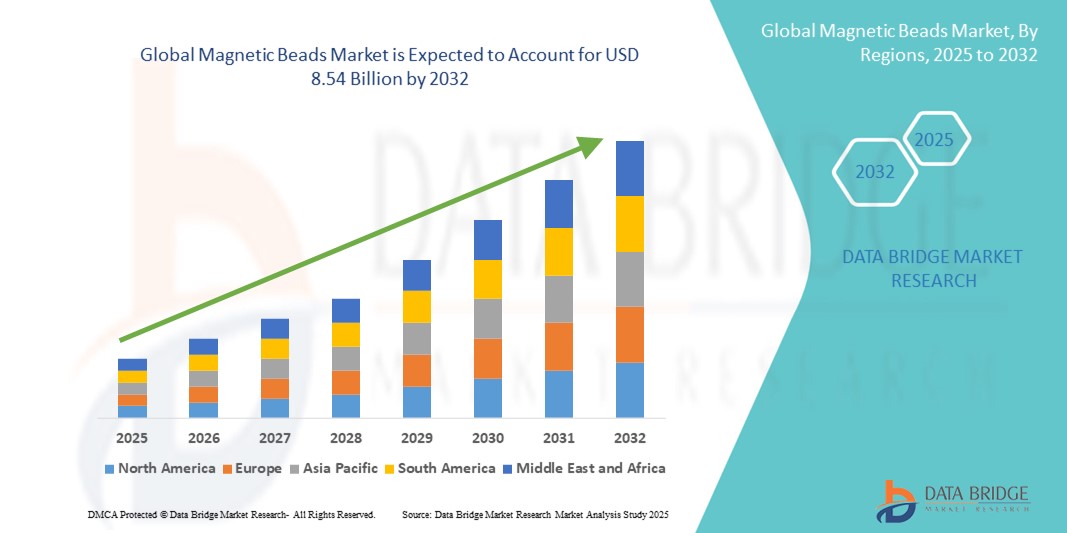
- The global magnetic beads market size was valued at USD 3.54 billion in 2024 and is expected to reach USD 8.54 billion by 2032, at a CAGR of 11.60% during the forecast period
- The market growth is primarily driven by the increasing application of magnetic beads in life sciences, diagnostics, and drug discovery, particularly in molecular biology and immunoassays where precise separation and purification are critical
- In addition, the rising prevalence of chronic diseases and the growing demand for efficient sample preparation in genomic and proteomic research are accelerating the adoption of magnetic beads, thereby substantially contributing to the market’s expansion
Magnetic Beads Market Analysis
- Magnetic beads, enabling targeted separation and purification of biomolecules, have become essential tools in molecular biology, clinical diagnostics, and drug discovery due to their high binding efficiency, automation compatibility, and scalability in laboratory workflows
- The growing demand for magnetic beads is primarily fueled by increased genomic and proteomic research, rising prevalence of infectious and chronic diseases, and the need for rapid and precise diagnostic solutions in clinical and research settings
- North America dominated the magnetic beads market with the largest revenue share of 39.4% in 2024, driven by advanced healthcare infrastructure, strong R&D funding, and the presence of major biotechnology and diagnostic companies, with the U.S. leading due to high adoption of magnetic bead-based assays in molecular diagnostics
- Asia-Pacific is expected to be the fastest growing region in the magnetic beads market during the forecast period, supported by rising investments in biopharmaceutical research, expanding diagnostics industry, and government initiatives for life science development
- The Protein segment dominated the magnetic beads market with a market share of 37.3% in 2024, driven by its widespread use in protein isolation, purification, and interaction studies across various research and clinical applications
Report Scope and Magnetic Beads Market Segmentation
|
Attributes |
Magnetic Beads Key Market Insights |
|
Segments Covered |
|
|
Countries Covered |
North America
Europe
Asia-Pacific
Middle East and Africa
South America
|
|
Key Market Players |
|
|
Market Opportunities |
|
|
Value Added Data Infosets |
In addition to the insights on market scenarios such as market value, growth rate, segmentation, geographical coverage, and major players, the market reports curated by the Data Bridge Market Research also include in-depth expert analysis, pricing analysis, brand share analysis, consumer survey, demography analysis, supply chain analysis, value chain analysis, raw material/consumables overview, vendor selection criteria, PESTLE Analysis, Porter Analysis, and regulatory framework. |
Magnetic Beads Market Trends
Automation-Ready Magnetic Beads for High-Throughput Applications
- A key and accelerating trend in the global magnetic beads market is the shift toward automation-ready and high-throughput-compatible magnetic bead solutions designed to streamline workflows in molecular biology, diagnostics, and pharmaceutical research. As laboratories and diagnostic centers increasingly adopt automated liquid handling and sample preparation systems, the demand for beads that can seamlessly integrate with robotic platforms is growing rapidly
- For instance, Thermo Fisher Scientific offers Dynabeads products optimized for automated nucleic acid purification and protein isolation, compatible with KingFisher systems, significantly enhancing throughput and reproducibility. Similarly, companies such as Merck KGaA and Bio-Rad Laboratories are developing magnetic bead kits tailored for automation platforms used in genomic research and IVD
- These automation-compatible beads ensure reduced hands-on time, minimal error rates, and increased sample throughput features that are vital in clinical labs, biopharma manufacturing, and COVID-era diagnostic testing environments
- In addition, magnetic beads are being engineered with surface chemistries that enhance binding specificity, such as streptavidin- or carboxyl-functionalized beads, enabling precision-targeted biomolecule capture. This innovation supports applications ranging from immunoprecipitation to exosome isolation
- As automation continues to drive research productivity and diagnostic speed, magnetic bead technologies that support seamless, scalable, and reproducible protocols are redefining standards in bioseparation and assay development. The growing demand for precision, speed, and compatibility in both clinical and research workflows is propelling this trend globally
Magnetic Beads Market Dynamics
Driver
Rising Demand in Molecular Diagnostics and Life Sciences Research
- The expanding application of magnetic beads in molecular diagnostics, biopharmaceutical production, and life sciences research is a primary driver of market growth. These beads provide efficient, reproducible, and high-throughput solutions for isolating nucleic acids, proteins, cells, and pathogens, making them indispensable in laboratories and diagnostic centers
- For instance, companies such as MagBio Genomics and Miltenyi Biotec are offering advanced magnetic bead kits for genomic DNA and RNA extraction that support next-generation sequencing (NGS) workflows, which are critical for cancer diagnostics, infectious disease screening, and personalized medicine
- The COVID-19 pandemic further highlighted the value of magnetic bead-based nucleic acid extraction kits in RT-PCR testing, establishing their role in emergency diagnostics and accelerating their adoption globally
- Moreover, the beads' compatibility with automation platforms allows for scalable testing and research, meeting the growing demand for rapid and high-throughput screening in both clinical and research environments
- The rise of precision medicine, coupled with increased R&D funding and biopharma innovation, is expanding the use of magnetic beads across various life science domains, significantly boosting the market outlook
Restraint/Challenge
High Production Costs and Technical Handling Limitations
- Despite their advantages, the high cost of functionalized magnetic beads especially those used in targeted or specialty applications remains a key restraint, limiting their adoption among small and mid-sized research labs and diagnostics firms with budget constraints
- For instance, beads coated with antibodies or ligands for specific biomarkers or rare cell types involve complex production processes, resulting in elevated costs that may not be feasible for cost-sensitive markets
- In addition, proper handling and optimization of magnetic bead-based assays often require technical expertise and precise control over protocols. Improper washing, magnetic separation, or storage can lead to sample loss, reduced yield, or cross-contamination
- While several companies offer standardized protocols, the learning curve for adapting bead-based workflows particularly for labs transitioning from traditional methods can impede adoption
- Addressing these challenges through the development of cost-effective, ready-to-use kits, along with improved user training and support, will be essential to expanding the market reach of magnetic bead technologies globally
- The use of magnetic beads in clinical diagnostics, particularly in in-vitro diagnostic (IVD) assays and molecular testing, is subject to stringent regulatory approval processes across different regions such as FDA (U.S.) and CE-IVD (Europe)
- These regulatory hurdles can delay product launches and increase the cost of compliance for manufacturers, especially smaller firms lacking dedicated regulatory teams. Adhering to evolving standards for clinical validation, traceability, and safety presents a barrier to rapid market expansion in the diagnostic sector
Magnetic Beads Market Scope
The market is segmented on the basis of product, type, application, and end-user.
- By Product
On the basis of product, the magnetic beads market is segmented into lead magnetic bead, lead magnetic pc bead, and SMD multilayer ferrite chip beads. The SMD Multilayer Ferrite Chip Beads segment dominated the market with the largest revenue share of 45.3% in 2024, owing to their extensive use in electronic applications for electromagnetic interference (EMI) suppression and signal filtering. Their compact size and high-performance filtering capabilities make them highly suitable for integration into diagnostic devices, medical instruments, and life science automation platforms.
The Lead Magnetic PC Bead segment is anticipated to witness the fastest growth rate of 20.1% from 2025 to 2032, driven by the rising demand for compact, high-frequency filtering components in advanced lab instrumentation and portable diagnostic devices. These beads are increasingly adopted in integrated circuits and precision electronics used across biotechnology and diagnostic platforms, promoting their growing utilization.
- By Type
On the basis of type, the magnetic beads market is segmented into cells, pathogenic microorganisms, nucleic acids, peptide, protein, and others. The Protein segment dominated the market with the largest share of 37.3% in 2024, attributed to the widespread use of magnetic beads in protein purification, isolation, and protein interaction analysis in both academic and commercial research. These beads offer high binding specificity, efficiency, and scalability, making them vital tools in biopharmaceutical and proteomic workflows.
The nucleic acids segment is expected to grow at the fastest rate during the forecast period, supported by rising demand for DNA/RNA extraction kits in next-generation sequencing (NGS), polymerase chain reaction (PCR), and molecular diagnostic tests. The surge in genetic research and infectious disease diagnostics is contributing significantly to the expansion of this segment.
- By Application
On the basis of application, the magnetic beads market is segmented into cell separation and cell expansion, exosome analysis, protein sample prep and protein isolation, IVD assay development, nucleic acid isolation, and others. The nucleic acid isolation segment held the dominant share of 33.5% in 2024, driven by its central role in molecular diagnostics, genetic testing, and infectious disease detection. Magnetic beads facilitate high-yield, contamination-free isolation of nucleic acids in both manual and automated workflows.
The IVD assay development segment is expected to experience strong growth from 2025 to 2032, propelled by increased adoption of magnetic beads in assay platforms for point-of-care testing, oncology diagnostics, and infectious disease detection. Their ability to enhance assay sensitivity, reproducibility, and scalability makes them attractive to IVD manufacturers globally.
- By End-User
On the basis of end-user, the magnetic beads market is segmented into bioresearch, in-vitro diagnostics, and others. the in-vitro diagnostics (IVD) segment dominated the market in 2024 with a revenue share of 42.6%, owing to the widespread deployment of magnetic bead-based kits and platforms in diagnostic laboratories and hospitals. Their utility in nucleic acid purification, immunoassays, and molecular testing supports rapid and high-accuracy diagnostics across multiple therapeutic areas.
The bioresearch segment is projected to grow significantly over the forecast period, supported by increasing research funding, growth in academic collaborations, and advancements in cellular and molecular biology. Magnetic beads are instrumental in facilitating research in genomics, proteomics, cell therapy, and stem cell research.
Magnetic Beads Market Regional Analysis
- North America dominated the magnetic beads market with the largest revenue share of 39.4% in 2024, driven by advanced healthcare infrastructure, strong R&D funding, and the presence of major biotechnology and diagnostic companies, with the U.S. leading due to high adoption of magnetic bead-based assays in molecular diagnostics\
- The region benefits from a well-established biotechnology and pharmaceutical industry, significant investment in R&D, and a robust infrastructure supporting clinical diagnostics and academic research institutions
- In addition, the presence of key market players and diagnostic labs, combined with a high rate of adoption of genomic and proteomic technologies, continues to propel the use of magnetic beads in both research and clinical applications across the U.S. and Canada
U.S. Magnetic Beads Market Insight
The U.S. magnetic beads market captured the largest revenue share of 79% in 2024 within North America, driven by the country’s advanced biotechnology sector and increasing reliance on molecular diagnostics. A high volume of R&D activities, growing adoption of next-generation sequencing (NGS), and the widespread use of automated laboratory workflows are key contributors to this dominance. Furthermore, strong government and private investments in life sciences, along with the presence of leading biopharma and diagnostics companies, continue to support robust market growth.
Europe Magnetic Beads Market Insight
The Europe magnetic beads market is projected to expand at a substantial CAGR throughout the forecast period, primarily supported by the rising demand for high-throughput diagnostic solutions and molecular research tools. The region benefits from a strong academic and clinical research base, alongside increasing adoption of precision medicine. Regulatory support for advanced diagnostic technologies and the growing use of bead-based assays in infectious disease screening are further accelerating market development across major economies, including Germany, France, and the U.K.
U.K. Magnetic Beads Market Insight
The U.K. magnetic beads market is anticipated to grow at a noteworthy CAGR during the forecast period, driven by expanding genomics research, biobank projects, and government-backed healthcare innovation. With institutions such as Genomics England and the NHS incorporating molecular diagnostics, magnetic beads are playing a critical role in nucleic acid extraction and personalized medicine efforts. Continued investment in biotech startups and collaborations between academia and the healthcare sector are expected to stimulate market expansion.
Germany Magnetic Beads Market Insight
The Germany magnetic beads market is expected to expand at a considerable CAGR during the forecast period, fueled by the country’s strong pharmaceutical manufacturing base and cutting-edge biomedical research. High demand for magnetic beads in proteomics, cell therapy, and diagnostic assay development is complemented by Germany's focus on sustainability and automation in lab processes. Increasing government and private investments in translational research and diagnostic innovation are reinforcing the growth trajectory.
Asia-Pacific Magnetic Beads Market Insight
The Asia-Pacific magnetic beads market is poised to grow at the fastest CAGR of 23.6% during 2025 to 2032, driven by expanding healthcare infrastructure, increased investments in biotech, and the rising burden of chronic and infectious diseases. Countries such as China, India, and Japan are actively integrating magnetic bead-based technologies in clinical labs and R&D settings. Government initiatives promoting molecular diagnostics, combined with regional manufacturing capabilities, are making high-quality bead-based products more accessible across diverse end-users.
Japan Magnetic Beads Market Insight
The Japan magnetic beads market is gaining momentum due to the country's leadership in advanced diagnostics, biomedical research, and aging population-driven healthcare needs. The adoption of magnetic beads in cancer diagnostics, regenerative medicine, and proteomics is increasing steadily. Integration with automated lab platforms and a cultural emphasis on high-precision, quality-controlled laboratory practices are driving consistent growth in both research and clinical segments.
India Magnetic Beads Market Insight
The India magnetic beads market accounted for the largest market revenue share in Asia-Pacific in 2024, supported by rapid advancements in diagnostics, biotechnology research, and a thriving life sciences startup ecosystem. Magnetic beads are increasingly used in public health labs, academic research, and emerging genomics companies. Government initiatives such as "Make in India" and the development of bio-clusters are fueling domestic production and accessibility of magnetic bead technologies, making India a key growth engine in the region.
Magnetic Beads Market Share
The Magnetic Beads industry is primarily led by well-established companies, including:
- Thermo Fisher Scientific Inc. (U.S.)
- Merck KGaA (Germany)
- Bio‑Rad Laboratories, Inc. (U.S.)
- Miltenyi Biotec B.V. & Co. KG (Germany)
- GenScript Biotech Corporation (China)
- Promega Corporation (U.S.)
- New England Biolabs, Inc. (U.S.)
- QIAGEN N.V. (Netherlands)
- MagBio Genomics, Inc. (U.S.)
- Takara Bio Inc. (Japan)
- SEPMAG Technologies (Spain)
- NEBION AG (Switzerland)
- Creative Diagnostics (U.S.)
- BioVision, Inc. (U.S.)
- Nanocs, Inc. (U.S.)
- Spherotech, Inc. (U.S.)
- Cardiff Biosciences Ltd. (U.K.)
- Advanced BioChemicals LLC (U.S.)
- Cube Biotech GmbH (Germany)
What are the Recent Developments in Global Magnetic Beads Market?
- In July 2024, Researchers have synthesized tannic acid-coated magnetic beads capable of extracting membrane vesicles called "exosomes" from biological fluids with 60% efficiency. This novel method will make it easier and faster to isolate exosomes from laboratory samples, while the chemical composition of the exosomes will help detect cancer in its early stages
- In April 2024, Applied BioCode introduced the STI + Resistance Panel Assay for research purposes only (RUO), designed for use on the BioCode MDx-3000 system. This multiplex nucleic acid amplification test qualitatively detects DNA from Chlamydia trachomatis (CT), Neisseria gonorrhoeae (NG), Trichomonas vaginalis (TV), Mycoplasma genitalium (MG), as well as macrolide-resistant and fluoroquinolone-resistant single nucleotide polymorphism (SNP) mutations in a single reaction. The assay aims to provide laboratories early access to cutting-edge panels, facilitating the collection of real-world clinical data while broadening the menu on the MDx-3000 platform in the U.S.
- In August 2023, Zymo Research, a leading provider of biomedical products, announced the launch of its new DNA Clean & Concentrator (DCC) MagBead Kit. This product is designed to provide high-quality nucleic acid purification from various biological samples, a crucial step for applications like next-generation sequencing (NGS). The development of such kits highlights the industry's focus on creating more efficient and reliable tools for molecular biology research and diagnostics
- In October 2022, Thermo Fisher Scientific introduced customized Dynabeads solutions to support the synthesis and purification of mRNA for vaccine manufacturing and development. These magnetic beads offer a simplified workflow, enabling scalable, GMP-grade mRNA production. The solutions are designed to accelerate the transition from development to commercialization, providing benefits such as quality, support, minimized footprint, scalability, efficiency, and flexibility
- In February 2022, Ferrotec Corporation, a global supplier of materials, components, and precision system solutions and the industry leader in producing nano-scale ferrofluids, today announced the introduction of the Magnetic Nano Particles (MNP) Developer’s Kit, a set of solutions that are specially suited for synthesis of microbeads used for in-vitro diagnostic (IVD) applications. With the capability of significantly increasing the microbead surface area, Ferrotec’s MNP products enable improved responsiveness, accuracy, and specificity for IVD applications like immunoassays, bio-separations, and molecular diagnostics

- Interactive Data Analysis Dashboard
- Company Analysis Dashboard for high growth potential opportunities
- Research Analyst Access for customization & queries
- Competitor Analysis with Interactive dashboard
- Latest News, Updates & Trend analysis
- Harness the Power of Benchmark Analysis for Comprehensive Competitor Tracking
Data collection and base year analysis are done using data collection modules with large sample sizes. The stage includes obtaining market information or related data through various sources and strategies. It includes examining and planning all the data acquired from the past in advance. It likewise envelops the examination of information inconsistencies seen across different information sources. The market data is analysed and estimated using market statistical and coherent models. Also, market share analysis and key trend analysis are the major success factors in the market report. To know more, please request an analyst call or drop down your inquiry.
The key research methodology used by DBMR research team is data triangulation which involves data mining, analysis of the impact of data variables on the market and primary (industry expert) validation. Data models include Vendor Positioning Grid, Market Time Line Analysis, Market Overview and Guide, Company Positioning Grid, Patent Analysis, Pricing Analysis, Company Market Share Analysis, Standards of Measurement, Global versus Regional and Vendor Share Analysis. To know more about the research methodology, drop in an inquiry to speak to our industry experts.
Data Bridge Market Research is a leader in advanced formative research. We take pride in servicing our existing and new customers with data and analysis that match and suits their goal. The report can be customized to include price trend analysis of target brands understanding the market for additional countries (ask for the list of countries), clinical trial results data, literature review, refurbished market and product base analysis. Market analysis of target competitors can be analyzed from technology-based analysis to market portfolio strategies. We can add as many competitors that you require data about in the format and data style you are looking for. Our team of analysts can also provide you data in crude raw excel files pivot tables (Fact book) or can assist you in creating presentations from the data sets available in the report.













