


MarTech Market Size
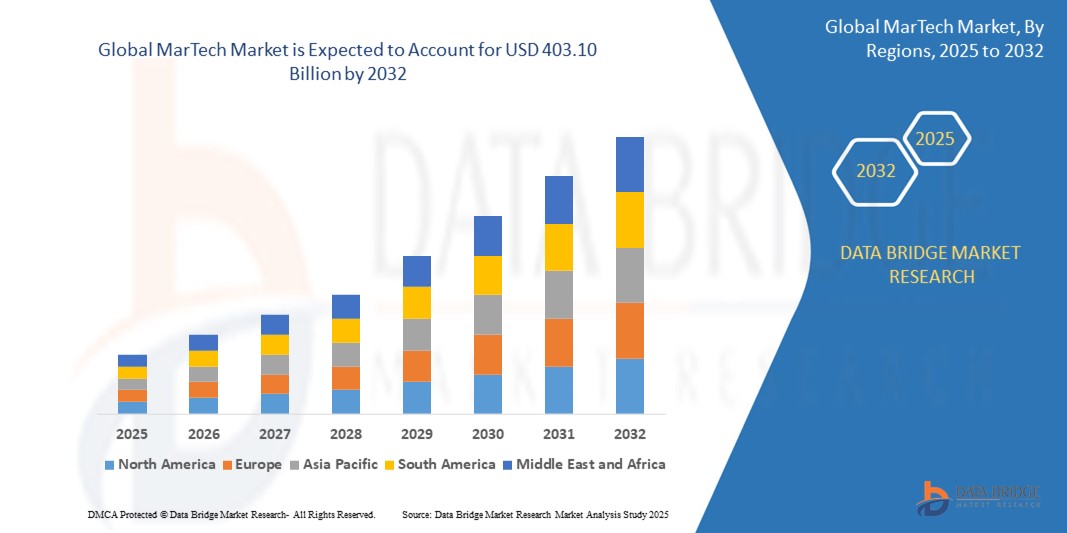
- The global MarTech market size was valued at USD 184.00 billion in 2024 and is expected to reach USD 403.10 billion by 2032, at a CAGR of 10.30% during the forecast period
- The market growth is largely driven by the increasing demand for personalized, data-driven marketing strategies that enhance customer engagement and ROI—capabilities made possible through advanced MarTech platforms
- In addition, the rising adoption of AI, machine learning, and automation tools is empowering brands to streamline campaign management, optimize customer journeys, and generate deeper analytics, thereby accelerating market expansion
- Moreover, the shift toward omnichannel marketing, supported by integrated platforms that unify CRM, social media, content management, and email marketing, is fostering widespread implementation across industries such as retail, finance, healthcare, and e-commerce—significantly boosting global MarTech market growth
MarTech Market Analysis
- MarTech, which integrates digital tools to streamline, automate, and measure marketing tasks, is becoming increasingly essential in industries such as retail, finance, healthcare, and media due to its ability to optimize customer engagement, improve ROI, and support data-driven strategies
- The escalating demand for MarTech is primarily fueled by the growing emphasis on personalization, omnichannel marketing, and real-time analytics, as businesses seek to deliver tailored customer experiences while maximizing efficiency and campaign effectiveness
- North America dominates the MarTech market, accounting for the largest revenue share of 40.01% in 2025, driven by high digital maturity, widespread cloud adoption, and the presence of leading tech companies and marketing solution providers. The U.S. market, in particular, is experiencing strong growth due to increased investment in AI-powered platforms, customer data platforms (CDPs), and programmatic advertising technologies
- Asia-Pacific is expected to be the fastest-growing region in the MarTech market during the forecast period, propelled by rapid digital transformation, the expansion of e-commerce, and growing smartphone penetration in markets like China, India, and Southeast Asia, where businesses are increasingly adopting digital marketing automation tools
- The cloud-based deployment segment is expected to dominate the MarTech market with a projected market share of 43.2% in 2025, owing to its scalability, cost-efficiency, and seamless integration capabilities, which appeal to both SMEs and large enterprises looking to streamline their marketing operations and enable remote collaboration
Report Scope and MarTech Market Segmentation
|
Attributes |
MarTech Key Market Insights |
|
Segments Covered |
|
|
Countries Covered |
North America
Europe
Asia-Pacific
Middle East and Africa
South America
|
|
Key Market Players |
|
|
Market Opportunities |
|
|
Value Added Data Infosets |
In addition to the market insights such as market value, growth rate, market segments, geographical coverage, market players, and market scenario, the market report curated by the Data Bridge Market Research team includes in-depth expert analysis, import/export analysis, pricing analysis, production consumption analysis, and pestle analysis. |
MarTech Market Trends
“Enhanced Convenience through Smart and Sustainable Innovations”
- A key and rapidly evolving trend in the global MarTech market is the integration of AI, automation, and sustainable digital infrastructure, aiming to enhance campaign efficiency, user experience, and environmental responsibility across industries such as retail, finance, healthcare, and e-commerce
- For instance, modern MarTech platforms are embedding AI-powered chatbots, predictive analytics, and real-time customer segmentation to automate workflows and personalize interactions, thereby improving lead conversion and customer satisfaction
- In addition, innovative companies are exploring voice-search optimization and virtual assistant integration within marketing campaigns, enabling users to engage with brands through Alexa, Google Assistant, or Siri—simplifying access to promotions, support, and personalized content
- AI-enabled recommendation engines are being widely adopted in MarTech platforms, leveraging machine learning to dynamically adjust content delivery based on user behavior, location, and purchase history—driving higher engagement and ROI
- The rise of green tech in digital marketing, such as energy-efficient data centers and carbon-neutral marketing platforms, is becoming prominent as brands aim to meet ESG goals and align with environmentally conscious consumers
- Integration of MarTech into the broader IoT and smart ecosystem, including CRM, CMS, and smart retail systems, enables seamless, cross-platform customer experiences and centralized campaign management through unified dashboard
- This wave of innovation is driving demand across both enterprise and SME segments, where marketers seek scalable, intelligent, and ethical tools to manage increasingly complex customer journeys
- Leading market players such as Adobe, Salesforce, and HubSpot are investing heavily in AI-driven MarTech R&D, focusing on features like automated content generation, personalized omnichannel delivery, and sustainability-focused data solutions to meet evolving consumer and regulatory expectations
MarTech Market Dynamics
Driver
“Rising Demand Driven by Sustainability and Consumer Convenience”
- Increasing business and consumer emphasis on sustainable, efficient, and privacy-compliant marketing is a key driver fueling the growth of the global MarTech market. MarTech solutions help minimize marketing inefficiencies, reduce digital waste, and ensure compliant data use—features highly valued by organizations prioritizing ESG goals and ethical data practices
- For example, in March 2024, Salesforce and Adobe announced expanded AI and sustainability features in their platforms, enabling marketers to reduce redundant content delivery, lower cloud resource usage, and improve campaign efficiency—all contributing to greener digital operations
- The surge in e-commerce, remote work, and digital-first customer journeys has accelerated demand for MarTech platforms that offer seamless automation, omnichannel engagement, and optimized personalization, helping brands deliver consistent, relevant messaging across touchpoints
- Additionally, marketers are increasingly prioritizing tools that enhance convenience and ROI—platforms that offer unified dashboards, real-time analytics, and low-code automation are gaining traction across B2B and B2C segments
- Technological advancements such as AI-driven predictive analytics, smart lead scoring, and personalized content delivery are emerging as powerful growth catalysts, supporting strategic decision-making and hyper-targeted marketing
- The shift toward modular, subscription-based MarTech stacks supports flexibility, sustainability, and scalability, allowing businesses to customize their solutions without over-investing in unnecessary capabilities.
Restraint/Challenge
“High Integration Costs and Data Privacy Concerns”
- Despite high demand, the relatively high costs of integrating complex MarTech solutions remain a challenge, especially for SMEs and businesses in developing economies. Licensing fees, implementation costs, and the need for skilled personnel to operate platforms can limit adoption
- For instance, deploying advanced CRM, AI, and customer journey orchestration tools often involves long onboarding times, third-party consultants, and infrastructure investments that smaller teams may struggle to afford
- Moreover, growing concerns around data privacy and compliance, especially with global regulations like GDPR, CCPA, and India's DPDP Act, present operational and legal challenges. MarTech systems handling vast amounts of customer data must ensure transparency, consent management, and security—requirements that increase complexity and cost
- Fragmentation across MarTech stacks (with thousands of available tools) can also lead to inefficiencies and integration issues, limiting the effectiveness of marketing operations and data-driven insights
- Marketers may face resistance from internal stakeholders due to lack of training, low platform adoption, or uncertainty around ROI, further hindering deployment in traditional or less digitally mature organizations
- Overcoming these barriers requires cost-effective SaaS solutions, open APIs for smoother integrations, and transparent data governance frameworks. Continued innovation in privacy-first personalization and unified data ecosystems will be critical to ensure long-term MarTech market growth.
MarTech Market Scope
The market is segmented on the basis of type, application, deployment model, organization size, vertical, and sales channel.
By Type
On the basis of type, the martech market is segmented into social media tools, Content Marketing Tools, Rich Media Tools, and Automation Tools. The Automation Tools segment dominates the largest market revenue share in 2025, driven by its efficiency in streamlining marketing operations and delivering personalized customer experiences at scale. Organizations prioritize automation tools for their ability to reduce manual tasks, enhance targeting accuracy, and improve campaign ROI. The market also sees strong demand for automation due to increasing reliance on data-driven decision-making and real-time engagement
The Social Media Tools segment is anticipated to witness the fastest growth rate from 2025 to 2032, fueled by the expanding influence of social platforms and increased investment in influencer and community-based marketing. These tools enable brands to track engagement, schedule content, and manage multi-channel presence, thereby boosting visibility and audience interaction
• By Application
On the basis of application, the MarTech market is segmented into Retail and E-Commerce, Healthcare, Infrastructural, Media and Entertainment, Sports and Events, Transportation and Logistics, BFSI, and Others. The Retail and E-Commerce segment held the largest market revenue share in 2025, driven by the sector’s need for personalized engagement, behavioral targeting, and seamless omnichannel customer journeys. MarTech plays a crucial role in optimizing digital storefronts, promotions, and loyalty program
The Healthcare segment is expected to witness the fastest CAGR from 2025 to 2032, driven by the increasing demand for patient engagement platforms, health data personalization, and compliance with data privacy regulations. MarTech enables healthcare providers to deliver accurate, secure, and patient-centric communications at scale
• By Deployment Model
On the basis of deployment model, the MarTech market is segmented into Cloud-Based, On Premises, and Others. The Cloud-Based segment held the largest market revenue share in 2025, driven by its scalability, lower upfront costs, and accessibility across geographies. Cloud deployment supports faster updates, integrations, and cross-functional collaboration, making it the preferred choice for most organizations
The On Premises segment is expected to witness the fastest CAGR from 2025 to 2032, driven by sectors requiring enhanced data security, compliance, and control. This model is favored in regulated industries and enterprises with dedicated IT infrastructure
• By Organization Size
On the basis of organization size, the MarTech market is segmented into Small and Medium Sized Enterprises (SMEs), and Large Enterprises. The Large Enterprises segment accounted for the largest market revenue share in 2025, driven by substantial marketing budgets, advanced analytics needs, and adoption of complex omnichannel strategies. These organizations leverage MarTech to unify marketing efforts across departments and markets
The Small and Medium Sized Enterprises segment is expected to witness the fastest CAGR from 2025 to 2032, fueled by growing awareness of marketing automation benefits, increased SaaS availability, and demand for cost-effective, scalable solutions
• By Vertical
On the basis of vertical, the MarTech market is segmented into B2B, B2C, and Others. The B2C segment held the largest market revenue share in 2025, driven by rising expectations for personalized and real-time consumer experiences. B2C companies leverage MarTech for customer journey mapping, personalized messaging, and automated retargeting
The B2B segment is expected to witness the fastest CAGR from 2025 to 2032, driven by increasing adoption of account-based marketing (ABM), lead nurturing, and data-driven sales enablement tools. MarTech in the B2B space supports long sales cycles and decision-maker targeting with precision
• By Sales Channel
On the basis of sales channel, the MarTech market is segmented into Direct Sales, Indirect Sales, and Others. The Direct Sales segment accounted for the largest market revenue share in 2025, driven by growing preference for customized solutions and dedicated customer success support. Direct sales channels allow vendors to provide in-depth product demos, tailored onboarding, and long-term service relationships
The Indirect Sales segment is expected to witness the fastest CAGR from 2025 to 2032, fueled by partner ecosystems, reseller networks, and digital marketplaces that expand MarTech accessibility across diverse geographies and verticals
MarTech Market Regional Analysis
- North America dominates the MarTech market with the largest revenue share of 40.01% in 2025, driven by the strong presence of leading technology companies, advanced digital infrastructure, and early adoption of AI-powered marketing platforms across industries such as retail, healthcare, and finance
- Businesses in the region prioritize data-driven and automated marketing solutions that enhance customer engagement, improve campaign efficiency, and align with regulatory standards. The emphasis on personalization, privacy compliance, and omnichannel marketing is significantly boosting the adoption of MarTech tools in both B2B and B2C sectors
- This widespread growth is further fueled by high marketing budgets, a mature digital ecosystem, and strong R&D investments, positioning North America as a key contributor to global MarTech market expansion
U.S. MarTech Market Insight
The U.S. MarTech market captured the largest revenue share of 81% within North America in 2025, driven by the country’s leadership in digital transformation, tech innovation, and advanced marketing practices. U.S. businesses are heavily investing in AI, automation, and data analytics to optimize customer engagement and drive ROI. The rise of omnichannel commerce, influencer marketing, and privacy-compliant personalization are major growth accelerators. The proliferation of startups, coupled with enterprise-level adoption of integrated marketing platforms, further solidifies the U.S. as the global hub for MarTech innovation
Europe MarTech Market Insight
The European MarTech market is projected to expand at a substantial CAGR throughout the forecast period, led by increasing emphasis on data privacy, ethical marketing, and regulatory compliance. The enforcement of GDPR and upcoming digital market acts is pushing companies to adopt MarTech solutions that offer secure, consent-based engagement. Demand for multi-language, cross-border marketing tools is also driving growth across e-commerce, finance, and media sectors. Markets such as France, Germany, and the Nordics are leading in adoption, while Eastern Europe presents emerging opportunities due to digital infrastructure growth
U.K. MarTech Market Insight
The U.K. MarTech market is anticipated to grow at a noteworthy CAGR during the forecast period, bolstered by a highly competitive digital marketing landscape and a strong ecosystem of B2B and B2C brands. British companies are investing in MarTech to enhance customer data analytics, journey orchestration, and cross-platform integration. The rapid digitalization of retail, fintech, and D2C sectors, along with the emergence of independent marketing technology providers and startups, is fueling market expansion. Sustainability and responsible marketing also remain important themes shaping the U.K. market
Germany MarTech Market Insight
The German MarTech market is expected to expand at a considerable CAGR, driven by the country's emphasis on engineering precision, data sovereignty, and automation. German enterprises are integrating MarTech into existing ERP and CRM ecosystems to enhance marketing precision and operational efficiency. Privacy-centric approaches and adherence to data protection regulations are key to market adoption. Additionally, sectors like automotive, industrial manufacturing, and pharmaceuticals are embracing MarTech for lead generation, customer lifecycle management, and content personalization
Asia-Pacific MarTech Market Insight
The Asia-Pacific MarTech market is poised to grow at the fastest CAGR of over 24% in 2025, fueled by rising digital adoption, economic development, and mobile-first consumer behavior. Countries like China, India, Japan, and South Korea are witnessing a surge in social commerce, mobile marketing, and content personalization, driving strong demand for agile and scalable MarTech solutions. Government support for digital innovation and startup ecosystems, combined with localized marketing requirements, is propelling rapid regional adoption across both multinational and domestic firms
Japan MarTech Market Insight
The Japan MarTech market is gaining momentum due to its mature digital infrastructure, precision-focused industries, and cultural emphasis on quality and convenience. Businesses in Japan are adopting MarTech solutions to improve customer loyalty, omnichannel experiences, and AI-driven personalization. The aging population and strong B2C retail environment encourage the use of tools that enhance ease of use and value delivery. Additionally, integration with QR codes, e-wallets, and smart loyalty programs supports Japan’s highly mobile and data-conscious consumers
China MarTech Market Insight
The China MarTech market accounted for the largest market revenue share in Asia-Pacific in 2025, driven by its tech-savvy consumer base, rapid e-commerce expansion, and dominance in mobile marketing. Chinese brands are leveraging MarTech for real-time campaign execution, AI-powered customer segmentation, and content automation on platforms like WeChat, Douyin, and Alibaba. The country's advanced digital ecosystem, robust cloud infrastructure, and strong domestic innovation make it a leading force in MarTech deployment, particularly in urban centers and competitive consumer sectors
MarTech Market Share
The martech industry is primarily led by well-established companies, including:
- Adobe Inc. (U.S.)
- Salesforce (U.S.)
- Oracle (U.S.)
- Google (U.S.)
- HubSpot (U.S.)
- ActiveCampaign (U.S.)
- The Trade Desk (U.S.)
- Bloomreach (U.S.)
- Funnel (Sweden)
- Quantcast (U.S.)
- Rokt (Australia)
- MoEngage (India)
- Banzai (U.S.)
- Konnect Insights (India)
- Brandtech (U.K.)
Latest Developments in Global MarTech Market
- In February 2025, Intuit Mailchimp introduced new product enhancements, including a revamped popup forms experience in beta. This feature enables marketers to engage site visitors with interactive popup forms, facilitating deeper audience targeting. With customizable, mobile-first designs, marketers can grow their customer base and leverage AI-driven insights for personalized marketing strategies. The update includes eight new offer types, such as discount promotions, free shipping, event signups, and newsletter subscriptions, ensuring higher engagement and conversion rates
- In January 2025, Google launched Meridian, an open-source Marketing Mix Model (MMM) designed to help marketers optimize budget allocation and measure performance across channels. Meridian uses Bayesian modeling to estimate marketing impact, offering customization and actionable insights for data-driven decision-making. It integrates with Google’s MMM Data Platform, providing core metrics and validated experiment results to enhance marketing strategies
- In November 2024, Apple took direct control of advertising sales within Apple News, moving away from third-party vendors. This shift enables brands to connect with Apple News’ engaged audience through premium sponsorships, banner placements, and video ads. Publishers now receive 70% of ad revenue from ads sold by Apple within their articles, optimizing monetization opportunities
- In September 2024, Techmagnate, a digital marketing agency in New Delhi, launched its MarTech consulting services to help businesses leverage marketing technology for growth. The services include Customer Data Platform (CDP) solutions, marketing automation, and hyperlocal SEO automation, guiding clients through the entire lifecycle of implementation and management. Techmagnate aims to provide data-driven insights that will become cornerstones for decision-making as organizations scale
- In June 2024, Infosys launched Infosys Aster™, an AI-amplified MarTech platform designed to enhance marketing effectiveness and return on investment. Aster provides a unified view of customers, brands, and channels, improving performance marketing and digital commerce. It integrates generative AI-powered content creation, intelligent recommendations, and real-time analytics, enabling businesses to optimize campaigns and drive growth

- Interactive Data Analysis Dashboard
- Company Analysis Dashboard for high growth potential opportunities
- Research Analyst Access for customization & queries
- Competitor Analysis with Interactive dashboard
- Latest News, Updates & Trend analysis
- Harness the Power of Benchmark Analysis for Comprehensive Competitor Tracking
Data collection and base year analysis are done using data collection modules with large sample sizes. The stage includes obtaining market information or related data through various sources and strategies. It includes examining and planning all the data acquired from the past in advance. It likewise envelops the examination of information inconsistencies seen across different information sources. The market data is analysed and estimated using market statistical and coherent models. Also, market share analysis and key trend analysis are the major success factors in the market report. To know more, please request an analyst call or drop down your inquiry.
The key research methodology used by DBMR research team is data triangulation which involves data mining, analysis of the impact of data variables on the market and primary (industry expert) validation. Data models include Vendor Positioning Grid, Market Time Line Analysis, Market Overview and Guide, Company Positioning Grid, Patent Analysis, Pricing Analysis, Company Market Share Analysis, Standards of Measurement, Global versus Regional and Vendor Share Analysis. To know more about the research methodology, drop in an inquiry to speak to our industry experts.
Data Bridge Market Research is a leader in advanced formative research. We take pride in servicing our existing and new customers with data and analysis that match and suits their goal. The report can be customized to include price trend analysis of target brands understanding the market for additional countries (ask for the list of countries), clinical trial results data, literature review, refurbished market and product base analysis. Market analysis of target competitors can be analyzed from technology-based analysis to market portfolio strategies. We can add as many competitors that you require data about in the format and data style you are looking for. Our team of analysts can also provide you data in crude raw excel files pivot tables (Fact book) or can assist you in creating presentations from the data sets available in the report.













