


Myoglobin Market Size
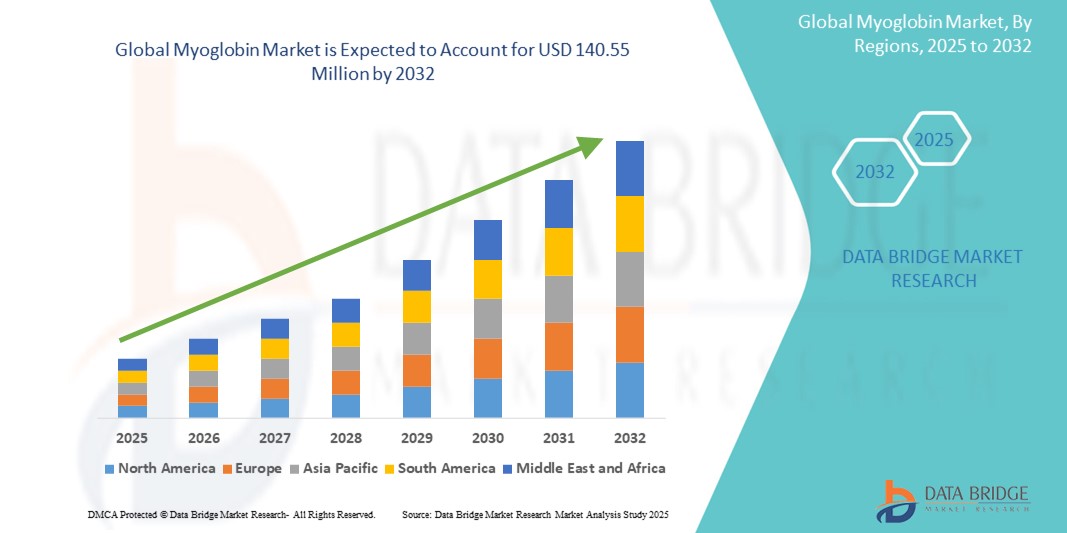
- The global myoglobin market size was valued at USD 101.91 million in 2024 and is expected to reach USD 140.55 million by 2032, at a CAGR of 4.10% during the forecast period
- The market growth is largely fueled by increasing utilization of myoglobin as an early biomarker in cardiovascular diagnostics, alongside rising awareness and advancements in point-of-care testing solutions, enabling quicker and more accurate clinical assessments
- Furthermore, growing demand from research institutions and food testing laboratories, driven by myoglobin’s role in muscle physiology studies and meat quality evaluation, is expanding the application spectrum. These converging factors are strengthening the demand trajectory, thereby significantly boosting the industry's growth
Myoglobin Market Analysis
- Myoglobin, a heme-containing protein used as a clinical biomarker and in food testing, is gaining traction in diagnostic, research, and food quality applications due to its sensitivity in detecting early myocardial infarction and its role in muscle oxygen transport analysis
- The growing demand for myoglobin is primarily fueled by the increasing prevalence of cardiovascular diseases, a rising focus on rapid and point-of-care diagnostics, and expanding research in muscle physiology and meat quality evaluation
- North America dominated the myoglobin market with the largest revenue share of 42.1% in 2024, driven by advanced healthcare infrastructure, high cardiovascular disease burden, and strong R&D investments across diagnostic and pharmaceutical sectors, especially in the U.S., where rapid assay adoption and public-private collaborations are prominent
- Asia-Pacific is expected to be the fastest growing region in the myoglobin market during the forecast period due to improving diagnostic capabilities, growing healthcare awareness, and increased government investment in medical research
- The human myoglobin segment dominated the market with a market share of 54.8% in 2024, attributed to its critical clinical role in cardiac diagnostics and widespread use in hospitals, diagnostic labs, and emergency care settings
Report Scope and Myoglobin Market Segmentation
|
Attributes |
Myoglobin Key Market Insights |
|
Segments Covered |
|
|
Countries Covered |
North America
Europe
Asia-Pacific
Middle East and Africa
South America
|
|
Key Market Players |
|
|
Market Opportunities |
|
|
Value Added Data Infosets |
In addition to the insights on market scenarios such as market value, growth rate, segmentation, geographical coverage, and major players, the market reports curated by the Data Bridge Market Research also include in-depth expert analysis, pricing analysis, brand share analysis, consumer survey, demography analysis, supply chain analysis, value chain analysis, raw material/consumables overview, vendor selection criteria, PESTLE Analysis, Porter Analysis, and regulatory framework. |
Myoglobin Market Trends
“Wider Adoption Driven by Diagnostic Innovation and Multi-sector Applications”
- A key trend shaping the global myoglobin market is the expanding role of myoglobin in both clinical and non-clinical sectors, supported by innovations in diagnostic technologies and broader awareness of cardiovascular health. The protein’s utility as a rapid-response cardiac biomarker is increasingly leveraged in emergency and point-of-care diagnostics, particularly in developed healthcare systems
- For instance, companies such as Abbott and Roche are refining high-sensitivity cardiac biomarker assays that include myoglobin to support quicker triage of patients with suspected acute myocardial infarction. In addition, the use of myoglobin in food testing to determine meat freshness and muscle content has seen growing interest, particularly within regulated food supply chains
- In clinical settings, integration of myoglobin into multiplex diagnostic platforms is improving the efficiency of testing workflows. Advanced analyzers now include myoglobin in panels alongside troponin and CK-MB, enabling a comprehensive and faster diagnosis. In parallel, myoglobin’s role in physiological research is expanding, as labs explore muscle oxygen transport and oxidative stress markers using high-purity reagents
- This increasing cross-sector demand is prompting manufacturers to improve assay sensitivity, reduce result times, and diversify applications. Diagnostic companies are also developing AI-powered platforms that analyze myoglobin levels in conjunction with other cardiac markers to aid early diagnosis
- The drive toward decentralized and rapid diagnostics, coupled with food safety and research demand, is redefining the market’s trajectory. As a result, manufacturers such as BioVendor and Creative Diagnostics are enhancing their portfolios with validated ELISA kits and lateral flow assays tailored for both medical and food testing use cases
- These developments are fostering robust growth opportunities in the myoglobin market, particularly as healthcare providers and laboratories seek reliable, fast, and cost-effective biomarkers across diverse domains
Myoglobin Market Dynamics
Driver
“Increased Use in Cardiovascular Diagnostics and Food Testing””
- The global burden of cardiovascular disease continues to rise, creating strong demand for reliable and early diagnostic biomarkers such as myoglobin. Its rapid release into circulation following myocardial injury makes it an essential component of emergency diagnostics, especially in high-acuity care settings
- For instance, in 2024, Beckman Coulter introduced enhancements to its cardiac panel diagnostics, integrating myoglobin with other cardiac biomarkers to streamline decision-making in emergency departments. Such developments are expected to accelerate the adoption of myoglobin assays worldwide
- In addition, the food industry is increasingly utilizing myoglobin to assess meat quality, freshness, and authenticity
- Regulatory emphasis on accurate food labeling and growing consumer awareness around food safety are pushing companies to incorporate myoglobin testing into quality control workflows
- The affordability and speed of lateral flow and ELISA-based myoglobin assays, coupled with ease of use in decentralized settings, are expanding adoption among diagnostic labs and food testing services
- The rise of preventive healthcare and personalized medicine further enhances the importance of early, accessible biomarkers such as myoglobin
Restraint/Challenge
“Limited Specificity and Regulatory Constraints”
- Despite its benefits, a significant challenge in the clinical use of myoglobin is its limited cardiac specificity. Since myoglobin is also present in skeletal muscle, elevated levels may not exclusively indicate myocardial infarction, potentially leading to diagnostic uncertainty when used in isolation
- This concern limits its standalone clinical utility, especially with the rise of highly specific markers such as cardiac troponins. To maintain relevance, manufacturers are focusing on myoglobin's use in combination assays and multiplex platforms to mitigate this limitation
- Furthermore, stringent regulatory requirements surrounding diagnostic test approvals, particularly in the U.S. and Europe, can pose entry barriers for new assay kits. Obtaining FDA or CE clearance involves high costs and lengthy validation procedures, which may deter small or emerging diagnostic firms
- In food testing, achieving consistent accuracy in different meat types and ensuring reproducibility across batches remain technical challenges. In addition, price-sensitive regions may find it difficult to implement widespread diagnostic testing due to cost constraints or lack of trained personnel
- Addressing these barriers through innovation in multiplex diagnostics, securing regulatory compliance, and expanding training and infrastructure especially in emerging markets will be key to unlocking the full potential of the myoglobin market
Myoglobin Market Scope
The market is segmented on the basis of product and end user.
- By Product
On the basis of product, the global myoglobin market is segmented into human myoglobin and animal myoglobin. human myoglobin segment dominated the market with the largest market revenue share of 54.8% in 2024, owing to its critical role as a biomarker in the early diagnosis of acute myocardial infarction. Human myoglobin is commonly utilized in hospitals and diagnostic laboratories due to its rapid release into the bloodstream following cardiac injury, making it a reliable option in emergency diagnostics. Technological advancements in assay sensitivity and the integration of human myoglobin in multiplex panels further contribute to its dominant position.
The animal myoglobin segment is anticipated to witness the fastest growth rate of 5.8% CAGR from 2025 to 2031, driven by increasing demand in the food industry for meat quality testing and freshness evaluation. The expanding use of animal myoglobin in academic research related to muscle physiology and oxidative stress, coupled with growing regulatory emphasis on food safety, is propelling demand. Moreover, the development of advanced analytical tools to measure animal-derived myoglobin across different meat types supports market growth in this segment.
- By End User
On the basis of end user, the global myoglobin market is segmented into hospitals, diagnostic laboratories, and others (including food testing labs and academic institutions). The hospitals segment held the largest market share in 2024, attributed to the widespread use of myoglobin-based assays in emergency and inpatient settings for cardiovascular diagnostics. Rapid point-of-care testing and integration with electronic medical records are streamlining workflows in hospitals, encouraging adoption. Myoglobin’s value in rapid triage and early intervention, particularly in cases of suspected heart attacks, supports sustained demand from this segment.
The diagnostic laboratories segment is expected to witness the fastest CAGR from 2025 to 2031. The increasing number of diagnostic centers in developing regions, along with the availability of automated testing platforms and high-sensitivity assay kits, is fueling adoption. Many labs are expanding their cardiac biomarker test menus to include myoglobin due to its complementary role in multi-marker diagnostic strategies. In addition, the shift toward outpatient testing and preventive care further strengthens the market outlook for this segment.
Myoglobin Market Regional Analysis
- North America dominated the myoglobin market with the largest revenue share of 42.1% in 2024, driven by advanced healthcare infrastructure, high cardiovascular disease burden, and strong R&D investments across diagnostic and pharmaceutical sectors,
- Consumers and healthcare providers in the region place high importance on early detection and rapid diagnostic capabilities, making biomarkers such as myoglobin critical in emergency and point-of-care settings
- This dominance is further supported by strong R&D investments, growing awareness of preventive healthcare, and the increasing integration of myoglobin testing into routine diagnostic protocols. The U.S., in particular, leads in both clinical and research applications of myoglobin, establishing it as a key market for manufacturers and diagnostic solution providers
U.S. Myoglobin Market Insight
The U.S. myoglobin market captured the largest revenue share of 78.4% in 2024 within North America, fueled by the country’s advanced diagnostic infrastructure and high incidence of cardiovascular disorders. Hospitals and diagnostic laboratories are increasingly adopting rapid myoglobin assays for early myocardial infarction detection, supporting efficient emergency care. The growing demand for point-of-care testing and personalized medicine, along with strong investments in R&D and clinical trials, continues to propel market expansion. Moreover, regulatory approvals and product innovation by leading players are further strengthening the U.S. market position.
Europe Myoglobin Market Insight
The Europe myoglobin market is projected to expand at a substantial CAGR throughout the forecast period, primarily driven by the region’s aging population and rising cardiovascular disease burden. Growing emphasis on early and accurate diagnosis, especially in countries with robust public healthcare systems, is supporting the widespread adoption of cardiac biomarker tests, including myoglobin. In addition, increasing investment in biotech research and improvements in diagnostic testing infrastructure are contributing to market growth across both Western and Eastern European regions.
U.K. Myoglobin Market Insight
The U.K. myoglobin market is anticipated to grow at a noteworthy CAGR during the forecast period, driven by a rising focus on preventive cardiovascular care and advancements in diagnostic methodologies. The National Health Service (NHS) is actively integrating rapid diagnostic tools, including myoglobin assays, into routine clinical workflows. Public awareness initiatives and high rates of heart-related emergencies have increased the demand for quick, reliable biomarkers. The country’s strong academic and research institutions also support ongoing biomarker development and clinical validation.
Germany Myoglobin Market Insight
The Germany myoglobin market is expected to expand at a considerable CAGR during the forecast period, supported by the country's leading position in healthcare innovation and its emphasis on diagnostic precision. Germany’s strong hospital network and advanced lab infrastructure enable widespread use of multi-marker cardiac panels that include myoglobin. In addition, increasing investment in biotechnology and growing demand for efficient diagnostic solutions for emergency care are fostering robust growth, especially in urban and academic centers.
Asia-Pacific Myoglobin Market Insight
The Asia-Pacific myoglobin market is poised to grow at the fastest CAGR of 6.1% during the forecast period of 2025 to 2031, driven by rising healthcare spending, growing awareness of heart health, and improved access to diagnostic services. Countries such as China, India, and Japan are seeing increased demand for early cardiac diagnostics due to rising cardiovascular disease prevalence. Government health initiatives, expanding hospital networks, and the growth of domestic diagnostic kit manufacturers are supporting broader availability and affordability of myoglobin assays across the region.
Japan Myoglobin Market Insight
The Japan myoglobin market is gaining momentum due to the country’s aging population and a strong focus on early detection of cardiovascular conditions. Japan’s sophisticated medical infrastructure supports high adoption of rapid diagnostic tests, including myoglobin, in both emergency and outpatient settings. Integration with high-tech diagnostic platforms and consistent investment in clinical research also support growth. Moreover, national health policies emphasize preventive care and efficient resource use, encouraging the uptake of fast-acting biomarkers such as myoglobin.
India Myoglobin Market Insight
The India myoglobin market accounted for the largest market revenue share in Asia-Pacific in 2024, attributed to increasing healthcare infrastructure development, urbanization, and the rising burden of heart diseases. Public-private healthcare partnerships and expanding access to diagnostic services across tier 2 and tier 3 cities are propelling demand for cost-effective, rapid biomarker tests. The availability of low-cost testing kits, government-backed health initiatives, and the presence of domestic diagnostic solution providers are key drivers accelerating the market in India.
Myoglobin Market Share
The Myoglobin industry is primarily led by well-established companies, including:
- Abbott (U.S.)
- F. Hoffmann-La Roche Ltd (Switzerland)
- Beckman Coulter, Inc. (U.S.)
- Siemens Healthineers AG (Germany)
- Bio-Rad Laboratories, Inc. (U.S.)
- Creative Diagnostics (U.S.)
- Merck KGaA (Germany)
- Thermo Fisher Scientific Inc. (U.S.)
- Randox Laboratories Ltd. (U.K.)
- Enzo Biochem, Inc. (U.S.)
- Abcam plc (U.K.)
- Boster Biological Technology (U.S.)
- HyTest Ltd. (Finland)
- Sino Biological Inc. (China)
- Elabscience Biotechnology Inc. (China)
- MyBioSource, Inc. (U.S.)
- RayBiotech, Inc. (U.S.)
- LifeSpan BioSciences, Inc. (U.S.)
- Wuhan Fine Biotech Co., Ltd. (China)
- GenScript Biotech Corporation (China)
What are the Recent Developments in Global Myoglobin Market?
- In April 2024, Beckman Coulter Diagnostics announced the launch of an enhanced cardiac biomarker testing panel that includes high-sensitivity myoglobin assays. This development aims to improve the early detection of acute myocardial infarction (AMI) in emergency settings by offering faster turnaround times and greater diagnostic accuracy. The panel is designed for use in high-throughput laboratories and is integrated into Beckman Coulter’s Access 2 immunoassay systems, highlighting the company's commitment to innovation in cardiac diagnostics
- In March 2024, Bio-Rad Laboratories, Inc. introduced a new range of ELISA kits for muscle physiology and cardiovascular biomarker research, including purified human and animal myoglobin assays. These products are tailored for academic and pharmaceutical research settings, enabling more precise quantification of myoglobin in complex biological samples. This launch reflects Bio-Rad’s efforts to support evolving biomedical research needs with highly specific, reproducible testing solutions
- In February 2024, Creative Diagnostics expanded its myoglobin product portfolio by introducing rapid diagnostic test strips and monoclonal antibodies for myoglobin detection. The new offerings are intended to serve both clinical diagnostics and food safety testing markets. By enhancing the accessibility of myoglobin testing across multiple sectors, Creative Diagnostics is reinforcing its role in promoting efficient, multi-purpose diagnostic tools
- In January 2024, Roche Diagnostics announced its ongoing collaboration with academic institutions in Europe to evaluate the performance of its next-generation cardiac biomarker analyzer, which incorporates myoglobin testing. The initiative is focused on optimizing early diagnosis of heart-related events in emergency care settings through improved assay precision. This partnership underscores Roche’s continued emphasis on research-driven advancements in cardiovascular diagnostics
- In December 2023, Merck KGaA's life science division introduced a new line of high-purity myoglobin reference standards for laboratory research and quality control. These products are intended to support researchers working on oxidative stress, muscle metabolism, and cardiac event modeling. Merck’s introduction of these certified reference materials illustrates its commitment to enabling scientific accuracy and reliability across diagnostic and academic laboratories

- Interactive Data Analysis Dashboard
- Company Analysis Dashboard for high growth potential opportunities
- Research Analyst Access for customization & queries
- Competitor Analysis with Interactive dashboard
- Latest News, Updates & Trend analysis
- Harness the Power of Benchmark Analysis for Comprehensive Competitor Tracking
Data collection and base year analysis are done using data collection modules with large sample sizes. The stage includes obtaining market information or related data through various sources and strategies. It includes examining and planning all the data acquired from the past in advance. It likewise envelops the examination of information inconsistencies seen across different information sources. The market data is analysed and estimated using market statistical and coherent models. Also, market share analysis and key trend analysis are the major success factors in the market report. To know more, please request an analyst call or drop down your inquiry.
The key research methodology used by DBMR research team is data triangulation which involves data mining, analysis of the impact of data variables on the market and primary (industry expert) validation. Data models include Vendor Positioning Grid, Market Time Line Analysis, Market Overview and Guide, Company Positioning Grid, Patent Analysis, Pricing Analysis, Company Market Share Analysis, Standards of Measurement, Global versus Regional and Vendor Share Analysis. To know more about the research methodology, drop in an inquiry to speak to our industry experts.
Data Bridge Market Research is a leader in advanced formative research. We take pride in servicing our existing and new customers with data and analysis that match and suits their goal. The report can be customized to include price trend analysis of target brands understanding the market for additional countries (ask for the list of countries), clinical trial results data, literature review, refurbished market and product base analysis. Market analysis of target competitors can be analyzed from technology-based analysis to market portfolio strategies. We can add as many competitors that you require data about in the format and data style you are looking for. Our team of analysts can also provide you data in crude raw excel files pivot tables (Fact book) or can assist you in creating presentations from the data sets available in the report.













