


Organic Honey Market Overview
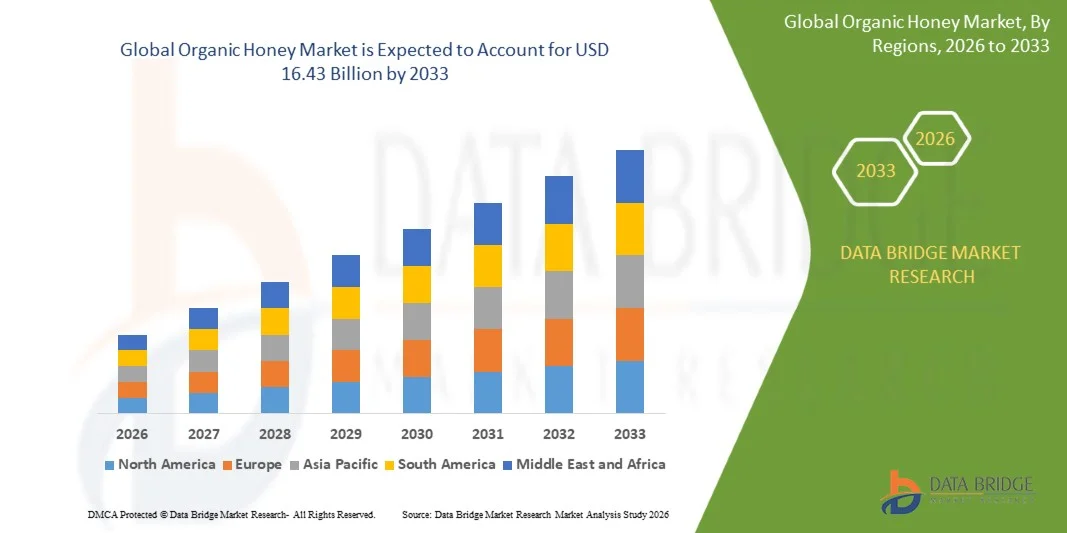
As per Data Bridge Market Research analysis, the organic honey market was valued at USD 10.31 billion in 2025 and is projected to reach USD 16.43 billion by 2033, growing at a CAGR of 6.00% from 2026 to 2033. The market is experiencing robust growth driven by increasing consumer preference for natural and chemical-free food products, rising awareness regarding the health benefits of organic honey, and growing demand for clean-label and sustainably sourced sweeteners. The expanding adoption of organic honey as a natural alternative to refined sugar, coupled with increasing use in functional foods, beverages, dietary supplements, and traditional medicine, is supporting market expansion. Consumers are increasingly seeking certified organic honey due to its antioxidant, antibacterial, and anti-inflammatory properties, while stringent organic certification standards are enhancing product credibility and consumer confidence.
The growing prevalence of lifestyle-related health concerns such as obesity, diabetes, and cardiovascular disorders, along with rising demand for immunity-boosting foods, is encouraging food manufacturers, nutraceutical companies, and personal care brands to incorporate organic honey into their product portfolios. Organic honey is increasingly being used in bakery products, confectionery, dairy products, herbal formulations, beverages, and natural skincare formulations due to its nutritional value and multifunctional properties. Furthermore, expanding organic farming practices, increasing availability through supermarkets and e-commerce platforms, rising exports of certified organic honey, and growing consumer preference for sustainably harvested and traceable bee products are further accelerating the adoption of organic honey across both developed and emerging markets.
Market Size & Forecast
- Market Value (2025): USD 10.31 Billion
- Expected Market Value (2033): USD 16.43 Billion
- Forecast CAGR (2026–2033): 6.00%
- Leading Region in 2025: North America
- Fastest Growing Region: Asia-Pacific
Key Market Trends & Insights
- Europe dominated the Organic Honey market with an estimated 37.8% revenue share in 2025, driven by strong consumer demand for certified organic food products, stringent organic farming regulations, high awareness of clean-label and natural ingredients, and well-established distribution networks across countries such as Germany, France, Italy, and the United Kingdom. The region also benefits from increasing imports of certified organic honey to meet growing domestic consumption and favorable regulatory standards for organic food certification.
- The glass jar segment dominated the market with an estimated 61.42% share in 2025 owing to increasing consumer preference for premium, sustainable, and environmentally friendly packaging solutions.
- Asia-Pacific is projected to be the fastest-growing regional market during 2026–2033, registering a CAGR of 9%, supported by increasing disposable incomes, rapid urbanization, expanding organic food consumption, growing awareness regarding the health benefits of organic honey, and rising production of certified organic honey in countries such as India, China, Australia, and New Zealand. Government initiatives promoting organic agriculture and the rapid expansion of e-commerce channels are further supporting regional market growth.
- The manuka organic honey segment is projected to witness the fastest CAGR of 9.8% from 2026 to 2033, driven by increasing demand for premium-grade honey products with recognized antibacterial, antioxidant, and therapeutic properties.
Report Scope and Organic Honey Market Segmentation
|
Attributes |
Organic Honey Key Market Insights |
|
Segments Covered |
|
|
Countries Covered |
North America
Europe
Asia-Pacific
Middle East and Africa
South America
|
|
Key Market Players |
|
|
Market Opportunities |
|
|
Value Added Data Infosets |
In addition to the insights on market scenarios such as market value, growth rate, segmentation, geographical coverage, and major players, the market reports curated by the Data Bridge Market Research also include in-depth expert analysis, geographically represented company-wise production and capacity, network layouts of distributors and partners, detailed and updated price trend analysis and deficit analysis of supply chain and demand. |
Organic Honey Market Trends
Trend: Rising Consumer Preference for Clean-Label, Organic, and Sustainably Produced Honey
Consumers worldwide are increasingly shifting toward organic, minimally processed, and clean-label honey products as awareness of healthy eating, natural sweeteners, and sustainable food production continues to rise. Organic honey is produced without the use of synthetic pesticides, antibiotics, or genetically modified crops and is harvested from certified organic apiaries, making it highly attractive to health-conscious consumers. Growing demand for chemical-free food ingredients, functional foods, and natural sugar alternatives is encouraging manufacturers to expand their certified organic honey portfolios. At the same time, retailers are increasing shelf space for premium organic food products while e-commerce platforms are improving accessibility to certified organic honey brands. Sustainable beekeeping practices, ethical sourcing, and traceability certifications are also becoming key purchasing factors among consumers. For instance, in September 2024, Nature Nate's Honey Co. announced the launch of its new USDA Certified Organic Raw & Unfiltered Honey, expanding its organic product portfolio to meet the growing demand for premium organic honey products across North America. The product is sourced from certified organic beekeepers and is designed to offer consumers a natural, minimally processed sweetener with verified organic certification.
Organic Honey Market Dynamics
Key Market Driver: Increasing Consumer Demand for Natural Sweeteners and Organic Food Products
The growing consumer preference for natural sweeteners and certified organic food products is a major driver of the organic honey market. Rising concerns regarding excessive sugar consumption and increasing awareness of the health benefits associated with natural honey are encouraging consumers to replace refined sugar with organic honey in beverages, bakery products, breakfast cereals, dairy products, and household consumption. Organic honey is perceived as a healthier alternative because it contains naturally occurring antioxidants, enzymes, vitamins, and minerals while being free from synthetic pesticides and artificial additives. The expansion of organic food retail chains, increasing disposable incomes, and growing demand for clean-label products are further accelerating market growth. Food manufacturers are also incorporating organic honey into functional foods, nutritional products, and premium beverages to meet evolving consumer preferences. For instance, in May 2023, Dabur India Ltd. expanded its honey portfolio by introducing Dabur Organic Honey, certified under India's National Programme for Organic Production (NPOP). The launch was aimed at addressing rising consumer demand for certified organic food products and strengthening the company's presence in the premium natural foods segment.
Key Restraint/Challenge: Rising Incidences of Honey Adulteration and Limited Availability of Certified Organic Apiaries
A major challenge facing the Organic Honey market is the increasing incidence of honeyadulteration and the limited availability of certified organic beekeeping areas. Organic honey production requires bees to forage within certified organic environments that are free from synthetic pesticides and industrial contaminants, making certification both complex and expensive. Many producers also face challenges associated with maintaining traceability, complying with stringent organic certification standards, and ensuring product authenticity throughout the supply chain. Adulteration through the addition of sugar syrups continues to undermine consumer confidence and creates regulatory challenges for manufacturers and distributors. In response, governments and food safety authorities are strengthening testing requirements and authentication protocols to improve product transparency. For instance, in May 2023, the Food Safety and Standards Authority of India (FSSAI) launched a nationwide surveillance drive on honey quality and authenticity, reinforcing efforts to detect adulteration and improve compliance with food safety regulations across the honey industry.
Key Market Opportunity: Expansion of Organic Honey Applications in Functional Foods, Nutraceuticals, and Natural Personal Care Products
The expanding use of organic honey in functional foods, nutraceuticals, dietary supplements, and natural personal care products presents a significant growth opportunity for the Organic Honey market. Consumers are increasingly seeking multifunctional ingredients that provide nutritional benefits while supporting immunity, digestive health, and overall wellness. Organic honey is being incorporated into herbal formulations, sports nutrition products, immunity-boosting beverages, premium confectionery, skincare formulations, and clean-label cosmetics due to its natural antimicrobial and antioxidant properties. Manufacturers are also investing in product innovation by introducing flavored organic honey, infused honey products, and premium monofloral organic honey varieties to diversify their offerings. Growing demand for sustainable ingredients and environmentally responsible sourcing is expected to further expand commercial opportunities across multiple end-use industries. For instance, in February 2024, Comvita announced the expansion of its premium honey-based wellness portfolio with new functional honey products designed to support immunity and everyday health, reinforcing the increasing use of natural honey ingredients in the wellness and nutraceutical sectors.
Organic Honey Market Scope
The organic honey market is segmented on the basis of type, application, sales channel, end use, and distribution channel.
- By Type
On the basis of type, the organic honey market is segmented into mixed organic honey, manuka organic honey, clover organic honey, sourwood, buckwheat, rosemary, dandelion, and other organic honey. The mixed organic honey segment dominated the market with an estimated 34.65% share in 2025 owing to its widespread availability, affordability, and increasing consumer preference for blended natural sweeteners with multiple nutritional benefits. Mixed organic honey combines nectar from different organic floral sources, offering balanced taste profiles, consistent quality, and broader consumer acceptance across household, food, and beverage applications. The segment benefits from rising awareness regarding chemical-free food products, growing demand for clean-label ingredients, and increasing adoption of organic honey as a healthier alternative to refined sugar. Food manufacturers are increasingly incorporating mixed organic honey into bakery products, beverages, sauces, and functional foods due to its natural sweetness and perceived health benefits. In addition, expanding organic farming practices, improved certification standards, and rising availability through retail and e-commerce channels are supporting market penetration. Growing consumer interest in immunity-supporting natural products and sustainable agricultural practices is expected to maintain the dominance of the mixed organic honey segment throughout the forecast period.
The manuka organic honey segment is projected to witness the fastest CAGR of 9.8% from 2026 to 2033, driven by increasing demand for premium-grade honey products with recognized antibacterial, antioxidant, and therapeutic properties. Manuka organic honey is gaining popularity among health-conscious consumers due to its high nutritional value and positioning as a functional wellness product. The growing adoption of natural remedies, increasing consumer spending on premium organic foods, and rising awareness regarding the health benefits associated with specialized honey varieties are accelerating segment growth. In addition, expanding applications of manuka organic honey in nutraceuticals, personal care products, and pharmaceutical formulations are creating new revenue opportunities. The increasing penetration of premium organic product retailers and online marketplaces is further improving accessibility among international consumers. Rising investments in organic beekeeping practices, quality certifications, and sustainable honey production are expected to further support the rapid growth of the manuka organic honey segment during the forecast period.
- By Packaging Type
On the basis of application, the organic honey market is segmented into glass jar and plastic containers. The glass jar segment dominated the market with an estimated 61.42% share in 2025 owing to increasing consumer preference for premium, sustainable, and environmentally friendly packaging solutions. Glass jars are widely preferred for organic honey packaging due to their ability to preserve honey quality, prevent contamination, and maintain natural flavor and nutritional properties over extended storage periods. Growing consumer awareness regarding chemical-free packaging materials and increasing demand for premium organic food products are strengthening the adoption of glass containers. Organic honey producers are increasingly using glass jars to enhance product visibility, improve brand positioning, and attract environmentally conscious consumers. Furthermore, glass packaging aligns with sustainability initiatives due to its recyclability and reduced impact on product purity. Rising demand for premium honey varieties, gifting applications, and health-focused food products is further supporting the growth of glass jar packaging. These factors are expected to maintain the leadership position of the glass jar segment throughout the forecast period.
The plastic containers segment is expected to register the fastest CAGR of 8.9% from 2026 to 2033, driven by increasing demand for lightweight, cost-effective, and convenient packaging solutions across emerging markets. Plastic containers offer advantages such as durability, easy transportation, lower production costs, and reduced risk of breakage compared with glass packaging. Growing expansion of organic honey distribution networks, particularly through supermarkets, convenience stores, and online platforms, is increasing demand for flexible packaging formats. Manufacturers are increasingly adopting food-grade recyclable plastic materials to address sustainability concerns while maintaining packaging efficiency. Rising consumption of small-sized honey packs, travel-friendly packaging, and single-use formats is further contributing to segment expansion. In addition, increasing penetration of organic honey products in developing economies, where affordability and convenience are major purchasing factors, is expected to accelerate the adoption of plastic containers during the forecast period.
- By Sales Channel
On the basis of sales channel, the organic honey market is segmented into wholesaler/distributor, modern trade, convenience stores, online sales, and others. The modern trade segment dominated the market with an estimated 36.28% share in 2025 owing to the growing availability of organic honey products across supermarkets, hypermarkets, and organized retail chains. Modern trade channels provide consumers with access to a wide range of certified organic honey products, enabling better product comparison, quality assurance, and brand visibility. Increasing urbanization, rising disposable income, and growing preference for premium natural food products are driving consumer purchases through organized retail outlets. These channels also support promotional activities, product sampling, and consumer education regarding the benefits of organic honey. Manufacturers are increasingly partnering with modern retailers to expand their geographical presence and strengthen distribution networks. Furthermore, improved cold-chain and inventory management systems are enhancing product availability and reducing supply disruptions. The continued expansion of organized retail infrastructure ly is expected to support the dominance of the modern trade segment during the forecast period.
The online sales segment is projected to witness the fastest CAGR of 11.2% from 2026 to 2033, driven by increasing consumer adoption of e-commerce platforms and rising demand for convenient purchasing options. Online channels enable consumers to access a broader variety of organic honey products, including premium and imported varieties that may not be readily available in physical stores. Growing digital penetration, increasing smartphone usage, and the expansion of direct-to-consumer business models are significantly accelerating online honey sales. Consumers are increasingly relying on online reviews, product certifications, and detailed nutritional information before purchasing organic food products. In addition, manufacturers are utilizing digital marketing strategies and subscription-based models to improve customer engagement and retention. The growing popularity of health-focused online marketplaces and increasing investments in e-commerce infrastructure are expected to create significant growth opportunities for the online sales segment throughout the forecast period.
- By End Use
On the basis of end use, the organic honey market is segmented into cosmetic and personal care, food and beverage, pharmaceuticals, and nutraceuticals. The food and beverage segment dominated the market with an estimated 52.36% share in 2025 owing to the extensive utilization of organic honey as a natural sweetener and functional ingredient across multiple food applications. Organic honey is increasingly incorporated into bakery products, beverages, dairy products, confectionery items, sauces, and health-focused foods due to growing consumer preference for clean-label and minimally processed ingredients. Rising awareness regarding the negative health impacts of artificial sweeteners and refined sugar is encouraging consumers to shift toward natural alternatives. Food manufacturers are increasingly using organic honey to enhance product nutritional value, improve taste profiles, and meet rising demand for healthier formulations. Furthermore, increasing consumption of organic and functional foods, coupled with expanding premium food categories, is strengthening market growth. The continuous development of innovative honey-based food products is expected to maintain the leadership position of the food and beverage segment throughout the forecast period.
The nutraceuticals segment is anticipated to witness the fastest CAGR of 10.6% from 2026 to 2033, supported by increasing consumer interest in natural health supplements and immunity-enhancing products. Organic honey is gaining popularity in nutraceutical formulations due to its antioxidant properties, nutritional benefits, and traditional medicinal applications. Growing awareness regarding preventive healthcare, rising demand for natural wellness products, and increasing adoption of functional ingredients are driving segment expansion. Manufacturers are developing honey-based supplements, herbal combinations, and wellness products targeting immune support, energy enhancement, and overall health improvement. In addition, increasing investments in research and development activities focused on natural bioactive compounds are creating new opportunities for organic honey applications. The growing popularity of holistic wellness trends and premium health products is expected to accelerate the growth of the nutraceuticals segment during the forecast period.
Organic Honey Market Regional Analysis
The Europe organic honey market dominated the organic honey market in 2025 and accounted for 37.8% of the revenue, driven by strong consumer preference for certified organic food products and well-established organic farming practices across the region. Countries including Germany, France, Italy, and the U.K. have witnessed increasing demand for clean-label, sustainably sourced, and minimally processed honey products. Strict European Union regulations governing organic certification and food traceability continue to strengthen consumer confidence in the organic honey market. Rising health consciousness and growing preference for natural sweeteners over refined sugar are further supporting market expansion. Supermarkets, specialty organic stores, and online retail channels have significantly improved product accessibility. Increasing imports of certified organic honey from Latin America and Asia are helping satisfy growing domestic demand. Food manufacturers are increasingly utilizing organic honey in bakery, confectionery, dairy, and beverage applications. Continuous innovation in sustainable beekeeping and eco-friendly packaging is further supporting growth across the organic honey market. These factors are expected to maintain Europe's leadership throughout the forecast period.
U.K. Organic Honey Market Insight
The U.K. organic honey market is experiencing steady growth owing to rising consumer awareness regarding healthy eating habits and increasing demand for certified organic food products. Consumers are increasingly replacing refined sugar with organic honey because of its natural nutritional properties and clean-label appeal. Expanding organic retail chains and online grocery platforms are improving product availability across the country. The organic honey market is also benefiting from rising demand for premium honey in breakfast foods, beverages, bakery products, and functional foods. Increasing consumer interest in sustainably sourced and ethically produced honey is encouraging retailers to expand their organic product portfolios. Growing imports of certified organic honey continue to support market demand due to limited domestic production. Food manufacturers are launching innovative organic honey-based products targeting health-conscious consumers. Government support for sustainable agriculture and organic certification further strengthens industry growth. Rising disposable income and preference for premium natural ingredients are expected to continue driving the organic honey market in the U.K.
Germany Organic Honey Market Insight
The Germany organic honey market is witnessing robust growth due to strong consumer demand for organic and environmentally sustainable food products. Germany remains one of Europe's largest markets for organic foods, supported by a well-developed retail network and high consumer awareness regarding food quality and traceability. The organic honey market benefits from stringent organic certification standards that encourage confidence in premium honey products. Consumers increasingly prefer raw and minimally processed organic honey because of its perceived health benefits and natural composition. Growing demand from bakery, dairy, and beverage manufacturers is expanding commercial applications across the country. Organic supermarkets and specialty food retailers continue introducing premium honey varieties sourced from certified producers. Rising investments in sustainable beekeeping and biodiversity conservation are also supporting long-term production. Increasing popularity of clean-label food products continues strengthening domestic demand. These factors are expected to support the continued expansion of the organic honey market across Germany.
Asia-Pacific Organic Honey Market Insight
The Asia-Pacific organic honey market is projected to witness the fastest growth with an estimated CAGR of 8.9% during 2026 to 2033, driven by rising disposable incomes, rapid urbanization, increasing health awareness, and expanding consumption of certified organic food products. Countries such as India, China, Australia, and New Zealand are experiencing growing production of certified organic honey due to favorable climatic conditions and expanding organic farming initiatives. The organic honey market is also benefiting from rapid growth in e-commerce platforms, making premium organic products more accessible to consumers. Government initiatives supporting organic agriculture and sustainable apiculture are encouraging domestic production and exports. Increasing demand for natural sweeteners among younger consumers is accelerating market expansion. Food manufacturers are incorporating organic honey into beverages, nutritional supplements, bakery products, and confectionery. Rising awareness regarding immunity and wellness continues to strengthen demand. Expanding international exports from Asia-Pacific producers are further supporting industry growth. These factors position Asia-Pacific as the fastest-growing regional market during the forecast period.
Japan Organic Honey Market Insight
The Japan organic honey market is growing steadily due to increasing consumer preference for premium, natural, and chemical-free food products. Japanese consumers place significant emphasis on food safety, quality assurance, and product traceability, supporting demand for certified organic honey. The organic honey market is benefiting from growing consumption of honey in functional foods, beverages, traditional health products, and premium confectionery. Increasing awareness regarding immunity-supporting natural ingredients is further encouraging market growth. Retailers continue expanding their portfolios of imported and domestically produced organic honey products. Sustainable packaging and environmentally responsible sourcing are becoming important purchasing considerations among consumers. Rising demand for organic ingredients in the foodservice and hospitality industries is creating additional commercial opportunities. Government initiatives promoting healthier dietary habits continue supporting consumption. Continued innovation in premium organic food products is expected to strengthen the organic honey market in Japan.
China Organic Honey Market Insight
The China organic honey market is expanding rapidly owing to increasing consumer awareness regarding organic food, rising disposable incomes, and strong government support for sustainable agriculture. Growing health consciousness has significantly increased demand for certified organic honey as a natural alternative to processed sweeteners. The organic honey market is witnessing rising investments in organic beekeeping, quality certification, and export-oriented production. Domestic manufacturers are expanding premium organic honey offerings through supermarkets, specialty stores, and leading e-commerce platforms. Increasing demand for functional foods and nutritional products containing organic honey is supporting commercial growth. China's expanding middle-class population continues driving consumption of premium organic food products. Government initiatives promoting organic farming and food safety standards are further strengthening consumer confidence. Rising exports of certified organic honey are improving the country's market presence. These factors are expected to position China among the fastest-growing countries within the Asia-Pacific organic honey market.
Organic Honey Market Share
The organic honey industry is primarily led by well-established companies, including:
- Capilano Honey Ltd. (Australia)
- Comvita Limited (New Zealand)
- Nate's Honey. (U.S.)
- GloryBee (U.S.)
- Barkman Honey, LLC (U.S.)
- Bee Maid Honey Limited (Canada)
- Rowse Honey Ltd. (U.K.)
- Little Bee Impex (India)
- Dabur (India)
- Wedderspoon Organic (Canada)
- Steens Honey (New Zealand)
- YS Organic Bee Farms (U.S.)
- Heavenly Organics, LLC (U.S.)
- Mieli Thun S.p.A. (Italy)
- Rigoni di Asiago S.r.l. (Italy)
Latest Developments in Organic Honey Market
- In September 2021, the Gujarat Cooperative Milk Marketing Federation Ltd. (Amul), in collaboration with India's National Bee Board, launched Amul Honey to strengthen the domestic honey industry and provide consumers with high-quality, traceable honey products. The launch was aimed at supporting beekeepers while expanding the availability of branded honey across India
- In January 2022, Sweet Harvest Foods Inc. announced the acquisition of Nature Nate's Honey Co., one of the leading producers of 100% pure, raw, and unfiltered honey in the United States. The acquisition strengthened Sweet Harvest Foods' position in the premium and organic honey segment while expanding its retail footprint across North America
- In March 2023, Comvita Limited launched Comvita Kids Yummy Honey featuring MGO 50+ Multifloral Mānuka Honey and introduced convenient squeeze-bottle packaging at Natural Products Expo West. The launch expanded the company's product portfolio by targeting children and families while enhancing product accessibility and convenience in the premium honey market
- In March 2023, Bagrrys India Limited launched Bagrry's Organic Wild Honey, expanding its portfolio of natural and organic food products. The product was introduced in glass jars and made available through retail outlets across India, reinforcing the company's presence in the organic honey category
- In January 2024, Apis India Limited launched its Organic Honey, produced using honey sourced from certified organic farms in India. The launch strengthened the company's organic product portfolio and addressed growing consumer demand for certified organic and sustainably sourced honey products

- Interactive Data Analysis Dashboard
- Company Analysis Dashboard for high growth potential opportunities
- Research Analyst Access for customization & queries
- Competitor Analysis with Interactive dashboard
- Latest News, Updates & Trend analysis
- Harness the Power of Benchmark Analysis for Comprehensive Competitor Tracking
Global Organic Honey Market, Supply Chain Analysis and Ecosystem Framework
To support market growth and help clients navigate the impact of geopolitical shifts, DBMR has integrated in-depth supply chain analysis into its Global Organic Honey Market research reports. This addition empowers clients to respond effectively to global changes affecting their industries. The supply chain analysis section includes detailed insights such as Global Organic Honey Market consumption and production by country, price trend analysis, the impact of tariffs and geopolitical developments, and import and export trends by country and HSN code. It also highlights major suppliers with data on production capacity and company profiles, as well as key importers and exporters. In addition to research, DBMR offers specialized supply chain consulting services backed by over a decade of experience, providing solutions like supplier discovery, supplier risk assessment, price trend analysis, impact evaluation of inflation and trade route changes, and comprehensive market trend analysis.
Data collection and base year analysis are done using data collection modules with large sample sizes. The stage includes obtaining market information or related data through various sources and strategies. It includes examining and planning all the data acquired from the past in advance. It likewise envelops the examination of information inconsistencies seen across different information sources. The market data is analysed and estimated using market statistical and coherent models. Also, market share analysis and key trend analysis are the major success factors in the market report. To know more, please request an analyst call or drop down your inquiry.
The key research methodology used by DBMR research team is data triangulation which involves data mining, analysis of the impact of data variables on the market and primary (industry expert) validation. Data models include Vendor Positioning Grid, Market Time Line Analysis, Market Overview and Guide, Company Positioning Grid, Patent Analysis, Pricing Analysis, Company Market Share Analysis, Standards of Measurement, Global versus Regional and Vendor Share Analysis. To know more about the research methodology, drop in an inquiry to speak to our industry experts.
Data Bridge Market Research is a leader in advanced formative research. We take pride in servicing our existing and new customers with data and analysis that match and suits their goal. The report can be customized to include price trend analysis of target brands understanding the market for additional countries (ask for the list of countries), clinical trial results data, literature review, refurbished market and product base analysis. Market analysis of target competitors can be analyzed from technology-based analysis to market portfolio strategies. We can add as many competitors that you require data about in the format and data style you are looking for. Our team of analysts can also provide you data in crude raw excel files pivot tables (Fact book) or can assist you in creating presentations from the data sets available in the report.













