


What is the Packaging as a Service Market Size and Growth Rate?
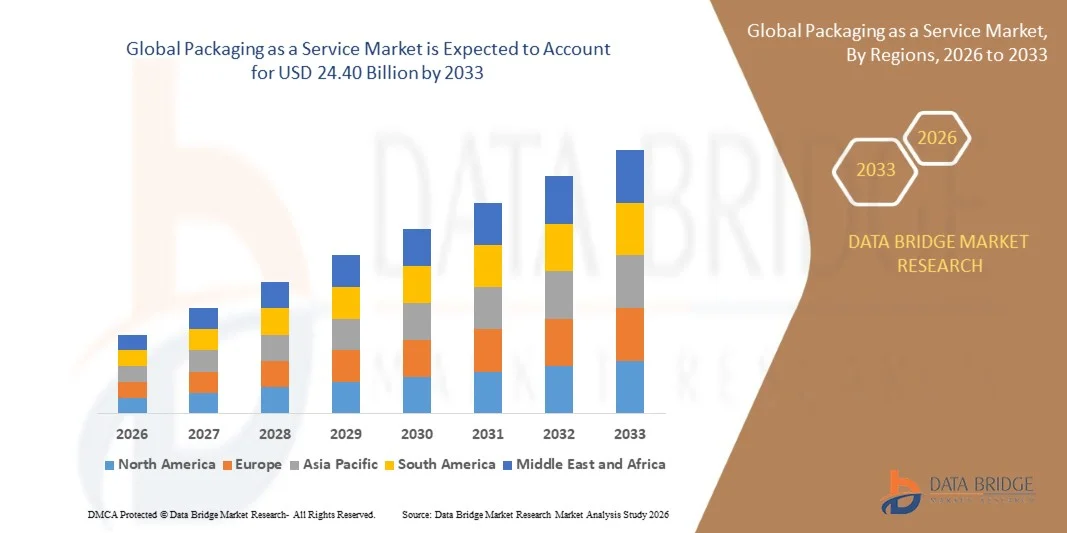
- As per Data Bridge Market Research analysis, the packaging as a service market was valued at USD 11.90 billion in 2025 and is projected to reach USD 24.40 billion by 2033, growing at a CAGR of 9.50% from 2026 to 2033.
- The market is experiencing consistent growth driven by rising demand for flexible and scalable packaging solutions, increasing adoption of reusable and sustainable packaging models, and growing outsourcing of packaging operations across food and beverage, healthcare, retail, e-commerce, and industrial sectors.
- The increasing focus on supply chain efficiency, packaging sustainability, and cost optimization, combined with stricter regulations on packaging waste and the rapid expansion of e-commerce, is compelling manufacturers and retailers to adopt packaging-as-a-service models. Subscription-based, reusable, and technology-enabled packaging services are gaining traction by offering cost-effective, scalable, and environmentally responsible solutions while reducing the operational burden associated with conventional packaging procurement and management.
Market Size & Forecast
- Global Market Value (2025): USD 11.90 Billion
- Expected Market Value (2033): USD 24.40 Billion
- Forecast CAGR (2026–2033): 9.50%
- Leading Region in 2025: North America
- Fastest Growing Region: Asia Pacific
What are the Major Takeaways of the Packaging as a Service Market?
- North America dominated the packaging as a service market with the largest revenue share of 33.4% in 2025, supported by mature logistics infrastructure, high e-commerce penetration, advanced fulfillment networks, and growing adoption of technology-enabled packaging services.
- Asia-Pacific is expected to be the fastest-growing region at a CAGR of 10.4% from 2026 to 2033, fueled by expanding e-commerce, manufacturing activity, organized retail, and increasing adoption of outsourced packaging and supply-chain solutions.
- The packaging manufacturing & procurement segment led the market with a 39.1% share in 2025, driven by increasing outsourcing of packaging production, material sourcing, and procurement activities.
- Reverse logistics & reuse are the fastest-growing service type, projected to register a CAGR of 10.3%, reflecting the surge in adoption of reusable packaging and circular supply-chain practices.
- The rigid packaging segment dominated the packaging format category with a 37.1% revenue share in 2025, led by its durability, structural strength, and broad application across major end-use industries
- Paper & paperboard accounted for 45% of the market share in 2025, preferred by recyclability, broad availability, and extensive use across retail, food and beverage, and e-commerce applications.
- The biodegradable materials segment is the fastest-growing material category, with a CAGR of 12.0%, driven by increasing demand for environmentally responsible packaging solutions.
Report Scope and Packaging as a Service Market Segmentation
|
Attributes |
Packaging as a Service Key Market Insights |
|
Segments Covered |
|
|
Countries Covered |
North America
Europe
Asia-Pacific
Middle East and Africa
South America
|
|
Key Market Players |
|
|
Market Opportunities |
|
|
Value Added Data Infosets |
In addition to the insights on market scenarios such as market value, growth rate, segmentation, geographical coverage, and major players, the market reports curated by the Data Bridge Market Research also include import export analysis, production capacity overview, production consumption analysis, price trend analysis, climate change scenario, supply chain analysis, value chain analysis, raw material/consumables overview, vendor selection criteria, PESTLE Analysis, Porter Analysis, and regulatory framework. |
What is the Key Trend in the Packaging as a Service Market?
- Businesses are increasingly adopting Packaging-as-a-Service models that combine packaging design, procurement, fulfillment, logistics, tracking, and maintenance, allowing companies to scale packaging capacity without owning the supporting infrastructure.
- For instance, in August 2025, Faes highlighted its Packaging-as-a-Service model, in which customers pay for packaging use while the provider manages maintenance, return logistics, repair, tracking, and end-of-life processing.
- Reusable and returnable packaging systems are becoming increasingly integrated with service-based models, enabling companies to shift from single-use packaging toward managed circular packaging loops with collection, cleaning, redistribution, and asset tracking.
- Digital tracking, reverse logistics, and standardized reusable packaging are increasingly becoming important components of Packaging-as-a-Service because providers must monitor packaging circulation, reduce asset losses, and optimize collection and redistribution.
- For instance, in June 2025, Fast Company reported that TerraCycle's Loop platform had scaled in France to hundreds of stores and more than 400 reusable packaged products, demonstrating growing commercial adoption of managed reuse systems
- As businesses increasingly prioritize flexible packaging capacity, circularity, and predictable operating costs, Packaging-as-a-Service is expected to gain traction by transforming packaging from an owned procurement item into an integrated, managed service.
What are the Key Drivers of the Packaging as a Service Market?
- The rapid expansion of e-commerce and omnichannel retail is increasing demand for scalable packaging procurement, fulfillment, logistics, and management services capable of handling fluctuating order volumes and complex last-mile requirements.
- For instance, in August 2026, the European Commission brought the Packaging and Packaging Waste Regulation into application, requiring a harmonized framework covering packaging design, reuse, recycling, and waste management across the European Union.
- Growing regulatory pressure to reduce packaging waste and increase reuse and recyclability is encouraging businesses to outsource packaging management to specialized providers that can operate collection, reuse, recycling, and compliance systems.
- The increasing focus on circular economy practices and resource efficiency is accelerating demand for service models that provide reusable packaging, reverse logistics, refurbishment, tracking, and recycling without requiring customers to develop these capabilities internally.
- For instance, in January 2025, the World Economic Forum reported that reusable packaging infrastructure is critical to lowering the unit cost of reuse models, while estimating the reuse economy could represent a USD 10 billion economic opportunity.
- With e-commerce expansion, stricter packaging regulations, and increasing sustainability requirements reshaping supply chains, Packaging-as-a-Service providers will remain important for organizations seeking scalable packaging operations and reduced packaging-management complexity.
What Factors are Challenging the Growth of the Packaging as a Service Market?
- Packaging-as-a-Service models involving reusable packaging require substantial investment in reverse logistics, cleaning facilities, tracking systems, packaging pools, and redistribution networks, increasing operational complexity for service providers.
- For instance, in June 2022, Tesco reported that its Loop reusable-packaging trial involved significant investment in new processes and production lines, while the cost of cleaning and prefilling reusable packaging could sometimes exceed the cost of the product itself, highlighting the cost barrier to scaling reusable Packaging-as-a-Service models.
- These infrastructure requirements can make reusable packaging more expensive than conventional single-use alternatives, particularly when return distances are long, utilization rates are low, or packaging assets experience losses during circulation.
- Reverse logistics and asset recovery remain significant challenges because service providers must synchronize deliveries, empty-package collection, transportation, cleaning, and redistribution across geographically dispersed supply chains.
- For instance, in September 2022, the European Commission's CORDIS project report on RePack stated that large-scale adaptation of reusable packaging had not yet been reached and that additional investment was required to develop Europe-wide return channels, demonstrating the infrastructure and reverse-logistics challenge for reusable packaging services.
- The capital requirements, operational complexity, and dependency on efficient return networks continue to restrict Packaging-as-a-Service adoption, particularly among smaller organizations and in regions where reverse-logistics infrastructure and packaging-reuse ecosystems remain underdeveloped.
How is the Packaging as a Service Market Segmented?
The packaging as a service market is segmented on the basis of service, packaging format, material, and end user.
- By Service
On the basis of service, the packaging as a service market is segmented into packaging design & engineering, packaging manufacturing & procurement, packaging management, packaging fulfillment & logistics, and reverse logistics & reuse. The packaging manufacturing & procurement segment dominated the market with a 39.1% share in 2025, owing to increasing outsourcing of packaging production, material sourcing, and procurement activities. Businesses are increasingly using specialized providers to reduce internal packaging infrastructure requirements and improve procurement efficiency. The segment enables companies to access scalable manufacturing capabilities while simplifying supplier coordination and packaging sourcing. Growing demand for customized packaging and standardized production is further supporting the segment. Increasing e-commerce activity and supply-chain complexity are also encouraging businesses to outsource packaging manufacturing and procurement.
The reverse logistics & reuse segment is projected to register the fastest growth at a CAGR of 10.3% from 2026 to 2033, driven by increasing adoption of reusable packaging and circular supply-chain practices. Businesses are increasingly seeking managed collection, return transportation, cleaning, refurbishment, and redistribution services. These services enable companies to improve the utilization of reusable packaging assets while reducing packaging waste. Growing sustainability initiatives are encouraging companies to shift toward closed-loop packaging systems. Packaging providers are also incorporating asset tracking and lifecycle management to improve the efficiency of reusable packaging programs. Increasing emphasis on resource efficiency and circular economy models is expected to further accelerate demand for reverse logistics and reuse services.
- By Packaging Format
On the basis of packaging format, the packaging as a service market is segmented into flexible packaging, rigid packaging, transport packaging, and protective packaging. The rigid packaging segment dominated the market with a 37.1% share in 2025, supported by its durability, structural strength, and broad application across major end-use industries. Rigid packaging is extensively used for food and beverage, healthcare, consumer goods, and industrial products. Its standardized structure also supports efficient handling, storage, transportation, and fulfillment operations. Packaging-as-a-Service providers can integrate rigid packaging into manufacturing, procurement, inventory management, and logistics programs. Increasing requirements for product protection and supply-chain efficiency are further supporting adoption.
The transport packaging segment is projected to register the fastest growth at CAGR of 10.1% from 2026 to 2033, driven by expanding e-commerce, logistics, warehousing, and omnichannel distribution. Transport packaging is increasingly required to protect products during storage, handling, transportation, and last-mile delivery. The adoption of reusable crates, containers, pallets, and other transport assets is creating additional demand for managed packaging services. Packaging-as-a-Service providers can coordinate packaging procurement, rental, pooling, asset circulation, collection, and maintenance. Growing integration between packaging and logistics services is further strengthening the segment's growth potential. Increasing emphasis on efficient and sustainable transportation packaging is expected to support continued expansion throughout the forecast period.
- By Material
On the basis of material, the packaging as a service market is segmented into plastic, paper & paperboard, glass, wood, biodegradable materials, compostable materials, and recycled materials. The paper & paperboard segment dominated the material category with 45% share in 2025, supported by recyclability, broad availability, and extensive use across retail, food and beverage, and e-commerce applications. Paper-based packaging is increasingly preferred by businesses seeking alternatives to conventional plastic packaging. Its compatibility with recyclable and recycled-content packaging solutions further supports adoption. Packaging service providers can integrate paper and paperboard materials into design, procurement, manufacturing, fulfillment, and recycling programs. Growing sustainability commitments are also encouraging companies to increase their use of fiber-based packaging.
The biodegradable materials segment is projected to register the fastest growth at CAGR of 12.0% from 2026 to 2033, driven by increasing demand for environmentally responsible packaging solutions. Businesses are increasingly exploring biodegradable materials to reduce dependence on conventional fossil-fuel-based packaging. Growing corporate sustainability commitments and packaging-waste concerns are supporting the transition toward lower-impact materials. Packaging-as-a-Service providers can incorporate biodegradable materials into customized packaging programs according to customer requirements. Advances in bio-based materials are also expanding their potential applications across food, retail, consumer goods, and other industries. Increasing demand for circular and sustainable packaging solutions is expected to strengthen adoption of biodegradable materials during the forecast period.
- By End User
On the basis of end user, the packaging as a service market is segmented into food & beverage, retail & e-commerce, healthcare & pharmaceuticals, automotive & industrial, consumer goods & electronics, and other end uses. The food & beverage segment dominated the market with a 26.9% share in 2025, driven by high packaging volumes, frequent replenishment requirements, and extensive distribution networks. Food and beverage companies require reliable packaging manufacturing, procurement, fulfillment, and logistics services. Outsourcing these activities enables businesses to manage changing packaging requirements while improving supply-chain efficiency. Increasing requirements for product safety, hygiene, durability, and traceability are further supporting demand for specialized packaging services. The recurring nature of packaging requirements in the food and beverage industry also makes it an important customer base for service providers.
The retail & e-commerce segment is projected to register the fastest growth at a CAGR of 10.4% from 2026 to 2033, driven by rapid e-commerce expansion, increasing order volumes, and growing demand for efficient last-mile packaging. Online retailers require flexible packaging capabilities that can accommodate changing order volumes and diverse product sizes. Packaging-as-a-Service providers enable retailers to outsource packaging procurement, fulfillment, inventory management, and logistics activities. The expansion of omnichannel retail is further increasing the need for scalable packaging solutions across multiple distribution channels. Growing demand for sustainable e-commerce packaging is also encouraging the adoption of recyclable, reusable, and optimized packaging solutions.
Which Region Holds the Largest Share of the Packaging as a Service Market?
- North America dominated the packaging as a service market with the largest revenue share of 33.4% in 2025, supported by mature logistics infrastructure, high e-commerce penetration, advanced fulfillment networks, and growing adoption of technology-enabled packaging services.
- The region also benefits from high demand for flexible packaging solutions, widespread use of technology-enabled fulfillment systems, and growing emphasis on reusable and sustainable packaging models across retail, food and beverage, healthcare, and industrial applications. Increasing investment in supply-chain optimization and circular packaging solutions continues to strengthen North America's leadership position in the global market.
U.S. Packaging as a Service Market Insight
The U.S. packaging as a service market is witnessing strong growth due to rising demand for outsourced packaging operations, e-commerce fulfillment, sustainable packaging solutions, and efficient supply-chain management. The country's mature retail and logistics ecosystem, along with increasing adoption of reusable, recyclable, and technology-enabled packaging systems, is driving demand across food and beverage, healthcare, retail, and industrial applications. In addition, growing emphasis on packaging waste reduction, circular economy practices, and cost-efficient packaging procurement is accelerating adoption among businesses.
Asia-Pacific Packaging as a Service Market Insight
The Asia-Pacific packaging as a service market is expected to witness rapid growth, driven by expanding e-commerce, increasing manufacturing activity, and rising investments in packaging and logistics infrastructure across countries such as China, India, and Japan. Growing demand for scalable packaging solutions, increasing sustainability initiatives, and rising adoption of outsourced packaging services are supporting regional market expansion. In addition, the growing presence of organized retail, consumer goods manufacturers, and technology-enabled fulfillment networks is accelerating adoption across commercial and industrial sectors.
Japan Packaging as a Service Market Insight
The Japan packaging as a service market is witnessing consistent growth due to rising investments in sustainable packaging, advanced logistics systems, and efficient supply-chain management. Manufacturers, retailers, and logistics companies are increasingly adopting managed packaging services for procurement, fulfillment, reusable packaging, and reverse logistics applications. Moreover, increasing integration of automation, digital tracking technologies, and circular packaging systems, along with the country's focus on resource efficiency, is further contributing to market growth.
China Packaging as a Service Market Insight
The China packaging as a service market is growing rapidly, driven by expanding e-commerce, large-scale manufacturing activity, and increasing investments in logistics and fulfillment infrastructure. Growing adoption of sustainable, reusable, and technology-enabled packaging solutions across retail, food and beverage, consumer goods, and industrial sectors is significantly boosting market demand. In addition, rising investments in smart logistics, packaging automation, and circular economy initiatives are positioning China as one of the fastest-growing markets for packaging as a service globally.
U.K. Packaging as a Service Market Insight
The U.K. packaging as a service market is experiencing steady growth, supported by rising adoption of sustainable packaging systems, e-commerce fulfillment solutions, and outsourced packaging operations. Increasing investments in reusable packaging infrastructure and growing demand for cost-effective, flexible packaging services are contributing to market growth. Furthermore, integration of digital tracking, reverse logistics, and circular packaging technologies is improving packaging efficiency and resource utilization, positioning the U.K. as a key market for packaging as a service.
Germany Packaging as a Service Market Insight
The Germany packaging as a service market is expanding steadily due to the country's strong manufacturing base, advanced logistics capabilities, and increasing adoption of sustainable packaging solutions. Manufacturers, retailers, and logistics providers are increasingly utilizing managed packaging services for procurement, fulfillment, reusable packaging, and supply-chain optimization activities. Continuous advancements in packaging automation, digital tracking, and circular economy solutions, along with strong emphasis on resource efficiency and packaging sustainability, are further driving market growth in Germany.
Which are the Top Companies in Packaging as a Service Market?
The packaging as a service industry is primarily led by well-established companies, including:
- Amcor plc (Switzerland)
- Mondi plc (U.K.)
- Sealed Air Corporation (U.S.)
- Sonoco Products Company (U.S.)
- Huhtamäki Oyj (Finland)
- Berry Global, Inc. (U.S.)
- Graphic Packaging International, LLC (U.S.)
- International Paper Company (U.S.)
- Pregis LLC (U.S.)
- ProAmpac (U.S.)
- Ranpak Holdings Corp. (U.S.)
- IFCO Systems (Germany)
- Tosca Services, LLC (U.S.)
- Brambles Limited (Australia)
- ORBIS Corporation (U.S.)
- Rehrig Pacific Company (U.S.)
- Coveris (Austria)
- ALPLA Werke Alwin Lehner GmbH & Co KG (Austria)
- Smurfit Westrock (Ireland)
- Constantia Flexibles Group GmbH (Austria)
What are Latest Developments in Packaging as a Service Market?
- In July 2025, Vytal acquired Bumerang to expand digital reusable packaging solutions across foodservice and events in Spain. The integration is intended to broaden Vytal's reusable packaging network and provide technology-enabled reuse solutions for restaurants, catering, events, universities, and hospitals.
- In April 2025, TOAST partnered with Kvatt to pilot a reusable packaging service for U.K. e-commerce orders. Customers receive products in returnable mailer bags, which are collected, sorted, cleaned, and reused, with the service incorporating return logistics and packaging refurbishment.
- In August 2024, ALPLA and zerooo developed a standardized reusable PET packaging solution for cosmetics and personal-care products. The system uses reusable and recyclable PET bottles equipped with a 2D data-matrix code to provide information about the contents and circulation of each bottle, supporting digitally managed reusable packaging systems.
- In February 2023, Amcor invested $250,000 in circolution's Packaging-as-a-Service solution, supporting a pay-per-cycle model for reusable food packaging. The service combines reusable packaging with reverse logistics, data analytics, and impact measurement while eliminating the need for customers to make upfront packaging investments.
- In July 2021, Loop partnered with Lyreco on a business-to-business reusable packaging trial for hand soap and hand sanitizers. The service enabled office customers to return empty containers for professional cleaning, refilling, and reuse, with the stainless-steel bottles designed for repeated use.

- Interactive Data Analysis Dashboard
- Company Analysis Dashboard for high growth potential opportunities
- Research Analyst Access for customization & queries
- Competitor Analysis with Interactive dashboard
- Latest News, Updates & Trend analysis
- Harness the Power of Benchmark Analysis for Comprehensive Competitor Tracking
Global Packaging As A Service Market, Supply Chain Analysis and Ecosystem Framework
To support market growth and help clients navigate the impact of geopolitical shifts, DBMR has integrated in-depth supply chain analysis into its Global Packaging As A Service Market research reports. This addition empowers clients to respond effectively to global changes affecting their industries. The supply chain analysis section includes detailed insights such as Global Packaging As A Service Market consumption and production by country, price trend analysis, the impact of tariffs and geopolitical developments, and import and export trends by country and HSN code. It also highlights major suppliers with data on production capacity and company profiles, as well as key importers and exporters. In addition to research, DBMR offers specialized supply chain consulting services backed by over a decade of experience, providing solutions like supplier discovery, supplier risk assessment, price trend analysis, impact evaluation of inflation and trade route changes, and comprehensive market trend analysis.
Data collection and base year analysis are done using data collection modules with large sample sizes. The stage includes obtaining market information or related data through various sources and strategies. It includes examining and planning all the data acquired from the past in advance. It likewise envelops the examination of information inconsistencies seen across different information sources. The market data is analysed and estimated using market statistical and coherent models. Also, market share analysis and key trend analysis are the major success factors in the market report. To know more, please request an analyst call or drop down your inquiry.
The key research methodology used by DBMR research team is data triangulation which involves data mining, analysis of the impact of data variables on the market and primary (industry expert) validation. Data models include Vendor Positioning Grid, Market Time Line Analysis, Market Overview and Guide, Company Positioning Grid, Patent Analysis, Pricing Analysis, Company Market Share Analysis, Standards of Measurement, Global versus Regional and Vendor Share Analysis. To know more about the research methodology, drop in an inquiry to speak to our industry experts.
Data Bridge Market Research is a leader in advanced formative research. We take pride in servicing our existing and new customers with data and analysis that match and suits their goal. The report can be customized to include price trend analysis of target brands understanding the market for additional countries (ask for the list of countries), clinical trial results data, literature review, refurbished market and product base analysis. Market analysis of target competitors can be analyzed from technology-based analysis to market portfolio strategies. We can add as many competitors that you require data about in the format and data style you are looking for. Our team of analysts can also provide you data in crude raw excel files pivot tables (Fact book) or can assist you in creating presentations from the data sets available in the report.













