


What is the Photonic Quantum Computing Market Size and Growth Rate?
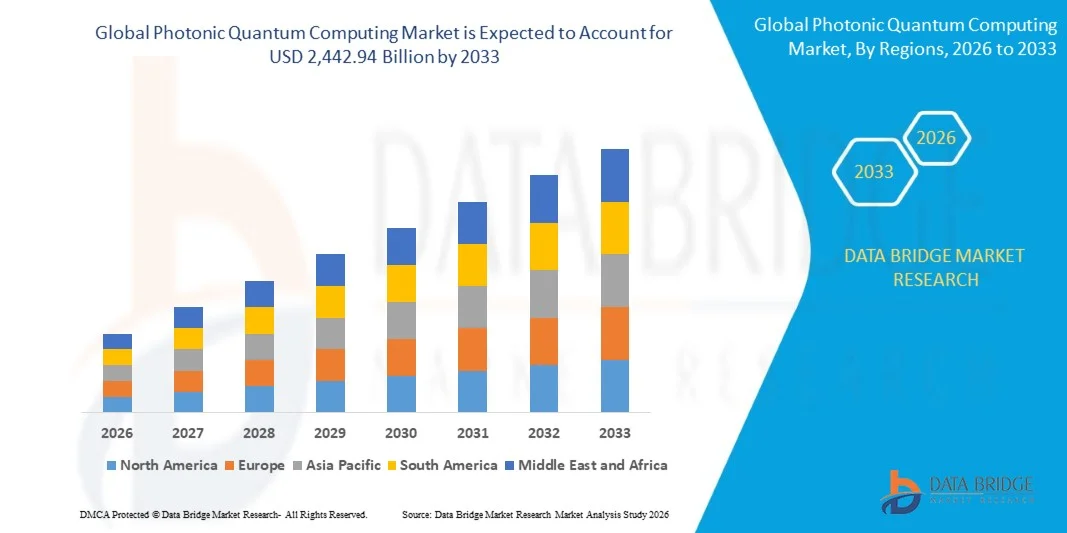
- As per Data Bridge Market Research analysis, the photonic quantum computing market was valued at USD 174.30 billion in 2025 and is projected to reach USD 2,442.94 billion by 2033, growing at a CAGR of 39.10% from 2026 to 2033.
- The market is experiencing rapid growth driven by increasing investments in scalable quantum computing technologies, advancements in photonic chip design, integration with semiconductor manufacturing processes, and expanding applications across quantum simulation, optimization, and quantum networking.
- The growing demand for high-performance computing, combined with advances in room-temperature photonic quantum systems and quantum networking capabilities, is encouraging research institutions, technology companies, and government organizations to adopt photonic quantum computing solutions. Silicon photonics integration, improved photon transmission accuracy, and cloud-based quantum computing access are supporting the development of scalable and commercially viable quantum computing platforms.
Market Size & Forecast
- Global Market Value (2025): USD 174.30 Billion
- Expected Market Value (2033): USD 2,442.94 Billion
- Forecast CAGR (2026–2033): 39.10%
- Leading Region in 2025: North America
- Fastest Growing Region: Asia Pacific
What are the Major Takeaways of the Photonic Quantum Computing Market?
- North America dominated the photonic quantum computing market with the largest revenue share of 41.3% in 2025, supported by strong investments in quantum research, advanced photonic technology companies, and the development of scalable quantum computing infrastructure.
- Asia-Pacific is expected to be the fastest-growing region at a CAGR of 29.3% from 2026 to 2033, fueled by increasing government investments in quantum technology, advancements in photonic computing research, and growing adoption across China, Japan, and India.
- The silicon photonics segment led the market with a 34.0% share in 2025, driven by its compatibility with established semiconductor manufacturing processes and suitability for scalable quantum architectures
- Integrated photonics are the fastest-growing technology type, projected to register a CAGR of 23.0%, reflecting the surge in demand for compact, scalable, and interconnected quantum computing architectures.
- The photonic quantum processors segment dominated the component type category with a 30.0% revenue share in 2025, led by their central role in performing quantum operations and processing photonic qubits.
- Cloud-based accounted for 49.9% of the market share in 2025, preferred by its ability to provide remote access to quantum computing systems without requiring dedicated infrastructure.
- The drug discovery and materials science segment is the fastest-growing software category, with a CAGR of 24.0%, driven by increasing interest in quantum computing for molecular simulation and complex materials problems.
Report Scope and Photonic Quantum Computing Market Segmentation
|
Attributes |
Photonic Quantum Computing Key Market Insights |
|
Segments Covered |
|
|
Countries Covered |
North America
Europe
Asia-Pacific
Middle East and Africa
South America
|
|
Key Market Players |
|
|
Market Opportunities |
|
|
Value Added Data Infosets |
In addition to the insights on market scenarios such as market value, growth rate, segmentation, geographical coverage, and major players, the market reports curated by the Data Bridge Market Research also include in-depth expert analysis, geographically represented company-wise production and capacity, network layouts of distributors and partners, detailed and updated price trend analysis and deficit analysis of supply chain and demand. |
What is the Key Trend in the Photonic Quantum Computing Market?
- Photonic quantum computing is increasingly moving toward modular, networked architectures that combine multiple photonic chips and optical interconnects to achieve scalable quantum processing while leveraging room-temperature operation and established fiber-optic infrastructure.
- For instance, in January 2025, Xanadu introduced Aurora, a 12-qubit photonic quantum computer built from four modular server racks containing 35 photonic chips and 13 kilometers of fiber optics, demonstrating a networked architecture designed for future scale.
- The integration of silicon photonics and semiconductor manufacturing is enabling quantum components to be produced using established fabrication processes, supporting greater consistency, miniaturization, and potential high-volume production.
- Photonic platforms are also advancing fault-tolerant quantum computing through improved qubit encoding and integrated quantum light sources, particularly through Gottesman-Kitaev-Preskill (GKP) qubits that can provide error-resistant quantum information processing.
- For instance, in June 2025, researchers published an integrated photonic GKP-qubit source fabricated on a customized multilayer silicon-nitride 300-mm wafer, demonstrating optical states with features required for future fault-tolerant photonic quantum systems.
- As quantum technology developers increasingly prioritize scalability, manufacturability, networking, and fault tolerance, photonic architectures are becoming an important pathway toward utility-scale quantum computing, supported by advances in integrated chips, optical interconnects, and quantum error correction.
What are the Key Drivers of the Photonic Quantum Computing Market?
- The rapid advancement of silicon photonics and integrated optical technologies is significantly increasing demand for photonic quantum computing platforms capable of integrating quantum state generation, manipulation, networking, and detection within scalable chip-based architectures.
- For instance, in February 2025, PsiQuantum demonstrated a manufacturable silicon-photonics platform, reporting 99.98% state-preparation and measurement fidelity, 99.50% Hong-Ou-Mandel interference visibility, 99.22% two-qubit fusion fidelity, and 99.72% chip-to-chip interconnect fidelity.
- Quantum computing developers, governments, and research organizations are investing in utility-scale photonic systems because photons can operate with low sensitivity to electromagnetic interference and can use existing optical-fiber networking infrastructure for modular quantum architectures.
- For instance, in February 2025, DARPA selected PsiQuantum and Microsoft for the Validation and Co-Design stage of its US2QC program, evaluating approaches toward utility-scale quantum computing and determining whether industrially useful quantum systems can be achieved by 2033.
- With increasing investment in scalable quantum infrastructure and growing emphasis on commercially useful quantum applications, advances in photonic processors, integrated optical components, and quantum networking are expected to support continued adoption of photonic quantum computing technologies.
Which Factors are Challenging the Growth of the Photonic Quantum Computing Market?
- Optical photon loss remains a major technical challenge because losses occur across photonic chips, optical connections, detectors, and other components, reducing quantum-state fidelity and making fault-tolerant computation more difficult to achieve at large scale.
- For instance, in January 2025, Nature reported that optical loss was the dominant and most challenging hurdle for Xanadu's Aurora architecture to cross the fault-tolerant threshold, while its demonstrated system used 35 photonic chips and recorded 2.16 dB end-to-end chip insertion loss.
- The requirement for extremely low-loss optical components and highly efficient photon sources and detectors increases manufacturing complexity and system-development costs, particularly when millions of components may be required for utility-scale quantum computers.
- Generating large photonic cluster states at high rates also remains challenging because photon detection probabilities can decline exponentially as the number of photons increases, creating additional requirements for high-efficiency sources, detectors, and error-correction techniques.
- For instance, in September 2024, Nature Photonics reported that generating large cluster states at high rates is notoriously difficult because detection probabilities decrease exponentially with the number of photons, highlighting a fundamental scalability constraint for measurement-based photonic quantum computing.
- The need to simultaneously improve optical loss, photon-source quality, detector efficiency, fabrication precision, and error correction continues to constrain the transition from experimental photonic quantum processors to commercially useful fault-tolerant systems.
How is the Photonic Quantum Computing Market Segmented?
The photonic quantum computing market is segmented on the basis of technology, component type, deployment mode, and application.
- By Technology
On the basis of technology, the photonic quantum computing market is segmented into silicon photonics, silicon nitride photonics, lithium niobate photonics, integrated photonics, and other technologies. The silicon photonics segment dominated the market with 34.0% share in 2025, owing to its compatibility with established semiconductor manufacturing processes and suitability for scalable quantum architectures. Silicon photonics enables multiple optical functions to be integrated onto compact chips, reducing system complexity and supporting high-speed quantum information processing. Its compatibility with CMOS-oriented fabrication is also helping developers pursue higher manufacturing scalability. Increasing investment in photonic chips and quantum processors is strengthening demand for silicon-based architectures. The technology can also support optical interconnects and quantum networking infrastructure.
The integrated photonics segment is projected to register the fastest growth at a CAGR of 23.0% from 2026 to 2033, driven by increasing demand for compact, scalable, and interconnected quantum computing architectures. Integrated photonics combines multiple optical functions on a single platform, reducing dependence on discrete optical components. This approach can improve system stability while lowering the footprint and complexity of photonic quantum processors. Increasing development of modular quantum systems is further supporting demand for integrated photonic architectures. Advances in silicon-based and silicon-nitride photonic platforms are improving the ability to manufacture components at larger wafer scales.
- By Component Type
On the basis of component type, the photonic quantum computing market is segmented into photonic quantum processors, single-photon sources, single-photon detectors, photonic integrated circuits (PICs), optical interconnects and waveguides, and control and readout systems. The photonic quantum processors segment dominated the market with 30.0% share in 2025, supported by their central role in performing quantum operations and processing photonic qubits. Photonic processors integrate optical components required to manipulate and measure quantum information. Increasing investment in scalable quantum computing architectures is generating demand for higher-performance processors. Companies are developing modular processor architectures that can be interconnected to increase computational capacity. Improvements in photon generation, interference, detection, and error correction are further enhancing processor capabilities.
The photonic integrated circuits (PICs) segment is projected to register the fastest growth at a CAGR of 22.0% from 2026 to 2033, driven by increasing integration of optical functions into compact semiconductor-based platforms. PICs can incorporate waveguides, interferometers, modulators, detectors, and other photonic elements on a single chip. This integration can reduce system complexity while supporting compact quantum computing architectures. Increasing adoption of semiconductor fabrication techniques is improving manufacturing scalability and component consistency. PICs are also important for developing modular quantum processors and optical networking interfaces.
- By Deployment Mode
On the basis of deployment mode, the photonic quantum computing market is segmented into on-premises, cloud-based, and hybrid. The cloud-based segment dominated the market with 49.9% share in 2025, supported by its ability to provide remote access to quantum computing systems without requiring dedicated infrastructure. Cloud deployment reduces the capital requirements associated with purchasing and maintaining specialized quantum hardware. It also allows universities, developers, enterprises, and research organizations to experiment with photonic quantum systems remotely. The model supports integration with classical cloud computing and high-performance computing environments. Increasing availability of photonic quantum processors through cloud platforms is strengthening accessibility.
The hybrid segment is projected to register the fastest growth at CAGR of 23.0% from 2026 to 2033, driven by increasing demand for combining quantum processors with classical computing infrastructure. Hybrid architectures allow computational workloads to be distributed between quantum and conventional systems according to performance requirements. This approach can help organizations integrate quantum capabilities into existing high-performance computing workflows. It also provides greater flexibility for organizations requiring local data handling alongside remote quantum resources. Growing integration of quantum processors with HPC and cloud environments is strengthening the adoption potential of hybrid deployment.
- By Application
On the basis of application, the photonic quantum computing market is segmented into quantum simulation and modeling, optimization, quantum machine learning, quantum chemistry, financial modeling and risk analysis, drug discovery and materials science, and other applications. Quantum simulation and modeling dominated the market with 38.0% share in 2025, supported by the potential of quantum computing to address complex scientific and mathematical problems that are difficult to solve efficiently using conventional systems. Photonic quantum processors can be applied to model complex physical, chemical, and mathematical systems. Research organizations are exploring quantum simulation for materials, molecular systems, and computationally intensive workloads. Increasing investment in quantum research is expanding demand for practical simulation applications. The development of scalable photonic architectures is further increasing the potential computational capacity available for simulation.
The drug discovery and materials science segment is projected to register the fastest growth at a CAGR of 24.0% from 2026 to 2033, driven by increasing interest in quantum computing for molecular simulation and complex materials problems. Quantum approaches can potentially help researchers analyze molecular interactions and material properties more efficiently. Pharmaceutical and materials companies are therefore exploring quantum computing as a tool for computationally intensive research. Photonic architectures are attracting attention because of their potential scalability and ability to connect quantum processors through optical networks. Increasing collaboration between quantum technology developers and research organizations is supporting application development.
Which Region Holds the Largest Share of the Photonic Quantum Computing Market?
- North America dominated the photonic quantum computing market with the largest revenue share of 41.3% in 2025, supported by strong investments in quantum research, advanced photonic technology companies, and the development of scalable quantum computing infrastructure.
- The region also benefits from extensive government-backed quantum research programs, established technology and cloud ecosystems, advanced silicon-photonics capabilities, and growing deployment of photonic quantum systems across research, defense, and commercial applications. Increasing investment in scalable quantum architectures and the development of large-scale photonic quantum computing facilities continue to strengthen North America's leadership position in the global market.
U.S. Photonic Quantum Computing Market Insight
The U.S. photonic quantum computing market is witnessing strong growth due to rising investments in utility-scale quantum computing, silicon photonics, and advanced quantum infrastructure. The country’s mature semiconductor and photonics ecosystem, along with strong government support for quantum technology development, is driving demand across research, defense, and commercial applications. In addition, growing collaboration between technology companies, government agencies, and research institutions is accelerating the development of scalable and fault-tolerant photonic quantum systems. The U.S. is also benefiting from the development of large-scale photonic quantum computing facilities and advanced semiconductor manufacturing capabilities.
Asia-Pacific Photonic Quantum Computing Market Insight
The Asia-Pacific photonic quantum computing market is expected to witness rapid growth, driven by increasing government investment in quantum technologies, expanding photonics research, and rising development of integrated quantum chips across countries such as China and Japan. Growing focus on scalable quantum computing architectures, optical quantum networking, and advanced semiconductor technologies is supporting regional market expansion. In addition, increasing research activities at universities and national laboratories are accelerating development of photonic processors and quantum communication technologies. China’s progress in integrated photonic quantum chips and Japan’s continued research in optical quantum computing are further strengthening the regional ecosystem.
Japan Photonic Quantum Computing Market Insight
The Japan photonic quantum computing market is witnessing consistent growth due to rising investments in quantum computing research, advanced photonics, and next-generation optical technologies. Research institutes are increasingly developing photonic quantum architectures for quantum information processing, networking, and fault-tolerant computing. Moreover, Japan has established expertise in optical quantum computing, including cluster-state generation, quantum error correction, and high-speed optical quantum information processing. Increasing government support for quantum technology commercialization and industrial development is further contributing to market growth. Continued research into integrated photonics and photon-based quantum systems is strengthening Japan’s position within the Asia-Pacific photonic quantum computing ecosystem.
China Photonic Quantum Computing Market Insight
The China photonic quantum computing market is growing rapidly, driven by increasing investments in integrated photonic quantum chips, optical quantum processors, and domestic quantum computing infrastructure. Growing government and research-industry support for quantum technologies is significantly boosting market development. In addition, Chinese researchers have demonstrated advances in continuous-variable quantum entanglement and cluster states on integrated photonic chips, supporting the development of scalable quantum computing architectures. China is also expanding domestic manufacturing capabilities for photonic quantum computers, strengthening the transition from laboratory research toward industrial production. These developments, combined with continued advancements in photon-based quantum processors, are positioning China as an important market for photonic quantum computing.
U.K. Photonic Quantum Computing Market Insight
The U.K. photonic quantum computing market is experiencing steady growth, supported by rising investment in quantum photonics, integrated photonic circuits, and quantum networking technologies. Universities, technology companies, and government-backed programs are increasingly developing photonic quantum hardware and networking platforms. Increasing emphasis on fault-tolerant quantum computing is also encouraging development of modular photonic quantum processing units and optical interconnect technologies. Furthermore, government-supported quantum missions are bringing together photonics companies, telecommunications organizations, and research institutions to develop networked quantum architectures. The U.K.’s established photonics research base and growing quantum technology ecosystem are further contributing to market development.
Germany Photonic Quantum Computing Market Insight
The Germany photonic quantum computing market is expanding steadily due to the country’s strong photonics research base, advanced semiconductor capabilities, and increasing investment in quantum technology development. Research organizations and technology companies are increasingly developing photonic quantum chips for scalable quantum computing and industrial applications. Continuous advancements in integrated photonics, optical components, and quantum system integration are supporting the development of next-generation photonic architectures. Germany is also developing national projects focused specifically on photonic quantum computing and industry-relevant applications. Furthermore, collaboration between research institutions, photonics manufacturers, and industrial partners is strengthening the country’s quantum technology ecosystem and supporting commercialization of photonic quantum computing.
Which are the Top Companies in Photonic Quantum Computing Market?
The photonic quantum computing industry is primarily led by well-established companies, including:
- Xanadu Quantum Technologies Inc. (Canada)
- PsiQuantum (U.S.)
- Quandela (France)
- ORCA Computing Limited (U.K.)
- QuiX Quantum B.V. (Netherlands)
- Aegiq Ltd. (U.K.)
- Photonic inc. (Canada)
- Quantum Source (Israel)
- Sparrow Quantum (Denmark)
- QphoX B.V. (Netherlands)
- LIGENTEC (Switzerland)
- LioniX International BV (Netherlands)
- Single Quantum (Netherlands)
- ID Quantique SA (Switzerland)
- HAMAMATSU PHOTONICS K.K. (Japan)
- Toshiba Corporation (Japan)
- NTT Corporation (Japan)
- Covesion Limited (U.K.)
- Thorlabs, Inc. (U.S.)
- Coherent Corp. (U.S.)
What are Latest Developments in Photonic Quantum Computing Market?
- In June 2025, Xanadu demonstrated GKP qubits on an integrated photonic chip, providing a photonic implementation of error-resistant qubits that can support the development of fault-tolerant quantum computing. The development represented an important advance in integrating quantum error-correction resources directly into photonic hardware.
- In May 2025, Xanadu announced a collaboration with Applied Materials to develop a 300-mm high-volume-compatible fabrication process for superconducting transition-edge sensors used in photon-number-resolving detectors. The collaboration is intended to support scalable manufacturing of key components for photonic quantum computers and advance the industry toward larger quantum systems.
- In January 2025, Xanadu announced Aurora, a modular and networked photonic quantum computer comprising four interconnected server racks, 35 photonic chips, and 13 kilometers of fiber optics operating at room temperature. The development demonstrated a scalable architecture for photonic quantum computing and marked an important step toward utility-scale quantum systems.
- In March 2024, researchers published a cloud-accessible single-photon quantum computing platform in Nature Photonics, demonstrating a six-photon system based on an on-demand quantum-dot source and a reconfigurable integrated optical circuit. The platform demonstrated one-, two-, and three-qubit gate operations as well as quantum chemistry and quantum machine-learning applications, supporting the development of versatile photonic quantum computing systems. Nature Photonics – A versatile single-photon-based quantum computing platform
- In March 2021, researchers demonstrated a programmable and scalable photonic circuit capable of executing multiple quantum algorithms, providing an important foundation for developing large-scale photonic quantum computers. The work demonstrated that programmable photonic hardware could perform different quantum algorithms on an integrated platform, strengthening the potential of photonics as a scalable quantum-computing architecture.

- Interactive Data Analysis Dashboard
- Company Analysis Dashboard for high growth potential opportunities
- Research Analyst Access for customization & queries
- Competitor Analysis with Interactive dashboard
- Latest News, Updates & Trend analysis
- Harness the Power of Benchmark Analysis for Comprehensive Competitor Tracking
Global Photonic Quantum Computing Market, Supply Chain Analysis and Ecosystem Framework
To support market growth and help clients navigate the impact of geopolitical shifts, DBMR has integrated in-depth supply chain analysis into its Global Photonic Quantum Computing Market research reports. This addition empowers clients to respond effectively to global changes affecting their industries. The supply chain analysis section includes detailed insights such as Global Photonic Quantum Computing Market consumption and production by country, price trend analysis, the impact of tariffs and geopolitical developments, and import and export trends by country and HSN code. It also highlights major suppliers with data on production capacity and company profiles, as well as key importers and exporters. In addition to research, DBMR offers specialized supply chain consulting services backed by over a decade of experience, providing solutions like supplier discovery, supplier risk assessment, price trend analysis, impact evaluation of inflation and trade route changes, and comprehensive market trend analysis.
Data collection and base year analysis are done using data collection modules with large sample sizes. The stage includes obtaining market information or related data through various sources and strategies. It includes examining and planning all the data acquired from the past in advance. It likewise envelops the examination of information inconsistencies seen across different information sources. The market data is analysed and estimated using market statistical and coherent models. Also, market share analysis and key trend analysis are the major success factors in the market report. To know more, please request an analyst call or drop down your inquiry.
The key research methodology used by DBMR research team is data triangulation which involves data mining, analysis of the impact of data variables on the market and primary (industry expert) validation. Data models include Vendor Positioning Grid, Market Time Line Analysis, Market Overview and Guide, Company Positioning Grid, Patent Analysis, Pricing Analysis, Company Market Share Analysis, Standards of Measurement, Global versus Regional and Vendor Share Analysis. To know more about the research methodology, drop in an inquiry to speak to our industry experts.
Data Bridge Market Research is a leader in advanced formative research. We take pride in servicing our existing and new customers with data and analysis that match and suits their goal. The report can be customized to include price trend analysis of target brands understanding the market for additional countries (ask for the list of countries), clinical trial results data, literature review, refurbished market and product base analysis. Market analysis of target competitors can be analyzed from technology-based analysis to market portfolio strategies. We can add as many competitors that you require data about in the format and data style you are looking for. Our team of analysts can also provide you data in crude raw excel files pivot tables (Fact book) or can assist you in creating presentations from the data sets available in the report.













