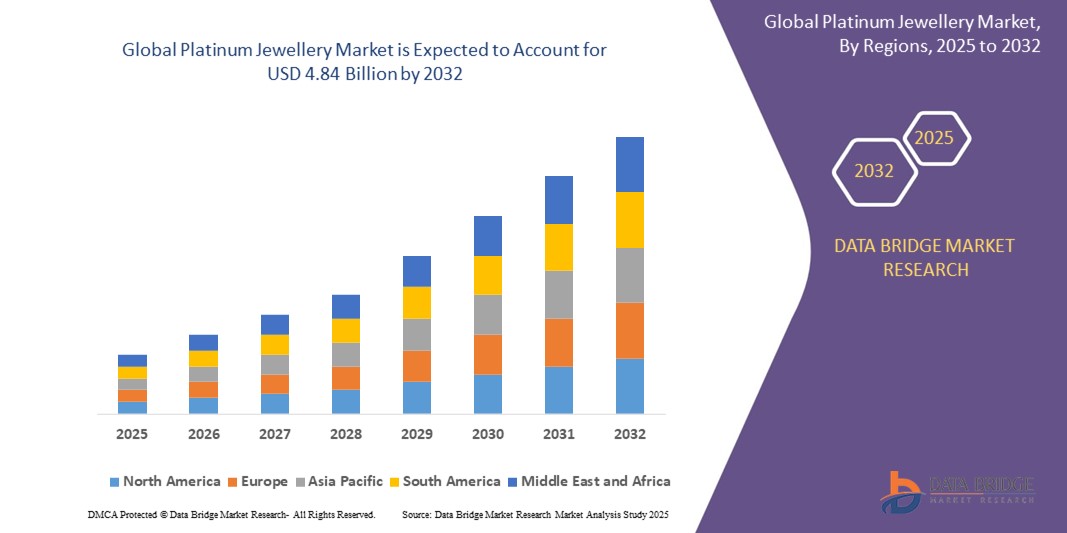
Platinum Jewellery Market Size
- The global platinum jewellery market was valued at USD 3.18 billion in 2024 and is expected to reach USD 4.84 billion by 2032
- During the forecast period of 2025 to 2032 the market is likely to grow at a CAGR of 5.4%, primarily driven by the evolving consumer preferences and expanding retail penetration
- This growth is driven by factors such as rising disposable incomes, growing demand for luxury and wedding jewellery, and increasing popularity of platinum among younger consumers
Platinum Jewellery Market Analysis
- Platinum jewellery is considered a symbol of luxury and durability, often used in high-end fashion, engagement, and wedding pieces. Its hypoallergenic properties, natural white sheen, and rarity make it highly desirable among consumers seeking premium accessories
- The demand for platinum jewellery is significantly driven by changing fashion trends, rising disposable income, and a growing preference for customized and branded jewellery. A substantial portion of the global demand stems from wedding and ceremonial use, particularly in countries like India, China, and the U.S., where platinum is gaining cultural and symbolic importance
- The Asia-Pacific region stands out as the dominant region for platinum jewellery consumption, led by India, China, and Japan. This dominance is fueled by a growing middle class, rising luxury spending, and aggressive marketing efforts by jewellery brands to position platinum as an aspirational metal
- For instance, the Platinum Guild International (PGI) has launched several campaigns across Asia to promote platinum jewellery among millennials and Gen Z, which has contributed to notable year-over-year growth in retail sales, especially in urban markets
- Globally, platinum is considered the third most popular metal in jewellery manufacturing, following gold and silver, and plays a pivotal role in premium and niche jewellery segments, including limited-edition collections and high-fashion collaborations
Report Scope and Platinum Jewellery Market Segmentation
|
Attributes |
Platinum Jewellery Key Market Insights |
|
Segments Covered |
|
|
Countries Covered |
North America
Europe
Asia-Pacific
Middle East and Africa
South America
|
|
Key Market Players |
|
|
Market Opportunities |
|
|
Value Added Data Infosets |
In addition to the insights on market scenarios such as market value, growth rate, segmentation, geographical coverage, and major players, the market reports curated by the Data Bridge Market Research also include import export analysis, production capacity overview, production consumption analysis, price trend analysis, climate change scenario, supply chain analysis, value chain analysis, raw material/consumables overview, vendor selection criteria, PESTLE Analysis, Porter Analysis, and regulatory framework. |
Platinum Jewellery Market Trends
“Integration of Technology and Personalization in Jewellery Design”
- One prominent trend in the global platinum jewellery market is the increasing integration of technology and personalization in design and manufacturing processes
- Advanced technologies such as 3D printing, computer-aided design (CAD), and AI-driven customization tools are transforming the way platinum jewellery is conceptualized and produced, allowing for highly personalized and intricate designs tailored to individual consumer preferences
- For instance, leading jewellery houses are leveraging 3D printing to produce complex platinum designs that were previously difficult to achieve with traditional techniques. This not only enhances design precision but also reduces production time and waste
- Digital platforms also enable consumers to customize their jewellery online, choosing elements such as metal finish, gemstone settings, engravings, and sizing before the piece is physically produced
- This trend is revolutionizing the platinum jewellery segment, especially among millennial and Gen Z consumers, who value individuality, exclusivity, and digital convenience, thereby driving market demand for tech-enabled, bespoke platinum pieces
Platinum Jewellery Market Dynamics
Driver
“Growing Demand Due to Rising Disposable Income and Aspirational Consumption”
- The increasing global disposable income, particularly in emerging economies, is significantly contributing to the growing demand for platinum jewellery as consumers increasingly seek luxury and aspirational products
- As more individuals move into higher income brackets, especially across Asia-Pacific and the Middle East, the demand for premium, high-quality jewellery like platinum has surged, driven by its perceived exclusivity and enduring value
- Platinum’s association with love, longevity, and prestige makes it especially popular for engagement rings, wedding bands, and milestone gifts, further fueling market growth
- Jewellery brands are also investing heavily in marketing campaigns to position platinum as a modern, youthful metal, which resonates strongly with millennials and Gen Z who value both luxury and personal expression
- In addition, innovations in jewellery design and increasing availability of platinum jewellery through both online and offline retail channels are making it more accessible to a broader customer base
For instance,
- In June 2023, the Platinum Guild International (PGI) reported a notable rise in platinum jewellery sales in India and China, driven by brand collaborations, wedding campaigns, and social media influence, particularly among urban millennials
- In October 2022, according to a market insight report by De Beers Group, luxury jewellery demand remained strong post-pandemic, with platinum gaining traction due to its unique color tone, hypoallergenic properties, and rarity, positioning it as a desirable alternative to gold and silver
- As a result of rising consumer spending power, evolving fashion sensibilities, and strategic branding, the global platinum jewellery market is witnessing sustained growth, making it a key driver for the industry’s expansion through 2032
Opportunity
“Growing Affinity for Ethical and Sustainable Luxury”
- The global shift toward sustainability and ethical sourcing is becoming a major opportunity for platinum jewellery brands to cater to environmentally conscious consumers
- Platinum, being one of the rarest metals, is increasingly being recognized for its ethical mining practices, and brands that focus on sourcing platinum responsibly are gaining traction in the luxury market
- Consumers are demanding transparency in sourcing and production processes, making it essential for brands to adopt sustainable practices such as recycled platinum, reduced carbon footprints, and eco-friendly packaging
For instance,
- In January 2024, Tiffany & Co. announced its commitment to using recycled platinum in its jewellery collections, aligning with growing consumer demand for sustainable luxury product
- In March 2023, Platinum Guild International (PGI) partnered with multiple industry stakeholders to promote the adoption of ethical platinum mining practices, emphasizing sustainability within the luxury jewellery sector
- This rising demand for sustainable luxury presents a growth opportunity for platinum jewellery brands to build stronger connections with eco-conscious customers, especially younger generations who prioritize environmental and ethical considerations in their purchase decisions
Restraint/Challenge
“High Cost of Platinum Limiting Market Accessibility”
- The high and volatile cost of platinum presents a significant challenge for the global platinum jewellery market, particularly impacting price-sensitive consumers and restricting broader market penetration in developing economies
- As one of the rarest and most expensive precious metals, platinum is often priced higher than gold or silver, making it less accessible to the mass market and positioning it primarily as a luxury product
- This cost barrier can deter middle-income consumers, especially in price-sensitive regions, from purchasing platinum jewellery, pushing them toward more affordable alternatives like white gold or sterling silver
For instance,
- In October 2024, a market pricing report by Johnson Matthey Plc highlighted significant volatility in platinum prices due to fluctuations in mining output, geopolitical tensions in South Africa (the largest producer), and global supply chain constraints. These pricing uncertainties make it challenging for retailers to maintain stable consumer pricing
- In March 2023, according to a report by the World Platinum Investment Council, retail jewellers in Southeast Asia and Latin America cited the high material cost of platinum as a limiting factor in expanding platinum offerings, especially in the bridal and casual wear segments
- As a result, the elevated cost of raw platinum limits the ability of smaller jewellers to include platinum in their collections and hampers efforts to democratize luxury jewellery, ultimately slowing the growth potential of the market across broader consumer segments
Platinum Jewellery Market Scope
The market is segmented on the basis of product type, application, distribution channel, and end user.
|
Segmentation |
Sub-Segmentation |
|
By Product Type |
|
|
By Application |
|
|
By Distribution Channel |
|
|
By End User |
|
Platinum Jewellery Market Regional Analysis
“Asia-Pacific is the Dominant Region in the Global Platinum Jewellery Market”
- Asia-Pacific dominates the platinum jewellery market, driven by high consumer demand in countries like China and India, cultural preference for precious metals, and increasing disposable income among the middle class
- China holds a significant share due to a strong tradition of platinum jewellery, rising urbanization, and the growing popularity of contemporary and luxury jewellery designs
- Favorable economic growth, rising millennial and Gen Z consumer base, and marketing initiatives by leading jewellery brands continue to support regional growth
- In addition, the expansion of organized retail, growing influence of fashion trends, and strategic collaborations between designers and jewellery houses are fueling market expansion across the region
“Asia-Pacific is Projected to Register the Highest Growth Rate”
- The Asia-Pacific region is expected to witness the highest growth rate in the platinum jewellery market, driven by rising disposable incomes, shifting consumer preferences toward premium and luxury products, and increasing influence of Western fashion trends
- Countries such as China, India, and Japan are emerging as key markets due to a growing young population, urbanization, and a rising inclination toward platinum as a symbol of status, purity, and modernity
- Japan, with its mature luxury market and strong affinity for high-quality craftsmanship, remains a crucial contributor. Platinum is widely used in wedding and engagement jewellery, reinforcing consistent demand
- China and India, with their expanding middle-class populations and rising participation in formal and casual luxury purchases, are witnessing strong promotional efforts by global jewellery brands. Government initiatives to support the gems and jewellery industry, alongside digital retail expansion, are further boosting market growth
Platinum Jewellery Market Share
The market competitive landscape provides details by competitor. Details included are company overview, company financials, revenue generated, market potential, investment in research and development, new market initiatives, global presence, production sites and facilities, production capacities, company strengths and weaknesses, product launch, product width and breadth, application dominance. The above data points provided are only related to the companies' focus related to market.
The Major Market Leaders Operating in the Market Are:
- Harry Winston, Inc. (U.S.)
- Société Cartier (France)
- Van Cleef & Arpels (France)
- Buccellati Holding Italia (Italy)
- Tiffany & Co. (U.S.)
- Graff (U.K.)
- Bulgari S.p.A (Italy)
- Piaget (Switzerland)
- Chopard (Switzerland)
- Mikimoto America (Japan)
- Panasonic Corporation (Japan)
- Diamond Engineering Works (India)
- Rockwell Industries Limited (India)
- REMI GROUP (India)
- Elanpro (India)
- Star Scientific Instruments (India)
Latest Developments in Global Platinum Jewellery Market
- In June 2024, Alloyed unveiled 'Inoveo,' a groundbreaking platinum alloy composed of 95% platinum and 5% proprietary metals. This innovative alloy is 40% harder and more durable than traditional platinum, designed to improve workability and attract jewellers
- In May 2023, Platinum Guild International (PGI) highlighted the role of branded platinum collections in driving market growth. Collections such as 'Platinum Born' in the US and 'Men of Platinum' in India were noted for their significant contributions. 'Platinum Born' expanded its presence into high-end department stores, further boosting its impact
- In April 2022, Impala Platinum Holdings Limited announced its intention to acquire a 100% stake in Royal Bafokeng Platinum, a South African platinum manufacturer. At the time, Impala already held 35.3% of Royal Bafokeng Platinum's shares. This full acquisition aims to establish one of the largest platinum metal mining entities globally and strengthen Impala's market position
- In February 2022, Heraeus Holding partnered with BASF SE to establish a joint venture aimed at recovering precious metals, such as platinum, from spent automotive catalysts in China. This collaboration led to the creation of BASF Heraeus Metal Resource Co. Ltd., located in Pinghu, China

- Interactive Data Analysis Dashboard
- Company Analysis Dashboard for high growth potential opportunities
- Research Analyst Access for customization & queries
- Competitor Analysis with Interactive dashboard
- Latest News, Updates & Trend analysis
- Harness the Power of Benchmark Analysis for Comprehensive Competitor Tracking
Data collection and base year analysis are done using data collection modules with large sample sizes. The stage includes obtaining market information or related data through various sources and strategies. It includes examining and planning all the data acquired from the past in advance. It likewise envelops the examination of information inconsistencies seen across different information sources. The market data is analysed and estimated using market statistical and coherent models. Also, market share analysis and key trend analysis are the major success factors in the market report. To know more, please request an analyst call or drop down your inquiry.
The key research methodology used by DBMR research team is data triangulation which involves data mining, analysis of the impact of data variables on the market and primary (industry expert) validation. Data models include Vendor Positioning Grid, Market Time Line Analysis, Market Overview and Guide, Company Positioning Grid, Patent Analysis, Pricing Analysis, Company Market Share Analysis, Standards of Measurement, Global versus Regional and Vendor Share Analysis. To know more about the research methodology, drop in an inquiry to speak to our industry experts.
Data Bridge Market Research is a leader in advanced formative research. We take pride in servicing our existing and new customers with data and analysis that match and suits their goal. The report can be customized to include price trend analysis of target brands understanding the market for additional countries (ask for the list of countries), clinical trial results data, literature review, refurbished market and product base analysis. Market analysis of target competitors can be analyzed from technology-based analysis to market portfolio strategies. We can add as many competitors that you require data about in the format and data style you are looking for. Our team of analysts can also provide you data in crude raw excel files pivot tables (Fact book) or can assist you in creating presentations from the data sets available in the report.