Circumvent the Tariff challenges with an agile supply chain Consulting
Supply Chain Ecosystem Analysis now part of DBMR Reports
Global Post-Harvest Treatment Market, By Type (Coatings, Cleaners, Fungicides, Ethylene Blockers, Sanitizers, and Sprout Inhibitors), Crop Type (Fruits and Vegetables), Country (U.S., Canada, Mexico, Germany, Poland, Ireland, Italy, U.K., France, Spain, Netherlands, Belgium, Switzerland, Turkey, Russia, Rest of Europe, Japan, China, India, South Korea, New Zealand, Vietnam, Australia, Singapore, Malaysia, Thailand, Indonesia, Philippines, Rest of Asia-Pacific, Brazil, Argentina, Chile, Rest of South America, UAE, Saudi Arabia, Egypt, Kuwait, South Africa, Rest of Middle East and Africa) Industry Trends and Forecast to 2029
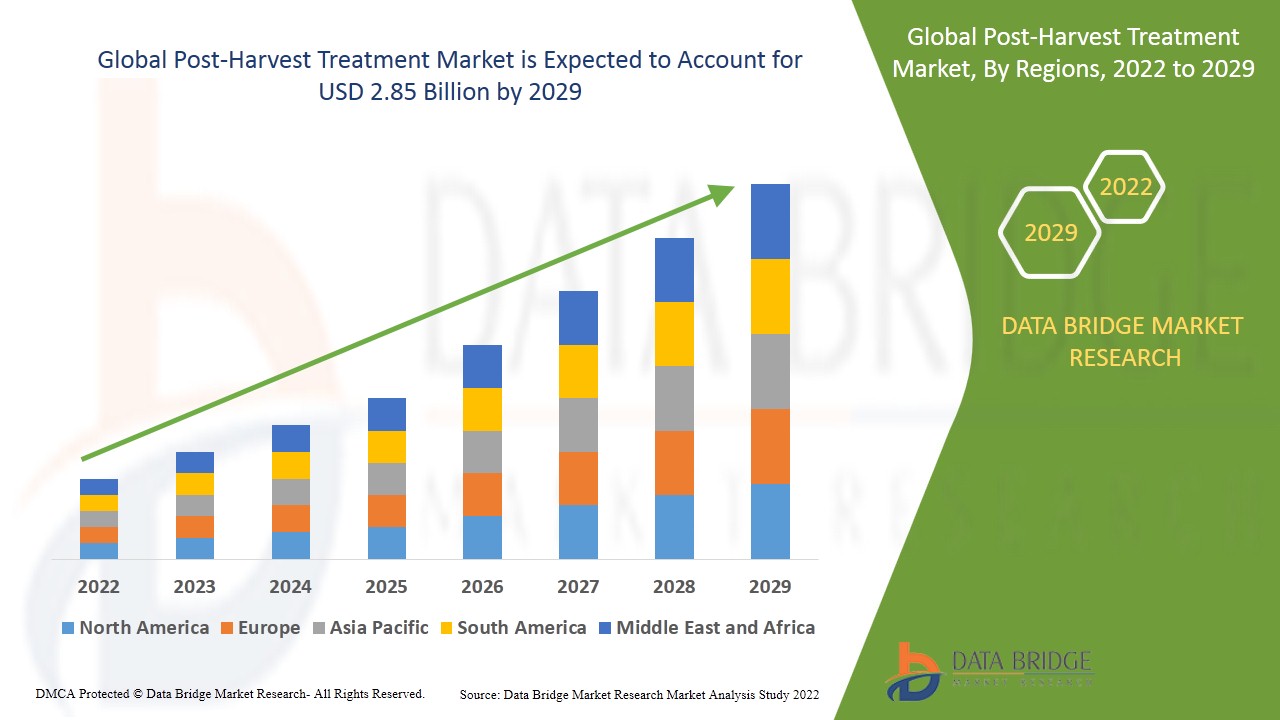
Market Analysis and Insights of Post-Harvest Treatment Market
Data Bridge Market Research analyses that the post-harvest treatment market will project a compound annual growth rate (CAGR) of 6.80% during the forecast period of 2022-2029 and is likely to reach USD 2.85 Billion in 2029.
Post-harvest treatment is a method of protective & enhancing quality of the product which incorporates fruits, vegetables, and root crops. Basic techniques concerned within the post-harvesting treatment are edible coatings, chemical treatment and temperature management together with heat and irradiation that helps in restoring antioxidants, antimicrobials & permits anti-browning
The high demand for fresh fruits and vegetables all over the globe is the major factor accelerating the growth of the post-harvest treatment market. Furthermore, rising awareness regarding the need for post-harvest losses are expected to increase the demand for post-harvest treatments for fruit and vegetables and growing concern towards for post-harvest treatment among the players are also expected to drive the growth of the post-harvest treatment market. However, stringent government regulations related to quality of food and high price of treatment will restrains the post-harvest treatment market, whereas, lack of efficient infrastructure for post-harvest mechanisms will challenge market growth.
In addition, Innovative post-harvest handling treatments and handling practises will create ample opportunities for the post-harvest treatment market.
This post-harvest treatment market report provides details of new recent developments, trade regulations, import export analysis, production analysis, value chain optimization, market share, impact of domestic and localised market players, analyses opportunities in terms of emerging revenue pockets, changes in market regulations, strategic market growth analysis, market size, category market growths, application niches and dominance, product approvals, product launches, geographic expansions, technological innovations in the market. To gain more info on post-harvest treatment market contact Data Bridge Market Research for an Analyst Brief, our team will help you take an informed market decision to achieve market growth.
Global Post-Harvest Treatment Market Scope and Market Size
The post-harvest treatment market is segmented on the basis of type & crop type. The growth among segments helps you analyse niche pockets of growth and strategies to approach the market and determine your core application areas and the difference in your target markets.
- On the basis of type, the post-harvest treatment market is segmented into coatings, cleaners, fungicides, ethylene blockers, sanitizers, and sprout inhibitors.
- The post-harvest treatment market is also segmented on the basis of crop type into fruits and vegetables.
Post-Harvest Treatment Market Country Level Analysis
The global post-harvest treatment market is analyses and market size, volume information is provided by country by type and crop type as referenced above.
The countries covered in the post-harvest treatment market report are U.S., Canada, Mexico in North America, Germany, Poland, Ireland, Italy, U.K., France, Spain, Netherlands, Belgium, Switzerland, Turkey, Russia, Rest of Europe in Europe, Japan, China, India, South Korea, New Zealand, Vietnam, Australia, Singapore, Malaysia, Thailand, Indonesia, Philippines, Rest of Asia-Pacific (APAC) in Asia-Pacific (APAC), Brazil, Argentina, Chile, Rest of South America as a part of South America, UAE, Saudi Arabia, Egypt, Kuwait, South Africa, Rest of Middle East and Africa(MEA) as a part of Middle East and Africa(MEA).
Asia-Pacific region is undergoing substantial gains and is projected to score the highest compound annual growth rate (CAGR) during the forecast period. This is because of the extensive production of fruits and vegetables and shifting focus on reducing post-harvest losses in countries such as China and India. Europe is the estimated region in terms of growth in the post-harvest treatment market because of the increasing export scenario in the region.
The country section of the post-harvest treatment market report also provides individual market impacting factors and changes in regulation in the market domestically that impacts the current and future trends of the market. Data points such as consumption volumes, production sites and volumes, import export analysis, price trend analysis, cost of raw materials, down-stream and upstream value chain analysis are some of the major pointers used to forecast the market scenario for individual countries. Also, presence and availability of global brands and their challenges faced due to large or scarce competition from local and domestic brands, impact of domestic tariffs and trade routes are considered while providing forecast analysis of the country data.
Competitive Landscape and Post-Harvest Treatment Market Share Analysis
The post-harvest treatment market competitive landscape provides details by competitor. Details included are company overview, company financials, revenue generated, market potential, investment in research and development, new market initiatives, global presence, production sites and facilities, production capacities, company strengths and weaknesses, product launch, product width and breadth, application dominance. The above data points provided are only related to the companies’ focus related to post-harvest treatment market.
Some of the major players operating in the post-harvest treatment market report are DECCO – UPL, JBT, Pace International, LLC, AgroFresh, FMC Corporation., Bayer AG, Futureco Bioscience S.A., Corteva., BASF SE, Carrier., Janssen Pharmaceutica NV, Colin Campbell (Chemicals) Pty Ltd, Valent BioSciences LLC, RPM International Inc Canterbury Design, Chevron Inc., Riya Fibrotech., RBA Exports Private Limited, Seksaria Foundries Limited, Nexus Cast.and Sneh Precast Products, among other.
SKU-
Get online access to the report on the World's First Market Intelligence Cloud
- Interactive Data Analysis Dashboard
- Company Analysis Dashboard for high growth potential opportunities
- Research Analyst Access for customization & queries
- Competitor Analysis with Interactive dashboard
- Latest News, Updates & Trend analysis
- Harness the Power of Benchmark Analysis for Comprehensive Competitor Tracking
Table of Content
1 INTRODUCTION
1.1 OBJECTIVES OF THE STUDY
1.2 MARKET DEFINITION
1.3 OVERVIEW OF GLOBAL POST HARVEST TREATMENT MARKET
1.4 CURRENCY AND PRICING
1.5 LIMITATION
1.6 MARKETS COVERED
2 MARKET SEGMENTATION
2.1 KEY TAKEAWAYS
2.2 ARRIVING AT THE GLOBAL POST HARVEST TREATMENT MARKET SIZE
2.2.1 VENDOR POSITIONING GRID
2.2.2 TECHNOLOGY LIFE LINE CURVE
2.2.3 MARKET GUIDE
2.2.4 COMPANY POSITIONING GRID
2.2.5 COMAPANY MARKET SHARE ANALYSIS
2.2.6 MULTIVARIATE MODELLING
2.2.7 DEMAND AND SUPPLY-SIDE VARIABLES
2.2.8 CONSUMPTION TREND OF END PRODUCTS
2.2.9 TOP TO BOTTOM ANALYSIS
2.2.10 STANDARDS OF MEASUREMENT
2.2.11 VENDOR SHARE ANALYSIS
2.2.12 DATA POINTS FROM KEY PRIMARY INTERVIEWS
2.2.13 DATA POINTS FROM KEY SECONDARY DATABASES
2.3 GLOBAL POST HARVEST TREATMENT MARKET: RESEARCH SNAPSHOT
2.4 ASSUMPTIONS
3 MARKET OVERVIEW
3.1 DRIVERS
3.2 RESTRAINTS
3.3 OPPORTUNITIES
3.4 CHALLENGES
4 EXECUTIVE SUMMARY
5 PREMIUM INSIGHTS
5.1 PRODUCTION ANALYSIS
5.2 IMPORT-EXPORT ANALYSIS
5.3 SUPPLY CHAIN ANALYSIS
5.4 VALUE CHAIN ANALYSIS
5.5 PRODUCTION COST ANALYSIS
5.6 GOVERNMENT SUPPORT FOR DEVELOPMENT AQUACULTURE ACTIVITIES
5.7 INCREASE IN ADOPTION OF PRECISION FARMING
6 REGULATORY FRAMEWORK
7 GLOBAL POST HARVEST TREATMENT MARKET, BY TYPE, 2020-2029, (USD MILLION)
(ASP, VALUE & VOLUME WILL BE PROVIDED FOR ALL THE SEGMENTS)
7.1 OVERVIEW
7.2 COATINGS
7.2.1 POLYSACCHARIDES
7.2.2 PROTEINS
7.2.3 LIPIDS
7.2.4 OTHER COATINGS
7.3 ETHYLENE BLOCKERS
7.4 CLEANERS
7.5 HERBICIDES
7.6 INSECTICIDES
7.7 FUNGICIDES
7.7.1 FLUIDIOXONIL
7.7.2 IMAZALIL
7.7.3 PYRIMETHANIL
7.7.4 THIABENDAZOLE
7.8 INHIBITORS
7.8.1 SPROUT INHIBITORS
7.8.2 SCALD INHIBITORS
7.9 SANITIZERS
7.1 GROWTH REGULATORS
7.11 ANTISCALD
7.12 STORAGE TREATMENT
7.12.1 STORAGE ROOMS
7.12.2 RIPENING ROOMS
7.12.3 ON THE MOVE ROOMS
7.13 OTHERS
8 GLOBAL POST HARVEST TREATMENT MARKET, BY CROP TYPE, 2020-2029, (USD MILLION)
8.1 OVERVIEW
8.2 FRUITS
8.2.1 FRUITS, BY TYPE
8.2.1.1. CITRUS FRUITS
8.2.1.1.1. ORANGES
8.2.1.1.2. GRAPEFRUIT
8.2.1.1.3. LEMONS
8.2.1.1.4. LIMES
8.2.1.1.5. KUMQUAT
8.2.1.1.6. TANGERINES
8.2.1.1.7. OTHERS
8.2.1.2. POME FRUITS
8.2.1.2.1. APPLES
8.2.1.2.2. PEARS
8.2.1.2.3. NASHI
8.2.1.2.4. QUINCE
8.2.1.2.5. OTHERS
8.2.1.3. STONE FRUITS
8.2.1.3.1. CHERRIES
8.2.1.3.2. PEACHES
8.2.1.3.3. PLUMS
8.2.1.3.4. APRICOTS
8.2.1.3.5. LYCHEES
8.2.1.3.6. MANGOES
8.2.1.3.7. OTHERS
8.2.1.4. TROPICAL FRUITS
8.2.1.4.1. ACEROLA CHERRY
8.2.1.4.2. AVOCADO
8.2.1.4.3. BANANA
8.2.1.4.4. BREADFRUIT
8.2.1.4.5. COCONUT
8.2.1.4.6. OTHERS
8.3 VEGETABLES
8.3.1 VEGETABLES, BY TYPE
8.3.1.1. POTATOES
8.3.1.2. BELL PEPPER
8.3.1.3. CUCUMBER
8.3.1.4. TOMATO
8.3.1.5. OTHERS
8.4 OTHERS
9 GLOBAL POST HARVEST TREATMENT MARKET, BY CATEGORY, 2020-2029, (USD MILLION)
9.1 OVERVIEW
9.2 ORGANIC
9.3 CONVENTIONAL
10 GLOBAL POST HARVEST TREATMENT MARKET, BY TECHNOLOGY, 2020-2029, (USD MILLION)
10.1 OVERVIEW
10.2 ENZYME SUBSTRATE-BASED
10.3 IMMUNOASSAY-BASED
10.4 POLYMERASE CHAIN REACTION (PCR) BASED
11 GLOBAL POST HARVEST TREATMENT MARKET, BY APPLICATION, 2020-2029, (USD MILLION)
11.1 OVERVIEW
11.2 DAIRY PRODUCTS
11.3 NUTS, SEEDS, AND SPICES
11.4 PACKAGED FOOD
11.5 MEAT, POULTRY, AND SEAFOOD PRODUCTS
11.6 CEREALS, GRAINS & PULSES
11.7 OTHERS
12 GLOBAL POST HARVEST TREATMENT MARKET, BY COUNTRY, 2020-2029, (USD MILLION)
GLOBAL POST HARVEST TREATMENT MARKET, (ALL SEGMENTATION PROVIDED ABOVE IS REPRESENTED IN THIS CHAPTER BY COUNTRY)
12.1 NORTH AMERICA
12.1.1 U.S.
12.1.2 CANADA
12.1.3 MEXICO
12.2 EUROPE
12.2.1 GERMANY
12.2.2 U.K.
12.2.3 ITALY
12.2.4 FRANCE
12.2.5 SPAIN
12.2.6 RUSSIA
12.2.7 SWITZERLAND
12.2.8 TURKEY
12.2.9 BELGIUM
12.2.10 NETHERLANDS
12.2.11 DENMARK
12.2.12 SWEDEN
12.2.13 POLAND
12.2.14 NORWAY
12.2.15 FINLAND
12.2.16 REST OF EUROPE
12.3 ASIA-PACIFIC
12.3.1 JAPAN
12.3.2 CHINA
12.3.3 SOUTH KOREA
12.3.4 INDIA
12.3.5 SINGAPORE
12.3.6 THAILAND
12.3.7 INDONESIA
12.3.8 MALAYSIA
12.3.9 PHILIPPINES
12.3.10 AUSTRALIA
12.3.11 NEW ZEALAND
12.3.12 VIETNAM
12.3.13 TAIWAN
12.3.14 REST OF ASIA-PACIFIC
12.4 SOUTH AMERICA
12.4.1 BRAZIL
12.4.2 ARGENTINA
12.4.3 REST OF SOUTH AMERICA
12.5 MIDDLE EAST AND AFRICA
12.5.1 SOUTH AFRICA
12.5.2 EGYPT
12.5.3 BAHRAIN
12.5.4 UNITED ARAB EMIRATES
12.5.5 KUWAIT
12.5.6 OMAN
12.5.7 QATAR
12.5.8 SAUDI ARABIA
12.5.9 REST OF MEA
13 GLOBAL POST HARVEST TREATMENT MARKET, COMPANY LANDSCAPE
13.1 COMPANY SHARE ANALYSIS: GLOBAL
13.2 COMPANY SHARE ANALYSIS: NORTH AMERICA
13.3 COMPANY SHARE ANALYSIS: EUROPE
13.4 COMPANY SHARE ANALYSIS: ASIA-PACIFIC
13.5 MERGERS & ACQUISITIONS
13.6 NEW PRODUCT DEVELOPMENT & APPROVALS
13.7 EXPANSIONS & PARTNERSHIP
13.8 REGULATORY CHANGES
14 GLOBAL POST HARVEST TREATMENT MARKET, SWOT & DBMR ANALYSIS
15 GLOBAL POST HARVEST TREATMENT MARKET, COMPANY PROFILE
15.1 DECCO – UPL
15.1.1 COMPANY OVERVIEW
15.1.2 REVENUE ANALYSIS
15.1.3 GEOGRAPHIC PRESENCE
15.1.4 PRODUCT PORTFOLIO
15.1.5 RECENT DEVELOPMENTS
15.2 JBT
15.2.1 COMPANY OVERVIEW
15.2.2 REVENUE ANALYSIS
15.2.3 GEOGRAPHIC PRESENCE
15.2.4 PRODUCT PORTFOLIO
15.2.5 RECENT DEVELOPMENTS
15.3 PACE INTERNATIONAL, LLC
15.3.1 COMPANY OVERVIEW
15.3.2 REVENUE ANALYSIS
15.3.3 GEOGRAPHIC PRESENCE
15.3.4 PRODUCT PORTFOLIO
15.3.5 RECENT DEVELOPMENTS
15.4 AGROFRESH
15.4.1 COMPANY OVERVIEW
15.4.2 REVENUE ANALYSIS
15.4.3 GEOGRAPHIC PRESENCE
15.4.4 PRODUCT PORTFOLIO
15.4.5 RECENT DEVELOPMENTS
15.5 FMC CORPORATION
15.5.1 COMPANY OVERVIEW
15.5.2 REVENUE ANALYSIS
15.5.3 GEOGRAPHIC PRESENCE
15.5.4 PRODUCT PORTFOLIO
15.5.5 RECENT DEVELOPMENTS
15.6 BAYER AG
15.6.1 COMPANY OVERVIEW
15.6.2 REVENUE ANALYSIS
15.6.3 GEOGRAPHIC PRESENCE
15.6.4 PRODUCT PORTFOLIO
15.6.5 RECENT DEVELOPMENTS
15.7 FUTURECO BIOSCIENCE S.A.
15.7.1 COMPANY OVERVIEW
15.7.2 REVENUE ANALYSIS
15.7.3 GEOGRAPHIC PRESENCE
15.7.4 PRODUCT PORTFOLIO
15.7.5 RECENT DEVELOPMENTS
15.8 CORTEVA
15.8.1 COMPANY OVERVIEW
15.8.2 REVENUE ANALYSIS
15.8.3 GEOGRAPHIC PRESENCE
15.8.4 PRODUCT PORTFOLIO
15.8.5 RECENT DEVELOPMENTS
15.9 BASF SE
15.9.1 COMPANY OVERVIEW
15.9.2 REVENUE ANALYSIS
15.9.3 GEOGRAPHIC PRESENCE
15.9.4 PRODUCT PORTFOLIO
15.9.5 RECENT DEVELOPMENTS
15.1 JANSSEN PMP
15.10.1 COMPANY OVERVIEW
15.10.2 REVENUE ANALYSIS
15.10.3 GEOGRAPHIC PRESENCE
15.10.4 PRODUCT PORTFOLIO
15.10.5 RECENT DEVELOPMENTS
15.11 COLIN CAMPBELL (CHEMICALS) PTY LTD
15.11.1 COMPANY OVERVIEW
15.11.2 REVENUE ANALYSIS
15.11.3 GEOGRAPHIC PRESENCE
15.11.4 PRODUCT PORTFOLIO
15.11.5 RECENT DEVELOPMENTS
15.12 VALENT BIOSCIENCES CORPORATION
15.12.1 COMPANY OVERVIEW
15.12.2 REVENUE ANALYSIS
15.12.3 GEOGRAPHIC PRESENCE
15.12.4 PRODUCT PORTFOLIO
15.12.5 RECENT DEVELOPMENTS
15.13 RPM INTERNATIONAL INC
15.13.1 COMPANY OVERVIEW
15.13.2 REVENUE ANALYSIS
15.13.3 GEOGRAPHIC PRESENCE
15.13.4 PRODUCT PORTFOLIO
15.13.5 RECENT DEVELOPMENTS
15.14 SYNGENTA
15.14.1 COMPANY OVERVIEW
15.14.2 REVENUE ANALYSIS
15.14.3 GEOGRAPHIC PRESENCE
15.14.4 PRODUCT PORTFOLIO
15.14.5 RECENT DEVELOPMENTS
15.15 NUFARM
15.15.1 COMPANY OVERVIEW
15.15.2 REVENUE ANALYSIS
15.15.3 GEOGRAPHIC PRESENCE
15.15.4 PRODUCT PORTFOLIO
15.15.5 RECENT DEVELOPMENTS
15.16 XEDA INTERNATIONAL
15.16.1 COMPANY OVERVIEW
15.16.2 REVENUE ANALYSIS
15.16.3 GEOGRAPHIC PRESENCE
15.16.4 PRODUCT PORTFOLIO
15.16.5 RECENT DEVELOPMENTS
15.17 FOMESA FRUITECH
15.17.1 COMPANY OVERVIEW
15.17.2 REVENUE ANALYSIS
15.17.3 GEOGRAPHIC PRESENCE
15.17.4 PRODUCT PORTFOLIO
15.17.5 RECENT DEVELOPMENTS
15.18 SENSITECH INC
15.18.1 COMPANY OVERVIEW
15.18.2 REVENUE ANALYSIS
15.18.3 GEOGRAPHIC PRESENCE
15.18.4 PRODUCT PORTFOLIO
15.18.5 RECENT DEVELOPMENTS
15.19 JOHN BEAN TECHNOLOGIES
15.19.1 COMPANY OVERVIEW
15.19.2 REVENUE ANALYSIS
15.19.3 GEOGRAPHIC PRESENCE
15.19.4 PRODUCT PORTFOLIO
15.19.5 RECENT DEVELOPMENTS
*Note: the companies profiled is not exhaustive list and is as per our previous client requirement. we profile more than 100 companies in our study and hence the list of Companies can be modified or replaced on request
16 RELATED REPORTS
17 QUESTIONNAIRE
18 ABOUT DATA BRIDGE MARKET RESEARCH
Research Methodology
Data collection and base year analysis are done using data collection modules with large sample sizes. The stage includes obtaining market information or related data through various sources and strategies. It includes examining and planning all the data acquired from the past in advance. It likewise envelops the examination of information inconsistencies seen across different information sources. The market data is analysed and estimated using market statistical and coherent models. Also, market share analysis and key trend analysis are the major success factors in the market report. To know more, please request an analyst call or drop down your inquiry.
The key research methodology used by DBMR research team is data triangulation which involves data mining, analysis of the impact of data variables on the market and primary (industry expert) validation. Data models include Vendor Positioning Grid, Market Time Line Analysis, Market Overview and Guide, Company Positioning Grid, Patent Analysis, Pricing Analysis, Company Market Share Analysis, Standards of Measurement, Global versus Regional and Vendor Share Analysis. To know more about the research methodology, drop in an inquiry to speak to our industry experts.
Customization Available
Data Bridge Market Research is a leader in advanced formative research. We take pride in servicing our existing and new customers with data and analysis that match and suits their goal. The report can be customized to include price trend analysis of target brands understanding the market for additional countries (ask for the list of countries), clinical trial results data, literature review, refurbished market and product base analysis. Market analysis of target competitors can be analyzed from technology-based analysis to market portfolio strategies. We can add as many competitors that you require data about in the format and data style you are looking for. Our team of analysts can also provide you data in crude raw excel files pivot tables (Fact book) or can assist you in creating presentations from the data sets available in the report.