


What is the Safety Valve Market Size and Growth Rate?
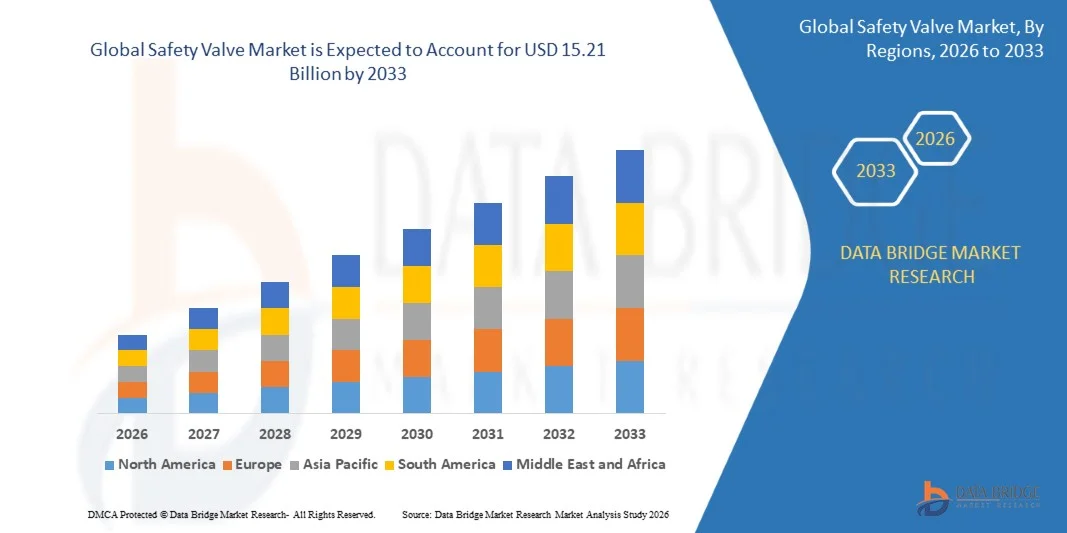
- As per Data Bridge Market Research analysis, the safety valve market was valued at USD 7.94 billion in 2025 and is projected to reach USD 15.21 billion by 2033, growing at a CAGR of 8.47% from 2026 to 2033.
- The market is experiencing consistent growth driven by rising demand for reliable pressure protection systems, stringent industrial safety regulations, and expanding applications across oil and gas, chemical processing, power generation, and manufacturing industries. Demand is further supported by the modernization of industrial infrastructure and increasing adoption of advanced safety valve technologies.
- The increasing emphasis on industrial safety, combined with stricter regulatory requirements for pressure management and equipment protection, is compelling industries to adopt dependable safety valve solutions. Spring-loaded, pilot-operated, and digitally monitored safety valves are increasingly being deployed to protect critical equipment from overpressure conditions, supporting safer operations, reducing equipment damage, and improving process reliability.
Market Size & Forecast
- Global Market Value (2025): USD 7.94 Billion
- Expected Market Value (2033): USD 15.21 Billion
- Forecast CAGR (2026–2033): 8.47%
- Leading Region in 2025: North America
- Fastest Growing Region: Asia Pacific
What are the Major Takeaways of the Safety Valve Market?
- North America dominated the safety valve market with the largest revenue share of 40% in 2025, supported by a large installed base of refining, chemical processing, LNG, and power generation infrastructure requiring continuous pressure protection and equipment replacement.
- Asia-Pacific is expected to be the fastest-growing region at a CAGR of 8.2% from 2026 to 2033, fueled by rapid industrialization, expanding oil and gas infrastructure, power-generation investments, and increasing demand for pressure-protection systems across China and India.
- The spring-loaded pressure-relief valves segment led the market with a 54% share in 2025, driven by its simple operating mechanism, reliability, and broad applicability across industrial pressure systems.
- Pilot-operated pressure-relief valves are the fastest-growing type, projected to register a CAGR of 7.4%, reflecting the surge in demand for precise pressure control and high-capacity pressure protection.
- The steel segment dominated the material category with a 40% revenue share in 2025, led by its high mechanical strength, durability, and suitability for demanding pressure applications
- 1” to 10 accounted for 45% of the market share in 2025, preferred by its broad utilization across industrial pressure systems and process equipment.
- The cryogenic segment is the fastest-growing material category, with a CAGR of 9.1%, driven by the increasing deployment of equipment operating at extremely low temperatures.
Report Scope and Safety Valve Market Segmentation
|
Attributes |
Safety Valve Key Market Insights |
|
Segments Covered |
|
|
Countries Covered |
North America
Europe
Asia-Pacific
Middle East and Africa
South America
|
|
Key Market Players |
|
|
Market Opportunities |
|
|
Value Added Data Infosets |
In addition to the market insights such as market value, growth rate, market segments, geographical coverage, market players, and market scenario, the market report curated by the Data Bridge Market Research team includes in-depth expert analysis, import/export analysis, pricing analysis, production consumption analysis, and pestle analysis. |
What is the Key Trend in the Safety Valve Market?
- Industrial operators are increasingly adopting smart safety valves with digital monitoring to detect pressure events, leakage, valve condition, and maintenance requirements while improving plant safety and operational visibility across critical applications.
- For instance, in February 2025, Emerson introduced the Anderson Greenwood Type 84 pressure relief valve for hydrogen applications, delivering leak-tight performance up to 21,756 psig for high-pressure storage, transportation, and refueling systems, addressing pressure protection requirements in emerging hydrogen infrastructure projects. Emerson announcement
- Real-time monitoring enables operators to identify pressure events, leakage, sticking conditions, and degradation before failures disrupt operations.
- Oil and gas, chemical, LNG, and power facilities use connected valve technologies to support predictive maintenance and improve reliability across processes.
- For instance, in September 2025, Emerson highlighted Crosby EM-Series spring-loaded pressure safety valves with optional wireless acoustic monitoring for instant opening, closing, and leakage notifications, supporting faster response to pressure events and maintenance needs. Crosby EM-Series announcement
- As industrial facilities prioritize connected asset management, predictive maintenance, emissions reduction, and process safety, adoption of digitally monitored safety valves is expected to accelerate, reinforcing intelligent pressure protection across industrial operations and critical infrastructure and safety programs globally.
What are the Key Drivers of the Safety Valve Market?
- The growing emphasis on industrial process safety and stricter pressure management requirements has increased demand for reliable safety valves capable of protecting vessels, pipelines, boilers, and other critical equipment from dangerous industrial overpressure events.
- For instance, in June 2025, India’s Petroleum and Explosives Safety Organisation (PESO) issued amendments for liquefied-hydrogen facilities requiring safety relief valves on LH₂ vessels, with sufficient relieving capacity to prevent vessel pressure from exceeding 120% of the design or maximum allowable working pressure, demonstrating increasing regulatory emphasis on pressure protection in emerging hydrogen infrastructure.
- Oil and gas, chemical, power, and manufacturing facilities are integrating advanced safety valves into expanding process infrastructure to improve pressure control, equipment protection, and operational reliability.
- For instance, in April 2025, LESER India announced plans to double its annual safety-relief-valve production capacity from 32,000 valves through machinery upgrades and specialized manufacturing processes at its Maharashtra facility, reflecting rising industrial demand for safety valves and pressure-protection equipment.
- As industrial operators increasingly invest in process safety, hydrogen infrastructure, and critical pressure systems, demand for specialized safety valves will continue expanding across energy, chemical, petrochemical, and manufacturing applications worldwide.
What Factors are Challenging the Growth of the Safety Valve Market?
- Safety valves require inspection, testing, maintenance, and replacement expenditure because reliable pressure protection depends on periodic verification, specialized servicing, and handling of components.
- For instance, in May 2022, Gas Processing & LNG highlighted that pressure-relief devices require routine maintenance to ensure safe and reliable plant operation, with some devices requiring more frequent maintenance when fouling, corrosion, or plugging can affect their operation.
- These maintenance requirements can increase operating costs for facilities managing safety valve populations across process units.
- For instance, in August 2024, Chemical Engineering reported that the costs associated with installing and maintaining pressure-relief valves can be significant and discussed the use of upstream rupture discs as a way to reduce PRV cost of ownership.
- The substantial lifecycle costs associated with safety valve inspection, testing, repair, and replacement can restrict adoption of premium connected solutions, particularly among cost-sensitive facilities and smaller industrial operators. These expenses can also increase downtime when valves must be removed, transported, tested, repaired, and reinstalled, creating additional operational burdens across facilities.
How is the Safety Valve Market Segmented?
The safety valve market is segmented on the basis of type, material, size, and end-use.
- By Type
On the basis of type, the safety valve market is segmented into spring-loaded pressure-relief valves, dead-weight pressure-relief valves, and pilot-operated pressure-relief valves. The spring-loaded pressure-relief valves segment dominated the market with 54% share in 2025, owing to its simple operating mechanism, reliability, and broad applicability across industrial pressure systems. These valves automatically release excess pressure when the system reaches a predetermined set point, supporting safe operation across diverse applications. Their relatively straightforward construction facilitates installation, inspection, and maintenance. They are widely deployed in oil and gas facilities, chemical plants, power-generation systems, boilers, and pressure vessels. The availability of standardized designs and established manufacturing capabilities further supports their widespread adoption. Their proven performance and suitability for numerous pressure-management applications continue to reinforce their dominant position.
The pilot-operated pressure-relief valves segment is projected to register the fastest growth at a CAGR of 7.4% from 2026 to 2033, driven by increasing demand for precise pressure control and high-capacity pressure protection. These valves are particularly suitable for applications where higher relieving capacity and tighter pressure control are required. Their ability to provide improved sealing performance supports their use in demanding industrial environments. Increasing deployment across refineries, chemical-processing facilities, LNG infrastructure, and other high-pressure applications is supporting adoption. Pilot-operated designs can also provide operational advantages where conventional spring-loaded valves may face limitations at higher pressures. Growing emphasis on process efficiency and reliable pressure protection is further contributing to segment expansion.
- By Material
On the basis of material, the safety valve market is segmented into steel, alloy, cast iron, cryogenic, and others. The steel segment dominated the market with 40% share in 2025, owing to its high mechanical strength, durability, and suitability for demanding pressure applications. Steel safety valves are extensively used in industrial facilities where equipment is exposed to elevated pressure and temperature conditions. Their broad compatibility with oil and gas, power generation, chemical processing, and manufacturing applications supports sustained demand. Steel construction also provides manufacturers with flexibility to develop valves for different operating environments and pressure requirements. The established supply chain and widespread availability of steel further support its use across large-scale industrial installations. Continued investment in industrial infrastructure is expected to maintain the strong position of steel-based safety valves.
The cryogenic segment is projected to register the fastest growth at a CAGR of 9.1% from 2026 to 2033, driven by increasing deployment of equipment operating at extremely low temperatures. Cryogenic safety valves are designed to provide reliable pressure protection in applications involving liquefied gases and other low-temperature fluids. Growing adoption of LNG infrastructure is supporting demand for specialized cryogenic pressure-protection equipment. Increasing development of hydrogen production, storage, and transportation systems is creating additional application potential. These valves are also relevant to specialized industrial, aerospace, and energy applications requiring reliable operation under severe temperature conditions. The expansion of low-temperature energy infrastructure and increasing requirements for specialized pressure-control equipment are expected to accelerate adoption of cryogenic safety valves.
- By Size
On the basis of size, the safety valve market is segmented into less than 1”, 1” to 10”, 11” to 20”, and 20’ & above. The 1” to 10” segment dominated the market with 45% share in 2025, supported by its broad utilization across industrial pressure systems and process equipment. Safety valves within this size range are suitable for a wide variety of pipelines, pressure vessels, boilers, compressors, and processing equipment. Their versatility allows them to serve applications across multiple industrial sectors rather than being concentrated in a single industry. Standardized configurations also facilitate integration with existing equipment and replacement of installed valves. Their availability across different pressure ratings and operating conditions further supports widespread adoption. The large installed base of industrial equipment requiring this size range continues to strengthen its position in the global market.
The 20” & above segment is projected to register the fastest growth at a CAGR of 7.7% from 2026 to 2033, driven by increasing requirements for high-capacity pressure protection in large-scale industrial facilities. Large-diameter safety valves are particularly relevant to systems handling substantial process flows and high-volume pressure discharge requirements. Expanding refinery, petrochemical, LNG, power-generation, and pipeline infrastructure is supporting demand for larger valve configurations. These valves are also increasingly required in large processing systems where conventional smaller valves may not provide adequate relieving capacity. Modernization of existing industrial infrastructure is generating additional replacement requirements for large-diameter pressure-protection equipment. Increasing investment in large-scale energy and process facilities is expected to support continued growth of this segment.
- By End-Use
On the basis of end-use, the safety valve market is segmented into oil & gas, energy & power, chemicals, food & beverage, water & wastewater treatment, and others. The oil & gas segment dominated the market with 38% share in 2025, owing to extensive utilization of safety valves throughout exploration, production, processing, refining, storage, and transportation operations. Oil and gas facilities contain numerous pressurized systems that require reliable protection against excessive pressure conditions. Safety valves are widely installed on pressure vessels, pipelines, compressors, separators, boilers, and other critical equipment. Expansion and modernization of refining and gas-processing infrastructure are supporting continued demand. The replacement and maintenance of installed pressure-protection equipment also create recurring requirements within the sector. The extensive installed base and stringent operational safety requirements continue to support the dominance of oil and gas.
The energy & power segment is projected to register the fastest growth at a CAGR of 9.3% from 2026 to 2033, driven by increasing investment in power-generation infrastructure and pressure-containing equipment. Safety valves are essential for protecting boilers, steam systems, pressure vessels, and other equipment used throughout power facilities. Growing requirements for reliable operation and equipment protection are increasing the deployment of pressure-relief systems. Modernization of existing power infrastructure is also creating demand for replacement and upgraded safety valves. Expansion of power-generation capacity and development of new energy infrastructure are further supporting market growth. Increasing emphasis on operational safety and compliance with industrial protection requirements is expected to reinforce demand for safety valves across the energy and power sector.
Which Region Holds the Largest Share of the Safety Valve Market?
- North America dominated the safety valve market with the largest revenue share of 40% in 2025, supported by a large installed base of refining, chemical processing, LNG, and power generation infrastructure requiring continuous pressure protection and equipment replacement.
- The region also benefits from stringent industrial safety requirements, a large installed base requiring replacement and maintenance, and established valve manufacturing and service networks. Continued investment in oil and gas, power generation, water and wastewater infrastructure, and industrial processing is further supporting demand for safety valves across North America.
U.S. Safety Valve Market Insight
The U.S. safety valve market is witnessing strong growth due to rising investments in oil and gas infrastructure, power generation, chemical processing, and industrial manufacturing. The country’s extensive installed base of pressure-containing equipment, along with increasing adoption of advanced pressure-relief technologies, is driving demand across energy, petrochemical, and industrial applications. In addition, stringent industrial safety requirements, equipment modernization, and growing emphasis on reliable pressure protection are accelerating safety valve adoption across processing facilities and infrastructure projects.
Asia-Pacific Global Safety Valve Market Insight
The Asia-Pacific safety valve market is expected to witness rapid growth, driven by expanding industrialization, rising energy demand, and increasing investments in oil and gas, power generation, chemical processing, and manufacturing infrastructure across countries such as China, India, and Japan. Growing adoption of advanced pressure-protection technologies, increasing industrial safety requirements, and expansion of large-scale processing facilities are supporting regional market expansion. In addition, the development of LNG, petrochemical, power, and water infrastructure is accelerating safety valve adoption across industrial applications.
Japan Global Safety Valve Market Insight
The Japan safety valve market is witnessing consistent growth due to rising investments in advanced industrial infrastructure, energy facilities, chemical processing, and equipment modernization. Manufacturers and industrial operators are increasingly adopting high-performance safety valves for pressure protection, process reliability, and equipment safety across demanding applications. Moreover, increasing focus on industrial safety, maintenance of aging infrastructure, and integration of advanced valve technologies are further contributing to market growth.
China Global Safety Valve Market Insight
The China safety valve market is growing rapidly, driven by expanding industrial infrastructure, increasing energy demand, and rising investments in oil and gas, power generation, chemical, and manufacturing facilities. Growing adoption of advanced pressure-relief technologies across large-scale industrial applications is significantly boosting market demand. In addition, increasing investments in LNG, petrochemical, and power infrastructure, along with stronger emphasis on industrial safety and equipment reliability, are supporting China's position as a major market for safety valves globally.
U.K. Global Safety Valve Market Insight
The U.K. safety valve market is experiencing steady growth, supported by rising demand for pressure-protection equipment across energy, chemical processing, manufacturing, and industrial applications. Increasing investments in infrastructure modernization and growing requirements for reliable pressure-control solutions are contributing to market growth. Furthermore, stringent industrial safety requirements, maintenance of existing pressure equipment, and adoption of advanced safety valve technologies are supporting the continued development of the U.K. safety valve market.
Germany Global Safety Valve Market Insight
The Germany safety valve market is expanding steadily due to the country’s strong industrial manufacturing base, advanced engineering capabilities, and increasing adoption of high-performance pressure-protection technologies. Chemical companies, power facilities, manufacturers, and process industries are increasingly utilizing safety valves for equipment protection and operational reliability. Continuous modernization of industrial infrastructure, increasing focus on process safety, and investments in advanced manufacturing and energy systems are further driving market growth in Germany.
Which are the Top Companies in Safety Valve Market?
The safety valve industry is primarily led by well-established companies, including:
- Emerson Electric Co. (U.S.)
- Baker Hughes Company (U.S.)
- LESER GmbH & Co. KG (Germany)
- Flowserve Corporation (U.S.)
- Curtiss-Wright Corporation (U.S.)
- Pentair plc (U.K.)
- Watts Water Technologies, Inc. (U.S.)
- Crane Company (U.S.)
- Spirax Group plc (U.K.)
- KSB SE & Co. KGaA (Germany)
- IMI plc (U.K.)
- SAMSON AKTIENGESELLSCHAFT (Germany)
- BESA S.p.A. (Italy)
- ValvesOnly Europe (Italy)
- Velan Inc. (Canada)
- Metso Corporation (Finland)
- Weir Group PLC (U.K.)
- KITZ Corporation (Japan)
- Alfa Laval AB (Sweden)
What are Latest Developments in Safety Valve Market?
- In February 2025, Emerson introduced the Anderson Greenwood Type 84 Pressure Relief Valve, specifically designed to protect tanks and vessels used in hydrogen and other high-pressure gas applications. The new valve incorporates specialized seating and stainless-steel components to provide leak-tight performance, resistance to hydrogen embrittlement, and reliable operation at very high pressures. This development strengthens pressure-protection solutions for emerging hydrogen storage, transportation, and refueling applications.
- In February 2024, Groth Corporation announced the release of its Model 16F Pilot Operated Relief Valve, designed to provide reliable low-pressure protection for storage tanks and process applications. The valve offers full opening at 10% overpressure, modulating action to reduce product loss, and improved sealing to minimize fugitive emissions. Its high-flow design and suitability for cryogenic applications expand the range of pressure-relief solutions available for industrial and storage-tank applications.
- In January 2024, Emerson introduced the Fisher 63EGLP-16 Pilot Operated Relief Valve, a new 2-inch model designed for pressurized bullet tanks storing liquid propane and anhydrous ammonia. The valve provides closer-to-setpoint control while simplifying installation and maintenance, and its dual-pilot configuration provides redundancy during testing. The development expands Emerson’s pilot-operated pressure-relief portfolio for storage-tank applications.
- In May 2023, Groth Corporation announced the launch of its Model 12F-TWW-0 Pressure/Vacuum Relief Valve, developed to provide increased protection against overpressure and excessive vacuum in tank equipment. The new valve incorporates improved sealing performance and high flow rates while enabling customers to potentially use smaller valve sizes for required flow rates. The development also focuses on reducing fugitive emissions and evaporative product losses, strengthening pressure-protection and environmental performance in tank applications.
- In December 2022, Emerson announced two new technologies for its Crosby J-Series pressure relief valve product line. The Balanced Diaphragm technology eliminates the need for bellows while providing balanced operation against backpressure, while the Bellows Leak Detection solution provides notification of bellows failure. The developments were designed to improve pressure-relief valve performance, safety, reliability, and emissions management.

- Interactive Data Analysis Dashboard
- Company Analysis Dashboard for high growth potential opportunities
- Research Analyst Access for customization & queries
- Competitor Analysis with Interactive dashboard
- Latest News, Updates & Trend analysis
- Harness the Power of Benchmark Analysis for Comprehensive Competitor Tracking
Data collection and base year analysis are done using data collection modules with large sample sizes. The stage includes obtaining market information or related data through various sources and strategies. It includes examining and planning all the data acquired from the past in advance. It likewise envelops the examination of information inconsistencies seen across different information sources. The market data is analysed and estimated using market statistical and coherent models. Also, market share analysis and key trend analysis are the major success factors in the market report. To know more, please request an analyst call or drop down your inquiry.
The key research methodology used by DBMR research team is data triangulation which involves data mining, analysis of the impact of data variables on the market and primary (industry expert) validation. Data models include Vendor Positioning Grid, Market Time Line Analysis, Market Overview and Guide, Company Positioning Grid, Patent Analysis, Pricing Analysis, Company Market Share Analysis, Standards of Measurement, Global versus Regional and Vendor Share Analysis. To know more about the research methodology, drop in an inquiry to speak to our industry experts.
Data Bridge Market Research is a leader in advanced formative research. We take pride in servicing our existing and new customers with data and analysis that match and suits their goal. The report can be customized to include price trend analysis of target brands understanding the market for additional countries (ask for the list of countries), clinical trial results data, literature review, refurbished market and product base analysis. Market analysis of target competitors can be analyzed from technology-based analysis to market portfolio strategies. We can add as many competitors that you require data about in the format and data style you are looking for. Our team of analysts can also provide you data in crude raw excel files pivot tables (Fact book) or can assist you in creating presentations from the data sets available in the report.













