


What is the Global Solar Powered Unmanned Aerial Vehicle (UAV) Market Size and Growth Rate?
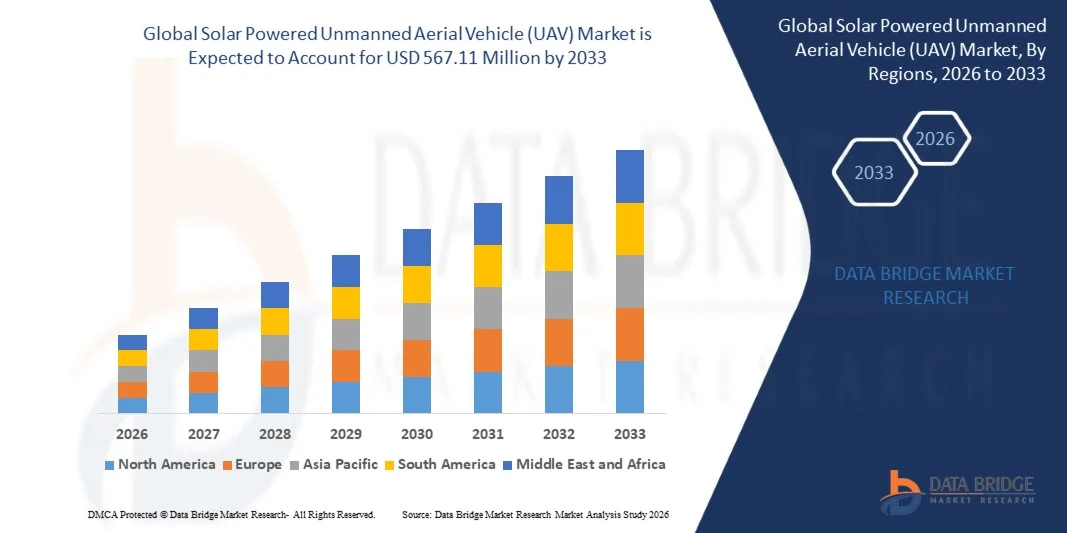
- The global solar powered unmanned aerial vehicle (UAV) market size was valued at USD 375.18 million in 2025 and is expected to reach USD 567.11 million by 2033, at a CAGR of 5.30% during the forecast period
- The factors such as growth in adoption of solar powered unmanned aerial vehicle (UAV) for civil and commercial applications due to its enhanced security and surveillance activities has resulted in growth in the market value
- In addition to this the rapid introduction of solar powered unmanned aerial vehicle to execute various activities such as real-time image transmission or internet service delivery which further induce the demand for the market
What are the Major Takeaways of Solar Powered Unmanned Aerial Vehicle (UAV) Market?
- The limited endurance capacity of conventional solar powered unmanned aerial vehicle (UAV) part in airlines engine is one of the major issues that will hamper the market’s growth rate
- Also, further technological advancements will also create lucrative growth opportunities for the market. The factors such as dissimilar restrictions and policies, technical constraints and deferred or withdrawn funds are challenging for the market
- North America dominated the solar powered unmanned aerial vehicle (UAV) market with a 40.8% revenue share in 2025, driven by strong investments in advanced aerospace technologies, defense modernization programs, and increasing development of high-altitude long-endurance UAV platforms across the U.S. and Canada
- Asia-Pacific is projected to register the fastest CAGR of 10.69% from 2026 to 2033, driven by rapid semiconductor expansion, strong electronics manufacturing ecosystems, 5G deployment, and rising adoption of embedded systems across China, Japan, India, South Korea, and Southeast Asia
- The Fixed-Wing segment dominated the market with a 52.7% share in 2025, as these UAVs are widely preferred for long-endurance and high-altitude missions
Report Scope and Solar Powered Unmanned Aerial Vehicle (UAV) Market Segmentation
|
Attributes |
Solar Powered Unmanned Aerial Vehicle (UAV) Key Market Insights |
|
Segments Covered |
|
|
Countries Covered |
North America
Europe
Asia-Pacific
Middle East and Africa
South America
|
|
Key Market Players |
|
|
Market Opportunities |
|
|
Value Added Data Infosets |
In addition to the insights on market scenarios such as market value, growth rate, segmentation, geographical coverage, and major players, the market reports curated by the Data Bridge Market Research also include in-depth expert analysis, pricing analysis, brand share analysis, consumer survey, demography analysis, supply chain analysis, value chain analysis, raw material/consumables overview, vendor selection criteria, PESTLE Analysis, Porter Analysis, and regulatory framework. |
What is the Key Trend in the Solar Powered Unmanned Aerial Vehicle (UAV) Market?
“Increasing Development of Long-Endurance, High-Altitude Solar UAV Platforms”
- The solar powered unmanned aerial vehicle (UAV) market is witnessing increasing adoption of long-endurance UAVs capable of operating for extended durations using solar energy, reducing dependence on conventional fuel sources
- Manufacturers are focusing on high-efficiency solar cells, lightweight composite materials, and advanced energy storage systems to improve flight endurance and operational efficiency of solar UAV platforms
- Growing demand for persistent aerial surveillance, environmental monitoring, and communication relay systems is encouraging the development of solar-powered UAVs capable of remaining airborne for days or even months
- For instance, companies such as Airbus, AeroVironment, BAE Systems, Thales Group, and Elbit Systems are developing high-altitude solar UAVs designed for intelligence, surveillance, and reconnaissance (ISR) missions and communication coverage
- Increasing need for low-emission aerial platforms and cost-efficient long-duration flight capabilities is accelerating the deployment of solar-powered UAVs across defense, telecommunications, and environmental monitoring applications
- As demand for sustainable aviation technologies and persistent aerial operations increases, Solar Powered UAVs are expected to play a crucial role in next-generation aerial monitoring and communication infrastructure
What are the Key Drivers of Solar Powered Unmanned Aerial Vehicle (UAV) Market?
- Rising demand for long-endurance UAV platforms capable of providing continuous aerial surveillance and communication services is significantly driving market growth
- For instance, in 2024–2025, leading companies such as Airbus, AeroVironment, and Thales Group expanded development programs focused on solar-powered high-altitude UAVs designed for long-duration flight and communication relay missions
- Growing adoption of UAVs across defense surveillance, border security, disaster monitoring, environmental observation, and telecommunications infrastructure is increasing demand for solar-powered UAV platforms worldwide
- Advancements in solar panel efficiency, lightweight airframe materials, energy storage technologies, and autonomous flight control systems are enhancing flight duration and operational reliability
- Increasing investments in high-altitude pseudo-satellite (HAPS) platforms, AI-enabled flight systems, and next-generation aerial monitoring technologies are creating significant opportunities for solar-powered UAV deployment
- Supported by rising investments in defense modernization, sustainable aviation technologies, and smart communication infrastructure, the Solar Powered UAV market is expected to witness strong long-term growth
Which Factor is Challenging the Growth of the Solar Powered Unmanned Aerial Vehicle (UAV) Market?
- High development and manufacturing costs associated with advanced solar panels, lightweight composite airframes, and energy storage systems limit large-scale adoption of solar-powered UAVs
- For instance, during 2024–2025, fluctuations in advanced material costs and supply chain constraints increased production expenses for several UAV manufacturers developing solar-powered aerial platforms
- Limited energy storage capacity and dependence on sunlight availability can restrict continuous operation in regions with limited solar radiation or adverse weather conditions
- Complexity in designing lightweight yet durable UAV structures capable of maintaining stable long-duration flight increases engineering challenges and development timelines
- Competition from conventional long-endurance UAVs, satellite-based monitoring systems, and hybrid fuel-powered drones creates technological and market adoption challenges
- To overcome these limitations, manufacturers are focusing on improving solar cell efficiency, advanced battery technologies, autonomous flight systems, and lightweight structural materials to enhance the performance and commercial viability of solar-powered UAV platforms
How is the Solar Powered Unmanned Aerial Vehicle (UAV) Market Segmented?
The market is segmented on the basis of type, component, and application.
• By Type
On the basis of type, the solar powered unmanned aerial vehicle (UAV) market is segmented into Fixed-Wing, Rotorcraft, and Umbrella. The Fixed-Wing segment dominated the market with a 52.7% share in 2025, as these UAVs are widely preferred for long-endurance and high-altitude missions. Fixed-wing solar UAVs offer superior aerodynamic efficiency, extended flight duration, and the ability to cover large geographic areas, making them highly suitable for surveillance, environmental monitoring, and communication relay operations. Their capability to integrate large solar panels across wings further improves energy harvesting and flight endurance.
The Umbrella segment is expected to grow at the fastest CAGR from 2026 to 2033, driven by increasing interest in innovative UAV designs capable of maximizing solar energy absorption and improving flight stability. Umbrella-style UAVs provide large surface areas for solar panel integration and enhanced energy efficiency. Growing investments in experimental UAV designs and high-altitude pseudo-satellite (HAPS) technologies are expected to accelerate adoption of umbrella-type solar UAVs in advanced aerial monitoring and communication applications.
• By Component
On the basis of component, the market is segmented into Propulsion System, Airframe, Guidance Navigation and Control System, and Payload. The Airframe segment dominated the market with a 34.6% share in 2025, supported by the increasing use of lightweight composite materials and advanced structural designs that enable long-endurance flight capabilities. Solar-powered UAV airframes are specifically engineered to support integrated solar panels while maintaining lightweight and aerodynamic performance. Continuous innovations in carbon fiber composites, structural optimization, and lightweight materials enhance durability and flight efficiency.
The Guidance Navigation and Control System segment is projected to grow at the fastest CAGR from 2026 to 2033, driven by rapid advancements in autonomous flight technologies, artificial intelligence-based navigation systems, and advanced sensors. Increasing deployment of solar-powered UAVs in complex missions such as long-duration surveillance, environmental monitoring, and communication relay requires highly accurate navigation, autonomous flight control, and advanced data processing capabilities.
• By Application
On the basis of application, the market is segmented into Defense and Commercial. The Defense segment dominated the market with a 61.9% share in 2025, driven by the increasing use of solar-powered UAVs for intelligence, surveillance, and reconnaissance (ISR) missions, border monitoring, and long-endurance defense operations. Defense organizations are investing heavily in high-altitude solar UAV platforms capable of remaining airborne for extended durations to provide persistent surveillance and communication support. These UAVs offer cost-effective alternatives to satellites for certain military monitoring operations.
The Commercial segment is expected to grow at the fastest CAGR from 2026 to 2033, fueled by expanding applications in telecommunications, environmental monitoring, disaster management, agriculture, and atmospheric research. Solar-powered UAVs are increasingly being explored as high-altitude communication platforms to deliver internet connectivity to remote areas. Growing demand for sustainable aerial monitoring technologies and advancements in solar energy systems are expected to accelerate commercial adoption globally.
Which Region Holds the Largest Share of the Solar Powered Unmanned Aerial Vehicle (UAV) Market?
- North America dominated the solar powered unmanned aerial vehicle (UAV) market with a 40.8% revenue share in 2025, driven by strong investments in advanced aerospace technologies, defense modernization programs, and increasing development of high-altitude long-endurance UAV platforms across the U.S. and Canada. Rising demand for persistent surveillance, border monitoring, and communication relay systems is encouraging defense organizations and aerospace companies to deploy solar-powered UAV technologies for long-duration missions
- Leading companies in North America are focusing on high-efficiency solar cells, lightweight composite airframes, advanced propulsion systems, and autonomous flight technologies, strengthening the region’s technological leadership in solar-powered UAV development. Continuous investments in high-altitude pseudo-satellite (HAPS) platforms and sustainable aviation technologies further drive market expansion
- Strong aerospace infrastructure, advanced research institutions, and increasing collaboration between defense agencies and private aerospace companies further reinforce North America’s leadership in the global Solar Powered UAV market
U.S. Solar Powered Unmanned Aerial Vehicle (UAV) Market Insight
The U.S. is the largest contributor in North America, supported by strong defense spending, advanced aerospace manufacturing capabilities, and continuous innovation in unmanned aerial systems. Government agencies and defense organizations are increasingly investing in solar-powered UAV platforms for intelligence, surveillance, and reconnaissance (ISR) missions, long-duration border monitoring, and communication relay applications. Increasing development of high-altitude UAV platforms, AI-enabled flight systems, and next-generation aerospace technologies further strengthens the demand for solar-powered UAV systems across the country.
Canada Solar Powered Unmanned Aerial Vehicle (UAV) Market Insight
Canada contributes significantly to regional market growth, driven by rising investments in aerospace innovation, environmental monitoring programs, and advanced unmanned aerial technologies. Solar-powered UAVs are increasingly used for climate monitoring, remote sensing, wildlife observation, and disaster management applications. The presence of a skilled aerospace workforce, growing research collaborations, and supportive government initiatives promoting advanced aviation technologies continue to strengthen solar UAV adoption across Canada.
Asia-Pacific Solar Powered Unmanned Aerial Vehicle (UAV) Market
Asia-Pacific is projected to register the fastest CAGR of 9.12% from 2026 to 2033, driven by increasing investments in defense modernization, expanding aerospace manufacturing capabilities, and rising demand for UAV-based surveillance and communication platforms across China, Japan, India, South Korea, and Southeast Asia. Rapid growth in drone technology development, satellite communication alternatives, and smart monitoring infrastructure is accelerating demand for long-endurance solar-powered UAV systems across the region.
China Solar Powered Unmanned Aerial Vehicle (UAV) Market Insight
China is the largest contributor within Asia-Pacific, supported by strong government investment in UAV technology development and large-scale aerospace manufacturing capabilities. Increasing deployment of solar-powered UAVs for border surveillance, environmental monitoring, and communication infrastructure expansion is driving market growth. Strong domestic drone manufacturing ecosystems and competitive technological innovation further support rapid adoption of solar-powered UAV platforms.
Japan Solar Powered Unmanned Aerial Vehicle (UAV) Market Insight
Japan demonstrates steady growth supported by its advanced aerospace engineering capabilities and strong focus on precision technology development. Solar-powered UAV systems are increasingly explored for disaster monitoring, atmospheric research, and communication applications. Continuous innovation in robotics, automation technologies, and aerospace engineering further supports long-term market expansion in the country.
India Solar Powered Unmanned Aerial Vehicle (UAV) Market Insight
India is emerging as a rapidly growing UAV technology hub, supported by government initiatives promoting domestic drone manufacturing and aerospace innovation. Solar-powered UAVs are increasingly being explored for applications such as border surveillance, agricultural monitoring, disaster management, and communication services in remote areas. Increasing investments in drone startups and research institutions are accelerating the development and deployment of solar UAV technologies across the country.
South Korea Solar Powered Unmanned Aerial Vehicle (UAV) Market Insight
South Korea contributes significantly to regional growth due to its strong electronics, aerospace, and advanced technology sectors. Increasing development of UAV platforms for defense surveillance, communication infrastructure, and environmental monitoring is supporting the adoption of solar-powered UAV systems. Continuous technological innovation, strong industrial infrastructure, and government support for drone technology development further strengthen the country’s role in the Asia-Pacific solar UAV market.
Which are the Top Companies in Solar Powered Unmanned Aerial Vehicle (UAV) Market?
The solar powered unmanned aerial vehicle (UAV) industry is primarily led by well-established companies, including:
- Sunbirds SAS (France)
- Ocean Aero (U.S.)
- DJI (China)
- Parrot Drones SAS (France)
- Elbit Systems Ltd (Israel)
- ZEROTECH (China)
- Yamaha Motor Corporation (Japan)
- Draganfly Innovations (Canada)
- Barnard Microsystems Ltd (U.K.)
- Skycatch, Inc. (U.S.)
- PrecisionHawk (U.S.)
- Lockheed Martin Corporation (U.S.)
- Boeing (U.S.)
- BAE Systems Plc (U.K.)
- AIR6 SYSTEMS (France)
- Sunlight Aerospace (U.S.)
- Thales Group (France)
- INSITU (U.S.)
- Aurora Flight Sciences (U.S.)
- Intel Corporation (U.S.)
- Silent Falcon UAS (U.S.)
- Bye Aerospace Inc (U.S.)
- EHang (China)
- HUVRData (U.S.)
- AeroVironment Inc. (U.S.)
- Airbus S.A.S (France)
- General Dynamics Mission Systems, Inc. (U.S.)
- Flyability (Switzerland)
- Northrop Grumman (U.S.)
What are the Recent Developments in Global Solar Powered Unmanned Aerial Vehicle (UAV) Market?
- In July 2023, BAE Systems’ PHASA-35 solar-electric drone, developed by Prismatic Ltd, successfully reached an altitude of over 66,000 feet during a trial flight in New Mexico, entering the stratosphere and demonstrating its capability for ultra-long-endurance missions such as surveillance, communications support, disaster response, and border monitoring, thereby highlighting its potential as a cost-effective alternative to satellites and conventional aircraft
- In April 2023, Kea Aerospace launched the solar-powered Kea Atmos Mk-1, an uncrewed stratospheric aircraft designed for high-altitude flight testing, featuring a 12.5-meter wingspan and a lightweight structure under 40 kg capable of reaching altitudes up to 50,000 feet, while its launch using an electric Audi e-tron Sportback showcased the integration of sustainable aviation technologies and electric mobility solutions, ultimately strengthening innovation in high-altitude solar UAV platforms
- In June 2022, DJI introduced DJI RS 3 and DJI RS 3 Pro, featuring an automated gimbal axis lock mechanism that automatically releases and unfolds upon powering on, enabling operators to set up the device within seconds and significantly improving operational efficiency for aerial imaging and drone-based applications, thereby enhancing user convenience and professional filming performance
- In May 2022, General Atomics Aeronautical Systems launched Gambit, an autonomous collaborative UAV platform developed using digital engineering technologies that help reduce acquisition costs while improving mission flexibility and system integration capabilities, thereby advancing the development of next-generation autonomous aerial platforms for defense and surveillance operations

- Interactive Data Analysis Dashboard
- Company Analysis Dashboard for high growth potential opportunities
- Research Analyst Access for customization & queries
- Competitor Analysis with Interactive dashboard
- Latest News, Updates & Trend analysis
- Harness the Power of Benchmark Analysis for Comprehensive Competitor Tracking
Data collection and base year analysis are done using data collection modules with large sample sizes. The stage includes obtaining market information or related data through various sources and strategies. It includes examining and planning all the data acquired from the past in advance. It likewise envelops the examination of information inconsistencies seen across different information sources. The market data is analysed and estimated using market statistical and coherent models. Also, market share analysis and key trend analysis are the major success factors in the market report. To know more, please request an analyst call or drop down your inquiry.
The key research methodology used by DBMR research team is data triangulation which involves data mining, analysis of the impact of data variables on the market and primary (industry expert) validation. Data models include Vendor Positioning Grid, Market Time Line Analysis, Market Overview and Guide, Company Positioning Grid, Patent Analysis, Pricing Analysis, Company Market Share Analysis, Standards of Measurement, Global versus Regional and Vendor Share Analysis. To know more about the research methodology, drop in an inquiry to speak to our industry experts.
Data Bridge Market Research is a leader in advanced formative research. We take pride in servicing our existing and new customers with data and analysis that match and suits their goal. The report can be customized to include price trend analysis of target brands understanding the market for additional countries (ask for the list of countries), clinical trial results data, literature review, refurbished market and product base analysis. Market analysis of target competitors can be analyzed from technology-based analysis to market portfolio strategies. We can add as many competitors that you require data about in the format and data style you are looking for. Our team of analysts can also provide you data in crude raw excel files pivot tables (Fact book) or can assist you in creating presentations from the data sets available in the report.













