


What is the Solid-State Solar Cell Market Size and Growth Rate?
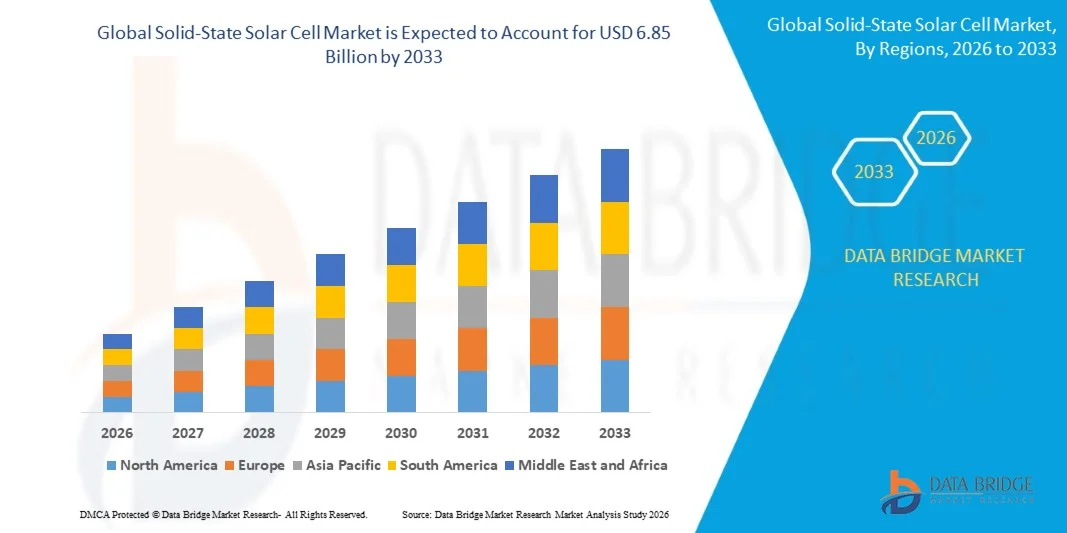
- As per Data Bridge Market Research analysis, the solid-state solar cell market was valued at USD 1.94 billion in 2025 and is projected to reach USD 6.85 billion by 2033, growing at a CAGR of 17.15% from 2026 to 2033.
- The market is experiencing rapid growth driven by record-setting efficiency gains in perovskite and tandem cell architectures, expanding gigawatt-scale manufacturing capacity, and rising integration of lightweight, flexible photovoltaic layers across utility, building, and consumer electronics applications.
- Escalating global electricity demand, combined with government incentives for next-generation renewable technologies such as the EU's Net-Zero Industry Act and U.S. federal tax credits, is compelling utility developers, automotive OEMs, and consumer electronics manufacturers to adopt solid-state photovoltaic solutions. Perovskite-silicon tandem cells are increasingly replacing conventional single-junction silicon modules in high-value installations, offering higher power output per unit area and improved levelized cost of energy.
Market Size & Forecast
- Global Market Value (2025): USD 1.94 Billion
- Expected Market Value (2033): USD 6.85 Billion
- Forecast CAGR (2026–2033): 17.15%
- Leading Region in 2025: Asia-Pacific
- Fastest Growing Region: Europe
What are the Major Takeaways of the Solid-State Solar Cell Market?
- Asia-Pacific dominated the global solid-state solar cell market with the largest revenue share of 44.62% in 2025, supported by gigawatt-scale perovskite manufacturing capacity in China, Japan, and South Korea.
- Europe is expected to be the fastest-growing region at a CAGR of 19.8% from 2026 to 2033, fueled by strong policy support under the EU's Net-Zero Industry Act and expanding tandem-cell gigafactory investments.
- The perovskite-silicon tandem cells segment led the market with a 38.72% share in 2025, driven by record efficiency achievements and rapid integration into existing crystalline-silicon production lines.
- Perovskite solar cells are the fastest-growing type segment, projected to register a CAGR of 20.3%, reflecting the surge in demand for low-cost, printable photovoltaic technologies.
- The utility-scale power generation segment dominated the application category with a 36.48% revenue share in 2025, led by grid-scale developers adopting high-efficiency tandem modules to lower the levelized cost of energy.
- The glass-based substrate segment accounted for 52.15% of the market share in 2025, preferred for its durability and superior conversion efficiency in utility and commercial installations.
- The flexible/film-based substrate segment is the fastest-growing category, with a CAGR of 21.4%, driven by demand for lightweight, bendable modules in aerospace, defense, and wearable electronics.
Report Scope and Solid-State Solar Cell Market Segmentation
|
Attributes |
Solid-State Solar Cell Key Market Insights |
|
Segments Covered |
|
|
Countries Covered |
North America
Europe
Asia-Pacific
Middle East and Africa
South America
|
|
Key Market Players |
|
|
Market Opportunities |
|
|
Value Added Data Infosets |
In addition to the insights on market scenarios such as market value, growth rate, segmentation, geographical coverage, and major players, the market reports curated by the Data Bridge Market Research also include in-depth expert analysis, geographically represented company-wise production and capacity, network layouts of distributors and partners, detailed and updated price trend analysis and deficit analysis of supply chain and demand. |
What is the Key Trend in the Solid-State Solar Cell Market?
- Manufacturers are racing to commercialize perovskite-silicon tandem cells at gigawatt scale, moving the technology rapidly from laboratory demonstration to full production.
- For instance, Oxford PV moved from R&D to commercial shipping of its perovskite-on-silicon tandem panels in late 2025, positioning its 72-cell tandem architecture as a benchmark for commercial efficiency in utility-scale deployments.
- Record efficiency milestones continue to accelerate industry confidence in solid-state technologies.
- For instance, in December 2024, Hanwha Qcells achieved a world-record 28.6% conversion efficiency on a full-area crystalline-silicon-perovskite tandem cell using an M10-format wafer, demonstrating the scalability of tandem manufacturing for mass production.
- Rising investment in dedicated gigafactories is reshaping the global supply chain for solid-state solar cells, with facilities in China and Europe scaling output to meet growing utility and BIPV demand.
- For instance, in February 2025, UtmoLight commissioned a gigawatt-scale perovskite module fabrication facility in Wuxi, China, designed to produce approximately 1.8 million modules annually.
What are the Key Drivers of the Solid-State Solar Cell Market?
- Continuous efficiency breakthroughs in perovskite and tandem architectures are significantly increasing demand from utility-scale developers seeking to lower the levelized cost of electricity.
- For instance, in August 2025, Oxford PV announced that its next-generation perovskite-on-silicon tandem solar panel achieved a world-record conversion efficiency of 25% for a commercial-format panel.
- Supportive government policy and patent-licensing activity are accelerating the transition from silicon-only production lines to tandem and solid-state architectures.
- For instance, in February 2026, First Solar licensed Oxford PV's perovskite patent portfolio for U.S. markets, integrating tandem technology into its thin-film production roadmap.
- Automotive and consumer electronics companies are increasingly integrating flexible, lightweight solid-state photovoltaic layers into their product roadmaps, reducing reliance on rigid silicon panels and expanding addressable applications for the technology.
Which Factors are Challenging the Growth of the Solid-State Solar Cell Market?
- Long-term operational stability and material degradation remain significant barriers to widespread commercial adoption of perovskite-based solid-state cells.
- For instance, outdoor stability tests conducted by researchers in Belgium and Cyprus on metal halide perovskite mini-modules showed performance loss rates of 7–8% per month, with the most durable sample retaining only 78% of its initial efficiency after one year.
- The high capital investment required to establish gigawatt-scale tandem and perovskite manufacturing lines limits adoption among smaller module makers and emerging-market producers.
- Regulatory scrutiny surrounding lead content in certain perovskite formulations continues to create uncertainty for manufacturers navigating environmental compliance across different regions, slowing commercial rollout in some markets despite strong technical performance.
How is the Solid-State Solar Cell Market Segmented?
The solid-state solar cell market is segmented on the basis of type, substrate, application, end user, deposition technique, efficiency tier, and sales channel.
- By Type
On the basis of type, the global solid-state solar cell market is segmented into perovskite solar cells, perovskite-silicon tandem cells, dye-sensitized solid-state cells, quantum dot solid-state cells, and organic solid-state cells. The Perovskite-Silicon Tandem Cells segment dominated the market with a 38.72% share in 2025, owing to record-setting efficiency gains, compatibility with existing crystalline-silicon production lines, and rapid commercialization by leading module manufacturers. Tandem architectures allow developers to capture a broader solar spectrum, delivering higher power output per unit area than single-junction cells.
The Perovskite Solar Cells (single-junction) segment is projected to register the fastest growth at a CAGR of 20.3% from 2026 to 2033, driven by low-cost, roll-to-roll printable manufacturing processes, declining raw material costs, and rising demand for lightweight, low-carbon-footprint photovoltaic solutions across emerging applications.
- By Substrate
On the basis of substrate, the global solid-state solar cell market is segmented into glass-based, flexible/film-based, and silicon wafer-based. The glass-based segment led the market with a 52.15% share in 2025, supported by superior durability, higher conversion efficiency, and widespread adoption in utility-scale and commercial installations that prioritize long-term performance stability.
The flexible/film-based segment is expected to witness the fastest CAGR of 21.4% from 2026 to 2033, driven by increasing demand for lightweight, bendable solar modules in aerospace, wearable electronics, and building-integrated applications where conventional rigid glass panels are impractical.
- By Application
On the basis of application, the global solid-state solar cell market is segmented into utility-scale power generation, building-integrated photovoltaics (BIPV), portable & wearable electronics, aerospace & defense, and automotive integration. The utility-scale power generation segment dominated the market with a 36.48% share in 2025, driven by rising deployment of high-efficiency tandem modules by grid-scale developers seeking to lower the levelized cost of electricity.
The building-integrated photovoltaics (BIPV) segment is anticipated to witness the fastest CAGR of 19.1% from 2026 to 2033, fueled by growing architectural adoption of solar-active glass façades, rising green-building certifications, and increasing government incentives for net-zero-energy construction.
- By End User
On the basis of end user, the global solid-state solar cell market is segmented into residential, commercial & industrial, utility providers, government & defense agencies, and consumer electronics manufacturers. The utility providers segment dominated the market with the largest share in 2025 due to sustained investment in gigawatt-scale tandem module procurement to meet renewable energy targets.
The consumer electronics manufacturers segment is expected to witness the fastest CAGR from 2026 to 2033, driven by rising integration of flexible solid-state photovoltaic layers into wearables, sensors, and self-charging portable devices.
- By Deposition Technique
On the basis of deposition technique, the global solid-state solar cell market is segmented into spin coating, vapor deposition, slot-die coating, screen printing, and inkjet printing. The vapor deposition segment dominated the market in 2025 owing to its ability to produce uniform, high-quality perovskite films suitable for large-area tandem cell manufacturing.
The slot-die coating segment is projected to register the fastest CAGR from 2026 to 2033, supported by its compatibility with continuous roll-to-roll production, which significantly lowers manufacturing costs at gigawatt scale.
- By Efficiency Tier
On the basis of efficiency tier, the global solid-state solar cell market is segmented into below 20%, 20%–25%, and above 25%. The 20%–25% efficiency tier dominated the market in 2025, reflecting the current commercial sweet spot for perovskite-silicon tandem modules shipped by leading manufacturers.
The above 25% efficiency tier is expected to witness the fastest CAGR from 2026 to 2033, as record-setting laboratory efficiencies achieved by leading developers move rapidly toward commercial-scale production.
- By Sales Channel
On the basis of sales channel, the global solid-state solar cell market is segmented into direct/OEM sales, distributors & system integrators, and online/retail. The direct/OEM sales segment dominated the market in 2025, supported by long-term supply agreements between module manufacturers and utility-scale developers.
The distributors & system integrators segment is expected to witness the fastest CAGR from 2026 to 2033, driven by expanding regional partner networks that improve accessibility for commercial and residential installers.
Which Region Holds the Largest Share of the Solid-State Solar Cell Market?
- Asia-Pacific dominated the solid-state solar cell market and accounted for the largest revenue share of 44.62% in 2025, supported by large-scale perovskite and tandem manufacturing capacity across China, Japan, and South Korea.
- The region benefits from strong government backing for next-generation photovoltaic manufacturing, an established electronics supply chain, and growing deployment of solid-state modules across utility, commercial, and consumer electronics applications. Continued investment in gigafactory capacity and R&D collaboration between manufacturers and research institutes is reinforcing Asia-Pacific's leadership position in the global market.
China Solid-State Solar Cell Market Insight
The China solid-state solar cell market is growing rapidly, supported by aggressive gigawatt-scale investment in perovskite and tandem module manufacturing capacity, strong government backing for next-generation photovoltaic technologies, and an established electronics and materials supply chain. Leading domestic manufacturers are scaling roll-to-roll and vapor-deposition production lines, positioning China as the largest production hub for solid-state solar technologies globally.
Japan Solid-State Solar Cell Market Insight
The Japan solid-state solar cell market is witnessing steady growth, driven by strong domestic expertise in materials science, thin-film coating technologies, and precision manufacturing. Automotive and electronics conglomerates are increasingly applying their materials and mass-production know-how to flexible perovskite modules, targeting building-integrated and mobility-surface applications alongside continued efficiency research.
Europe Solid-State Solar Cell Market Insight
The Europe solid-state solar cell market is expected to witness the fastest growth at a CAGR of 19.8% from 2026 to 2033, driven by strong policy support under the European Union’s Net-Zero Industry Act and increasing investments in domestic next-generation photovoltaic manufacturing. Growing development of tandem solar cell technologies, expansion of gigafactory projects, and rising focus on strengthening regional solar manufacturing capabilities are further supporting market growth.
Germany Solid-State Solar Cell Market Insight
The Germany solid-state solar cell market is expanding due to the country's strong photovoltaic research base, advanced manufacturing capabilities, and supportive EU policy frameworks such as the Net-Zero Industry Act. Automotive suppliers and research institutes are collaborating with tandem-cell developers to scale pilot production lines and validate performance for utility and BIPV applications.
U.K. Solid-State Solar Cell Market Insight
The U.K. solid-state solar cell market is growing steadily, anchored by the presence of leading perovskite-tandem developers advancing commercial-scale production. Rising investment in domestic manufacturing capacity, strong intellectual-property licensing activity, and growing utility-scale demand for high-efficiency modules are positioning the U.K. as a key innovation hub for solid-state photovoltaic technology.
Which are the Top Companies in Solid-State Solar Cell Market?
The solid-state solar cell industry is primarily led by well-established companies, including:
- First Solar, Inc. (U.S.)
- Hanwha Qcells Co., Ltd. (South Korea)
- LONGi Green Energy Technology Co., Ltd. (China)
- JinkoSolar Holding Co., Ltd. (China)
- Trina Solar Limited (China)
- Canadian Solar Inc. (Canada)
- JA Solar Technology Co., Ltd. (China)
- Tongwei Co., Ltd. (China)
- GCL System Integration Technology Co., Ltd. (China)
- Risen Energy Co., Ltd. (China)
- SunPower Corporation (U.S.)
- Meyer Burger Technology AG (Switzerland)
- REC Solar Holdings AS (Norway)
- Sharp Corporation (Japan)
- Panasonic Holdings Corporation (Japan)
What are Latest Developments in Solid-State Solar Cell Market?
- In February 2026, First Solar licensed Oxford PV's perovskite patent portfolio for U.S. markets, integrating tandem cell technology into its thin-film manufacturing roadmap and strengthening its position in the domestic high-efficiency module segment.
- In December 2024, Hanwha Qcells achieved a world-record 28.6% conversion efficiency on a full-area crystalline-silicon-perovskite tandem cell built on an M10-format wafer, demonstrating a scalable path to mass production of high-efficiency tandem modules.
- In February 2025, UtmoLight commissioned its gigawatt-scale perovskite module fabrication facility in Wuxi, China, designed to produce approximately 1.8 million ultra-large modules annually, with initial pilot units reaching 450 W output.
- In March 2025, Tandem PV closed a $50 million Series A funding round to build a commercial-scale perovskite-silicon tandem manufacturing line, and subsequently acquired nexTC Corporation to strengthen its advanced thin-film coating capabilities.
- In June 2024, LONGi achieved a world-record 34.6% conversion efficiency on a two-terminal perovskite-silicon tandem solar cell, reinforcing the technology's potential to surpass the theoretical efficiency limits of conventional silicon cells.

- Interactive Data Analysis Dashboard
- Company Analysis Dashboard for high growth potential opportunities
- Research Analyst Access for customization & queries
- Competitor Analysis with Interactive dashboard
- Latest News, Updates & Trend analysis
- Harness the Power of Benchmark Analysis for Comprehensive Competitor Tracking
Global Solid State Solar Cell Market, Supply Chain Analysis and Ecosystem Framework
To support market growth and help clients navigate the impact of geopolitical shifts, DBMR has integrated in-depth supply chain analysis into its Global Solid State Solar Cell Market research reports. This addition empowers clients to respond effectively to global changes affecting their industries. The supply chain analysis section includes detailed insights such as Global Solid State Solar Cell Market consumption and production by country, price trend analysis, the impact of tariffs and geopolitical developments, and import and export trends by country and HSN code. It also highlights major suppliers with data on production capacity and company profiles, as well as key importers and exporters. In addition to research, DBMR offers specialized supply chain consulting services backed by over a decade of experience, providing solutions like supplier discovery, supplier risk assessment, price trend analysis, impact evaluation of inflation and trade route changes, and comprehensive market trend analysis.
Data collection and base year analysis are done using data collection modules with large sample sizes. The stage includes obtaining market information or related data through various sources and strategies. It includes examining and planning all the data acquired from the past in advance. It likewise envelops the examination of information inconsistencies seen across different information sources. The market data is analysed and estimated using market statistical and coherent models. Also, market share analysis and key trend analysis are the major success factors in the market report. To know more, please request an analyst call or drop down your inquiry.
The key research methodology used by DBMR research team is data triangulation which involves data mining, analysis of the impact of data variables on the market and primary (industry expert) validation. Data models include Vendor Positioning Grid, Market Time Line Analysis, Market Overview and Guide, Company Positioning Grid, Patent Analysis, Pricing Analysis, Company Market Share Analysis, Standards of Measurement, Global versus Regional and Vendor Share Analysis. To know more about the research methodology, drop in an inquiry to speak to our industry experts.
Data Bridge Market Research is a leader in advanced formative research. We take pride in servicing our existing and new customers with data and analysis that match and suits their goal. The report can be customized to include price trend analysis of target brands understanding the market for additional countries (ask for the list of countries), clinical trial results data, literature review, refurbished market and product base analysis. Market analysis of target competitors can be analyzed from technology-based analysis to market portfolio strategies. We can add as many competitors that you require data about in the format and data style you are looking for. Our team of analysts can also provide you data in crude raw excel files pivot tables (Fact book) or can assist you in creating presentations from the data sets available in the report.













