What is the Specialty Fertilizers Market Size and Growth Rate?
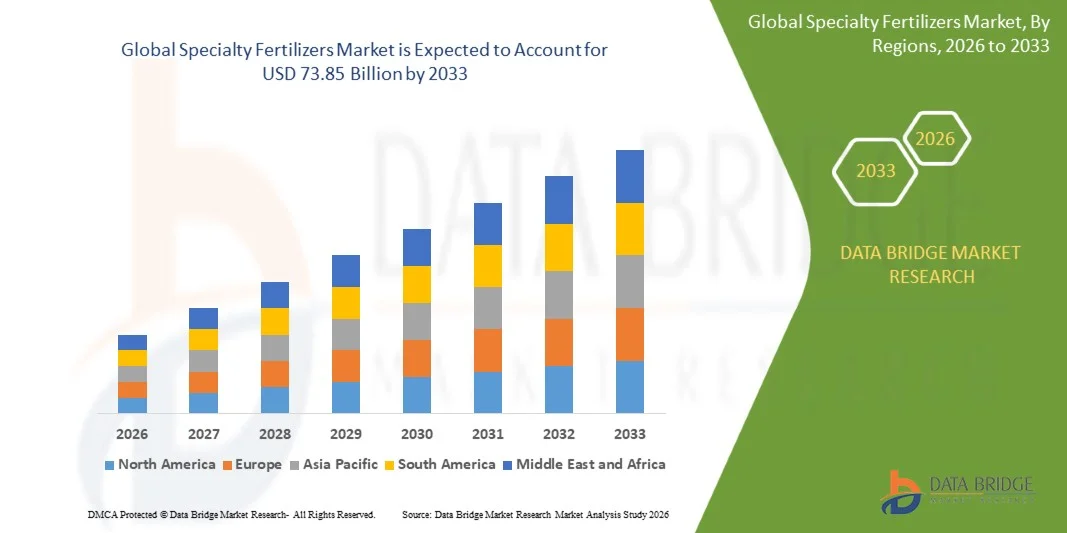
- As per Data Bridge Market Research analysis, the specialty fertilizers market was valued at USD 40.50 billion in 2025 and is projected to reach USD 73.85 billion by 2033, growing at a CAGR of 7.80% from 2026 to 2033.
- The market is experiencing consistent growth driven by rising demand for precision agriculture and nutrient-use efficiency, increasing adoption of controlled-release and water-soluble fertilizers, and expanding applications across high-value crops, fertigation, and sustainable farming practices.
- The increasing need to improve crop productivity while reducing nutrient losses, combined with growing concerns over soil health and environmental sustainability, is compelling farmers and agricultural producers to adopt advanced specialty fertilizer solutions. Water-soluble, controlled-release, and micronutrient fertilizers are increasingly being used to provide targeted nutrient delivery, improve nutrient-use efficiency, and support precision farming and high-value crop cultivation.
Market Size & Forecast
- Global Market Value (2025): USD 40.50 Billion
- Expected Market Value (2033): USD 73.85 Billion
- Forecast CAGR (2026–2033): 7.80%
- Leading Region in 2025: North America
- Fastest Growing Region: Asia Pacific
What are the Major Takeaways of the Specialty Fertilizers Market?
- North America dominated the specialty fertilizers market with the largest revenue share of 33.0% in 2025, supported by advanced precision agriculture infrastructure, widespread adoption of efficient nutrient-management practices, and strong demand for specialty fertilizer products.
- Asia-Pacific is expected to be the fastest-growing region at a CAGR of 7.5% from 2026 to 2033, fueled by increasing agricultural productivity requirements, growing adoption of precision farming, and rising demand for efficient nutrient delivery solutions.
- The fruits & vegetables segment led the market with a 35% share in 2025, driven by the intensive nutrient requirements of horticultural crops and the increasing adoption of specialized nutrient management practices.
- Cereals & grains are the fastest-growing crop type, projected to register a CAGR of 8.2%, reflecting the surge in demand for food grains and increasing focus on improving agricultural productivity
- The fertigation segment dominated the application method category with a 53.8% revenue share in 2025, led by its ability to deliver nutrients directly to the crop root zone with high precision.
- Urea ammonium nitrate accounted for 23% of the market share in 2025, preferred by its high nitrogen availability, application efficiency, and versatility across different crops.
- The micronutrients segment is the fastest-growing technology category, with a CAGR of 8.9%, driven by increasing recognition of micronutrient deficiencies and the need for targeted crop nutrition.
Report Scope and Specialty Fertilizers Market Segmentation
|
Attributes |
Specialty Fertilizers Key Market Insights |
|
Segments Covered |
|
|
Countries Covered |
North America
Europe
Asia-Pacific
Middle East and Africa
South America
|
|
Key Market Players |
|
|
Market Opportunities |
|
|
Value Added Data Infosets |
In addition to the insights on market scenarios such as market value, growth rate, segmentation, geographical coverage, and major players, the market reports curated by the Data Bridge Market Research also include import export analysis, production capacity overview, production consumption analysis, price trend analysis, climate change scenario, supply chain analysis, value chain analysis, raw material/consumables overview, vendor selection criteria, PESTLE Analysis, Porter Analysis, and regulatory framework. |
What is the Key Trend in the Specialty Fertilizers Market?
- Specialty fertilizer producers are increasingly developing precision nutrient solutions that improve nutrient-use efficiency, support targeted application, and reduce nutrient losses across intensive and high-value agricultural production systems and modern precision-farming practices.
- For instance, in February 2026, Orbia Netafim introduced its Dosing 5G range with AI-automated fertigation dosing, remote control, monitoring, and precision nutrient delivery, helping farmers optimize resource use, reduce costs, protect crop quality, and improve yields under changing climatic conditions systems.
- Water-soluble fertilizers are gaining traction as growers seek precise nutrient delivery through fertigation and foliar application systems.
- Controlled-release formulations are increasingly being adopted to synchronize nutrient release with crop requirements, improving efficiency, reducing nutrient losses, and supporting fertilizer management.
- For instance, in January 2025, Origin Amenity Solutions launched Xtend CRF, combining controlled-release technologies with temperature-responsive coating to deliver nitrogen consistently across changing seasonal conditions and crop requirements in professional turf and amenity applications.
- As growers increasingly prioritize nutrient efficiency, sustainability, and precision application, specialty fertilizers are expected to become more integrated with digital agriculture, fertigation, crop-specific nutrient management, and advanced controlled-release technologies worldwide and high-value crop cultivation globally in commercial agriculture.
What are the Key Drivers of the Specialty Fertilizers Market?
- The growing demand for higher crop productivity and nutrient-use efficiency is significantly increasing adoption of specialty fertilizers capable of delivering targeted nutrition across diverse soil and crop conditions, while improving fertilizer application efficiency and profitability.
- For instance, in August 2025, Kan Biosys launched 12 ROFA water-soluble specialty fertilizers developed with De Sangosse, designed to provide precise crop nutrition from sowing through harvest in Indian agriculture across Indian farms.
- Farmers and input companies are integrating specialty fertilizers into precision farming programs to improve nutrient uptake, reduce wastage, and enhance crop quality while supporting data-driven management.
- For instance, in January 2025, Haifa Group launched its wholly owned Indian subsidiary to expand access to precision-focused fertilizers, including water-soluble products designed for fertigation, foliar feeding, and soilless cultivation.
- With agriculture increasingly prioritizing resource efficiency, climate resilience, and improved soil health, specialty fertilizers will remain essential for supporting productive and sustainable crop production systems worldwide through precise nutrient management.
What Factors are Challenging the Growth of the Specialty Fertilizers Market?
- Specialty fertilizers often require higher production costs because coatings, inhibitors, micronutrients, and solubility technologies add complexity compared with conventional fertilizers at scale globally.
- For instance, in March 2026, the Asian Development Bank reported that enhanced-efficiency specialty fertilizers in India face higher costs from coatings, inhibitors, and solubility controls, limiting wider adoption among farmers for broad-based precision agriculture adoption across developing agricultural markets.
- These higher costs can limit adoption among smallholder farmers where specialty products receive limited subsidy programs.
- Limited awareness regarding specialty fertilizer benefits and insufficient technical knowledge among farmers also restrict widespread adoption, especially in emerging agricultural markets.
- For instance, in October 2022, the Asian Development Bank provided a USD 30 million loan to Smartchem Technologies to finance capital expenditure and research for enhanced-efficiency specialty fertilizers, illustrating the substantial investment required to scale advanced fertilizer technologies while strengthening climate-resilient farming and commercial production capacity and long-term farmer adoption models.
- The high cost of specialty fertilizer products, limited farmer awareness, and affordability challenges continue to restrict market penetration, particularly among small and medium-sized agricultural producers in developing economies.
How is the Specialty Fertilizers Market Segmented?
The specialty fertilizers market is segmented on the basis of crop type, application method, fertilizer type, and technology.
- By Crop Type
On the basis of crop type, the specialty fertilizers market is segmented into cereals & grains, oilseeds & pulses, fruits & vegetables, turf & ornamentals, and others. The fruits & vegetables segment dominated the market with 35% share in 2025, owing to the intensive nutrient requirements of horticultural crops and the increasing adoption of specialized nutrient management practices. Fruits and vegetables require precise nutrition to support plant growth, yield, and crop quality. Specialty fertilizers are widely used in these crops through fertigation, foliar application, and soil application. Water-soluble fertilizers and micronutrients are particularly suitable for intensive horticultural production. The increasing cultivation of high-value fruits and vegetables is also supporting demand for targeted fertilizer solutions.
The cereals & grains segment is projected to register the fastest growth at 8.2% CAGR from 2026 to 2033, driven by rising demand for food grains and increasing focus on improving agricultural productivity. Cereals and grains such as wheat, rice, and maize require substantial nutrient inputs to maintain productivity. Specialty fertilizers are increasingly being used to address crop-specific nutrient requirements and improve nutrient-use efficiency. Precision agriculture is enabling farmers to apply nutrients more accurately across large cereal-growing areas. Increasing emphasis on sustainable food production is also encouraging the use of fertilizers that reduce nutrient losses.
- By Application Method
On the basis of application method, the specialty fertilizers market is segmented into foliar, fertigation, and soil. The fertigation segment dominated the market with a 53.8% share in 2025, owing to its ability to deliver nutrients directly to the crop root zone with high precision. Fertigation enables farmers to synchronize fertilizer application with irrigation requirements. The method improves nutrient-use efficiency while reducing unnecessary fertilizer losses. It is particularly suitable for water-soluble and liquid specialty fertilizers. Increasing adoption of drip and sprinkler irrigation is creating additional demand for fertigation-compatible products.
The foliar segment is projected to register the fastest growth at a CAGR of 8.5% from 2026 to 2033, supported by the increasing need for rapid and targeted nutrient delivery. Foliar application allows nutrients to be supplied directly through plant leaves during critical growth stages. This approach is particularly useful for addressing certain micronutrient deficiencies quickly. Increasing awareness of crop stress management is encouraging growers to adopt foliar nutrition alongside conventional applications. Advances in spraying equipment are improving application uniformity and precision.
- By Fertilizer Type
On the basis of fertilizer type, the specialty fertilizers market is segmented into urea ammonium nitrate, calcium ammonium nitrate, monoammonium phosphate, sulfate of potash, potassium nitrate, urea derivatives, blends of NPK, and others. The urea ammonium nitrate segment dominated the market with 23% share in 2025, owing to its high nitrogen availability, application efficiency, and versatility across different crops. UAN combines different forms of nitrogen, supporting sustained nutrient availability to plants. Its liquid formulation also makes it suitable for mechanized application and fertigation systems. The product is widely used across agricultural applications where efficient nitrogen management is required. Its suitability across different climatic and farming conditions further supports adoption.
The monoammonium phosphate segment is projected to register the fastest growth at a CAGR of 8.3% from 2026 to 2033, driven by its ability to provide both nitrogen and phosphorus to crops. MAP is widely used to support early root development and plant establishment. Its balanced nutrient composition makes it suitable for different crop nutrition programs. The fertilizer can be incorporated into various precision application systems depending on crop and soil requirements. Increasing emphasis on balanced fertilization is supporting the adoption of phosphorus-containing specialty fertilizers. Growing demand for efficient nutrient management and improved crop productivity is further contributing to segment growth.
- By Technology
On the basis of technology, the specialty fertilizers market is segmented into controlled-release fertilizers, water-soluble fertilizers, liquid fertilizers, micronutrients, and others. The water-soluble fertilizers segment dominated the market with 33% share in 2025, owing to its compatibility with fertigation, greenhouse farming, and precision nutrient-delivery systems. These fertilizers dissolve readily in water and allow nutrients to be delivered according to crop requirements. Their high nutrient availability makes them suitable for intensive crop production. Water-soluble formulations are extensively used in fruits and vegetables and other high-value crops. Their compatibility with drip and sprinkler irrigation further supports adoption.
The micronutrients segment is projected to register the fastest growth at a CAGR of 8.9% from 2026 to 2033, driven by increasing recognition of micronutrient deficiencies and the need for targeted crop nutrition. Micronutrient fertilizers provide essential nutrients such as zinc, boron, and molybdenum that are required for healthy crop development. Intensive cultivation and nutrient depletion are increasing the need for supplemental micronutrient applications. Precision agriculture is enabling growers to identify nutrient deficiencies and apply specific micronutrients more efficiently. These products can also be incorporated into foliar and fertigation programs for targeted delivery.
Which Region Holds the Largest Share of the Specialty Fertilizers Market?
- North America dominated the specialty fertilizers market with the largest revenue share of 33.0% in 2025, supported by advanced precision agriculture infrastructure, widespread adoption of efficient nutrient-management practices, and strong demand for specialty fertilizer products.
- The region also benefits from extensive use of fertigation, foliar application, and controlled-release fertilizer technologies, along with increasing adoption of specialty products for high-value crops. Growing emphasis on sustainable agriculture, nutrient-use efficiency, and modern farming technologies continues to strengthen North America’s leading position in the global market.
U.S. Specialty Fertilizers Market Insight
The U.S. specialty fertilizers market is witnessing strong growth due to rising adoption of precision agriculture, advanced nutrient-management practices, and efficient fertilizer application technologies. The country’s large-scale agricultural sector, along with increasing use of water-soluble, controlled-release, and micronutrient fertilizers, is driving demand across major crop production systems. In addition, growing emphasis on improving nutrient-use efficiency, reducing fertilizer losses, and enhancing crop productivity is accelerating the adoption of specialty fertilizer solutions across the country.
Asia-Pacific Specialty Fertilizers Market Insight
The Asia-Pacific specialty fertilizers market is expected to witness rapid growth, driven by expanding agricultural production, rising food demand, and increasing adoption of modern farming practices across countries such as China, India, and Japan. Growing awareness regarding balanced crop nutrition, precision agriculture, and efficient fertilizer application is supporting regional market expansion. In addition, increasing adoption of fertigation, water-soluble fertilizers, and micronutrient products is accelerating specialty fertilizer use across commercial farming and high-value crop production.
Japan Specialty Fertilizers Market Insight
The Japan specialty fertilizers market is witnessing consistent growth due to rising adoption of precision farming technologies, advanced crop nutrition practices, and efficient agricultural production systems. Farmers and agricultural producers are increasingly adopting specialty fertilizers to improve nutrient-use efficiency, crop quality, and productivity. Moreover, increasing integration of fertigation, water-soluble fertilizers, and micronutrient solutions, along with the country’s focus on sustainable and efficient agriculture, is further contributing to market growth.
China Specialty Fertilizers Market Insight
The China specialty fertilizers market is growing rapidly, driven by increasing agricultural modernization, rising demand for food production, and growing government focus on efficient fertilizer utilization. Growing adoption of precision agriculture, fertigation, and advanced nutrient-management practices across commercial farming is significantly boosting market demand. In addition, increasing awareness regarding soil health, nutrient-use efficiency, and sustainable crop production, along with expanding cultivation of high-value crops, is positioning China as a major growth market for specialty fertilizers.
U.K. Specialty Fertilizers Market Insight
The U.K. specialty fertilizers market is experiencing steady growth, supported by rising adoption of precision agriculture, sustainable farming practices, and advanced crop nutrition technologies. Increasing use of controlled-release fertilizers, micronutrients, and water-soluble products is contributing to improved nutrient management and crop productivity. Furthermore, growing emphasis on reducing nutrient losses, improving soil health, and adopting environmentally efficient agricultural practices is supporting specialty fertilizer demand across the U.K.
Germany Specialty Fertilizers Market Insight
The Germany specialty fertilizers market is expanding steadily due to the country’s advanced agricultural practices, strong focus on sustainable farming, and increasing adoption of precision nutrient-management technologies. Farmers and agricultural producers are increasingly utilizing specialty fertilizers to improve nutrient-use efficiency and support crop productivity while reducing unnecessary nutrient losses. Continuous adoption of controlled-release fertilizers, micronutrients, fertigation, and other advanced fertilizer technologies, along with strong emphasis on environmentally responsible agriculture, is further driving market growth in Germany.
Which are the Top Companies in Specialty Fertilizers Market?
The specialty fertilizers industry is primarily led by well-established companies, including:
- ICL Group Ltd. (Israel)
- Haifa Negev technologies LTD (Israel)
- Yara International ASA (Norway)
- The Mosaic Company (U.S.)
- Nutrien Ltd. (Canada)
- K+S Aktiengesellschaft (Germany)
- EuroChem Group AG (Switzerland)
- Coromandel International Limited (India)
- Grupa Azoty (Poland)
- OCP S.A. (Morocco)
- Sociedad Química y Minera de Chile S.A. (Chile)
- CF Industries Holdings, Inc. (U.S.)
- OCI Global (Netherlands)
- Deepak Fertilisers and Petrochemicals Corporation Limited (India)
- Gujarat State Fertilizers & Chemicals Limited (India)
- Chambal Fertilisers and Chemicals Limited (India)
- Aries Agro Limited (India)
- UPL Limited (India)
- COMPO EXPERT GmbH (Germany)
- AgroLiquid (U.S.)
What are Latest Developments in Specialty Fertilizers Market?
- In January 2025, Haifa Group launched its 18th international subsidiary in India, strengthening its presence in one of the world’s major agricultural markets. The new subsidiary is focused on making Haifa’s specialty fertilizers and precision plant nutrition solutions more accessible to Indian farmers, with products tailored to local crop and agricultural requirements. The expansion is intended to support improved nutrient-use efficiency and promote advanced agricultural practices across India.
- In August 2024, ICL announced a five-year distribution agreement with AMP Holdings Group for specialty water-soluble fertilizers in China. The agreement covers products used in drip irrigation for high-value crops including apples, watermelons, vegetables, strawberries, ginger, and grapes. The development expands ICL’s specialty fertilizer distribution network in China and strengthens access to irrigation-based crop nutrition solutions.
- In May 2023, Yara International announced plans to build a new global production plant for specialty crop nutrition products and biostimulants in Yorkshire, U.K. The facility was designed to increase production capacity for YaraVita specialty crop nutrition products and biostimulants and was expected to become operational by the end of 2025. The project supports Yara’s expansion in specialty crop nutrition and its development of solutions designed to improve crop yields, quality, and nutrient-use efficiency.
- In June 2023, ICL launched a new line of water-soluble micronutrient and N-P-K fertilizers in the North American agricultural market under its Nova brand. The portfolio included Nova FINISH, Nova PULSE, Nova ELEVATE, and Nova FLOW, providing high-solubility solutions for foliar and fertigation applications. The products were developed to provide crop-specific nutrient delivery and improve compatibility with agricultural application programs.
- In September 2021, Yara acquired Finnish fertilizer producer Ecolan Oy to expand its presence in organic fertilizers and circular agriculture. Ecolan produces recycled fertilizers using industrial side streams, allowing nutrients to be recovered and returned to agricultural production. The acquisition expanded Yara’s portfolio into organic and recycled fertilizer solutions while supporting its focus on nutrient-use efficiency and circular-economy practices.

- Interactive Data Analysis Dashboard
- Company Analysis Dashboard for high growth potential opportunities
- Research Analyst Access for customization & queries
- Competitor Analysis with Interactive dashboard
- Latest News, Updates & Trend analysis
- Harness the Power of Benchmark Analysis for Comprehensive Competitor Tracking
Data collection and base year analysis are done using data collection modules with large sample sizes. The stage includes obtaining market information or related data through various sources and strategies. It includes examining and planning all the data acquired from the past in advance. It likewise envelops the examination of information inconsistencies seen across different information sources. The market data is analysed and estimated using market statistical and coherent models. Also, market share analysis and key trend analysis are the major success factors in the market report. To know more, please request an analyst call or drop down your inquiry.
The key research methodology used by DBMR research team is data triangulation which involves data mining, analysis of the impact of data variables on the market and primary (industry expert) validation. Data models include Vendor Positioning Grid, Market Time Line Analysis, Market Overview and Guide, Company Positioning Grid, Patent Analysis, Pricing Analysis, Company Market Share Analysis, Standards of Measurement, Global versus Regional and Vendor Share Analysis. To know more about the research methodology, drop in an inquiry to speak to our industry experts.
Data Bridge Market Research is a leader in advanced formative research. We take pride in servicing our existing and new customers with data and analysis that match and suits their goal. The report can be customized to include price trend analysis of target brands understanding the market for additional countries (ask for the list of countries), clinical trial results data, literature review, refurbished market and product base analysis. Market analysis of target competitors can be analyzed from technology-based analysis to market portfolio strategies. We can add as many competitors that you require data about in the format and data style you are looking for. Our team of analysts can also provide you data in crude raw excel files pivot tables (Fact book) or can assist you in creating presentations from the data sets available in the report.