What is the Unsweetened Almond Milk Market Size and Growth Rate?
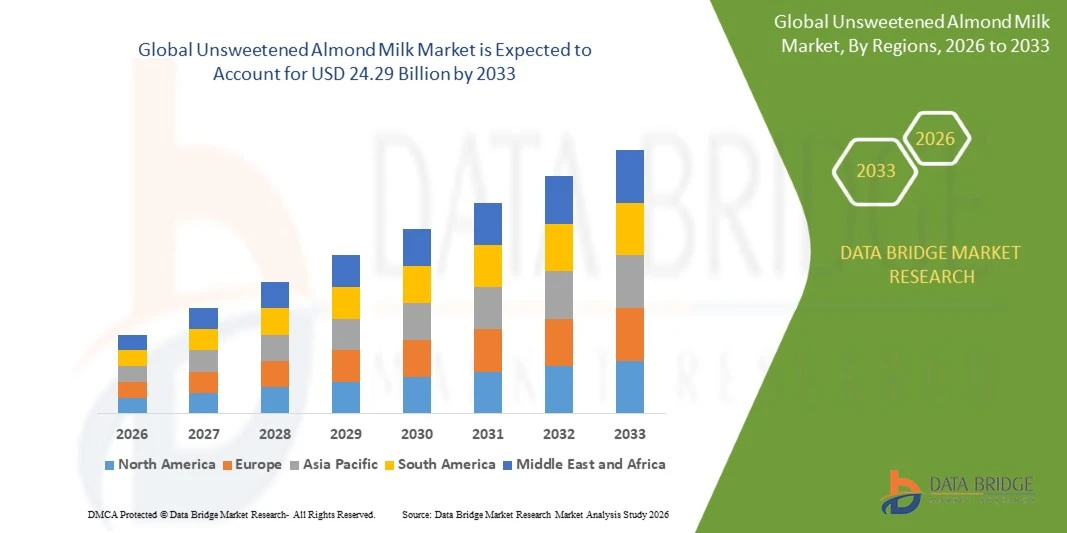
- As per Data Bridge Market Research analysis, the unsweetened almond milk market was valued at USD 8.82 billion in 2025 and is projected to reach USD 24.29 billion by 2033, growing at a CAGR of 13.50% from 2026 to 2033.
- The market is experiencing consistent growth driven by rising consumer preference for plant-based beverages, increasing awareness of the health benefits associated with dairy alternatives, and growing demand for low-sugar and lactose-free products across household and commercial applications.
- The increasing prevalence of lactose intolerance, growing adoption of vegan diets, and rising concerns regarding sugar consumption are encouraging consumers to shift toward unsweetened almond milk. Expanding product availability across supermarkets, online retail platforms, and foodservice establishments, combined with innovations in taste, texture, and nutritional fortification, is further supporting market growth.
Market Size & Forecast
- Global Market Value (2025): USD 8.82 Billion
- Expected Market Value (2033): USD 24.29 Billion
- Forecast CAGR (2026–2033): 13.50%
- Leading Region in 2025: North America
- Fastest Growing Region: Asia Pacific
What are the Major Takeaways of the Unsweetened Almond Milk Market?
- North America dominated the unsweetened almond milk market with the largest revenue share of 38.6% in 2025, supported by strong consumer awareness of plant-based beverages, established retail distribution networks, and increasing demand for dairy alternatives.
- Asia-Pacific is expected to be the fastest-growing region at a CAGR of 7.3% from 2026 to 2033, fueled by rising health consciousness, increasing disposable incomes, and growing adoption of plant-based beverages.
- The conventional segment led the market with a 86.3% share in 2025, driven by its widespread availability, relatively affordable pricing, and established presence across supermarkets, grocery stores, and online retail platforms.
- Organic are the fastest-growing category type, projected to register a CAGR of 15.8%, reflecting the surge in consumer interest in organic ingredients, clean-label beverages, and sustainable food production.
- The beverages segment dominated the application category with a 66.9% revenue share in 2025, led by widespread use in direct consumption, coffee, smoothies, and health drinks.
- Cartons accounted for 58.7% of the market share in 2025, preferred by its lightweight construction, efficient storage, and suitability for large-scale distribution
- The bottles segment is the fastest-growing packaging type category, with a CAGR of 14.6%, driven by increasing demand for convenient, resealable packaging formats
Report Scope and Unsweetened Almond Milk Market Segmentation
|
Attributes |
Unsweetened Almond Milk Key Market Insights |
|
Segments Covered |
|
|
Countries Covered |
North America
Europe
Asia-Pacific
Middle East and Africa
South America
|
|
Key Market Players |
|
|
Market Opportunities |
|
|
Value Added Data Infosets |
In addition to the insights on market scenarios such as market value, growth rate, segmentation, geographical coverage, and major players, the market reports curated by the Data Bridge Market Research also include in-depth expert analysis, pricing analysis, brand share analysis, consumer survey, demography analysis, supply chain analysis, value chain analysis, raw material/consumables overview, vendor selection criteria, PESTLE Analysis, Porter Analysis, and regulatory framework. |
What is the Key Trend in the Unsweetened Almond Milk Market?
- Manufacturers are increasingly developing unsweetened almond milk with clean-label ingredients, improved creaminess, and enhanced nutritional profiles to meet growing consumer demand for healthier, low-sugar, plant-based beverages.
- For instance, in July 2024, Ezaki Glico launched its Almond Koka Rich Unsweetened almond beverage in Japan, featuring approximately 3.8 times the almond concentration of its existing Almond Koka range to deliver a richer taste and smoother texture, highlighting product innovation in premium unsweetened almond milk.
- The growing popularity of plant-based diets is encouraging brands to introduce unsweetened almond milk fortified with calcium and vitamins, targeting consumers seeking dairy-free alternatives without added sugars.
- Barista-style unsweetened almond milk is gaining traction among cafés and foodservice providers because of its improved foaming properties, smooth texture, and suitability for coffee-based beverages.
- For instance, in September 2024, Maiva Fresh launched its unsweetened almond milk in India, featuring vitamin B12 and vitamin D fortification, zero cholesterol, and a low glycemic index, reflecting the trend toward nutritionally enhanced plant-based beverages for everyday consumption.
- Manufacturers are also emphasizing sustainable packaging, transparent ingredient labeling, and product innovation to strengthen consumer trust and differentiate their offerings in the competitive plant-based beverage market.
What are the Key Drivers of the Unsweetened Almond Milk Market?
- The rising health consciousness and increasing concerns about added sugar consumption are encouraging consumers to choose unsweetened almond milk as a low-sugar alternative to conventional dairy beverages.
- For instance, in September 2024, Maiva Fresh launched its unsweetened almond milk in India, fortified with vitamins B12 and D and positioned for everyday consumption. The launch illustrates how nutritional fortification and demand for dairy-free, low-sugar beverages are encouraging product innovation in the unsweetened almond milk market.
- Growing lactose intolerance awareness and the adoption of vegan diets are expanding demand for plant-based beverages among health-conscious consumers and individuals seeking dairy-free options.
- Increasing product innovation, including protein enrichment and vitamin fortification, is strengthening the appeal of unsweetened almond milk among consumers seeking convenient, nutritionally enhanced beverages.
- For instance, in August 2024, an article published in Food Bioscience examined the growing demand for plant-based functional beverages, identifying lactose intolerance, food allergies, vegan lifestyles, and interest in more sustainable food choices as important factors driving adoption. These factors support the expansion of unsweetened almond milk as a dairy-free beverage option
- Expanding supermarket distribution, online grocery platforms, and café partnerships are improving product accessibility and supporting wider adoption across household and commercial applications.
What Factors are Challenging the Growth of the Unsweetened Almond Milk Market?
- Unsweetened almond milk faces challenges associated with almond cultivation costs, raw material price fluctuations, processing requirements, and competition from other plant-based beverages.
- For instance, in August 2024, the University of Florida's Institute of Food and Agricultural Sciences highlighted that one cup of unsweetened almond milk typically contains approximately 1 gram of protein, compared with 8 grams in cow's milk. This nutritional gap can limit adoption among consumers seeking protein-rich beverages and increase the need for product fortification.
- The relatively low protein content of conventional almond milk compared with dairy milk and some alternative beverages may limit its appeal among consumers seeking protein-rich nutritional products.
- Environmental concerns regarding almond cultivation, particularly irrigation water requirements in drought-prone growing regions, are increasing pressure on producers to improve resource efficiency and sustainability.
- For instance, in March 2024, the Los Angeles Times reported that California's almond industry was experiencing a downturn, with declining almond prices, high interest rates, and financial difficulties affecting some growers. Such agricultural supply-chain pressures can create cost and raw-material availability challenges for almond milk manufacturers.
- Taste preferences, thinner texture, and potential allergen concerns associated with tree nuts can also restrict adoption among certain consumer groups, despite the growing availability of dairy-free alternatives.
How is the Unsweetened Almond Milk Market Segmented?
The unsweetened almond milk market is segmented on the basis of category, application, packaging type, and distribution channel.
- By Category
On the basis of category, the unsweetened almond milk market is segmented into conventional and organic. The conventional segment dominated the market with an estimated 86.3% share in 2025, owing to its widespread availability, relatively affordable pricing, and established presence across supermarkets, grocery stores, and online retail platforms. Conventional unsweetened almond milk appeals to consumers seeking reduced-sugar alternatives without paying a premium for organic certification. Manufacturers benefit from established sourcing, processing, and distribution networks that support large-scale production. Its suitability for everyday consumption in cereals, smoothies, coffee, and cooking further strengthens demand. Product variety and promotional pricing also encourage repeat purchases among price-conscious households
The organic segment is projected to register the fastest growth at an estimated CAGR of 15.8% from 2026 to 2033, driven by increasing consumer interest in organic ingredients, clean-label beverages, and sustainable food production. Organic unsweetened almond milk appeals to consumers seeking products made from organically cultivated almonds. Growing awareness of ingredient transparency is encouraging manufacturers to expand their certified organic beverage portfolios. Premium grocery stores and online platforms are improving access to specialized plant-based products. Innovation in organic formulations and packaging is helping brands differentiate their offerings. Rising demand for premium dairy alternatives is expected to support continued expansion of this segment.
- By Application
On the basis of application, the unsweetened almond milk market is segmented into beverages, frozen desserts, personal care, and others. The beverages segment dominated the market with an estimated 66.9% share in 2025, driven by widespread use in direct consumption, coffee, smoothies, and health drinks. Unsweetened almond milk is widely consumed as an alternative to dairy milk in household and commercial applications. Its mild flavor and versatility make it suitable for breakfast cereals, coffee preparation, and blended beverages. Growing awareness of lactose intolerance and the adoption of plant-based diets are further supporting demand. Manufacturers are introducing improved formulations to enhance taste, texture, and nutritional value.
The frozen desserts segment is projected to register the fastest growth at an estimated CAGR of 15.4% from 2026 to 2033, supported by increasing demand for dairy-free ice cream, frozen desserts, and plant-based sweet treats. Unsweetened almond milk provides a dairy alternative for consumers seeking to reduce sugar intake or avoid lactose-containing ingredients. Food manufacturers are incorporating almond milk into frozen formulations to develop products for vegan and flexitarian consumers. Improvements in freezing technology and formulation techniques are helping manufacturers address texture and creaminess challenges. Expanding plant-based dessert portfolios across supermarkets and specialty retailers are improving product accessibility.
- By Packaging Type
On the basis of packaging type, the unsweetened almond milk market is segmented into bottles, cans, and cartons. The cartons segment dominated the market with an estimated 58.7% share in 2025, owing to its lightweight construction, efficient storage, and suitability for large-scale distribution. Carton packaging helps protect products from external contamination and, when combined with appropriate aseptic processing, supports extended shelf life without refrigeration before opening. Its space-efficient design also helps retailers optimize shelf displays and transportation. Manufacturers favor cartons for distributing shelf-stable unsweetened almond milk through supermarkets and grocery chains. Packaging innovations incorporating recyclable materials are further supporting carton adoption.
The bottles segment is projected to register the fastest growth at an estimated CAGR of 14.6% from 2026 to 2033, driven by increasing demand for convenient, resealable packaging formats. Bottles allow consumers to pour and store almond milk easily after opening, making them suitable for frequent household consumption. Their portability also supports use in workplaces, cafés, and on-the-go consumption occasions. Manufacturers can differentiate products through distinctive bottle designs, transparent packaging, and premium branding. Improvements in lightweight packaging materials and recyclable bottle formats are further supporting product development. Expanding demand for convenient beverage packaging is expected to contribute to the growth of this segment.
- By Distribution Channel
On the basis of distribution channel, the unsweetened almond milk market is segmented into store-based and non-store-based channels. The store-based segment dominated the market with an estimated 74.3% share in 2025, supported by the extensive presence of supermarkets, hypermarkets, convenience stores, and specialty food retailers. Physical stores allow consumers to compare brands, review ingredient lists, and assess nutritional information before purchasing. Established retail networks provide broad product visibility and access to different price points. Promotional campaigns, discounts, and multi-pack offerings encourage repeat purchases. Refrigerated and shelf-stable varieties can be displayed across suitable grocery sections, improving product accessibility.
The non-store-based segment is projected to register the fastest growth at an estimated CAGR of 17.1% from 2026 to 2033, driven by rising e-commerce penetration and increasing consumer preference for convenient grocery shopping. Online platforms allow consumers to compare nutritional profiles, ingredients, prices, and product varieties across multiple brands. Home delivery services reduce the need for frequent store visits and make specialized unsweetened almond milk products easier to access. Subscription-based grocery services can also support repeat purchases among regular consumers. Digital marketing and direct-to-consumer sales are helping brands reach health-conscious and plant-based consumer groups. Continued expansion of online grocery infrastructure is expected to strengthen this distribution channel
Which Region Holds the Largest Share of the Unsweetened Almond Milk Market?
- North America dominated the unsweetened almond milk market with the largest revenue share of 38.6% in 2025, supported by strong consumer awareness of plant-based beverages, established retail distribution networks, and increasing demand for dairy alternatives.
- The region also benefits from growing health consciousness, increasing demand for low-sugar and lactose-free beverages, and the strong presence of established almond milk brands. California's extensive almond production base further supports regional supply chains, while supermarkets, specialty retailers, and online grocery platforms improve product accessibility. Continued innovation in organic, fortified, and barista-style unsweetened almond milk is expected to reinforce North America's leading position in the global market.
U.S. Unsweetened Almond Milk Market Insight
The U.S. unsweetened almond milk market is witnessing strong growth due to rising consumer preference for plant-based beverages, increasing awareness of lactose intolerance, and growing demand for low-sugar dairy alternatives. The country's established almond production industry, mature retail ecosystem, and strong presence of plant-based beverage brands are driving demand across household and foodservice applications. In addition, increasing interest in vegan diets, clean-label products, and nutritionally fortified beverages is accelerating the adoption of unsweetened almond milk among health-conscious consumers.
Asia-Pacific Unsweetened Almond Milk Market Insight
The Asia-Pacific unsweetened almond milk market is expected to witness rapid growth, driven by increasing health awareness, rising disposable incomes, and growing acceptance of plant-based beverages across countries such as China, India, and Japan. Expanding urban populations and increasing awareness of lactose intolerance are encouraging consumers to explore dairy-free alternatives. In addition, the expansion of modern retail outlets, e-commerce platforms, and foodservice channels is improving product accessibility and supporting regional market expansion. Growing demand for premium and fortified plant-based beverages is further contributing to market development.
Japan Unsweetened Almond Milk Market Insight
The Japan unsweetened almond milk market is witnessing consistent growth due to rising consumer interest in health-oriented beverages, sugar-conscious diets, and convenient plant-based nutritional alternatives. Manufacturers are introducing almond-based drinks with improved flavor profiles, enhanced nutritional value, and convenient packaging to attract health-conscious consumers. Moreover, growing demand for dairy-free beverages and increasing product availability across supermarkets, convenience stores, and online platforms are supporting market expansion. Continued innovation in almond-based beverages is further strengthening the segment's growth prospects in Japan.
China Unsweetened Almond Milk Market Insight
The China unsweetened almond milk market is growing due to increasing health consciousness, rising disposable incomes, and expanding demand for plant-based beverage alternatives. Growing interest in reduced-sugar products and diversified nutritional beverages is encouraging consumers to explore alternatives to conventional dairy drinks. In addition, the expansion of e-commerce platforms, modern grocery retailing, and premium beverage brands is improving access to almond milk products. Increasing product innovation and growing consumer interest in convenient, health-oriented beverages are expected to support further market development in China.
U.K. Unsweetened Almond Milk Market Insight
The U.K. unsweetened almond milk market is experiencing steady growth, supported by rising adoption of plant-based diets, growing demand for low-sugar beverages, and increasing awareness of dairy-free alternatives. Supermarkets, specialty retailers, and online grocery platforms are expanding product availability across conventional and organic categories. Furthermore, increasing use of almond milk in coffee shops, smoothies, breakfast products, and home cooking is supporting demand across household and commercial applications. Continued interest in clean-label ingredients and sustainable packaging is further contributing to market growth in the U.K.
Germany Unsweetened Almond Milk Market Insight
The Germany unsweetened almond milk market is expanding steadily due to increasing consumer preference for plant-based nutrition, reduced-sugar beverages, and lactose-free alternatives. The country's established grocery retail infrastructure and growing availability of organic food products are supporting the distribution of unsweetened almond milk. Manufacturers are focusing on ingredient transparency, improved texture, and fortified formulations to meet evolving consumer preferences. In addition, rising adoption of vegan and flexitarian diets, along with expanding online grocery sales, is further supporting market development in Germany.
Which are the Top Companies in Unsweetened Almond Milk Market?
The unsweetened almond milk industry is primarily led by well-established companies, including:
- Blue Diamond Growers (U.S.)
- Califia Farms, LLC (U.S.)
- MALK Organics (U.S.)
- Elmhurst Milked, LLC (U.S.)
- Three Trees Foods, Inc. (U.S.)
- Milkadamia LLC (U.S.)
- New Barn, Inc. (U.S.)
- Danone S.A. (France)
- Oatly Group AB (Sweden)
- Rude Health Ltd (U.K.)
- Nutriops, S.L. (Spain)
- Abafoods S.r.l. (Italy)
- The Bridge S.r.l. (Italy)
- Riso Scotti S.p.A. (Italy)
- Alinor S.p.A. (Italy)
- Natumi GmbH (Germany)
- Earth's Own Food Company Inc. (Canada)
- Sanitarium Health Food Company (Australia)
- The Hain Celestial Group, Inc. (U.S.)
What are Latest Developments in Unsweetened Almond Milk Market?
- In July 2025, MALK Organics launched a shelf-stable Vanilla Almond Milk. The new plant-based beverage was formulated with four ingredients: filtered water, organic almonds, organic vanilla extract, and Himalayan pink salt. The launch expanded MALK's shelf-stable almond milk portfolio and highlighted the brand's emphasis on ingredient transparency and simplified formulations. The product was made available through Whole Foods Market and online via Amazon, strengthening its retail reach.
- In September 2024, Maiva Fresh launched its Unsweetened Almond Milk in India. The product was introduced as part of the company's health drinks range and positioned as a dairy-free beverage for everyday consumption. According to the launch announcement, the formulation contains no cholesterol, has a low glycemic index, and is fortified with vitamins B12 and D. The launch reflects product innovation focused on combining unsweetened formulations with added nutritional benefits.
- In January 2023, Califia Farms launched a new range of organic almond and oat milks. The organic almond milk was formulated with three ingredients—purified water, sea salt, and almonds—supporting demand for products with shorter ingredient lists. The range was introduced in 48-ounce bottles and distributed through major U.S. retailers, including Kroger, Whole Foods Market, and Sprouts Farmers Market. The launch strengthened Califia Farms' organic plant-based beverage portfolio and highlighted clean-label product development in the almond milk category.
- In January 2022, Blue Diamond Growers introduced Almond Breeze Extra Creamy Almondmilk. The new product was developed to provide a richer texture closer to whole dairy milk, using almond oil made from Blue Diamond almonds. The launch expanded the company's almond milk portfolio and aimed to attract consumers seeking a creamier plant-based alternative for everyday use. The product was scheduled to reach grocery stores and major retailers beginning that month, demonstrating continued innovation in texture and consumer experience within the almond beverage category.
- In October 2021, Hershey India expanded its Sofit portfolio with unsweetened and chocolate-flavored almond drinks. The new almond beverage range was introduced in 200-milliliter and one-liter packs to serve consumers looking for non-dairy alternatives. The company positioned the products as cholesterol-free and gluten-free, with protein, dietary fiber, and vitamins including A, E, and B12. The launch broadened the availability of almond-based beverages in India and strengthened Sofit's presence in the plant-based drinks category.
- Interactive Data Analysis Dashboard
- Company Analysis Dashboard for high growth potential opportunities
- Research Analyst Access for customization & queries
- Competitor Analysis with Interactive dashboard
- Latest News, Updates & Trend analysis
- Harness the Power of Benchmark Analysis for Comprehensive Competitor Tracking
Global Unsweetened Almond Milk Market, Supply Chain Analysis and Ecosystem Framework
To support market growth and help clients navigate the impact of geopolitical shifts, DBMR has integrated in-depth supply chain analysis into its Global Unsweetened Almond Milk Market research reports. This addition empowers clients to respond effectively to global changes affecting their industries. The supply chain analysis section includes detailed insights such as Global Unsweetened Almond Milk Market consumption and production by country, price trend analysis, the impact of tariffs and geopolitical developments, and import and export trends by country and HSN code. It also highlights major suppliers with data on production capacity and company profiles, as well as key importers and exporters. In addition to research, DBMR offers specialized supply chain consulting services backed by over a decade of experience, providing solutions like supplier discovery, supplier risk assessment, price trend analysis, impact evaluation of inflation and trade route changes, and comprehensive market trend analysis.
Data collection and base year analysis are done using data collection modules with large sample sizes. The stage includes obtaining market information or related data through various sources and strategies. It includes examining and planning all the data acquired from the past in advance. It likewise envelops the examination of information inconsistencies seen across different information sources. The market data is analysed and estimated using market statistical and coherent models. Also, market share analysis and key trend analysis are the major success factors in the market report. To know more, please request an analyst call or drop down your inquiry.
The key research methodology used by DBMR research team is data triangulation which involves data mining, analysis of the impact of data variables on the market and primary (industry expert) validation. Data models include Vendor Positioning Grid, Market Time Line Analysis, Market Overview and Guide, Company Positioning Grid, Patent Analysis, Pricing Analysis, Company Market Share Analysis, Standards of Measurement, Global versus Regional and Vendor Share Analysis. To know more about the research methodology, drop in an inquiry to speak to our industry experts.
Data Bridge Market Research is a leader in advanced formative research. We take pride in servicing our existing and new customers with data and analysis that match and suits their goal. The report can be customized to include price trend analysis of target brands understanding the market for additional countries (ask for the list of countries), clinical trial results data, literature review, refurbished market and product base analysis. Market analysis of target competitors can be analyzed from technology-based analysis to market portfolio strategies. We can add as many competitors that you require data about in the format and data style you are looking for. Our team of analysts can also provide you data in crude raw excel files pivot tables (Fact book) or can assist you in creating presentations from the data sets available in the report.