What is the Middle East and Africa Insect Protein Market Size and Growth Rate?
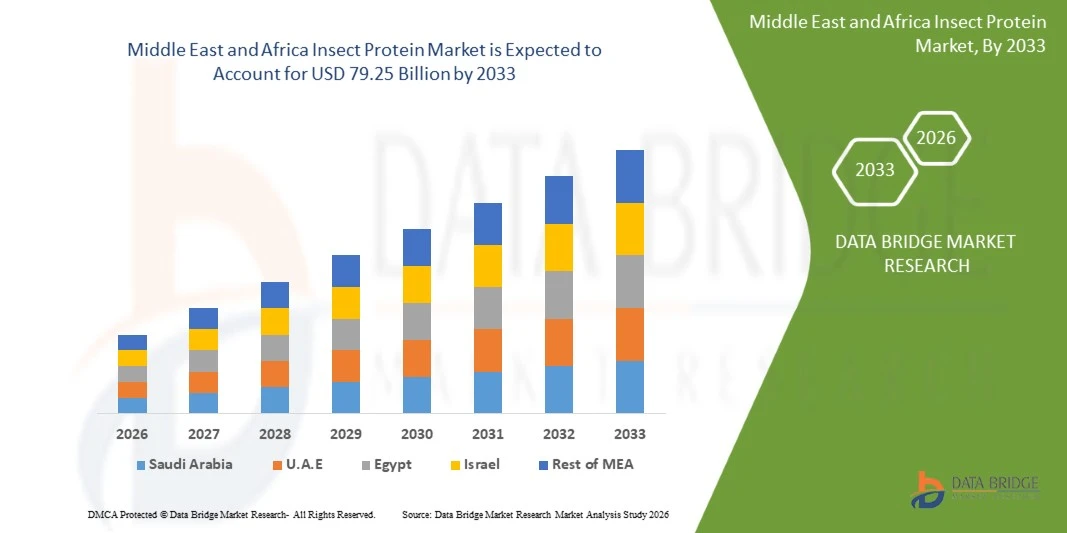
- As per Data Bridge Market Research analysis, the Middle East and Africa insect protein market was valued at USD 18.93 billion in 2025 and is projected to reach USD 79.25 billion by 2033, growing at a CAGR of 19.60% from 2026 to 2033.
- The market is experiencing rapid growth driven by rising demand for affordable animal feed protein, increasing focus on food security and waste upcycling, and expanding applications across aquaculture, poultry, pet food, and fertilizer products.
- The increasing shift toward circular agriculture, local feed production, and low-footprint protein sources, combined with high feed import dependence and abundant organic waste across the region, is supporting market adoption. Insect protein is being positioned across fish and poultry feed, pet food, and organic fertilizer, offering producers greater flexibility in replacing imported inputs used in aquaculture, supplying key amino acids, and creating new insect protein supply chains for food and feed manufacturers.
Market Size & Forecast
- Middle East and Africa Market Value (2025): USD 18.93 Billion
- Expected Market Value (2033): USD 79.25 Billion
- Forecast CAGR (2026–2033): 19.60%
- Leading Country in 2025: South Africa
- Fastest Growing Country: Saudi Arabia
What are the Major Takeaways of the Middle East and Africa Insect Protein Market?
- South Africa dominated the Middle East and Africa insect protein market with the largest revenue share of 37.40% in 2025, supported by early commercial black soldier fly farming, established feed and pet food industries, and strong research and investment activity.
- Saudi Arabia is expected to be the fastest-growing country at a CAGR of 22.30% from 2026 to 2033, fueled by food security programs, growing aquaculture and poultry output, and rising investment in local protein production.
- The black soldier fly segment led the market with a 51.60% share in 2025, driven by efficient waste conversion, low-cost rearing, and strong demand from feed and fertilizer buyers.
- Crickets are the fastest-growing insect type, projected to record a CAGR of 22.10%, reflecting rising demand for protein powders, snacks, and traditional edible insect foods.
- The insect meal & powder segment dominated the product form category with a 48.90% revenue share in 2025, led by its versatility in feed, pet food, and food formulations.
- The feed application accounted for 66.30% of the market share in 2025, preferred for replacing imported fishmeal and soybean meal in aquaculture and poultry diets.
- The food & beverage segment is the fastest-growing application, with a CAGR of 23.80%, driven by protein snack demand, traditional insect consumption, and growing interest in novel foods.
Report Scope and Middle East and Africa Insect Protein Market Segmentation
|
Attributes |
Middle East and Africa Insect Protein Key Market Insights |
|
Segments Covered |
|
|
Countries Covered |
Middle East and Africa
|
|
Key Market Players |
|
|
Market Opportunities |
|
|
Value Added Data Infosets |
In addition to the insights on market scenarios such as market value, growth rate, segmentation, geographical coverage, and major players, the market reports curated by the Data Bridge Market Research also include in-depth expert analysis, geographically represented company-wise production and capacity, network layouts of distributors and partners, detailed and updated price trend analysis and deficit analysis of supply chain and demand. |
What is the Key Trend in the Middle East and Africa Insect Protein Market?
- Insect protein production in the Middle East and Africa is increasingly moving from small-scale pilot farms to organized, technology-supported industries, combining waste upcycling, farmer training, research partnerships, and standardized ingredients for feed makers.
- For instance, in November 2025, according to the IN-FEAST Partnership, the Association for Insect Farming and Its Products was formally registered in Kenya and convened the country’s first insect stakeholder event, showing the growing institutional organization of East Africa’s insect farming sector and encouraging wider industry collaboration
- Producers are increasingly linking insect farms to urban waste streams such as market produce and food by-products, which lowers feed costs, reduces landfill, and supplies fertilizer from larval frass as a secondary product.
- Companies are developing decentralized models, as buyers compare insect ingredients on protein content, consistency, supply reliability, and price against imported fishmeal and soybean meal while farms scale to meet commercial feed demand.
- For instance, in March 2026, according to Streamlined Feed, black soldier fly farming is reshaping Kenya’s agricultural landscape by turning organic waste into high-value protein and easing the feed crisis for farmers, with the research hub icipe in Nairobi supporting skills, technology, and wider industry adoption
- As farmer training, regulatory development, industrial scale-up, and feed demand continue to advance, insect protein is expected to expand beyond informal farming into commercial supply chains for aquaculture, poultry, pet food, and food products.
What are the Key Drivers of the Middle East and Africa Insect Protein Market?
- High dependence on imported feed ingredients and rising demand for local protein have significantly increased interest in insect protein, which can be produced from organic waste at lower cost.
- For instance, in November 2025, according to Farmtario, the International Centre of Insect Physiology and Ecology, supported by Canada through the International Development Research Centre, is scaling climate-smart agriculture and edible insect farming across Africa, with Kenyan farms converting market waste into high-protein animal feed and organic fertilizer.
- Aquaculture producers, poultry farmers, pet food brands, and food start-ups are adopting insect ingredients to reduce feed costs, improve growth and survival, and create jobs through decentralized rearing and processing.
- For instance, in December 2025, according to the Australian Centre for International Agricultural Research, delegates from Ghana and Nigeria completed a week-long icipe training program in Nairobi in July 2025 on black soldier fly larvae, oil, and fertilizer production, supporting knowledge transfer across West Africa.
- With governments, development agencies, and investors supporting food security and circular agriculture, insect protein can gain wider visibility, qualification, and repeat orders across feed mills, farms, and food supply chains.
What Factors Are Challenging the Growth of the Middle East and Africa Insect Protein Market?
- Insect farming requires significant capital for rearing facilities, climate control, and processing equipment, and many producers face limited access to finance, which can delay scale-up and commercialization.
- For instance, in May 2021, according to FeedNavigator, the U.K.-based Insect Technology Group, parent of South African producer AgriProtein, entered administration, demonstrating the financial risk of scaling large insect protein plants ahead of stable demand and long-term supply contracts.
- These capital and operating costs can slow adoption among small farms and feed mills, while inconsistent quality, limited standards, and limited consumer familiarity may restrict demand outside traditional consumption areas.
- Fragmented regulations, dietary and religious requirements, and food safety concerns further restrict growth, requiring producers to invest in controlled rearing, testing, certification, and traceability systems that may increase compliance and operating costs.
- For instance, in January 2021, according to NoCamels, grasshoppers are the only kosher edible insect, which limits the range of insect species that can be marketed for Israeli and Jewish cuisines and illustrates how religious dietary rules and certification needs can narrow product options and raise compliance complexity in parts of the region.
- The combination of high capital costs, regulatory differences, religious and cultural considerations, and competition from soybean meal, fishmeal, and plant proteins can constrain adoption among cost-sensitive buyers and smaller producers, particularly where conventional feed already meets performance needs.
How is the Middle East and Africa Insect Protein Market Segmented?
The Middle East and Africa insect protein market is segmented on the basis of insect type, product form, application, and distribution channel.
- By Insect Type
On the basis of insect type, the Middle East and Africa insect protein market is segmented into black soldier flies, crickets, mealworms, and others. The black soldier fly segment dominated the market with 51.60% share in 2025, supported by efficient conversion of organic waste, low-cost rearing, and strong demand from feed and fertilizer buyers. Larvae produce protein, oil, and frass fertilizer, creating several revenue streams. Warm climates in many African countries reduce heating needs. Research support from icipe and growing farmer networks are improving technical skills. Regulatory acceptance of black soldier fly meal in feed further strengthens the segment’s leadership.
The cricket segment is projected to register the fastest growth at a CAGR of 22.10% from 2026 to 2033, driven by increasing demand for protein powders, snacks, and traditional edible insect foods. Crickets and other insects are part of traditional diets in parts of East, Central, and Southern Africa, which supports consumer acceptance. Brands use cricket flour in bars, porridge, bakery products, and sports nutrition. Efforts to improve food safety and farming practices are creating new opportunities. Improvements in rearing, processing, and flavor masking are enhancing quality, while small farms and cooperatives are expanding supply. Development programs and nutrition projects are also promoting insects as an affordable source of protein and micronutrients.
- By Product Form
On the basis of product form, the Middle East and Africa insect protein market is segmented into insect meal & powder, whole insects, insect oil, and others. The insect meal & powder segment dominated the market with 48.90% share in 2025, supported by its versatility in feed, pet food, and food formulations. Defatted meals and powders are easy to store, transport, and blend into compound feed. Commercial producers report steady output of defatted meal and oil from black soldier fly larvae. Standardized specifications help feed manufacturers adopt the ingredient without major process changes. Continued improvement in drying, milling, and quality testing further strengthens its leadership.
The insect oil segment is projected to register the fastest growth at a CAGR of 22.40% from 2026 to 2033, driven by rising demand for sustainable fats in aquafeed, pet food, and young livestock diets. Black soldier fly oil provides energy and lauric acid, which supports gut health in young animals. Producers are adding oil as a second revenue stream next to meal, improving plant economics. Growing interest in cosmetics and oleochemicals is creating additional opportunities. Advances in extraction and refining are improving yield and consistency, and partnerships with feed mills and pet food brands are supporting investment in dedicated oil lines.
- By Application
On the basis of application, the Middle East and Africa insect protein market is segmented into feed, food & beverage, and pharmaceuticals & cosmetics. The feed segment dominated the market with 66.30% share in 2025, driven by growing aquaculture, poultry, and pet food industries and the high cost of imported fishmeal and soybean meal. Insect meal offers high digestibility, a favorable amino acid profile, and potential benefits for young animal survival. Local production reduces exposure to import costs and currency swings. Established relationships with feed manufacturers, large production volumes, and growing sustainability expectations continue to reinforce this segment's leadership.
The food & beverage segment is projected to register the fastest growth at a CAGR of 23.80% from 2026 to 2033, supported by rising demand for protein snacks, nutrition products, and sustainable ingredients. Cricket, grasshopper, and mealworm flours are being used in bars, baked goods, and fortified porridges. Traditional insect consumption in several African countries supports acceptance. Younger urban consumers are showing curiosity about novel proteins and environmental benefits. Food safety standards, education, and taste improvement remain important for broader acceptance. Start-ups, universities, and retailers are introducing new recipes and packaged products to build awareness and trial among health-conscious consumers.
- By Distribution Channel
On the basis of distribution channel, the Middle East and Africa insect protein market is segmented into direct and indirect. The direct segment dominated the market with 61.20% share in 2025, supported by supply agreements between producers and feed mills, fish farms, poultry operations, and food companies. Direct sales allow better control over specifications, pricing, and logistics. Long-term contracts provide demand visibility and support investment in new capacity. Technical support and joint product development further strengthen buyer relationships. Established partnerships continue to reinforce this channel's leadership, especially for bulk feed ingredients delivered to large customers.
The indirect segment is projected to register the fastest growth at a CAGR of 21.70% from 2026 to 2033, driven by expansion of distributors, agro-dealers, retailers, and online platforms that serve smaller farms and consumers. Agro-dealer networks help reach farmers in remote areas. Retailers and e-commerce sites are adding insect-based snacks and pet foods. Branding, education, and certification support consumer trust. Smaller pack sizes and flexible ordering are also helping new customers try insect-based products. Mobile payments and local delivery services are widening access in rural and peri-urban areas.
Which Country Holds the Largest Share of the Middle East and Africa Insect Protein Market?
- South Africa dominated the Middle East and Africa insect protein market with the largest revenue share of 37.40% in 2025, supported by early commercial black soldier fly farming, established feed and pet food industries, and strong research and investment activity.
- The country also benefits from established black soldier fly facilities, a well-developed feed and pet food industry, and active investment in insect farming technology, along with strong university and industry research. Increasing demand for local protein and organic waste solutions continues to strengthen South Africa’s position in the Middle East and Africa market.
South Africa Insect Protein Market Insight
The South Africa insect protein market is witnessing strong growth due to early commercial black soldier fly production, a mature feed and pet food sector, and demand for local alternatives to imported protein. The country’s large organic waste streams, along with large production facilities near Cape Town, are driving supply of insect meal and oil. In addition, growing investor interest, export ambitions, and use in aquaculture and pet food are accelerating adoption across feed and food applications.
Saudi Arabia Insect Protein Market Insight
The Saudi Arabia insect protein market is expected to witness rapid growth, driven by food security programs, expanding aquaculture and poultry production, and rising investment in local protein production. Growing interest in sustainable agriculture, imported feed cost reduction, and agri-food innovation is supporting market expansion. In addition, government-backed diversification programs, research partnerships, growing pet ownership, and large integrated farming projects are accelerating availability and demand for insect protein.
U.A.E. Insect Protein Market Insight
The U.A.E. insect protein market is witnessing consistent growth due to high food import dependence, strong food security strategy, and active support for agri-food technology. Start-ups, retailers, and research institutions are increasingly exploring insect protein as a sustainable ingredient. Moreover, strong demand for novel proteins, advanced logistics, innovation hubs, and a diverse consumer base is further contributing to market growth in the U.A.E.
Egypt Insect Protein Market Insight
The Egypt insect protein market is growing rapidly, driven by a large aquaculture and poultry industry, rising feed costs, and a need to reduce reliance on imported protein. Growing interest in waste recycling and circular agriculture is significantly boosting market demand. In addition, large agricultural by-product streams, university research, and demand for lower-cost feed ingredients are positioning Egypt as an important growth market in the Middle East and Africa region.
Which are the Top Companies in Middle East and Africa Insect Protein Market?
The Middle East and Africa insect protein industry is primarily led by well-established companies, including:
- Inseco (South Africa)
- Ecodudu (Kenya)
- InsectiPro Ltd (Kenya)
- Hargol FoodTech (Israel)
- Entoprotech (Israel)
- FreezeM (Israel)
- Chrysalis Holdings (Kenya)
- Protix B.V. (Netherlands)
- Ÿnsect SAS (France)
- Innovafeed SAS (France)
- Nutrition Technologies Group (Singapore)
- Enterra Feed Corporation (Canada)
- EnviroFlight, LLC (U.S.)
- Entomo Farms (Canada)
- BioflyTech (Spain)
- Agronutris (France)
- Global Bugs Asia Co., Ltd. (Thailand)
- All Things Bugs LLC (U.S.)
- Cricket Lab Limited (U.K.)
- Insect Technology Group (U.K.)
What are Latest Developments in Middle East and Africa Insect Protein Market?
- In November 2025, the Association for Insect Farming and Its Products was formally registered in Kenya and convened the country’s first insect stakeholder event under the IN-FEAST Partnership with icipe and partners. The group is also running farmer roadshows in Western Kenya and has begun engagement with stakeholders in Ethiopia to build the sector, with a wider roadshow planned for 2026.
- In November 2023, a consortium of eight Israeli companies, backed by the Israel Innovation Authority, joined forces to accelerate black soldier fly production for pet feed, with Entoprotech leading the first pilot facility in Israel. The group includes FreezeM, NRGene, Neomanna, BugEra, and Rafael Feed Mills.
- In April 2022, Inseco raised USD 5.3 million in what was described as the country’s largest-ever seed round to expand black soldier fly production capacity. The company operates a 10,000 square meter facility in Cape Town, taken over from AgriProtein, producing more than 100 metric tons of defatted insect meal and oil each month, and plans decentralized production at sources of organic waste.
- In January 2021, Hargol FoodTech announced a new line of grasshopper protein products, positioning grasshoppers as the only kosher edible insect. The company develops farm systems for sustainable grasshopper production and works on feeding lines that rely on dry feed to improve efficiency.
- In May 2020, Beta Hatch announces that the company receives a funding of USD 3.00 million for the construction of new manufacturing units to expand their product portfolio in the market.
- Interactive Data Analysis Dashboard
- Company Analysis Dashboard for high growth potential opportunities
- Research Analyst Access for customization & queries
- Competitor Analysis with Interactive dashboard
- Latest News, Updates & Trend analysis
- Harness the Power of Benchmark Analysis for Comprehensive Competitor Tracking
Middle East And Africa Insect Protein Market, Supply Chain Analysis and Ecosystem Framework
To support market growth and help clients navigate the impact of geopolitical shifts, DBMR has integrated in-depth supply chain analysis into its Middle East And Africa Insect Protein Market research reports. This addition empowers clients to respond effectively to global changes affecting their industries. The supply chain analysis section includes detailed insights such as Middle East And Africa Insect Protein Market consumption and production by country, price trend analysis, the impact of tariffs and geopolitical developments, and import and export trends by country and HSN code. It also highlights major suppliers with data on production capacity and company profiles, as well as key importers and exporters. In addition to research, DBMR offers specialized supply chain consulting services backed by over a decade of experience, providing solutions like supplier discovery, supplier risk assessment, price trend analysis, impact evaluation of inflation and trade route changes, and comprehensive market trend analysis.
Data collection and base year analysis are done using data collection modules with large sample sizes. The stage includes obtaining market information or related data through various sources and strategies. It includes examining and planning all the data acquired from the past in advance. It likewise envelops the examination of information inconsistencies seen across different information sources. The market data is analysed and estimated using market statistical and coherent models. Also, market share analysis and key trend analysis are the major success factors in the market report. To know more, please request an analyst call or drop down your inquiry.
The key research methodology used by DBMR research team is data triangulation which involves data mining, analysis of the impact of data variables on the market and primary (industry expert) validation. Data models include Vendor Positioning Grid, Market Time Line Analysis, Market Overview and Guide, Company Positioning Grid, Patent Analysis, Pricing Analysis, Company Market Share Analysis, Standards of Measurement, Global versus Regional and Vendor Share Analysis. To know more about the research methodology, drop in an inquiry to speak to our industry experts.
Data Bridge Market Research is a leader in advanced formative research. We take pride in servicing our existing and new customers with data and analysis that match and suits their goal. The report can be customized to include price trend analysis of target brands understanding the market for additional countries (ask for the list of countries), clinical trial results data, literature review, refurbished market and product base analysis. Market analysis of target competitors can be analyzed from technology-based analysis to market portfolio strategies. We can add as many competitors that you require data about in the format and data style you are looking for. Our team of analysts can also provide you data in crude raw excel files pivot tables (Fact book) or can assist you in creating presentations from the data sets available in the report.