
In 2020, the data by the UNAIDS- for the global HIV and AIDS statistics show that there were 37.7 million [30.2 million–45.1 million] people living with HIV. Around 36 million adults were living with HIV. Around 1.7 million children aged 14 years were living with HIV, and 17.8 million women were diagnosed with HIV.
Access Full Report @ https://www.databridgemarketresearch.com/reports/global-rapid-diagnostic-tests-rdt-market
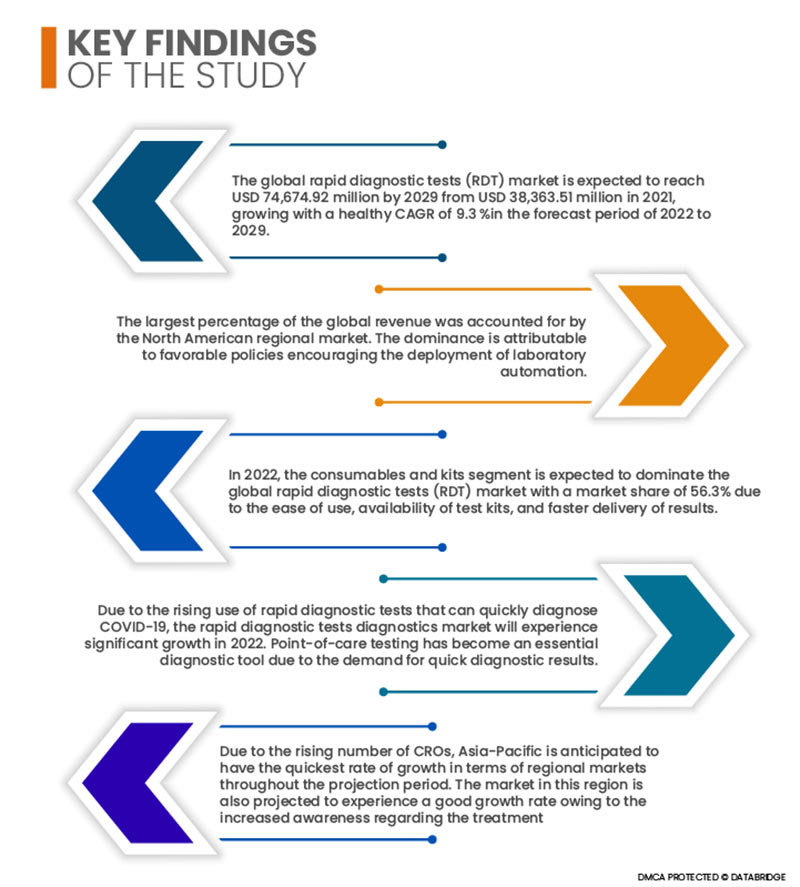
The global rapid diagnostic tests (RDT) market is expected to reach USD 74,674.92 million by 2029 from USD 38,363.51 million in 2021, growing with a healthy CAGR of 9.3% in the forecast period of 2022 to 2029. This market's expansion is attributed to several factors, including the growing need for LIMS adoption, the increasing use of rapid care diagnostics to comply with strict regulatory requirements, rising R&D spending in various industries, and rising support by the government.
The increase in incidence of chronic diseases across the world will drive the market's growth rate
Rapid diagnostic tests are essential for the diagnosis of chronic infectious diseases such as Human Immuno Deficiency Virus (HIV) and malaria. Both the conditions have non-specific symptoms. The rapid diagnostic tests reduce the multiple visits to diagnostic centers to receive the results. Hence, it improves diagnosis specificity, reduces presumptive treatment dependence, and reduces the risk of getting sicker before making a correct diagnosis. This will create awareness and is expected to increase the demand for research and development for rapid diagnostic test kits among scientists. It would result in timely treatment of the patients suffering from chronic ailments.
Report Scope and Market Segmentation
Report Metric
|
Details
|
Forecast Period
|
2022 to 2029
|
Base Year
|
2021
|
Historic Years
|
2020 (Customizable to 2014 - 2019)
|
Quantitative Units
|
Revenue in USD Million, Volumes in Units, Pricing in USD
|
Segments Covered
|
Product Type (Consumables and Kits, Instruments and Others), Mode (Professional Rapid Diagnostic Test Product and Over-The-Counter [OTC] Rapid Diagnostic Test Product), Technology (PCR-Based, Flow-Through Assays, Lateral Flow Immunochromatographic Assays, Agglutination Assay, Microfluidics, Substrate Technology and Others), Modality (Laboratory Based Test and Non-Laboratory Based Test), Age Group (Adult and Pediatric), Test Type (Determining Confirmation, Serological Testing and Viral Sequencing), Approach (In-Vitro Diagnostic, Molecular Diagnostic), Specimen (Swab, Blood, Urine, Saliva, Sputum and Others), Application (Infectious Disease Testing, Glucose Monitoring, Cardiology Testing, Oncology Testing, Cardiometabolic Testing, Drugs-of-Abuse Testing, Pregnancy & Fertility Testing, Toxicology Testing, Others), End User (Hospital & Clinic, Diagnostic Laboratory, Home Care Setting, Research and Academic Institutes and Others), Distribution Channel (Direct Tender, Retail Sales, Others)
|
Countries Covered
|
U.S., Canada and Mexico in North America, Germany, France, U.K., Netherlands, Switzerland, Belgium, Russia, Italy, Spain, Turkey, Rest of Europe in Europe, China, Japan, India, South Korea, Singapore, Malaysia, Australia, Thailand, Indonesia, Philippines, Rest of Asia-Pacific (APAC) in the Asia-Pacific (APAC), Saudi Arabia, U.A.E, South Africa, Egypt, Israel, Rest of Middle East and Africa (MEA) as a part of Middle East and Africa (MEA), Brazil, Argentina and Rest of South America as part of South America.
|
Market Players Covered
|
Abbott (U.S.), Danaher (U.S.), Cellex (Italy), AdvaCare Pharma (India), Access Bio (U.S.), Cardinal Health (U.S.), Bio-Rad Laboratories, Inc. (U.S.), BD (U.S.), F. Hoffmann-La Roche Ltd (Switzerland), bioMérieux SA (France), InBios International, Inc. (U.S.), Gnomegen LLC (U.S.), QIAGEN (Germany), Quidel Corporation (U.S.), Chembio Diagnostics Systems, Inc. (U.S.), Siemens Healthcare Gmbh (Germany), PerkinElmer Inc. (U.S.), Sekisui Diagnostics (U.S.), Fujirebio (Japan), PTS Diagnostics (U.S.), LamdaGen Corporation (U.S.), Werfen (Spain), Nova Biomedical (U.S.), Trinity Biotech (Ireland), Sysmex Europe GmbH (Germany), Luminex Corporation. (U.S.), MEGAKOR DIAGNOSTK GMBH (Austria) among others.
|
Data Points Covered in the Report
|
In addition to the market insights such as market value, growth rate, market segments, geographical coverage, market players, and market scenario, the market report curated by the Data Bridge Market Research team includes in-depth expert analysis, patient epidemiology, pipeline analysis, pricing analysis, and regulatory framework.
|
Segment Analysis:
The global rapid diagnostic tests (RDT) market is categorized into eleven notable segments based on product type, mode, technology, modality, age group, test type, approach, specimen, application, end user, and distribution channel.
- On the basis of product type, the global rapid diagnostic tests (RDT) market is segmented into consumables and kits, instruments, and others. In 2022, the consumables and kits segment is expected to dominate the global rapid diagnostic tests (RDT) market with a market share of 56.3% due to the ease of use, availability of test kits, and faster delivery of results.
- On the basis of mode, the global rapid diagnostic tests (RDT) market is segmented into professional rapid diagnostic test product, and over-the-counter [OTC] rapid diagnostic test product. In 2022, the professional rapid diagnostic test product segment is expected to dominate the global rapid diagnostic tests (RDT) market with a market share of 76.4% due to accuracy and increased use in points of care, such as homes.
- On the basis of technology, the global rapid diagnostic tests (RDT) market is segmented into PCR-based, flow-through assays, lateral flow immunochromatographic assays, agglutination assay, microfluidics, substrate technology, and others. In 2022, the PCR-based segment is expected to dominate the global rapid diagnostic tests (RDT) market with a market share of 39.31% due to speed, reliability, delivery of results at a faster rate, and quantitative capacity.
- On the basis of modality, the global rapid diagnostic tests (RDT) market is segmented into laboratory based test and non-laboratory based test. In 2022, the laboratory based test segment is expected to dominate the global rapid diagnostic tests (RDT) market with a market share of 71.6% due to the safety, availability of laboratories, following the regulatory guidelines, and cost savings.
- On the basis of age group, the global rapid diagnostic tests (RDT) market is segmented into adult and pediatric. In 2022, the adult segment is expected to dominate the global rapid diagnostic tests (RDT) market with a market share of 85.1% due to the geriatric population and chronic infectious diseases increase.
- On the basis of test type, the global rapid diagnostic tests (RDT) market is segmented into determining confirmation, serological testing, and viral sequencing. In 2022, the determining confirmation segment is expected to dominate the global rapid diagnostic tests (RDT) market with a market share of 43.6% since it is necessary to determine the cause of infectious diseases since the diagnosis by the RDTs provides confirmed results of the diagnosis of infectious disease the RDTs being more sensitive.
- On the basis of approach, the global rapid diagnostic tests (RDT) market is segmented into in-vitro diagnostic and molecular diagnostic. In 2022, the in-vitro diagnostic segment is expected to dominate the global rapid diagnostic tests (RDT) market with a market share of 74.2% due to its ability to detect infectious diseases, such as the COVID-19, detection of pregnancy and fertility disorders, and its applicability in precision medicine.
- On the basis of specimen, the global rapid diagnostic tests (RDT) market is segmented into swab, blood, urine, saliva, sputum, and others. In 2022, the swab segment is expected to dominate the global rapid diagnostic tests (RDT) market with a market share of 45.5%, due to its increased preference by the patients and advancements in serology, for the collection of swabs.
- On the basis of application, the global rapid diagnostic tests (RDT) market is segmented into infectious disease testing, glucose monitoring, cardiology testing, oncology testing, cardiometabolic testing, drugs-of-abuse testing, pregnancy & fertility testing, toxicology testing, and others. In 2022, the infectious disease testing segment is expected to dominate the global rapid diagnostic tests (RDT) market with a market share of 34.5% due to the rise in cases of chronic infectious disease, rise in geriatric population, and government funding for the use of rapid diagnostics.
- On the basis of end user, the global rapid diagnostic tests (RDT) market is segmented into hospital & clinic, diagnostic laboratory, home care setting, research and academic institutes, and others. In 2022, the hospital and clinic segment is expected to dominate the global rapid diagnostic tests (RDT) market with a market share of 55.1% due to the availability of advanced rapid diagnostic test kits in hospitals and the rise in disposable income.
The hospital and clinic segment will dominate the end user segment of the rapid diagnostic tests (RDT) market
The hospital and clinic segment will emerge as the dominating segment under end user segment. This is because of the growing number of hospitals and clinics in the market especially in the developing economies. Further, growth and expansion of research development services on a global scale will further bolster the growth of this segment.
- On the basis of distribution channel, the global rapid diagnostic tests (RDT) market is segmented into direct tender, retail sales, and others. In 2022, the direct tender segment is expected to dominate the global rapid diagnostic tests (RDT) market with a market share of 61.7% due to the rise in contractual agreements between manufacturers and distributors for rapid diagnostic tests and equity in the tendering process.
The direct tenders segment will dominate the distribution channel segment of the rapid diagnostic tests (RDT) market
The direct tenders segment will emerge as the dominating segment under distribution channel with approximately 62% market share. This is because of the growing number of infrastructural development activities and store based retailers in the market especially in the developing economies. Further, growth and expansion of the chemicals and industry all around the globe will further bolster the growth of this segment.
Major Players
Data Bridge Market Research признает следующие компании в качестве игроков рынка быстрых диагностических тестов (БДТ): Abbott (США), Danaher (США), Cellex (Италия), AdvaCare Pharma (Индия), Access Bio (США), Cardinal Health (США), Bio-Rad Laboratories, Inc. (США), BD (США), F. Hoffmann-La Roche Ltd (Швейцария), bioMérieux SA (Франция), InBios International, Inc. (США), Gnomegen LLC (США), QIAGEN (Германия), Quidel Corporation (США), Chembio Diagnostics Systems, Inc. (США), Siemens Healthcare Gmbh (Германия), PerkinElmer Inc. (США), Sekisui Diagnostics (США), Fujirebio (Япония) и PTS Diagnostics (США).
Развитие рынка
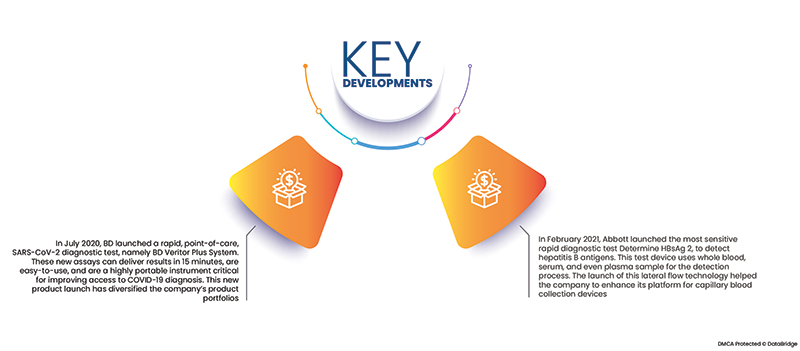
- В июле 2020 года BD запустила быстрый диагностический тест SARS-CoV-2 в месте оказания медицинской помощи, а именно BD Veritor Plus System. Эти новые анализы могут выдавать результаты в течение 15 минут, просты в использовании и являются портативным инструментом, критически важным для улучшения доступа к диагностике COVID-19. Этот новый запуск продукта диверсифицировал продуктовые портфели компании
- В феврале 2021 года компания Abbott запустила самый чувствительный экспресс-тест на диагностику HBsAg 2 для обнаружения антигенов гепатита B. Это тестовое устройство использует для обнаружения образцы цельной крови, сыворотки и даже плазмы. Запуск этой технологии бокового потока помог компании усовершенствовать свою платформу для устройств для сбора капиллярной крови
Региональный анализ
Географически в отчете о рынке быстрых диагностических тестов (БДТ) представлены следующие страны: США, Канада и Мексика в Северной Америке, Германия, Франция, Великобритания, Нидерланды, Швейцария, Бельгия, Россия, Италия, Испания, Турция, остальные страны Европы в Европе, Китай, Япония, Индия, Южная Корея, Сингапур, Малайзия, Австралия, Таиланд, Индонезия, Филиппины, остальные страны Азиатско-Тихоокеанского региона (APAC) в Азиатско-Тихоокеанском регионе (APAC), Саудовская Аравия, ОАЭ, Южная Африка, Египет, Израиль, остальные страны Ближнего Востока и Африки (MEA) как часть Ближнего Востока и Африки (MEA), Бразилия, Аргентина и остальные страны Южной Америки как часть Южной Америки.
Согласно анализу Data Bridge Market Research:
Северная Америка будет доминирующим регионом на рынке быстрых диагностических тестов (ДТТ) в прогнозируемый период 2022–2029 гг.
Североамериканский региональный рынок обеспечил наибольшую долю мирового дохода. Доминирование объясняется благоприятной политикой, поощряющей внедрение автоматизации лабораторий. Наличие передовой инфраструктуры, увеличение государственного финансирования, компании, занимающиеся разработкой новых экспресс-тестов на COVID-19, и растущий спрос на генетические исследования — вот некоторые из причин, способствующих высокой доле региона.
По оценкам, Азиатско-Тихоокеанский регион станет самым быстрорастущим регионом на рынке быстрых диагностических тестов (ДТТ) в прогнозируемый период 2022–2029 гг.
Из-за растущего числа CRO, Азиатско-Тихоокеанский регион, как ожидается, будет иметь самые быстрые темпы роста с точки зрения региональных рынков в течение прогнозируемого периода. Рынок в этом регионе, как ожидается, также будет испытывать хорошие темпы роста из-за возросшей осведомленности о лечении инфекционных заболеваний и благоприятных сценариев возмещения.
Влияние COVID -19
Из-за растущего использования быстрых диагностических тестов, которые могут быстро диагностировать COVID-19, рынок диагностических быстрых диагностических тестов будет испытывать значительный рост в 2022 году. Тестирование в местах оказания медицинской помощи стало важным диагностическим инструментом из-за спроса на быстрые диагностические результаты. Спрос на наборы для быстрого тестирования антигенов, которые могут успешно использоваться в местах оказания медицинской помощи, увеличился из-за быстро растущего числа случаев COVID-19 и растущего давления на правительства с целью улучшения управления пациентами. Другие важные факторы, которые, вероятно, будут способствовать долгосрочному росту рынка диагностики в местах оказания медицинской помощи, включают рост распространенности других респираторных заболеваний во всем мире, переход к децентрализованной диагностике и расширенный доступ к устройствам в местах оказания медицинской помощи через онлайн-платформы.
Для получения более подробной информации об отчете о рынке быстрых диагностических тестов (БДТ) нажмите здесь – https://www.databridgemarketresearch.com/reports/global-rapid-diagnostic-tests-rdt-market










