The growing global emphasis on health and wellness has significantly propelled the demand for natural and nutritious beverage options, with packaged fruit juices emerging as a preferred choice among consumers. As individuals become more conscious of their dietary intake, there is an increasing shift away from carbonated soft drinks and synthetic beverages toward healthier alternatives such as cold-pressed juices, organic fruit blends, and no-added-sugar variants. This consumer behavior is directly influencing the expansion of the packaged fruit juice market across developed and developing economies.
Furthermore, government campaigns promoting fruit and vegetable consumption, along with evolving fitness trends and increasing disposable incomes, are encouraging people to incorporate fruit juices into their daily routines. Health-driven innovations—such as fortified juices enriched with vitamins, probiotics, or functional superfoods—are further attracting a wide demographic, including millennials, working professionals, and senior citizens. These developments not only fulfill the rising nutritional expectations of modern consumers but also expand the application scope of fruit juices across retail, hospitality, and on-the-go consumption.
Access Full Report @ https://www.databridgemarketresearch.com/reports/global-packaged-fruit-juice-market
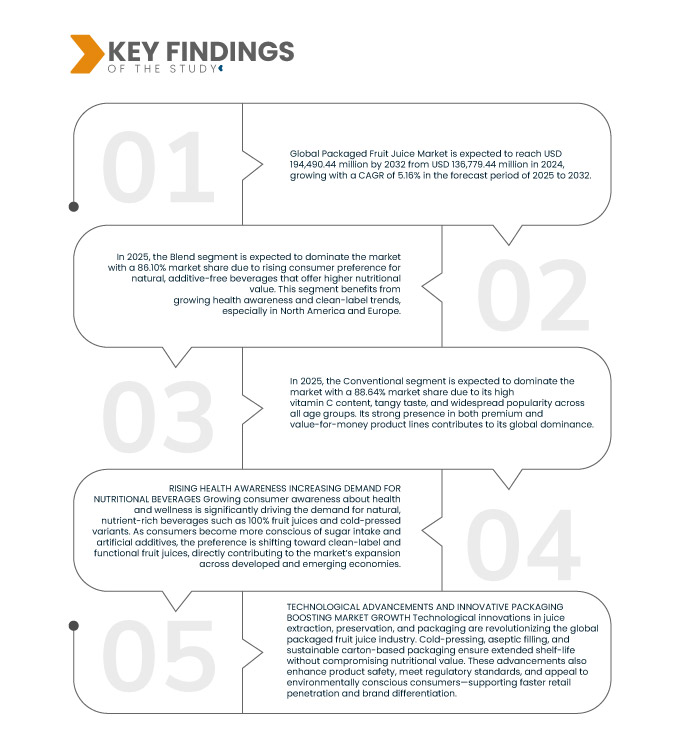
Data Bridge Market Research analyses that the Global Packaged Fruit Juice Market is expected to reach USD 194,490.44 million by 2032 from USD 136,779.44 million in 2024, growing with a CAGR of 5.16% in the forecast period of 2025 to 2032.
Key Findings of the Study
Innovation In Flavor Profiles and Packaging Enhancing Market Penetration
Rising consumer demand for variety and convenience is driving manufacturers to innovate beyond traditional juice flavors like orange and apple. Exotic combinations—such as dragon fruit blends, turmeric-infused citrus, and herbal fruit infusions—are gaining popularity. This experimentation with new taste profiles caters to regional preferences and attracts adventurous and health-aware consumers alike, fostering greater market engagement.
Simultaneously, advancements in packaging formats—such as eco-friendly cartons, glass bottles, and convenient resealable pouches—are redefining product accessibility and portability. These innovations are not only supporting sustainable business practices but also improving shelf visibility and consumer appeal. As a result, leading players in the packaged fruit juice market are focusing on packaging design and extended shelf-life technologies to gain a competitive edge, especially in densely populated urban areas where convenience and sustainability are key purchase drivers.
Report Scope and Packaged Fruit Juice Market Segmentation
|
Report Metric
|
Details
|
|
Forecast Period
|
2025 to 2032
|
|
Base Year
|
2024
|
|
Historic Years
|
2023 (Customizable from 2018-2023)
|
|
Quantitative Units
|
Revenue in USD Thousand
|
|
Segments Covered
|
|
|
Countries Covered
|
North America
Europe
Asia-Pacific
Middle East and Africa
South America
|
|
Market Players Covered
|
|
|
Data Points Covered in the Report
|
In addition to the market insights such as market value, growth rate, market segments, geographical coverage, market players, and market scenario, the market report curated by the Data Bridge Market Research team includes in-depth expert analysis, import/export analysis, pricing analysis, production consumption analysis, and PESTLE analysis.
|
Segment Analysis
The packaged fruit juice market is categorized into nine notable segments which are based on the product type, nature, fruit, volume, claims, packaging, price, end-user, distribution channel.
- On the basis of product type, the global packaged fruit juice market is segmented 100% pure and blend.
In 2025, the Blend segment dominates the packaged fruit juice market
In 2025, the Blend segment is expected to dominate the market with a 86.17% market share due to Blend juices gain traction due to diverse flavor profiles and perceived nutritional balance. Consumers seek variety and enhanced taste, driving demand. Manufacturers innovate with exotic combinations, appealing to younger demographics. Affordable pricing and wide availability in mass retail channels further boost consumption in household segments through store-based outlets.
- On the basis of nature, the global packaged fruit juice market is segmented organic and conventional
In 2025, the Conventional segment dominates the packaged fruit juice market
In 2025, the Conventional segment is expected to dominate the market with a 88.64% market share due Conventional juices dominate due to consumer familiarity and consistent taste. Established brands leverage trust and wide distribution. Mass-market appeal, low price points, and long-standing presence in grocery stores support steady demand. Households prefer these reliable options without premium claims, ensuring sustained growth in store-based retail channels.
- On the basis on fruit, the global packaged fruit juice market is segmented into mixed fruit and single fruit
In 2025, the Single Fruit segment dominates the packaged fruit juice market
In 2025, the Single Fruit segment is expected to dominate the market with a 66.35% market share owing to Single fruit juices are favored for clear ingredient labeling and perceived purity. Consumers associate them with authenticity and natural benefits. Popular flavors like orange and apple maintain strong demand. Easy recognition and trust in single-origin products drive purchases in mass-market, household-focused, store-based retail environments, especially in carton packaging.
- On the basis on volume, the global packaged fruit juice market is segmented into 201–300 ml, up to 200 ml, above 500 ml, 301–400 ml and 401–500 ml
In 2025, the 201–300 ml segment dominates the packaged fruit juice market
In 2025, the 201–300 ml segment is expected to dominate the market with a 41.03% market share The 201–300 ml size balances portability and value, ideal for individual consumption. It suits on-the-go lifestyles and portion control. Widely adopted in schools and households, this size fits standard coolers and lunchboxes. Its convenience and affordability drive volume sales in mass retail, especially in carton format.
- On the basis on claims, the global packaged fruit juice market is segmented into without claims and with claims
In 2025, the Without Claims segment dominates the packaged fruit juice market
In 2025, the Without Claims segment is expected to dominate the market with a 72.33% market share Juices without health or functional claims appeal to price-sensitive consumers seeking basic refreshment. Lower production costs allow competitive pricing, crucial in mass markets. Households prioritize affordability and taste over premium benefits. These products dominate shelf space in store-based retail, ensuring accessibility and high turnover across conventional distribution channels
- On the basis on packaging, the global packaged fruit juice market is segmented into carton, bottles, tetra pack, pouch and others
In 2025, the Carton segment dominates the packaged fruit juice market
In 2025, the Carton segment is expected to dominate the market with a 21.25% market share Cartons offer shelf stability, portability, and eco-friendly perception. They require no refrigeration pre-opening, reducing logistics costs. Lightweight and stackable, they are ideal for mass retail. Households prefer cartons for convenience and portion control. Dominant in store-based channels, cartons support high-volume sales in the juice segment.
- On the basis on price, the global packaged fruit juice market is segmented into mass, premium and luxury
In 2025, the Mass segment dominates the packaged fruit juice market
In 2025, the Mass segment is expected to dominate the market with a 50.59% market share Mass-market juices focus on affordability, wide availability, and broad appeal. Brands leverage economies of scale to maintain low prices. Distribution spans supermarkets, convenience stores, and neighborhood shops. Targeting average-income households, these products prioritize taste and accessibility over premium attributes, ensuring high volume through store-based retail networks.
- On the basis on end-user, the global packaged fruit juice market is segmented into household and commercial
In 2025, the Household segment dominates the packaged fruit juice market
In 2025, the Household segment is expected to dominate the market with a 59.74% market share Households drive bulk and repeat purchases, favoring family-sized or multipack formats. Juices are seen as daily refreshments or meal complements. Parents prefer convenient, safe, and familiar options for children. Store-based retail channels offer accessibility and promotions, reinforcing routine buying behavior in mass-market, carton-packaged, single or blend fruit juice segments.
- On the basis on distribution channel, the Global packaged fruit juice market is segmented into stored-based and non-store based
In 2025, the Store-Based segment dominates the packaged fruit juice market
In 2025, the Store-Based segment is expected to dominate the market with a 61.38% market share Store-based channels—supermarkets, grocery stores, and convenience outlets—dominate juice distribution. They offer visibility, promotions, and immediate product access. Consumers trust physical retail for quality assessment. Mass-market, carton-packaged juices benefit from shelf placement and bundling. Household purchases are primarily fulfilled through these established, high-traffic retail environments.
Major Players
Data Bridge Market Research analyzes Tropicana Products, Inc (U.S.), Suja Life, LLC (U.S.), Ocean Spray (U.S.), Welch's (U.S.), The Hain Celestial Group, Inc (U.S.), The Coca-Cola Company (U.S.), Florida’s Natural Growers, Inc (U.S.) and R.W. Knudsen Family (U.S.) among others.
Market Developments
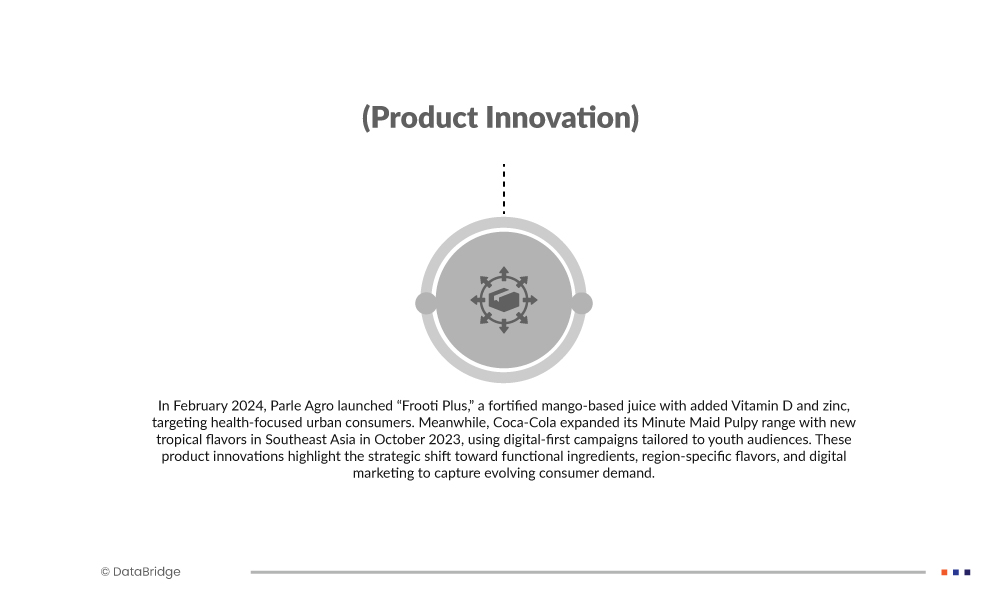
- In February 2024, Parle Agro launched “Frooti Plus,” a fortified mango juice enriched with Vitamin D and zinc, targeting immunity-conscious urban consumers and expanding its product footprint in premium juice categories
- In October 2023, Coca-Cola expanded its “Minute Maid Pulpy” portfolio in Southeast Asia with new tropical flavors, supported by digital-first campaigns tailored to Gen Z and millennial audiences
Regional Analysis
Geographically, the countries covered in the global packaged fruit juice market report are UU.S., Canada, Mexico, China , India, Japan, South Korea , Indonesia , Thailand , Singapore, Australia and New Zealand, Malaysia, Philippines, Rest of Asia-Pacific, Germany, U.K., France, Italy, Spain, Netherlands, Belgium, Russia, Turkey, Switzerland, Rest of Europe, United Arab Emirates, Saudi Arabia, South Africa, Israel, Egypt, Rest of Middle East and Africa, Brazil, Argentina, Rest of South America.
As per Data Bridge Market Research analysis:
For more detailed information about the Global Packaged Fruit Juice Market, click here – https://www.databridgemarketresearch.com/reports/global-packaged-fruit-juice-market