
The rising prevalence of diabetes in the Dominican Republic is a significant driver of the country's diabetes market. As of 2024, approximately 17.6% of adults aged 20 to 79 are living with diabetes, equating to over 1.2 million individuals affected by the condition. This escalating trend is attributed to various factors, including increasing rates of obesity, sedentary lifestyles, and dietary habits high in sugars and fats. The growing diabetic population has intensified the demand for medical services, diagnostic tools, medications, and patient education programs, thereby propelling the expansion of the diabetes market in the region.
Access Full Report @ https://www.databridgemarketresearch.com/reports/dominican-republic-diabetes-market
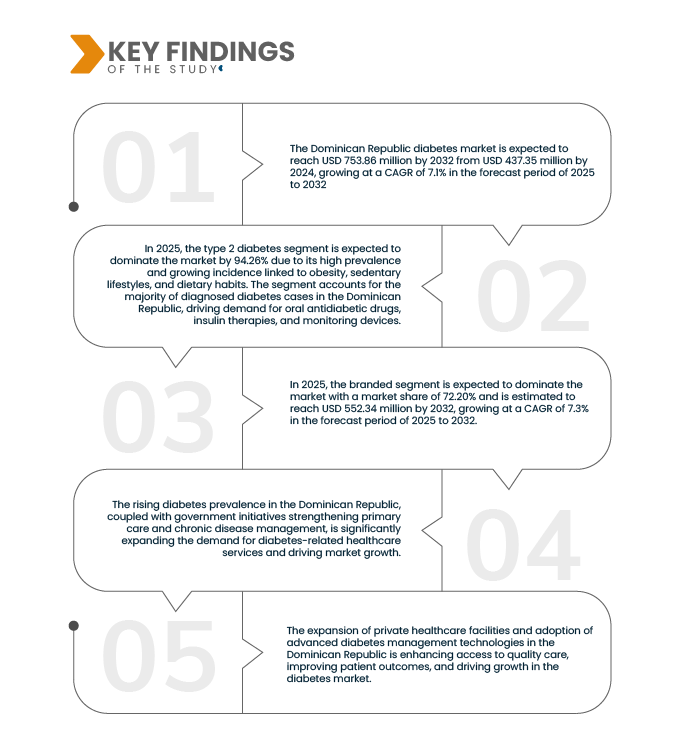
Data Bridge market research analyzes that the Dominican Republic Diabetes Market is expected to reach USD 753.86 million by 2032 from USD 437.35 million by 2024, growing at a CAGR of 7.1% in the forecast period of 2025 to 2032.
Key Findings of the Study
Policy Focus on Primary Care & Chronic Disease Control
The Dominican Republic is intensifying its focus on primary care and chronic disease management as part of a comprehensive strategy to combat the rising burden of diabetes. With diabetes prevalence among adults (20–79 years) reaching approximately 17.6% as of 2024, the country is implementing various initiatives to strengthen its healthcare system. These efforts include enhancing primary care services, integrating chronic disease management into routine healthcare, and providing free medications for hypertension and diabetes to enrolled populations. Such policy measures are pivotal in addressing the increasing healthcare demands and improving the quality of life for individuals living with diabetes.
Report Scope and Market Segmentation
|
Report Metric
|
Details
|
|
Forecast Period
|
2025 to 2032
|
|
Base Year
|
2024
|
|
Historic Years
|
2023 (Customizable to 2018-2022)
|
|
Quantitative Units
|
Revenue in USD Million
|
|
Segments Covered
|
Type (Type 2 Diabetes, Type 1 Diabetes, Gestational Diabetes), Drug Type (Branded, Generic) Product (Medications, Devices), Route of Administration (Subcutaneous, Oral, Intravenous), Patient Group (Adult, Geriatric, Pediatric), Gender (Female, Male), End User (Clinics, Hospitals, Home healthcare Dialysis Centers, Academic & Research Institutes, others), Distribution Channel (Direct Trader, Retail Sales)
|
|
Countries Covered
|
Dominican Republic
|
|
Market Players Covered
|
Novo Nordisk A/S (Denmark), Lilly (U.S.), Roche Diabetes Care Limited, subsidiary of F. Hoffmann-La Roche Ltd (Switzerland), AstraZeneca (U.K./Sweden), Sanofi (France), Johnson & Johnson and its affiliates (U.S.), Medtronic (Ireland/U.S.), Abbott (U.S.), Pfizer Inc. (U.S.), Novartis AG (Switzerland), Dexcom, Inc. (U.S.), Carelife USA (U.S.), MHCmed (U.S.), Inmenol Industrial Laboratorios, S.R.L. (Argentina), Cruz Ayala (Mexico), LUMINOVA PHARMA GROUP (Mexico), AOSS Medical Supply (U.S.), Macrotech (India), Alfa Laboratories (U.K.), Tandem Diabetes Care, Inc. (U.S.)
|
|
Data Points Covered in the Report
|
In addition to the insights on market scenarios such as market value, growth rate, segmentation, geographical coverage, and major players, the market reports curated by the Data Bridge Market Research also include in-depth expert analysis, geographically represented company-wise production and capacity, network layouts of distributors and partners, detailed and updated price trend analysis and deficit analysis of supply chain and demand.
|
Segment Analysis
Dominican Republic Diabetes market is categorized into eight notable categories on the basis of type, product, drug type, route of administration, gender, patient group, end-user, and distribution channel.
- On the basis of type, the market is segmented into type 1 diabetes, type 2 diabetes, gestational diabetes.
In 2025, the type 2 diabetes segment is expected to dominate the market
In 2025, the type 2 diabetes segment is expected to dominate the market with a market share of 94.26% due to its high prevalence and growing incidence linked to obesity, sedentary lifestyles, and dietary habits. The segment accounts for the majority of diagnosed diabetes cases in the Dominican Republic, driving demand for oral antidiabetic drugs, insulin therapies, and monitoring devices.
- On the basis of drug type, the market is segmented into branded, generic.
In 2025, the branded segment is expected to dominate the market
In 2025, the branded segment is expected to dominate the market with a market share of 72.20%. due to strong physician preference, proven clinical efficacy, and higher trust among patients for established diabetes therapies. Branded drugs and devices are often associated with superior quality, reliability, and consistent treatment outcomes, which drive their adoption across hospitals, clinics, and pharmacies. Additionally, ongoing launches of innovative branded formulations and advanced insulin delivery systems by multinational companies further strengthen their presence
- On the basis of product, the market is segmented into medications, devices.
In 2025, the medications segment is expected to dominate the market.
In 2025, the medications segment is expected to dominate the market due to the high prevalence of type 2 diabetes, increasing adoption of oral antidiabetic drugs and insulin therapies, improved access to pharmaceuticals through public health programs, and growing awareness of early diagnosis and treatment adherence. The continued innovation in drug formulations and rising healthcare spending further support the segment’s dominance in the market
- On the basis of route of administration, the market is segmented into subcutaneous, oral, intravenous.
In 2025, the biopharmaceutical companies segment is expected to dominate the market
In 2025, the subcutaneous segment is expected to dominate the market. due to its extensive use in insulin administration for diabetes management. This route offers convenience, reliable absorption, and patient-friendly options through insulin pens, syringes, and pumps. Its suitability for long-term self-administration and preference among both patients and healthcare providers enhance its adoption across hospitals, specialty clinics, and homecare settings in the Dominican Republic.
- On the basis of patient group, the market is segmented into adult, geriatric, pediatric
In 2025, the adult segment is expected to dominate the market
In 2025, the adult segment is expected to dominate the market with a market share of 94.16%.due to the higher prevalence of type 2 diabetes among middle-aged and older adults, driven by lifestyle factors, obesity, and aging populations. Adults represent the largest patient pool requiring continuous monitoring, medication, and long-term disease management. Their higher healthcare utilization and increased risk of diabetes-related complications further strengthen the adoption of treatment and monitoring solutions across hospitals, specialty clinics, and community healthcare settings in the Dominican Republic.
- On the basis of gender, the market is segmented into female, male.
. In 2025, the female segment is expected to dominate the market
In 2025, the female segment is expected to dominate the market with a market share of 56.08%. due to the rising incidence of type 2 diabetes and gestational diabetes among women, influenced by hormonal changes, obesity, and lifestyle factors. Women face unique health risks, including complications during pregnancy and a higher likelihood of cardiovascular issues linked to diabetes, which drive demand for specialized care and monitoring
- On the basis of end user, the market is segmented into hospitals, clinics, dialysis centers, home healthcare, research & academic institutes, others.
In 2025, the clinics segment is expected to dominate the market
In 2025, the clinics segment is expected to dominate the market with a market share of 41.38% due to their critical role in providing accessible and cost-effective diabetes management services. Clinics serve as primary points of care for regular check-ups, monitoring, and treatment adjustments, especially for patients requiring long-term follow-up. Their growing presence in urban and semi-urban areas, along with the availability of specialized diabetes care programs, enhances their adoption.
- On the basis of distribution channel, the market is segmented into direct tender, retail sales, others.
In 2025, the retail sales segment is expected to dominate the market.
In 2025, the retail sales segment is expected to dominate the market with a market share of 58.33%.due to the increasing availability and accessibility of diabetes medicines, insulin, and monitoring devices through community pharmacies and retail outlets. Retail stores play a vital role in ensuring continuous patient access to essential drugs and consumables such as test strips, lancets, and glucose meters. Their widespread presence, affordability, and convenience make them a preferred channel for diabetes patients managing their condition on a daily basis.
Major Players
Novo Nordisk A/S (Denmark), Lilly (U.S.), Roche Diabetes Care Limited, subsidiary of F. Hoffmann-La Roche Ltd (Switzerland), AstraZeneca (U.K./Sweden), Sanofi (France), Johnson & Johnson and its affiliates (U.S.), Medtronic (Ireland/U.S.), Abbott (U.S.), Pfizer Inc. (U.S.), Novartis AG (Switzerland), Dexcom, Inc. (U.S.), Carelife USA (U.S.), MHCmed (U.S.), Inmenol Industrial Laboratorios, S.R.L. (Argentina), Cruz Ayala (Mexico), LUMINOVA PHARMA GROUP (Mexico), AOSS Medical Supply (U.S.), Macrotech (India), Alfa Laboratories (U.K.), Tandem Diabetes Care, Inc. (U.S.) among others as the major market players of the market.
Market Developments
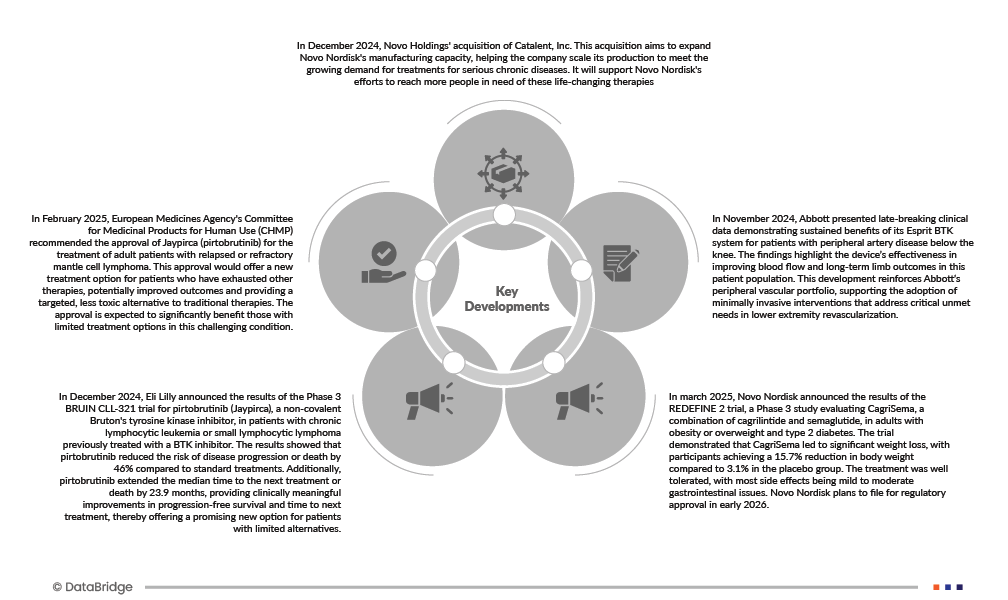
- In December 2024, Novo Holdings' acquisition of Catalent, Inc. This acquisition aims to expand Novo Nordisk's manufacturing capacity, helping the company scale its production to meet the growing demand for treatments for serious chronic diseases. It will support Novo Nordisk's efforts to reach more people in need of these life-changing therapies.
- In February 2025, European Medicines Agency's Committee for Medicinal Products for Human Use (CHMP) recommended the approval of Jaypirca (pirtobrutinib) for the treatment of adult patients with relapsed or refractory mantle cell lymphoma. This approval would offer a new treatment option for patients who have exhausted other therapies, potentially improved outcomes and providing a targeted, less toxic alternative to traditional therapies. The approval is expected to significantly benefit those with limited treatment options in this challenging condition.
- In December 2024, Eli Lilly announced the results of the Phase 3 BRUIN CLL-321 trial for pirtobrutinib (Jaypirca), a non-covalent Bruton's tyrosine kinase inhibitor, in patients with chronic lymphocytic leukemia or small lymphocytic lymphoma previously treated with a BTK inhibitor. The results showed that pirtobrutinib reduced the risk of disease progression or death by 46% compared to standard treatments. Additionally, pirtobrutinib extended the median time to the next treatment or death by 23.9 months, providing clinically meaningful improvements in progression-free survival and time to next treatment, thereby offering a promising new option for patients with limited alternatives.
- In march 2025, Novo Nordisk announced the results of the REDEFINE 2 trial, a Phase 3 study evaluating CagriSema, a combination of cagrilintide and semaglutide, in adults with obesity or overweight and type 2 diabetes. The trial demonstrated that CagriSema led to significant weight loss, with participants achieving a 15.7% reduction in body weight compared to 3.1% in the placebo group. The treatment was well tolerated, with most side effects being mild to moderate gastrointestinal issues. Novo Nordisk plans to file for regulatory approval in early 2026.
- In November 2024, Abbott presented late-breaking clinical data demonstrating sustained benefits of its Esprit BTK system for patients with peripheral artery disease below the knee. The findings highlight the device’s effectiveness in improving blood flow and long-term limb outcomes in this patient population. This development reinforces Abbott’s peripheral vascular portfolio, supporting the adoption of minimally invasive interventions that address critical unmet needs in lower extremity revascularization.
As per Data Bridge Market Research analysis:
For more detailed information about the Dominican Republic Diabetes market report, click here – https://www.databridgemarketresearch.com/reports/dominican-republic-diabetes-market










