The continued expansion of Germany’s industrial and construction sectors has been a critical driver for sustained growth in the safety footwear market. Germany remains Europe’s largest construction market and a global manufacturing hub, with ongoing investments in residential housing, commercial infrastructure, transportation networks, renewable energy facilities, and industrial modernization. Construction sites, factories, warehouses, and energy installations inherently expose workers to risks such as falling objects, sharp debris, uneven surfaces, heavy machinery, and slippery environments, making certified safety footwear a mandatory requirement rather than a discretionary purchase. As project volumes increase and labor intensity remains high, demand for durable, compliant, and task-specific safety footwear rises proportionally.
This growth is further reinforced by Germany’s long-term infrastructure and industrial transition initiatives, including energy-efficient building programs, rail and road upgrades, and the expansion of logistics and warehousing driven by e-commerce and export-oriented manufacturing. These activities generate continuous employment across construction trades, mechanical installation, electrical work, and maintenance services—each governed by strict PPE requirements. Consequently, safety footwear consumption benefits from both new workforce additions and recurring replacement cycles due to wear-and-tear in high-intensity environments, supporting stable volume growth across S1, S2, and S3 footwear categories. Overall, the structural growth of industrial output and construction activity in Germany directly translates into a robust and recurring demand base for safety footwear, positioning the segment as a beneficiary of both economic expansion and long-term infrastructure development.
Access Full Report @ https://www.databridgemarketresearch.com/reports/germany-safety-footwear-market
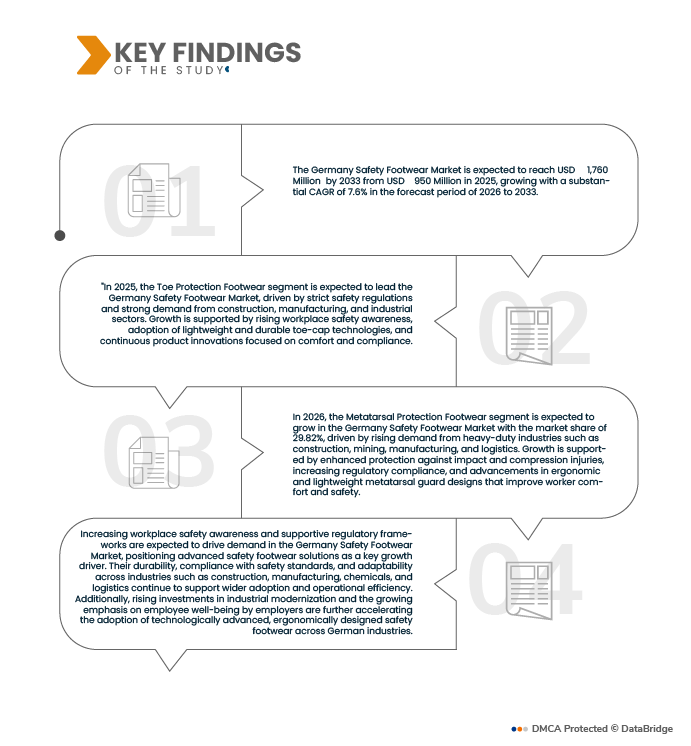
Data Bridge market research analyzes that Germany Safety Footwear Market is expected to reach USD 1,706.01 million by 2033 from USD 954.94 million in 2025, growing with a substantial CAGR of 7.6% in the forecast period of 2025 to 2033.
Key Findings of the Study
Growing Demand for Sustainable and Eco Friendly Footwear
Rising demand for sustainable and eco-friendly safety footwear is creating a strong opportunity in Germany, as employers increasingly align PPE procurement with ESG commitments and EU sustainability objectives. Procurement managers are favoring certified safety shoes made with recycled, low-impact, and recyclable materials, pushing manufacturers to innovate while maintaining compliance with safety standards. Sustainability is thus emerging as an important purchasing criterion alongside durability and protection.
In response, leading manufacturers are integrating eco-conscious materials and circular design principles into their safety footwear portfolios. Companies such as Bata Industrials and Engelbert Strauss have highlighted initiatives focused on recycled textiles, improved recyclability, and reduced resource consumption. This shift positions sustainability as a competitive differentiator, enabling brands to attract environmentally conscious buyers across construction, industrial, and logistics sectors.
Report Scope and Market Segmentation
|
Report Metric
|
Details
|
|
Forecast Period
|
2026 to 2033
|
|
Base Year
|
2025
|
|
Historic Years
|
2024 (Customizable to 2018-2023)
|
|
Quantitative Units
|
Revenue in USD billion
|
|
Segments Covered
|
By Product Type (Toe Protection Footwear, Metatarsal Protection Footwear, Electrical Hazard Protection Footwear, Chemical or Waterproof Footwear, Heat or Fire-Resistant Footwear, Slip-Resistant Footwear, Sport Safety Footwear, Others), By Material (Leather, Rubber, Plastic, Textile, Others), Gender (Men, Women, Unisex), Industry (Oil and Gas, Agriculture Industry, Chemical Industry, Construction Industry, Metal Industry, Food Industry, Transport Industry, Security Industry, Mining Industry, Pharmaceutical Industry, Electronic Industry, Others), Distribution Channel (Non-Store-Based, Store-Based, Others)
|
|
Countries Covered
|
|
|
Market Players Covered
|
|
|
Data Points Covered in the Report
|
In addition to the insights on market scenarios such as market value, growth rate, segmentation, geographical coverage, and major players, the market reports curated by the Data Bridge Market Research also include porter five forces, innovation tracker and strategic analysis, supply chain analysis, raw material coverage, value chain analysis, cost analysis breakdown, profit margins scenario, pricing analysis, vendor selection criteria, brand outlook, climate change scenario, consumer buying behaviour, industry ecosystem analysis, technological advancements, tariffs & their impact, regulation coverage.
|
Segment Analysis
The Germany Safety Footwear Market is segmented into Five notable segments based on Product Type, Material, Gender, Industry and distribution channel.
- On the basis of product type, the Germany Safety Footwear Market is segmented into toe protection footwear, metatarsal protection footwear, electrical hazard protection footwear, chemical or waterproof footwear, heat and fire-resistant footwear, slip-resistant footwear, sport safety footwear, others.
In 2026, the toe protection footwear segment is expected to dominate the market
In 2026, the toe protection footwear segment is expected to dominate the Germany Safety Footwear market share of 29.82% due to its widespread adoption across construction, manufacturing, metal processing, and logistics industries where protection against impact and compression hazards is mandatory. Toe protection footwear offers enhanced durability, compliance with European safety standards, and improved worker confidence, making it a fundamental requirement across both heavy-duty and light industrial work environments.
- On the basis of material, the Germany Safety Footwear Market is segmented into leather, rubber, plastic, textile, others.
In 2026, the leather segment is expected to dominate the market
In 2026, leather segment is expected to dominate the Germany Safety Footwear market share of 51.39% due to its superior durability, breathability, and comfort, making it well suited for prolonged industrial usage. Leather-based safety footwear provides enhanced resistance to abrasion, maintains flexibility under varying working conditions, and supports ergonomic footwear design, reinforcing its widespread adoption across construction, manufacturing, and heavy industrial sectors in.
- On the basis of gender, the Germany Safety Footwear Market is segmented into men, women, unisex.
In 2026, the men segment is expected to dominate the market
In 2026, the men segment is anticipated to dominate the Germany Safety Footwear market share of 71.63% due to the higher concentration of male workforce across construction, manufacturing, metal processing, and heavy industrial sectors. Men’s safety footwear is widely adopted due to its availability in a broader range of protective designs, load-bearing capacities, and compliance with stringent workplace safety regulations. However, the women and unisex segments are gaining steady traction with increasing female workforce participation and growing demand for ergonomically designed, size-inclusive safety footwear across diverse industries in Germany.
- On the basis of industry, the Germany Safety Footwear Market is segmented into oil and gas, agriculture industry, chemical industry, construction industry, metal industry, food industry, transportation industry, security industry, mining industry, pharmaceutical industry, electronic industry, others.
In 2026, the construction industry segment is expected to dominate the market
In 2026, the construction industry segment is anticipated to dominate the Germany Safety Footwear market share of 31.83% due to continuous infrastructure development, strict workplace safety regulations, and high worker exposure to mechanical, electrical, and slip-related hazards across diverse construction environments.
- On the basis of distribution channel, the Germany Safety Footwear Market is segmented into non-store based, store based, others.
In 2026, the non-store based segment is expected to dominate the market
In 2026, the non-store based segment is anticipated to dominate the Germany Safety Footwear market share of 63.51% due to strong presence of organized retail networks, easy accessibility for industrial and commercial buyers, and the ability to provide personalized fittings and demonstrations, while the non-store based segment is witnessing steady growth owing to increasing adoption of online platforms and e-commerce channels for convenient procurement and wider product selection.
Major Players
Engelbert Strauss Inc. (Germany), ATLAS (Germany), ELTEN (Germany), UVEX Safety Group (Germany), Heinrich Klumpen Söhne GmbH & Co. KG (Germany) among others.
Latest Developments in Germany Safety Footwear Market
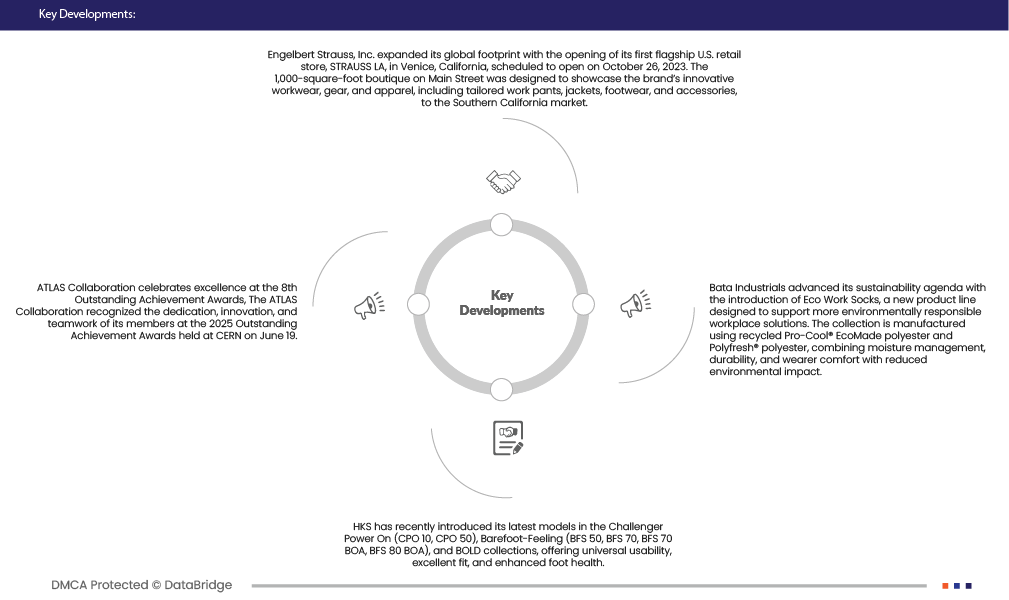
- In September 2023, Engelbert Strauss, Inc. expanded its global footprint with the opening of its first flagship U.S. retail store, STRAUSS LA, in Venice, California, scheduled to open on October 26, 2023. The 1,000-square-foot boutique on Main Street was designed to showcase the brand’s innovative workwear, gear, and apparel, including tailored work pants, jackets, footwear, and accessories, to the Southern California market. The launch event featured local culture, live music, food, and community engagement, signaling the company’s commitment to building a strong retail presence in the United States and introducing the European workwear leader directly to American consumers.
- On May 2024, Bata Industrials advanced its sustainability agenda with the introduction of Eco Work Socks, a new product line designed to support more environmentally responsible workplace solutions. The collection is manufactured using recycled Pro-Cool® EcoMade polyester and Polyfresh® polyester, combining moisture management, durability, and wearer comfort with reduced environmental impact. This development reflects Bata Industrials’ ongoing commitment to integrating sustainable materials into its product portfolio while maintaining performance standards required for professional work environments.
- In October, Cofra highlights a significant sustainable development in safety footwear, focusing on COFRA’s new eco friendly safety shoe range that blends high safety performance with environmental responsibility. This news describes how COFRA uses recycled materials (including post consumer plastics transformed into yarn for fabrics, footbeds, laces, and labels), sustainable packaging, and lightweight aluminium toe caps while still meeting the latest safety standards, effectively reducing waste and supporting a circular economy.
- In March 2025, FTG Safety Shoes S.r.l. has strengthened its quality assurance framework through the renewal of its UNI EN ISO 9001:2015 certification, confirming the effective implementation of a structured Quality Management System across its operations. The certification covers the design, development, production, and commercialization of safety and work footwear and related accessories, ensuring consistent product quality and process control. Renewed in March 2025 and valid through September 2027, this certification reflects FTG’s long-standing commitment to operational excellence, regulatory compliance, and continuous improvement in serving global occupational safety markets.
- In June 2025, HAIX launched the FIRE EAGLE 2.0 EXG, a new firefighting boot featuring a GORE TEX CROSSTECH EXTRAGUARD upper that improves durability, weather resistance, moisture management, and comfort in harsh conditions making it the first firefighting boot in the world with this advanced material.
For more detailed information about the Germany Safety Footwear Market report, click here – https://www.databridgemarketresearch.com/reports/germany-safety-footwear-market