Press Release

Jan, 13 2026

Increased Expenditure on Infrastructure Development and Construction Activities is a Major Driving Factor in the Market

Infrastructure and building are the main commodities that sustain modern human civilization with rapid urbanization development and better personal economic development of people. With the larger population of people moving into the cities, there is a greater demand for quality infrastructure and buildings. The increase in infrastructure expenditure includes the creation of huge demand for private and public sector infrastructure developments. The requirement for high-performance materials that are strong, durable and versatile, thus the demand for waterproofing membranes, is increasing for infrastructure development.

In addition, waterproofing has currently seen a significant increase in the construction industry as people expect buildings to last longer. Extensive waterproofing measures are added during construction to provide moisture control to the building. Still, waterproofing can also be done after construction or as part of a building improvement or renovation. Builders, construction, and chemicals companies such as BASF, JOBS group, water shields solutions and many others are finding ways to develop waterproofing systems to be installed in the building to prevent risk and damage from water leakages and are coming up with new products with new technologies and ideas.

The increase and boom of real estate industries and many developments of infrastructure, especially in the urban area, there is a huge investment, and with huge investment from various comes heavy expenditure on infrastructure and construction activities, which have to cope with the demand of the qualities building for better living standard and low cost of long term management and to minimize the risk of the building reputation there is a high demand of waterproofing membrane in the construction market this drive is expected to drive the market in this next forecast periods.

Access Full Report @ https://www.databridgemarketresearch.com/reports/europe-waterproofing-membrane-market

Data Bridge market research analyzes that the Europe Waterproofing Membrane Market is expected to reach USD 46.74 billion by 2033 from USD 27.10 billion in 2025, growing with a substantial CAGR of 7.4% in the forecast period of 2026 to 2033.

Key Findings of the Study

Europe Waterproofing Membrane Market

Growing Interest in Eco-Friendly and New Materials in Waterproofing Membranes

New research found that people are driving more to more sustainable and eco-friendly products in both developed and developing countries. In a survey, 66% of all respondents and 77% of millennial respondents said they consider sustainability when making a purchase. Almost all around the world, young people are more attracted to sustainable products, and the voices of the younger generation will only increase the demand for sustainable and eco-friendly products after the COVID-19 pandemic has reflected on people about the priorities about choosing ecological materials.

Over the past few years, there has been new technological advancement in waterproofing products and systems; manufacturers have developed new, long-lasting and eco-friendly products in the market that focus more on environmental safety and health considerations. Green is the spotlight from all sectors for its eco-friendly nature, and waterproofing is no exception.

Increasing demand for eco-friendly and the launching of new products of new advanced materials will attract more customers in the market, and it is expected to be an opportunity for the players involved in this industry to increase R&D for new products and grow their business and increase their overall revenue in the coming forecast periods. This increase in the eco-friendly and new materials in waterproofing membranes is expected to create an opportunity for the market.

The growing shift towards sustainability and eco-friendly products, particularly among younger generations, is significantly influencing the waterproofing membrane market. Technological advancements have led to the development of innovative, eco-friendly waterproofing materials that prioritize environmental safety and health, offering non-toxic and low-impact solutions. This trend presents a key opportunity for manufacturers to invest in research and development of energy-efficient, high-performance waterproofing products. As the demand for sustainable solutions continues to rise, companies that embrace these eco-friendly innovations will not only cater to consumer preferences but also position themselves for long-term growth in an increasingly environmentally conscious market.

Report Scope and Market Segmentation

Report Metric

Details

Forecast Period

2026 to 2033

Base Year

2025

Historic Years

2024 (Customizable to 2019-20223)

Quantitative Units

Revenue in USD Thousand

Segments Covered

By Type (Cementitious Waterproofing, Epoxy Waterproofing, Bituminous

Waterproofing, EPDM Waterproofing, HDPE Waterproofing, PVC Waterproofing, Polymer Waterproofing, Admixture Waterproofing, Hypalon Waterproofing, Modified Bitumen Membrane, Polyurethane Membrane, Others), Product (Liquid Applied Membranes, Sheet Based Membranes), Construction (Retrofit Construction, New Construction), Installation Type (Torch-Applied, Hot-Air Weld, Cold Applied Self-Adhesive Sheets, Brush/Roller Applied, Spray Applied Membranes, Injection / Crystalline, Bim-Assisted, Others), Application (Roofing and Walls, Building Structures, Waste and Water Management, Mining Application, Tunnel Liners, Bridges and Highways, Others), Distribution Channel (Direct, Indirect)

Countries Covered

Germany, U.K., Italy, France, Spain, Switzerland, Russia, Turkey, Belgium, Netherlands, Denmark, Norway, Finland, Sweden, Poland, Portugal, Rest of Europe

Market Players Covered

  • Sika AG (Switzerland)
  • BASF (Germany)
  • Minerals Technologies Inc. (U.S.)
  • Fosroc, Inc. (UAE)
  • Renolit SE (Germany)
  • Bauder Ltd. (U.K.)
  • Bermüller & CO GmbH (Germany)
  • Juta LTD (Czech Republic)
  • Nophadrain BV (Netherlands)
  • Rawell Environmental (U.K.)
  • Schluter Systems Ltd. (U.K.)
  • Soprema (France)
  • MAPEI (Italy)
  • Polyflex Geomembrane (Netherlands)
  • Tremco (U.S.)
  • IKO EUROPE (Belgium)
  • ARDEX GMBH (Germany)
  • IZOTEX - Waterproofing & Membranes (Poland)
  • Kingspan Group (Ireland)

Data Points Covered in the Report

In addition to the insights on market scenarios such as market value, growth rate, segmentation, geographical coverage, and major players, the market reports curated by the Data Bridge Market Research also include in-depth expert analysis, industry analysis & futuristic scenario, penetration and growth prospect mapping, competitor key pricing strategies, and technology analysis

Segment Analysis

The Europe Waterproofing Membrane Market is segmented into six notable segments based on type, product, construction, installation type, application, distribution channel.

  • On the basis of type, the market is segmented into Cementitious Waterproofing, Epoxy Waterproofing, Bituminous Waterproofing, EPDM Waterproofing, HDPE Waterproofing, PVC Waterproofing, Polymer Waterproofing, Admixture Waterproofing, Hypalon Waterproofing, Modified Bitumen Membrane, Polyurethane Membrane and Others.

In 2026, the Bituminous Waterproofing segment is expected to dominate the market

In 2026 the Bituminous Waterproofing segment is expected to dominate the market with a market share of 21.69% due to because of its well-established performance record and long-term reliability in preventing water ingress across diverse construction applications, which has built strong trust among developers and contractors over decades. Its cost-effectiveness and widespread availability make it an attractive choice for both large infrastructure projects and residential roofing, helping to control project budgets without compromising on protective performance. Bitumen’s compatibility with varied substrates (like concrete, masonry, and metal) and applicability in refurbishment as well as new builds further broadens its use cases across the region. Additionally, bituminous membranes offer robust resistance to extreme European climatic conditions, including temperature fluctuations and UV exposure, enhancing durability and service life. The material’s adaptability to different application methods (e.g., torch-applied, self-adhesive) also simplifies installation logistics, strengthening its preference over alternative membrane types.

  • On the basis of product, the market is segmented into liquid applied membranes and sheet based membranes.

In 2026, the Liquid Applied Membranes segment is expected to dominate the market

In 2026, Liquid Applied Membranes segment dominates the market with a market share of 58.90% due to the fact that they form a seamless, monolithic barrier that conforms to irregular surfaces and complex architectural details better than traditional sheet membranes, reducing potential leak points and enhancing long-term performance. Their versatile application methods (brush, roller, spray) and compatibility with diverse substrates like concrete, metal, and masonry make them ideal for both new construction and extensive renovation projects across Europe’s historic and modern buildings. LAMs also deliver high elasticity and movement accommodation, crucial in regions where temperature variation and building settlement demand flexible waterproofing solutions. Strict European sustainability standards and regulations further favor liquid systems with low VOC emissions and solvent-free formulations, aligning with green construction goals. Additionally, their reduced installation complexity and cost efficiencies, especially on intricate or hard-to-reach surfaces, drive preference among contractors and specifiers across residential, commercial, and infrastructure applications.

  • On the basis of construction, the market is segmented into retrofit construction and new construction. 

In 2026, the Retrofit Construction segment is expected to dominate the market

In 2026, the retrofit construction segment is expected to dominate the market with a market share of 57.39% due to the fact that Europe has an extensive stock of ageing buildings that increasingly require water-damage protection and performance upgrades rather than entirely new builds. The EU’s Renovation Wave strategy, which aims to double renovation rates and improve energy efficiency across millions of existing structures by 2030, directly fuels demand for waterproofing solutions in retrofit projects as building envelopes are enhanced for durability and climate performance.

  • On the basis of installation type, the market is segmented into Torch-Applied, Hot-Air Weld, Cold Applied Self-Adhesive Sheets, Brush / Roller Applied, Spray Applied Membranes, Injection / Crystalline, Bim-Assisted and Others. 

In 2026, the Torch-Applied segment is expected to dominate the market

In 2026, the torch-applied segment is expected to dominate the market with a market share of 26.09% due to the fact that it delivers exceptional adhesion and long-term durability, especially in large-scale commercial and industrial projects where performance reliability is critical. The heat-activated bitumen forms a robust bond with substrates, ensuring superior waterproofing in extreme weather and varied climatic conditions common across Europe. This method’s established installer familiarity and widespread contractor acceptance further reinforce its prevalence, as skilled labor and standardized procedures reduce installation risk and rework. Additionally, torch-applied membranes are often more cost-competitive on a per-area basis for extensive roof and foundation applications versus alternative systems. Finally, their proven track record in meeting stringent European building codes and performance standards makes them a go-to for developers and engineers seeking dependable, regulatory-compliant solutions.

  • On the basis of application, the market is segmented into Roofing and Walls Building Structures, Waste and Water Management, Mining Application, Tunnel Liners, Bridges and Highways and Others. 

In 2026, the roofing and walls segment is expected to dominate the market

In 2026, the roofing and walls segment is expected to dominate the market with a market share of 34.76% due to the fact that roofing systems represent the largest area in buildings exposed to water ingress and weather impacts, driving consistent demand for high-performance waterproofing membranes to prevent leaks, structural damage, and long-term maintenance costs. This segment’s prominence is further strengthened by extensive residential and commercial construction and refurbishment activities across major European economies, where robust roof and wall waterproofing is essential for compliance with stringent building codes and durability standards. Additionally, the rising adoption of sustainable and energy-efficient building practices—including green roofs and advanced membrane technologies—boosts demand for waterproofing solutions tailored to roofs and walls. Regulatory emphasis on building safety and energy performance also incentivizes the use of certified waterproofing materials in these applications. Collectively, these factors make roofing and walls the largest contributor to the market’s application share in Europe.

  • On the basis of distribution channel, the market is segmented into direct and indirect 

In 2026, the indirect segment is expected to dominate the market

In 2026, the indirect segment is expected to dominate the market with a market share of 68.40% due to the fact that it provides extensive regional reach through a network of distributors, retailers, and third-party vendors that ensures products are readily available across both urban and rural construction markets. This widespread availability enhances accessibility for residential builders, small and medium contractors, and DIY segments, which form a significant portion of demand in fragmented European markets. Indirect channels also offer localized inventory, quicker delivery, and value-added services like technical advice and on-site support, helping smaller buyers make informed choices and complete projects efficiently. Moreover, distributors often bundle services such as after-sales support and product training, which strengthens customer relationships and loyalty in a competitive landscape. Finally, the rise of digital and e-commerce platforms integrated with traditional distribution has further expanded market penetration, making indirect channels even more effective in addressing diverse customer needs across Europe.

Major Players

Sika AG, BASF, Minerals Technologies Inc., Fosroc, Inc., Renolit SE, Bauder Ltd., Bermüller & CO GmbH, among others.

Europe Waterproofing Membrane Market

Market Developments

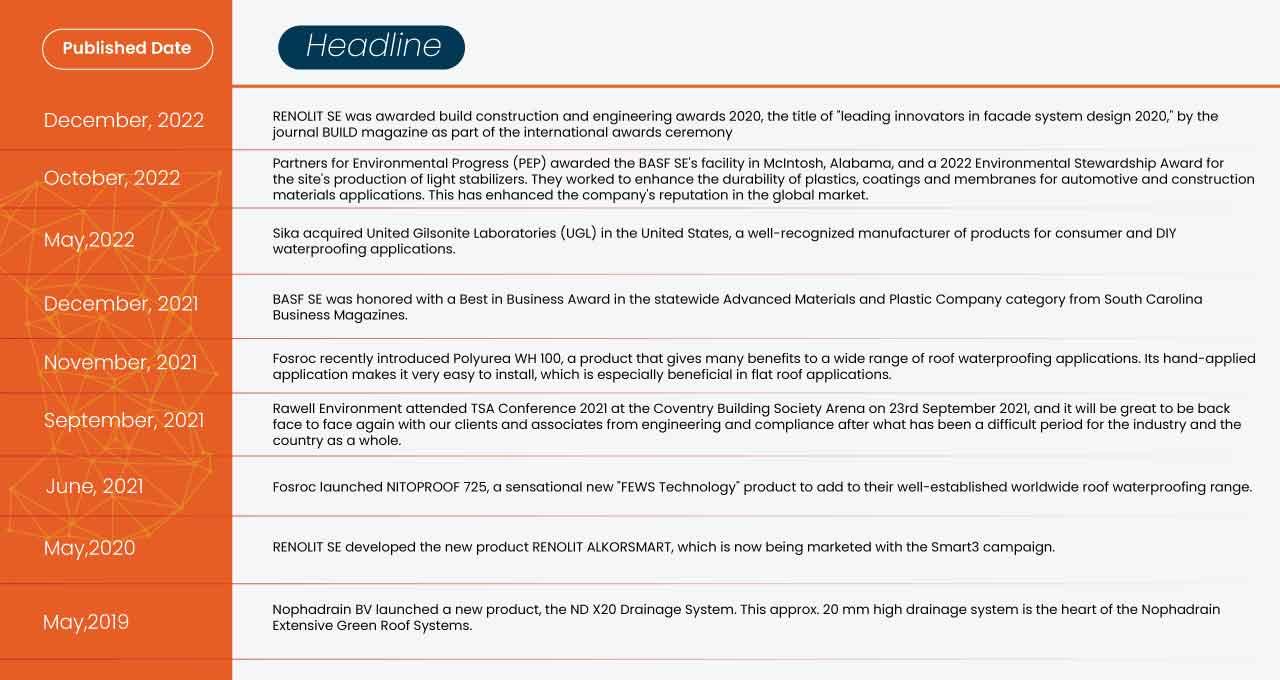
  • In March, Sika AG and BASF launched Baxxodur EC 151, a new epoxy hardener for sustainable construction applications. The product offered low emissions, quick curing at low temperatures, and excellent flow properties. It reduced VOCs by up to 90% and minimized the need for thinners. The hardener enabled durable, high-gloss flooring with better color stability and lower maintenance. Through this launch, BASF and Sika strengthened their positions as leaders in sustainable construction solutions and supported customers efficiency and environmental goals.
  • In December 2023, SOPREMA Group acquired Gripfix Ireland Ltd, a wellknown construction materials supplier based in County Meath, Ireland. The acquisition was finalized by representatives from both companies, aiming to strengthen Soprema’s market presence in Ireland. Gripfix had a strong reputation for quality and innovation in the local construction sector. This move expanded Soprema’s footprint, enriched its product portfolio, and aligned with its global growth strategy. The deal also created opportunities for innovation and collaboration within the Irish construction industry.
  • In 2024 financial results, Kingspan reported significant expansion of its Roofing & Waterproofing division, with flat roofing membrane business growth and improvement in underlayment activity. The company also increased its ownership in Nordic Waterproofing to around 87.4% by year‑end.
  • In October, Kingspan boosted its ownership in Nordic Waterproofing to 62.6%, reinforcing its strategic footprint in European waterproofing products and services, including membranes and installation operations across multiple countries.
  • In November, IZOTEX's Under-ceramic waterproofing membranes offer effective solutions to prevent the harmful effects of water in wet areas. IZOTEX's textile insulation membranes can be customized to customer needs with different layer structures and material options.

Regional Analysis

Geographically, the countries covered in the Europe Waterproofing Membrane Market report are (Germany, U.K., Italy, France, Spain, Switzerland, Russia, Turkey, Belgium, Netherlands, Denmark, Norway, Finland, Sweden, Poland, Portugal, Rest of Europe).

As per Data Bridge Market Research analysis:

Germany is the dominant country in the Europe Waterproofing Membrane Market during the forecast period of 2026 to 2033

Germany is expected to dominate the market due to its highly advanced construction ecosystem, which emphasizes quality, long‑term durability, and performance in both new builds and renovation projects. The country’s construction sector is one of the most developed in Europe, driving substantial demand for high‑performance waterproofing membranes across commercial, residential, and infrastructure applications. Germany’s stringent building codes and regulatory standards require robust waterproofing solutions that meet strict durability and sustainability benchmarks, pushing developers and contractors toward premium membrane technologies. Additionally, strong investments in infrastructure projects—such as tunnels, bridges, and below‑grade structures—necessitate advanced waterproofing systems to protect against water ingress and long‑term structural damage.

The presence of major market players and materials manufacturers with significant R&D capabilities further strengthens Germany’s position by fostering innovation in eco‑friendly, energy‑efficient membrane technologies. Growing emphasis on sustainable and energy‑efficient construction practices, supported by both government initiatives and EU regulations, accelerates the adoption of advanced waterproofing materials that reduce environmental impact and improve building performance. Renovation and preservation of Germany’s extensive built heritage also create steady demand for specialized membrane solutions tailored to unique architectural requirements, reinforcing its leadership in the regional market. These factors collectively contribute to Germany’s commanding share and leadership position in the Europe waterproofing membrane market in 2025.

For more detailed information about the Europe Waterproofing Membrane Market report, click here – https://www.databridgemarketresearch.com/reports/europe-waterproofing-membrane-market


Client Testimonials