The global automotive soft trim interior materials market is witnessing robust growth, primarily driven by rising consumer expectations for enhanced comfort, premium aesthetics, and a superior in-cabin experience. As automakers increasingly focus on differentiating their vehicles through interior design and quality, the demand for advanced soft trim materials is expanding, reshaping the automotive interior landscape. Modern consumers place significant emphasis on the look and feel of vehicle interiors when making purchasing decisions. This has fueled the adoption of soft-touch materials such as premium fabrics, synthetic leather, microfiber, and advanced polymer-based surfaces that provide both visual appeal and enhanced tactile comfort. These materials enable manufacturers to create refined, luxurious, and ergonomic cabin environments that improve passenger comfort, particularly during long journeys, while supporting growing demand for personalization and premium vehicle experiences.
In addition, the industry's increasing commitment to sustainability is influencing the selection of interior materials. Consumers are becoming more environmentally conscious and are showing a stronger preference for vehicles incorporating recycled, renewable, and bio-based materials. In response, automotive manufacturers are integrating eco-friendly soft trim solutions into their interiors, helping reduce environmental impact while complying with evolving regulations and supporting broader sustainability objective.
Access Full Report @ https://www.databridgemarketresearch.com/reports/global-automotive-soft-trim-interior-materials-market
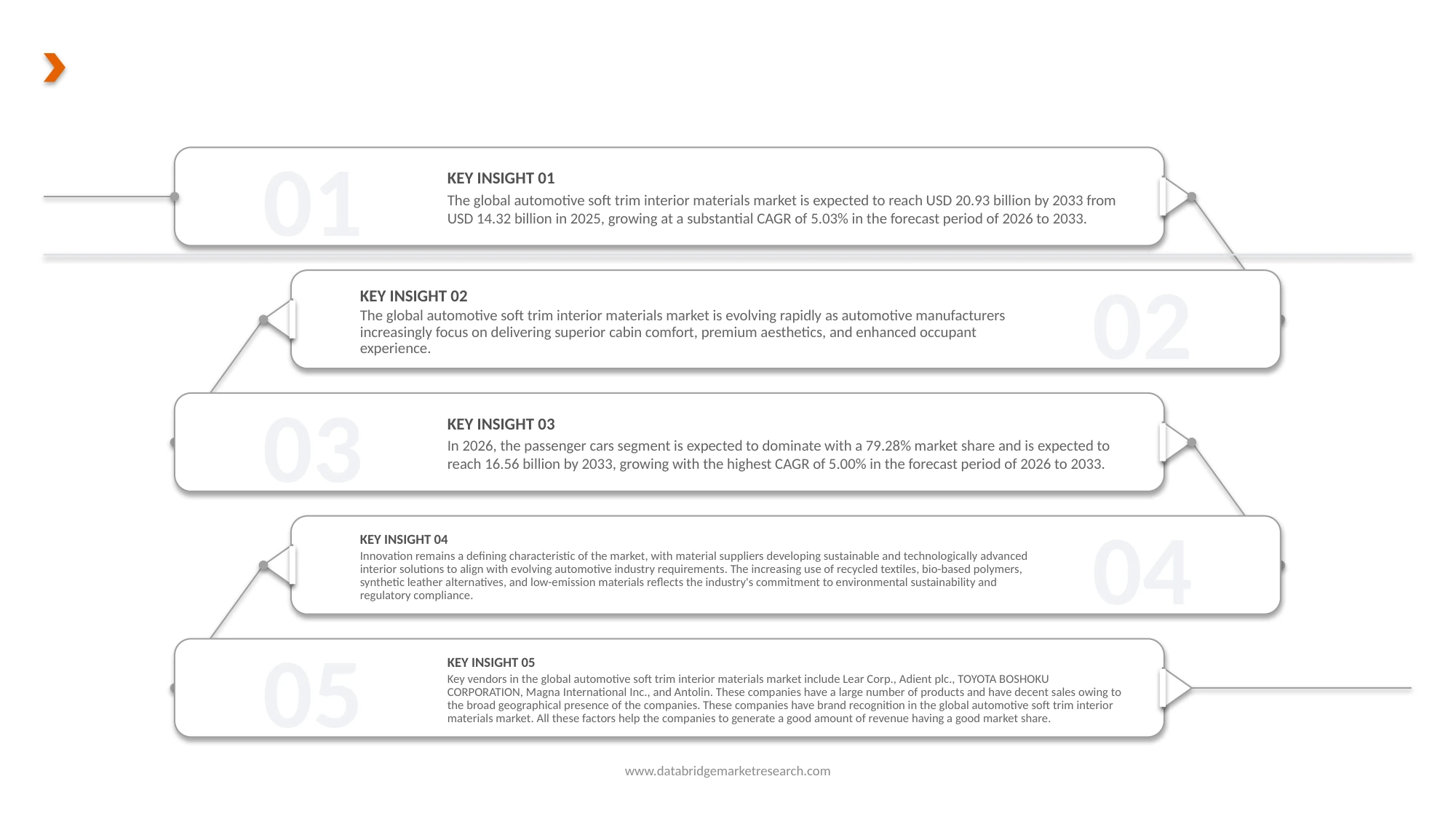
Data Bridge market research analyzes that the Global Automotive Soft Trim Interior Materials Market size was valued at USD 20.93 billion by 2033 from USD 14.32 billion in 2025, growing with a CAGR of 5.03% during the forecast period of 2026 to 2033.
Key Findings of the Study
Rapid Expansion of the Automotive Industry
The rapid expansion of the global automotive industry is a major factor driving the growth of the automotive soft trim interior materials market. Rising vehicle production, increasing disposable incomes, rapid urbanization, and improving living standards are contributing to higher vehicle ownership across both developed and emerging economies. As competition among automakers intensifies, manufacturers are increasingly focusing on enhancing cabin quality, comfort, and aesthetics to differentiate their vehicles, thereby driving demand for premium soft trim interior materials. The automotive industry continues to grow steadily, particularly in emerging markets such as India, China, Brazil, and Southeast Asia, where expanding middle-class populations and favorable economic conditions are supporting higher vehicle sales. At the same time, consumers are placing greater importance on premium interior experiences that combine comfort, attractive design, and enhanced functionality. This shift in consumer preferences is encouraging automakers to adopt advanced soft trim materials, including premium fabrics, synthetic leather, microfiber, and polymer-based surfaces that improve both appearance and tactile comfort. The ongoing transition toward electric and hybrid vehicles is also reshaping automotive interior design. As manufacturers compete in the growing electric mobility segment, they are investing in modern, spacious, and technology-enabled cabins that enhance the overall user experience. Soft trim materials contribute significantly by offering lightweight, aesthetically appealing, and sustainable interior solutions that align with evolving consumer expectations and environmental objectives. In addition, increasing consumer interest in personalized vehicle interiors is influencing material selection and design strategies. Buyers are seeking customized cabin environments featuring unique combinations of colors, textures, stitching patterns, and finishes. To address this demand, manufacturers are expanding their soft trim material portfolios while adopting advanced manufacturing technologies such as digital printing, precision cutting, and 3D design to efficiently produce customized interior components.
Report Scope and Market Segmentation
|
Report Metric
|
Details
|
|
Forecast Period
|
2026 to 2033
|
|
Base Year
|
2025
|
|
Historic Years
|
2018-2024 (Customizable to 2013-2017)
|
|
Quantitative Units
|
Revenue in USD thousands
|
|
Segments Covered
|
By Material Type (Fabric, Leather, Vinyl, Suede, and Alcantara-Type Materials), By Interior Component (Seat Trim, Door Trim, Headliner, Pillar Trim, Parcel Shelf Trim, Sun Visor Trim, and Steering Wheel Wrap), By Vehicle Type (Passenger Cars, Light Commercial Vehicles, Medium Commercial Vehicles, Heavy Commercial Vehicles, and Buses and Coaches), By Surface Finish (Smooth Finish, Textured Finish, Perforated Finish, Quilted Finish, and Brushed Finish), By Technology (Conventional Soft Trim Materials, Lightweight Soft Trim Materials, Smart Interior Materials, Sustainable Interior Materials, and Acoustic Interior Materials), By Application (Seating Systems, Cabin Interior Panels, Roof Systems, Cargo Area Trim, and Cockpit Components), By Performance Characteristic (Durability Focused Materials, Comfort Focused Materials, Acoustic Performance Materials, Thermal Comfort Materials, and Stain Resistant Materials), By Sustainability Profile (Recycled Materials, Bio-Based Materials, Low Emission Materials, Circular Economy Materials, and Animal-Free Materials), By Manufacturing Process (Lamination, Coating, Embossing, Stitching, Molding, and Wrapping), By Sales Channel (Original Equipment Manufacturers, Aftermarket, and Custom Interior Specialists), By End User (Mass Market Vehicles, Premium Vehicles, Luxury Vehicles, Performance Vehicles, and Commercial Fleets), By Soft Trim Functional Property (Aesthetic Enhancement Materials, Comfort Enhancement Materials, Acoustic Management Materials, Safety Supporting Materials, and Environmental Compliance Materials), and By Distribution Channel (Offline and Online)
|
|
Countries Covered
|
China, Japan, India, South Korea, Thailand, Malaysia, Indonesia, Vietnam, Taiwan, Philippines, Singapore, New Zealand, Australia, Rest of Asia-Pacific, Germany, France, Spain, U.K., Italy, Turkey, Poland, Belgium, Netherlands, Sweden, Russia, Switzerland, Denmark, Finland, Norway, Rest of Europe, U.S., Mexico, Canada, Brazil, Argentina, Colombia, Chile, Peru, Ecuador, Uruguay, Paraguay, Bolivia, Venezuela, Rest of South America, South Africa, Egypt, Saudi Arabia, U.A.E, Israel, Kuwait, Oman, Qatar, Bahrain, Rest of Middle East & Africa
|
|
Market Players Covered
|
|
|
Data Points Covered in the Report
|
In addition to the market insights such as market value, growth rate, market segments, geographical coverage, market players, and market scenario, the market report curated by the Data Bridge Market Research team includes in-depth expert analysis, import/export analysis, pricing analysis, production consumption analysis, and pestle analysis.
|
Segment Analysis
The global automotive soft trim interior materials market is segmented into seven notable segments based on the vehicle type, power output, number of passengers, transmission type, propulsion type, battery type, and application.
- On the basis of material type, the global automotive soft trim interior materials market is segmented into fabric, leather, vinyl, suede, and alcantara-type materials.
In 2026, the fabric segment is expected to dominate the market
In 2026, the fabric segment is expected to dominate due to its cost-effectiveness, lightweight nature, durability, and design flexibility. It is widely used in seat upholstery, door panels, and headliners because it offers a balance of comfort, aesthetics, and affordability. The increasing adoption of recycled and high-performance fabrics further supports its strong market position.
- On the basis of interior component, the global automotive soft trim interior materials market is segmented into seat trim, door trim, headliner, pillar trim, parcel shelf trim, sun visor trim, and steering wheel wrap.
In 2026, the seat trim segment is expected to dominate the market
In 2026, the seat trim segment is expected to dominate due to its extensive use across all vehicle categories and its significant contribution to interior comfort, aesthetics, and durability. Growing demand for premium seating, ergonomic designs, and sustainable trim materials further supports the segment's leading position.
- On the basis of vehicle type, the global automotive soft trim interior materials market is segmented into passenger cars, light commercial vehicles (LCVS), medium commercial vehicles (MCVS), heavy commercial vehicles (HCVS), and buses & coaches.
In 2026, the passenger cars segment is expected to dominate the market
In 2026, the passenger cars segment is expected to dominate due to high global production volumes, increasing consumer demand for enhanced interior comfort and aesthetics, and the growing adoption of premium and sustainable soft trim materials across economy and luxury vehicle models.
- On the basis of surface finish, the global automotive soft trim interior materials market is segmented into smooth finish, textured finish, perforated finish, quilted finish, and brushed finish.
In 2026, the smooth finish segment is expected to dominate the market
In 2026, the smooth finish segment is expected to dominate due to its premium appearance, soft-touch feel, and ease of maintenance. It is widely preferred across vehicle interiors for enhancing comfort, aesthetics, and overall cabin quality while supporting modern interior design trends.
- On the basis of technology, the global automotive soft trim interior materials market is segmented into conventional soft trim materials, lightweight soft trim materials, smart interior materials, sustainable interior materials, and acoustic interior materials.
In 2026, the conventional soft trim materials segment is anticipated to dominate the market
In 2026, the conventional soft trim materials segment is expected to dominate due to their widespread use, established supply chains, cost-effectiveness, and proven durability. These materials continue to be preferred by manufacturers for meeting performance, quality, and affordability requirements across a wide range of vehicle models.
- On the basis of application, the global automotive soft trim interior materials market is segmented into seating systems, cabin interior panels, roof systems, cargo area trim, and cockpit components.
In 2026, the seating systems segment is anticipated to dominate the market
In 2026, the seating systems segment is expected to dominate due to its high material consumption, essential role in passenger comfort, and continuous demand for durable, aesthetically appealing, and ergonomic interior solutions across all vehicle categories.
- On the basis of performance characteristic, the global automotive soft trim interior materials market is segmented into durability focused materials, comfort focused materials, acoustic performance materials, thermal comfort materials, and stain resistant materials.
In 2026, the durability focused materials segment is anticipated to dominate the market
In 2026, the durability focused materials segment is expected to dominate due to their superior resistance to wear, abrasion, stains, and daily usage. Automakers increasingly prefer these materials to ensure longer product life, lower maintenance, and consistent interior quality across a wide range of vehicles.
- On the basis of sustainability profile, the global automotive soft trim interior materials market is segmented into recycled materials, bio-based materials, low emission materials, circular economy materials, and animal-free materials.
In 2026, the recycled materials segment is anticipated to dominate the market
In 2026, the recycled materials segment is expected to dominate due to increasing sustainability initiatives, stricter environmental regulations, and growing demand for eco-friendly vehicle interiors. Automakers are increasingly adopting recycled materials to reduce carbon emissions while maintaining quality, durability, and aesthetic appeal.
- On the basis of manufacturing process, the global automotive soft trim interior materials market is segmented into lamination, coating, embossing, stitching, molding, and wrapping.
In 2026, the lamination segment is anticipated to dominate the market
In 2026, the lamination segment is expected to dominate due to its ability to enhance durability, improve surface appearance, and provide superior bonding between multiple material layers. It is widely used to achieve premium finishes, better comfort, and long-lasting interior performance
- On the basis of sales channel, the global automotive soft trim interior materials market is segmented into original equipment manufacturers, aftermarket, and custom interior specialists.
In 2026, the original equipment manufacturers (OEMS) segment is anticipated to dominate the market
In 2026, the original equipment manufacturers (OEMS) segment is expected to dominate due to high demand for factory-installed interior components, stringent quality standards, and increasing production of new vehicles requiring integrated and customized soft trim solutions
- On the basis of end user, the global automotive soft trim interior materials market is segmented into mass market vehicles, premium vehicles, luxury vehicles, performance vehicles, and commercial fleets.
In 2026, the mass market vehicles segment is anticipated to dominate the market
In 2026, the mass market vehicles segment is expected to dominate due to high global production volumes, strong consumer demand for affordable vehicles, and the widespread use of cost-effective, durable, and comfortable soft trim materials across mainstream vehicle models
- On the basis of soft trim functional property, the global automotive soft trim interior materials market is segmented into aesthetic enhancement materials, comfort enhancement materials, acoustic management materials, safety supporting materials, and environmental compliance materials.
In 2026, the aesthetic enhancement materials segment is anticipated to dominate the market
In 2026, the aesthetic enhancement materials segment is expected to dominate due to growing consumer demand for premium-looking vehicle interiors, improved tactile experience, and modern design finishes. Automakers are increasingly using these materials to enhance cabin appeal and strengthen brand differentiation
- On the basis of distribution channel, the global automotive soft trim interior materials market is segmented into offline and online.
In 2026, the offline segment is anticipated to dominate the market
In 2026, the offline segment is expected to dominate due to established supplier networks, direct oem procurement channels, and the need for quality inspection, customization, and long-term supply agreements for automotive interior materials
Major Players
Lear Corp. (U.S.), Adient plc. (U.S.), TOYOTA BOSHOKU CORPORATION (Japan), Magna International Inc. (Canada), and Antolin (Spain), among others are the major players dealing in the market.
Regional Analysis
Geographically, the country covered in the global automotive soft trim interior materials market report is China, Japan, India, South Korea, Thailand, Malaysia, Indonesia, Vietnam, Taiwan, Philippines, Singapore, New Zealand, Australia, Rest of Asia-Pacific, Germany, France, Spain, U.K., Italy, Turkey, Poland, Belgium, Netherlands, Sweden, Russia, Switzerland, Denmark, Finland, Norway, Rest of Europe, U.S., Mexico, Canada, Brazil, Argentina, Colombia, Chile, Peru, Ecuador, Uruguay, Paraguay, Bolivia, Venezuela, Rest of South America, South Africa, Egypt, Saudi Arabia, U.A.E, Israel, Kuwait, Oman, Qatar, Bahrain, Rest of Middle East & Africa.
As per Data Bridge Market Research analysis:
Asia-Pacific is the dominant region in the global automotive soft trim interior materials market
Asia-Pacific is expected to remain the dominant region in the global automotive soft trim interior materials market, supported by its large automotive manufacturing base, expanding vehicle production, and rising demand for comfortable and aesthetically enhanced interiors. China, Japan, South Korea, and India represent major automotive production and consumption centers, generating substantial demand for fabrics, leather, foams, thermoplastics, and other soft-trim materials. The rapid expansion of electric vehicles is further encouraging the adoption of lightweight, sustainable, and premium interior materials. Additionally, increasing consumer spending, urbanization, and investments in advanced vehicle interiors are supporting regional market growth. China remains a key contributor, while India is emerging as a high-growth market due to increasing vehicle production and consumer preference for upgraded interiors.
Asia-Pacific is estimated to be the fastest-growing region in the global automotive soft trim interior materials market
Asia-Pacific is estimated to be one of the fastest-growing regions in the global automotive soft trim interior materials market, supported by expanding vehicle production, rising disposable incomes, and increasing consumer demand for comfortable and premium vehicle interiors. Rapid growth in electric vehicle manufacturing is further stimulating demand for lightweight, sustainable, and innovative soft-trim materials. China and India are expected to remain important growth engines, supported by expanding automotive manufacturing capabilities and increasing vehicle ownership. Rising adoption of eco-friendly fabrics, synthetic leather, thermoplastics, and advanced foams is also expected to strengthen regional demand.
Market Developments
- In February 2023, Adient's Korea R&D Center received the Best Collaboration Award from Hyundai Motor Group in recognition of its outstanding partnership and innovative contributions to the development of automotive seating solutions. The award highlights Adient's collaborative approach to advancing seating technologies and supporting innovation across Hyundai Motor Group's vehicle programs. The award strengthens Adient's reputation as a trusted automotive seating supplier and reinforces its strategic collaboration with Hyundai Motor Group in developing advanced seating solutions.
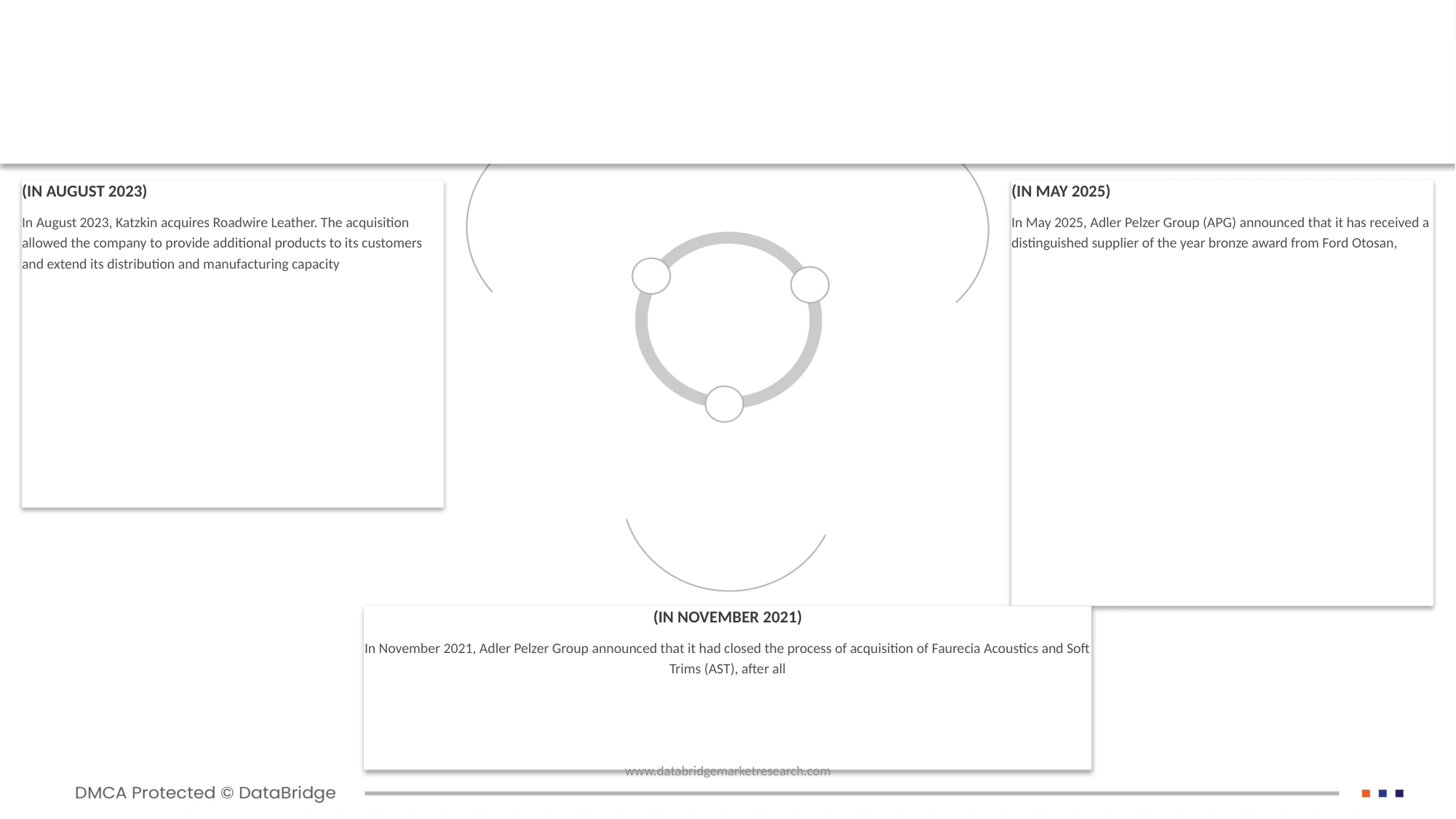
- In May 2025, Adler Pelzer Group (APG) announced that it has received a distinguished supplier of the year bronze award from Ford Otosan, recognizing its sustainable success in the areas of Quality, Delivery, and Collaboration across both Ford of Europe and the Global Ford team
- In July 2025, Grupo Antolin continued advancing its innovation strategy focused on intelligent vehicle interiors, including smart surfaces, integrated electronics, lighting solutions, and sustainable materials to support future mobility requirements.
- In July 2025, Asahi Kasei Life Science announced the construction of a new Planova virus removal filter spinning plant in Nobeoka, Japan, to strengthen global bioprocess supply capabilities and expand production capacity for the biopharmaceutical industry.
- In November 2024, AUNDE Group SE released an update on its sustainability initiatives, highlighting continued progress in environmental, social, and governance (ESG) activities, including improvements in sustainable production processes, resource efficiency, and responsible supply chain practices.
As per Data Bridge Market Research analysis:
For more detailed information about the Global Automotive Soft Trim Interior Materials Market report, click here – https://www.databridgemarketresearch.com/reports/global-automotive-soft-trim-interior-materials-market