Global Antiaging Products and Services Market, By Product (UV Absorbers, Anti-Wrinkle, Anti-Stretch, Natural, Hair Color, Intense Pulsed Light (IPL), Oils and Serums, Microdermabrasion, Shampoo and Conditioner, Others), Active Ingredients (Alpha Hydroxy Acids, Epidermal Growth Factors, Argirelline, Retinol, Peptides, Co-enzyme Q10, Sun Protection Factor (SPF), Vitamin C, Anti-Oxidants), Therapies and Services (Eye-Lid Surgery, Abdominoplasty, Hormone Replacement Therapy, Breast Augmentation, Liposuction, Sclerotherapy, Injectable Skin, Anti-Pigmentation Therapy, Hair Restoration Services, Chemical Peels), Demography (Baby Boomer, Generation X, Generation Y), End User (Hospitals, Clinics, Home Health Care) – Industry Trends and Forecast to 2029.
Global Antiaging Products and Services Market Analysis and Size
Aging is a rising concern among the millennials. In today’s world, everyone wants to look good and attractive when at a public place or around people in general. This boosts a sense of confidence into them. Antiaging products and services were primarily used in the western economies. But with the rising globalization, the products and services have reached other territories.
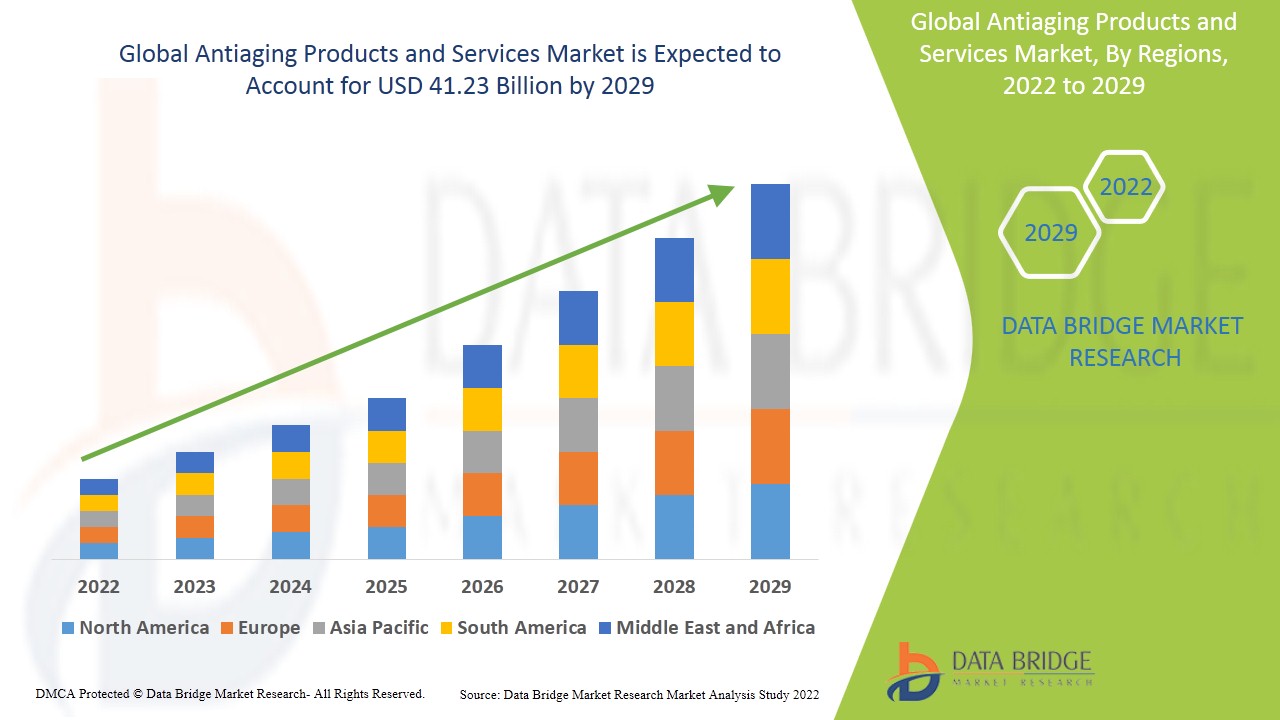
Data Bridge Market Research analyses that the antiaging products and services market is expected to undergo a CAGR of 5.32% during the forecast period. This indicates that the market value, which was USD 23.33 billion in 2021, would rocket up to USD 41.23 billion by 2029. “Anti-Wrinkle and Anti-Stretch” dominate the product segment of the antiaging products and services market owing to rising geriatric population base all around the globe and growing rate of pregnancy. The market report curated by the Data Bridge Market Research team includes in-depth expert analysis, patient epidemiology, pipeline analysis, pricing analysis, and regulatory framework.
Global Antiaging Products and Services Market Definition
From the name itself, it is clear that antiaging products and services are applied or used with an aim to control and hide the signs of aging. These are the skincare products and services that are used to hide the wrinkles over the skin and make the consumer look young and vibrant. Some examples of antiaging products and services are aesthetic treatments, face masks and others.
Report Metric
Details
Forecast Period
2022 to 2029
Base Year
2021
Historic Years
2020 (Customizable to 2019 - 2014)
Quantitative Units
Revenue in USD Billion, Volumes in Units, Pricing in USD
Segments Covered
Product (UV Absorbers, Anti-Wrinkle, Anti-Stretch, Natural, Hair Color, Intense Pulsed Light (IPL), Oils and Serums, Microdermabrasion, Shampoo and Conditioner, Others), Active Ingredients (Alpha Hydroxy Acids, Epidermal Growth Factors, Argirelline, Retinol, Peptides, Co-enzyme Q10, Sun Protection Factor (SPF), Vitamin C, Anti-Oxidants), Therapies and Services (Eye-Lid Surgery, Abdominoplasty, Hormone Replacement Therapy, Breast Augmentation, Liposuction, Sclerotherapy, Injectable Skin, Anti-Pigmentation Therapy, Hair Restoration Services, Chemical Peels), Demography (Baby Boomer, Generation X, Generation Y), End User (Hospitals, Clinics, Home Health Care)
Countries Covered
U.S., Canada and Mexico in North America, Germany, France, U.K., Netherlands, Switzerland, Belgium, Russia, Italy, Spain, Turkey, Rest of Europe in Europe, China, Japan, India, South Korea, Singapore, Malaysia, Australia, Thailand, Indonesia, Philippines, Rest of Asia-Pacific (APAC) in the Asia-Pacific (APAC), Saudi Arabia, U.A.E, South Africa, Egypt, Israel, Rest of Middle East and Africa (MEA) as a part of Middle East and Africa (MEA), Brazil, Argentina and Rest of South America as part of South America.
Market Players Covered
Chanel SA (UK), GlaxoSmithKline Plc (UK), Allergan Inc. (Ireland), Neutrogena Corporation (US), Procter & Gamble (US), Elizabeth Arden Inc. (Switzerland), Johnson & Johnson Services, Inc. (US), Orlane SA (France), Revlon Inc (US), Novartis AG (Switzerland), Unilever (UK), Avon Products Inc (UK), L'Oral SA (France), Merck Sharp & Dohme Corp (Germany), Christian Dior (France), Valeant Pharmaceuticals International (Canada), NeoStrata Company Inc (US), Bayer AG (Germany) and F. Hoffmann-La Roche Ltd (Switzerland)
Antiaging Products and Services Market Dynamics
Drivers
Rising number of stretch marks
Surging prevalence of stretch marks on the bodies is one of the major factors fostering the growth of the market. Stretch marks in women due to pregnancy and in men due to obesity is carving the way for the growth of the market.
Research and development proficiencies
Rising expenditure for research and development proficiencies especially in the developed and developing economies pertaining to the medical instruments and devices will further create lucrative market growth opportunities. Research and development proficiencies being conducted for the development of organic products is also bolstering the market growth rate.
Growing awareness about fitness
Surging participation of individuals in weight training exercises, at the gym, activity centres and others is helping them reduce a lot of weight. This results in skin lessening which in turn causes stretchmarks on the body. Therefore, rising number of fitness centres and gyms will directly induce the growth of the market.
Opportunities
Furthermore, upsurge in the public-private funding for target research activities, rising concerns over wrinkles on face and hands, rising geriatric population base and rising product innovations and development owing to technological advancements all around the world will extend profitable opportunities for the market players in the forecast period of 2022 to 2029. Additionally, surging number of strategic collaborations, rising internet penetration rate, growing awareness regarding the availability of products via both online and offline modes of distribution, growing emphasis on promotional strategies, changing lifestyle of individuals and increasing per capita expenditure on health care will further expand the market's growth rate in the future.
Restraints/Challenges Global Antiaging Products and Services Market
On the other hand, high cost associated with the research and development proficiencies, limited infrastructural facilities and dearth of awareness in the backward economies are expected to obstruct market growth. Also, lack of favourable reimbursement scenario and technology penetration in the developing economies, high costs associated with aesthetic treatment services and certain high grade and high quality products, side effects associated with the products on the skin, large scale availability of counterfeit products and lack of suitable infrastructure in low- and middle-income countries are projected to challenge the market in the forecast period of 2022-2029.
This antiaging products and services market report provides details of new recent developments, trade regulations, import-export analysis, production analysis, value chain optimization, market share, impact of domestic and localized market players, analyses opportunities in terms of emerging revenue pockets, changes in market regulations, strategic market growth analysis, market size, category market growths, application niches and dominance, product approvals, product launches, geographic expansions, technological innovations in the market. To gain more info on the antiaging products and services market contact Data Bridge Market Research for an Analyst Brief, our team will help you take an informed market decision to achieve market growth.
COVID-19 Impact on Antiaging Products and Services Market
COVID-19 has slightly impacted the market. This is because of the significant drop in the aesthetic treatment surgeries. The measures and healthcare resources were solely utilized towards the demands arising out of the pandemic. Also, disruptions in the manufacturing and supply chain resulted in non-availability of antiaging products to the consumers. However, this pandemic resulted in booming the online and e-commerce sales which was a ray of hope for the market. With the rising relaxations, the market is bound the rise significantly.
Recent Developments
In August 2020, Merck KGaA entered into strategic cooperation with the Chinese cosmetics company Pechoin Group to develop herbal technology and planned to launch a new product line – Pechoin Zhenyan anti-wrinkle repair series.
In July 2020, Lancer Skincare launched the Pro Polish microdermabrasion device which aims to serve the consumers and meeting their expectations.
Global Antiaging Products and Services Market Scope
The antiaging products and services market is segmented on the basis of product, active ingredients, therapies and services, demography and end user. The growth amongst these segments will help you analyze meagre growth segments in the industries and provide the users with a valuable market overview and market insights to help them make strategic decisions for identifying core market applications.
Product
UV Absorbers
Anti-Wrinkle
Anti-Stretch
Natural
Hair Color
Intense Pulsed Light (IPL)
Oils and Serums
Microdermabrasion
Shampoo and Conditioner
Others
Based on product, the antiaging products and services market is segmented into UV absorbers, anti-wrinkle, anti-stretch, natural, hair color, intense pulsed light (IPL), oils and serums, microdermabrasion, shampoo and conditioner and others.
Active ingredients
Alpha Hydroxy Acids
Epidermal Growth Factors
Argirelline
Retinol
Peptides
Co-enzyme Q10
Sun Protection Factor (SPF)
Vitamin C
Anti-Oxidants
Based on active ingredients, the antiaging products and services market is segmented into alpha hydroxy acids, epidermal growth factors, argirelline, retinol, peptides, co-enzyme Q10, sun protection factor (SPF), vitamin C and anti-oxidants.
Therapies and services
Eye-Lid Surgery
Abdominoplasty
Hormone Replacement Therapy
Breast Augmentation
Liposuction
Sclerotherapy
Injectable Skin
Anti-Pigmentation Therapy
Hair Restoration Services
Chemical Peels
On the basis of therapies and services, the antiaging products and services market is segmented into eye-lid surgery, abdominoplasty, hormone replacement therapy, breast augmentation, liposuction, sclerotherapy, injectable skin, anti-pigmentation therapy, hair restoration services and chemical peels.
Demography
Baby Boomer
Generation X
Generation Y
Based on demography, the antiaging products and services market is segmented into baby boomer, generation X and Y.
End user
Hospitals
Clinics
Home Health Care
Antiaging products and services market has also been segmented based on the end user into hospitals, clinics and home health care.
Antiaging Products and Services Market Regional Analysis/Insights
The antiaging products and services market is analysed and market size insights and trends are provided by country, product, active ingredients, therapies and services, demography and end user as referenced above.
The countries covered in the antiaging products and services market report are U.S., Canada and Mexico in North America, Germany, France, U.K., Netherlands, Switzerland, Belgium, Russia, Italy, Spain, Turkey, Rest of Europe in Europe, China, Japan, India, South Korea, Singapore, Malaysia, Australia, Thailand, Indonesia, Philippines, Rest of Asia-Pacific (APAC) in the Asia-Pacific (APAC), Saudi Arabia, U.A.E, South Africa, Egypt, Israel, Rest of Middle East and Africa (MEA) as a part of Middle East and Africa (MEA), Brazil, Argentina and Rest of South America as part of South America.
North America dominates the antiaging products and services market because of the strong base of healthcare facilities, rise in the population of people using anti-aging products in this region and rising number of research activities in this region.
Asia-Pacific is expected to witness significant growth during the forecast period of 2022 to 2029 due to the increase in government initiatives to promote awareness, rise in medical tourism, growing research activities in the region, availability of massive untapped markets, large population pool, availability of the well-established infrastructure, presence of key market players, increasing average life expectancies and the median age and the growing demand for quality healthcare in the region.
The country section of the report also provides individual market impacting factors and changes in regulation in the market domestically that impacts the current and future trends of the market. Data points like down-stream and upstream value chain analysis, technical trends and porter's five forces analysis, case studies are some of the pointers used to forecast the market scenario for individual countries. Also, the presence and availability of global brands and their challenges faced due to large or scarce competition from local and domestic brands, impact of domestic tariffs and trade routes are considered while providing forecast analysis of the country data.
Healthcare Infrastructure Growth Installed Base and New Technology Penetration
The antiaging products and services market also provides you with detailed market analysis for every country growth in healthcare expenditure for capital equipment, installed base of different kind of products for antiaging products and services market, impact of technology using life line curves and changes in healthcare regulatory scenarios and their impact on the antiaging products and services market. The data is available for historic period 2010-2020.
Competitive Landscape and Antiaging Products and Services Market Share Analysis
The antiaging products and services market competitive landscape provides details by competitor. Details included are company overview, company financials, revenue generated, market potential, investment in research and development, new market initiatives, global presence, production sites and facilities, production capacities, company strengths and weaknesses, product launch, product width and breadth, application dominance. The above data points provided are only related to the companies' focus related to antiaging products and services market.
Some of the major players operating in the antiaging products and services market are Chanel SA (UK), GlaxoSmithKline Plc (UK), Allergan Inc. (Ireland), Neutrogena Corporation (US), Procter & Gamble (US), Elizabeth Arden Inc. (Switzerland), Johnson & Johnson Services, Inc. (US), Orlane SA (France), Revlon Inc (US), Novartis AG (Switzerland), Unilever (UK), Avon Products Inc (UK), L'Oral SA (France), Merck Sharp & Dohme Corp (Germany), Christian Dior (France), Valeant Pharmaceuticals International (Canada), NeoStrata Company Inc (US), Bayer AG (Germany) and F. Hoffmann-La Roche Ltd (Switzerland) among others.
Research Methodology : Global Antiaging Products and Services Market
Data collection and base year analysis is done using data collection modules with large sample sizes. The market data is analyzed and estimated using market statistical and coherent models. Also market share analysis and key trend analysis are the major success factors in the market report. To know more please request an analyst call or can drop down your inquiry.
The key research methodology used by DBMR research team is data triangulation which involves data mining, analysis of the impact of data variables on the market, and primary (industry expert) validation. Apart from this, data models include Vendor Positioning Grid, Market Time Line Analysis, Market Overview and Guide, Company Positioning Grid, Company Market Share Analysis, Standards of Measurement, Global versus Regional and Vendor Share Analysis. To know more about the research methodology, drop in an inquiry to speak to our industry experts https://www.databridgemarketresearch.com/speak-to-analyst/?dbmr=global-antiaging-products-and-services-market
SKU-
Get online access to the report on the World's First Market Intelligence Cloud
Interactive Data Analysis Dashboard
Company Analysis Dashboard for high growth potential opportunities
Research Analyst Access for customization & queries
Competitor Analysis with Interactive dashboard
Latest News, Updates & Trend analysis
Harness the Power of Benchmark Analysis for Comprehensive Competitor Tracking
Research Methodology
Data collection and base year analysis are done using data collection modules with large sample sizes. The stage includes obtaining market information or related data through various sources and strategies. It includes examining and planning all the data acquired from the past in advance. It likewise envelops the examination of information inconsistencies seen across different information sources. The market data is analysed and estimated using market statistical and coherent models. Also, market share analysis and key trend analysis are the major success factors in the market report. To know more, please request an analyst call or drop down your inquiry.
The key research methodology used by DBMR research team is data triangulation which involves data mining, analysis of the impact of data variables on the market and primary (industry expert) validation. Data models include Vendor Positioning Grid, Market Time Line Analysis, Market Overview and Guide, Company Positioning Grid, Patent Analysis, Pricing Analysis, Company Market Share Analysis, Standards of Measurement, Global versus Regional and Vendor Share Analysis. To know more about the research methodology, drop in an inquiry to speak to our industry experts.
Customization Available
Data Bridge Market Research is a leader in advanced formative research. We take pride in servicing our existing and new customers with data and analysis that match and suits their goal. The report can be customized to include price trend analysis of target brands understanding the market for additional countries (ask for the list of countries), clinical trial results data, literature review, refurbished market and product base analysis. Market analysis of target competitors can be analyzed from technology-based analysis to market portfolio strategies. We can add as many competitors that you require data about in the format and data style you are looking for. Our team of analysts can also provide you data in crude raw excel files pivot tables (Fact book) or can assist you in creating presentations from the data sets available in the report.
Claudio Rondena
Group Business Development & Strategic Marketing Director, C.O.C Farmaceutici SRL
"This morning we were involved in the first part, the data presentation of MKT analysis, selected abstract from your work. The board team was really impressed and very appreciated, as well."
David Manning - Thermo Fisher Scientific
Director, Global Strategic Accounts,
Dear Ricky, I want to thank you for the excellent market analysis (LIMS INSTALLED BASE DATA) that you and your team delivered, especially end of year on short notice.
Sachin and Shraddha captured the requirements, determined their path forward and executed quickly.
You, Sachin and Shraddha have been a pleasure to work with – very responsive, professional and thorough.
Your work is much appreciated.
Manager - Market Analytics,
Uriah D. Avila - Zeus Polymer Solutions
Thank you for all the assistance and the level of detail in the market report. We are very pleased with the results and the customization. We would like to continue to do business.
Business Development Manager,
(Pharmaceuticals Partner for Nasal Sprays) | Renaissance Lakewood LLC
DBMR was attentive and engaged while discussing the Global Nasal Spray Market. They understood what we were looking for and was able to provide some examples from the report as requested. DBMR Service team has been responsive as needed. Depending on what my colleagues were looking for, I will recommend your services and would be happy to stay connected in case we can utilize your research in the future.
Business Intelligence and Analytics,
Ipsen Biopharm Limited
We are impressed by the CENTRAL PRECOCIOUS PUBERTY (CPP) TREATMENT report - so a BIG thanks to you colleagues.
Competition Analyst,
Basler Web
I just wanted to share a quick note and let you know that you guys did a really good job. I’m glad I decided to work with you. I shall continue being associated with your company as long as we have market intelligence needs.
Marketing Director,
Buhler Group
It was indeed a good experience, would definitely recommend and come back for future prospects.
COO,
A global leader providing Drug Delivery Services
DBMR did an outstanding job on the Global Drug Delivery project, We were extremely impressed by the simple but comprehensive presentation of the study and the quality of work done. This report really helped us to access untapped opportunities across the globe.
Marketing Director,
Philips Healthcare
The study was customized to our targets and needs with well-defined milestones. We were impressed by the in-depth customization and inclusion of not only major but also minor players across the globe. The DBMR Market position grid helped us to analyze the market in different dimension which was very helpful for the team to get into the minute details.
Product manager,
Fujifilms
Thankful to the team for the amazing coordination, and helping me at the last moment with my presentation. It was indeed a comprehensive report that gave us revenue impacting solution enabling us to plan the right move.
Investor relations,
GE Healthcare
Thank you for the report, and addressing our needs in such short time. DBMR has outdone themselves in this project with such short timeframe.
Market Analyst,
Medincell
We found the results of this study compelling and will help our organization validate a market we are considering to enter. Thank you for a job well done.
Andrew - Senior Global Marketing Manager,
Medtronic (US)
I want to thank you for your help with this report – It’s been very helpful in our business planning and it well organized.
Amarildo - Manager, Global Strategic Alignment
MasterCard
We believe the work done by Data Bridge Team for our requirements in the North America Loyalty Management Market was fantastic and would love to continue working with your team moving forward.
Tor Hammer
Green Nexus LLc
Thank you for your quick response to this unfortunate circumstance. Please extend my thanks to your reach team. I will be contacting you in the future with further projects
I acknowledge the difficulty given by the very short warning for this report, and I think that its quality and your delivering time have been very satisfying.
Obviously, as a provider Data Bridge Market Research will be considered as a plus for future needs of Nippon Gases.
Yuki Kopyl (Asian Business Development Department)
UENO FOOD TECHNO INDUSTRY, LTD. (JAPAN)
Xylose report was very useful for our team. Thank you very much & hope to work with you again in the future