


What is the Marine Insurance Market Size and Growth Rate?
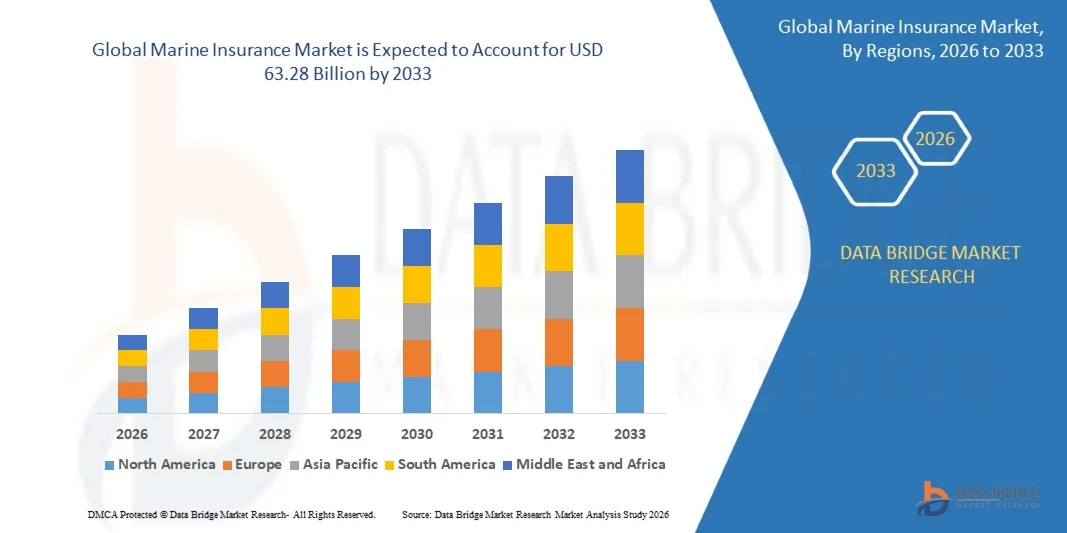
- As per Data Bridge Market Research analysis, the marine insurance market was valued at USD 42.60 billion in 2025 and is projected to reach USD 63.28 billion by 2033, growing at a CAGR of 5.07% from 2026 to 2033.
- The market is experiencing consistent growth driven by the expansion of global seaborne trade, increasing cargo volumes and vessel values, rising demand for comprehensive risk protection, growth in offshore energy activities, and the increasing complexity of maritime supply chains. The market is also being supported by growing demand for specialized coverage against geopolitical disruptions, climate-related events, cyber risks, cargo damage, and other emerging maritime exposures.
- The increasing movement of goods through international shipping routes, combined with rising investments in fleet modernization, port infrastructure, and offshore energy projects, is encouraging shipowners, cargo owners, freight forwarders, and logistics companies to expand their marine insurance coverage. Product innovation across cargo insurance, hull and machinery insurance, marine liability insurance, and offshore and energy insurance is further supporting market growth, while digital underwriting, data analytics, real-time vessel monitoring, and online distribution channels are improving accessibility and efficiency across the marine insurance industry.
Market Size & Forecast
- Global Market Value (2025): USD 42.60 Billion
- Expected Market Value (2033): USD 63.28 Billion
- Forecast CAGR (2026–2033): 5.07%
- Leading Region in 2025: Europe
- Fastest Growing Region: Asia Pacific
What are the Major Takeaways of the Marine Insurance Market?
- Europe dominated the marine insurance market with the largest revenue share of 44.6% in 2025, supported by its established marine insurance ecosystem, major shipping and financial centers, extensive maritime trade, and strong presence of insurers and brokers.
- Asia-Pacific is expected to be the fastest-growing region at a CAGR of 4.5% from 2026 to 2033, fueled by expanding seaborne trade, increasing cargo volumes, port infrastructure development, rising exports, and growing maritime logistics activities across China, India, Japan, South Korea, and Southeast Asia.
- The cargo insurance segment led the coverage category with a 55.0% share in 2025, driven by expanding international trade, increasing cargo movements, rising shipment values, and growing demand for protection against loss, damage, theft, and transportation-related risks.
- The floating policy segment is the fastest-growing policy type, projected to register a CAGR of 5.8% from 2026 to 2033, reflecting increasing international shipments and the need for flexible coverage of multiple consignments under a single insurance arrangement.
- The shipping companies segment accounted for 36.9% of the end-user category in 2025, supported by extensive commercial fleet operations, rising vessel values, expanding maritime transportation activity, and increasing requirements for hull, cargo, liability, and operational risk protection.
- Insurance brokers accounted for 80.0% of the distribution channel segment in 2025, supported by their expertise in evaluating complex maritime risks, arranging customized coverage, providing access to multiple insurers, and assisting with policy placement and claims.
- The digital/online channels segment is the fastest-growing distribution channel, with a CAGR of 7.0% from 2026 to 2033, driven by increasing digitalization of insurance services, online policy management, automated underwriting, faster quotation processes, and growing adoption of technology-enabled insurance platforms.
Report Scope and Marine Insurance Market Segmentation
|
Attributes |
Marine Insurance Key Market Insights |
|
Segments Covered |
|
|
Countries Covered |
North America
Europe
Asia-Pacific
Middle East and Africa
South America
|
|
Key Market Players |
|
|
Market Opportunities |
|
|
Value Added Data Infosets |
In addition to the market insights such as market value, growth rate, market segments, geographical coverage, market players, and market scenario, the market report curated by the Data Bridge Market Research team includes in-depth expert analysis, import/export analysis, pricing analysis, production consumption analysis, and pestle analysis.. |
What is the Key Trend in the Marine Insurance Market?
- Marine insurance companies are increasingly adopting digital technologies, data analytics, and real-time risk monitoring to improve underwriting, claims management, and risk assessment across marine and cargo portfolios.
- For instance, in 2025, Allianz Commercial identified artificial intelligence as an emerging shipping-industry risk and highlighted the increasing importance of technology and data in maritime risk management.
- Marine insurers are also expanding risk-management solutions to address increasingly complex exposures associated with vessel operations, cargo movements, supply-chain disruptions, and changing environmental requirements.
- For instance, in September 2025, IUMI reported that the average global fleet age had reached 22.6 years, increasing exposure to machinery failures, maintenance requirements, fires, and higher repair costs.
- Insurers are also strengthening coverage and underwriting approaches for geopolitical events, war risks, climate-related exposures, cyber threats, and alternative-fuel technologies as maritime operations become more complex.
- As marine insurers continue to combine digital risk assessment, specialized coverage, real-time information, and risk-mitigation services, technology-enabled underwriting and emerging-risk management are expected to remain important components of the global marine insurance market.
What are the Key Drivers of the Marine Insurance Market?
- The expansion of global seaborne trade, increasing cargo values, rising vessel values, and continued growth in maritime logistics are supporting demand for marine insurance coverage.
- For instance, in September 2026, IUMI reported that global marine insurance premiums increased 5.5% to USD 42.6 billion in 2025, while cargo premiums reached USD 24.2 billion, reflecting the continued importance of global trade to marine insurance demand
- Marine insurers are also responding to increasing geopolitical disruptions, trade-policy changes, vessel rerouting, and supply-chain uncertainty, which are creating additional requirements for risk protection across maritime operations.
- For instance, in September 2026, marine insurers expanded the Black Sea high-risk zone following increased attacks affecting commercial shipping, resulting in higher war-risk premiums for affected voyages.
- The expansion of offshore energy and the transition toward alternative fuels are also supporting demand for specialized marine insurance as vessels and energy projects become more technologically complex.
- For instance, IUMI reported that approximately 31% of 2025 newbuilding orders were capable of using alternative fuels, creating new underwriting considerations involving methanol, ammonia, hydrogen, and other emerging technologies.
- With global trade, vessel values, offshore investment, geopolitical risks, and emerging maritime technologies continuing to evolve, demand for specialized marine insurance and risk-management solutions is expected to support market growth.
Which Factors are Challenging the Growth of the Marine Insurance Market?
- Marine insurers face challenges from geopolitical uncertainty, increasing claims severity, an ageing global fleet, rising repair costs, and growing exposure to vessel fires, groundings, machinery failures, and weather-related incidents.
- For instance, in September 2026, IUMI reported that the average global vessel age reached 22.4 years in 2025, while maintenance and repair costs continued to increase and spare-parts availability became more challenging.
- The need to assess increasingly complex risks associated with alternative fuels, larger vessels, cyber threats, climate events, and new maritime technologies can increase underwriting and risk-management requirements.
- For instance, IUMI highlighted methanol, ammonia, and hydrogen as alternative fuels that introduce new hazard profiles and require insurers to assess less-established technologies and repair histories.
- Marine insurance companies also face pressure from increased market capacity and competitive pricing, which can affect premium growth and profitability across major business lines.
- In addition, geopolitical disruptions, trade-policy changes, rerouting of vessels, inflation, and higher claims costs can increase uncertainty for insurers and complicate risk pricing across international marine insurance portfolios.
How is the Marine Insurance Market Segmented?
The marine insurance market is segmented on the basis of product type, policy type, distribution channel, and end user.
- By Product Type
On the basis of product type, the marine insurance market is segmented into cargo insurance, hull and machinery insurance, marine liability insurance, and offshore/energy insurance. The cargo insurance segment dominated the market with a 55.4% share in 2025, supported by expanding international trade, increasing cargo volumes, rising shipment values, and growing demand for protection against loss, damage, theft, and transportation-related risks. Cargo insurance remains the largest marine insurance business line across current industry sources, with reported shares generally ranging from the low-40% to high-50% range depending on market definition.
The marine liability insurance segment is projected to register the fastest growth at a 6.8% CAGR during the forecast period, supported by increasing regulatory requirements, rising liability exposures, environmental risks, and growing demand for protection against third-party claims arising from marine operations.
- By Policy Type
On the basis of policy type, the marine insurance market is segmented into time policy, voyage policy, floating policy, valued policy, and others. The time policy segment dominated the market with a 44.0% share in 2025, supported by its suitability for continuous vessel operations and annual coverage requirements. Time policies provide predictable coverage for shipping companies and vessel operators and are widely used for commercial fleet operations. Current market sources consistently identify time policies as the leading policy type.
The floating policy segment is projected to register the fastest growth at a 5.9% CAGR during the forecast period, supported by increasing international shipments and the need to insure multiple cargo consignments under a single arrangement. The flexibility of floating policies is particularly suitable for exporters, importers, and logistics providers with frequent shipping activities.
- By Distribution Channel
On the basis of distribution channel, the marine insurance market is segmented into wholesalers, retail brokers, direct, and digital/online channels. The retail brokers segment dominated the market with a 68.5% share in 2025, supported by their ability to assess complex marine risks, arrange customized coverage, negotiate policy terms, and provide claims and risk-management support. Brokers remain an important distribution route for commercial marine insurance because of the technical complexity of maritime risks.
The digital/online channels segment is projected to register the fastest growth at a 7.1% CAGR during the forecast period, driven by increasing digitalization of insurance services, online quotation and policy-management platforms, automated underwriting, and growing demand for faster and more accessible insurance solutions.
- By End Use
On the basis of end user, the marine insurance market is segmented into ship owners, traders, shipping companies, logistics and freight forwarding companies, and others. The shipping companies segment dominated the market with a 36.8% share in 2025, supported by extensive commercial fleet operations, rising vessel values, expanding maritime transportation, and increasing requirements for hull, machinery, liability, and operational risk protection. Current market research also identifies shipping companies as the leading end-user segment.
The logistics and freight forwarding companies segment is projected to register the fastest growth at a 4.8% CAGR during the forecast period, supported by increasing cross-border trade, growth in multimodal transportation, expanding global supply chains, and rising demand for cargo and transportation-related risk protection.
Which Region Holds the Largest Share of the Marine Insurance Market?
- Europe dominated the marine insurance market with the largest revenue share of 44.6% in 2025, supported by a mature marine insurance industry, extensive maritime trade activity, strong shipping and logistics infrastructure, and the presence of established insurers and specialized marine insurance providers.
- The region also benefits from well-developed ports, shipping networks, insurance brokerage channels, and advanced risk-management capabilities. Increasing exposure to climate-related events, geopolitical uncertainties, cyber risks, and supply chain disruptions is further encouraging shipping companies, cargo owners, and logistics providers to strengthen marine insurance coverage across the region.
U.S. Marine Insurance Market Insight
The U.S. marine insurance market is witnessing strong growth due to extensive maritime trade, substantial commercial shipping activity, and increasing demand for comprehensive protection against cargo, vessel, liability, and operational risks. The country's developed insurance infrastructure and strong presence of major insurers and brokers support the availability of marine insurance products across shipping companies, cargo owners, traders, and logistics providers. In addition, growing exposure to extreme weather events, supply chain disruptions, cyber threats, and geopolitical risks is encouraging businesses to strengthen marine insurance coverage and adopt more comprehensive risk-management solutions.
Asia-Pacific Marine Insurance Market Insight
The Asia-Pacific marine insurance market is expected to witness rapid growth at a CAGR of 4.5% from 2026 to 2033, driven by expanding international trade, increasing maritime transportation, rising shipbuilding activity, and growing cargo volumes across countries such as China, India, Japan, South Korea, and Singapore. Expansion of ports, logistics networks, shipping fleets, and cross-border trade is increasing demand for cargo, hull and machinery, and marine liability insurance. In addition, digitalization of insurance distribution, automated underwriting, and increasing awareness of maritime risk protection are supporting market expansion across the region.
Japan Marine Insurance Market Insight
The Japan marine insurance market is witnessing consistent growth due to the country's strong maritime industry, extensive international trade, established shipping infrastructure, and significant presence in global logistics and vessel operations. Demand for cargo, hull and machinery, and marine liability insurance remains supported by commercial shipping activities and the movement of high-value goods through Japanese ports. Moreover, increasing adoption of digital insurance services, advanced risk assessment technologies, and coverage against natural catastrophes and supply chain disruptions is supporting the development of marine insurance solutions.
China Marine Insurance Market Insight
The China marine insurance market is growing rapidly, driven by extensive international trade, large-scale port infrastructure, expanding shipping activity, and the country's significant role in global supply chains. Increasing cargo volumes, vessel operations, shipbuilding activity, and cross-border trade are strengthening demand for cargo, hull and machinery, and marine liability insurance. In addition, the expansion of logistics networks, digital insurance platforms, and risk-management solutions is improving access to marine insurance products among shipping companies, traders, and logistics and freight forwarding companies.
U.K. Marine Insurance Market Insight
The U.K. marine insurance market is experiencing steady growth, supported by its established maritime services industry, strong international trade links, and extensive marine insurance and brokerage infrastructure. The country's position as a major global maritime and insurance center supports demand for cargo, hull and machinery, marine liability, and offshore and energy insurance products. Furthermore, increasing exposure to geopolitical risks, cyber threats, climate-related events, and supply chain disruptions is encouraging shipping companies and cargo owners to adopt broader marine risk protection.
Germany Marine Insurance Market Insight
The Germany marine insurance market is expanding steadily due to its strong industrial base, extensive international trade, established shipping industry, and strategic role in European logistics and supply chains. Ports, shipping companies, traders, and logistics providers generate consistent demand for cargo, hull and machinery, and marine liability insurance coverage. Continuous developments in maritime risk management, digital underwriting, and protection against climate-related disruptions, cyber risks, and geopolitical uncertainties are also supporting the expansion of marine insurance solutions.
Which are the Top Companies in Marine Insurance Market?
The marine insurance industry is primarily led by well-established companies, including:
- Allianz Group (Germany)
- American International Group, Inc. (U.S.)
- AXA S.A. (France)
- Chubb Limited (Switzerland)
- Zurich Insurance Group AG (Switzerland)
- QBE Insurance Group Limited (Australia)
- The Travelers Companies, Inc. (U.S.)
- Tokio Marine Holdings, Inc. (Japan)
- Sompo Holdings, Inc. (Japan)
- Mitsui Sumitomo Insurance Company, Limited (Japan)
- HDI Global SE (Germany)
- Markel Group Inc. (U.S.)
- The Hartford Financial Services Group, Inc. (U.S.)
- Beazley plc (U.K.)
- Swiss Re AG (Switzerland)
- Munich Re (Germany)
- Berkshire Hathaway Inc. (U.S.)
- Everest Group, Ltd. (Bermuda)
- Marsh McLennan (U.S.)
- Lockton Companies, LLC (U.S.)
What are Latest Developments in Marine Insurance Market?
- In September 2025, DUAL Europe launched its cargo insurance business, expanding its marine insurance proposition across Europe. The offering provides coverage for traders, producers, manufacturers, exporters, importers, road carriers, and freight forwarders, including cargo property and liability protection, stock and transit coverage, and waterborne war-risk extensions.
- In September 2025, MSIG and MSIG Specialty Marine launched a new protection and indemnity (P&I) offering from Singapore, providing fixed-premium owner's P&I and charterer's liability solutions. The development reflects increasing demand for specialized liability coverage tailored to the evolving risks faced by shipowners and charterers.
- In September 2025, the International Union of Marine Insurance (IUMI) highlighted the growing role of artificial intelligence in marine insurance, emphasizing opportunities to improve efficiency and transform insurance processes while also noting challenges associated with rapid technological change. The development demonstrates the increasing adoption of AI and data-driven technologies across marine underwriting and risk management.
- In April 2025, WTW reported increasing competition and additional capacity in the upstream energy insurance market, with insurers increasingly seeking lead positions and expanding their participation in energy-related risks. The development reflects changing market conditions for offshore and energy insurance, which forms an important component of the marine insurance market.
- In February 2025, marine protection and indemnity insurers implemented cautious renewal strategies amid inflation and geopolitical uncertainty, with several P&I clubs applying or targeting general increases of 5.0% to 7.5% for renewals. The development reflects continuing pressure from higher operating and claims costs and elevated geopolitical risks affecting marine insurance.

- Interactive Data Analysis Dashboard
- Company Analysis Dashboard for high growth potential opportunities
- Research Analyst Access for customization & queries
- Competitor Analysis with Interactive dashboard
- Latest News, Updates & Trend analysis
- Harness the Power of Benchmark Analysis for Comprehensive Competitor Tracking
Data collection and base year analysis are done using data collection modules with large sample sizes. The stage includes obtaining market information or related data through various sources and strategies. It includes examining and planning all the data acquired from the past in advance. It likewise envelops the examination of information inconsistencies seen across different information sources. The market data is analysed and estimated using market statistical and coherent models. Also, market share analysis and key trend analysis are the major success factors in the market report. To know more, please request an analyst call or drop down your inquiry.
The key research methodology used by DBMR research team is data triangulation which involves data mining, analysis of the impact of data variables on the market and primary (industry expert) validation. Data models include Vendor Positioning Grid, Market Time Line Analysis, Market Overview and Guide, Company Positioning Grid, Patent Analysis, Pricing Analysis, Company Market Share Analysis, Standards of Measurement, Global versus Regional and Vendor Share Analysis. To know more about the research methodology, drop in an inquiry to speak to our industry experts.
Data Bridge Market Research is a leader in advanced formative research. We take pride in servicing our existing and new customers with data and analysis that match and suits their goal. The report can be customized to include price trend analysis of target brands understanding the market for additional countries (ask for the list of countries), clinical trial results data, literature review, refurbished market and product base analysis. Market analysis of target competitors can be analyzed from technology-based analysis to market portfolio strategies. We can add as many competitors that you require data about in the format and data style you are looking for. Our team of analysts can also provide you data in crude raw excel files pivot tables (Fact book) or can assist you in creating presentations from the data sets available in the report.













