Circumvent the Tariff challenges with an agile supply chain Consulting
Supply Chain Ecosystem Analysis now part of DBMR Reports
Global Semiconductor Micro Components Market
Market Size in USD Billion
CAGR :
%
USD
175.50 Billion
USD
290.70 Billion
2024
2032
Forecast Period
2025 –2032
Market Size(Base Year)
USD
175.50 Billion
Market Size (Forecast Year)
USD
290.70 Billion
CAGR
%
Major Markets Players
Renesas Electronics Corporation.
Texas Instruments Incorporated.
STMicroelectronics
ABB
Micron TechnologyInc.
Global Semiconductor Micro Components Market Segmentation: By Type (Microprocessors, Microcontrollers, Digital Signal Processors, Others), Architecture (8-bit, 16-bit, 32-bit, 64-bit), Application (Consumer Electronics, Automotive, Industrial, Healthcare, Aerospace & Defense, IT & Telecom, Others), End User (OEMs, ODMs, System Integrators)
Semiconductor Micro Components Market Size
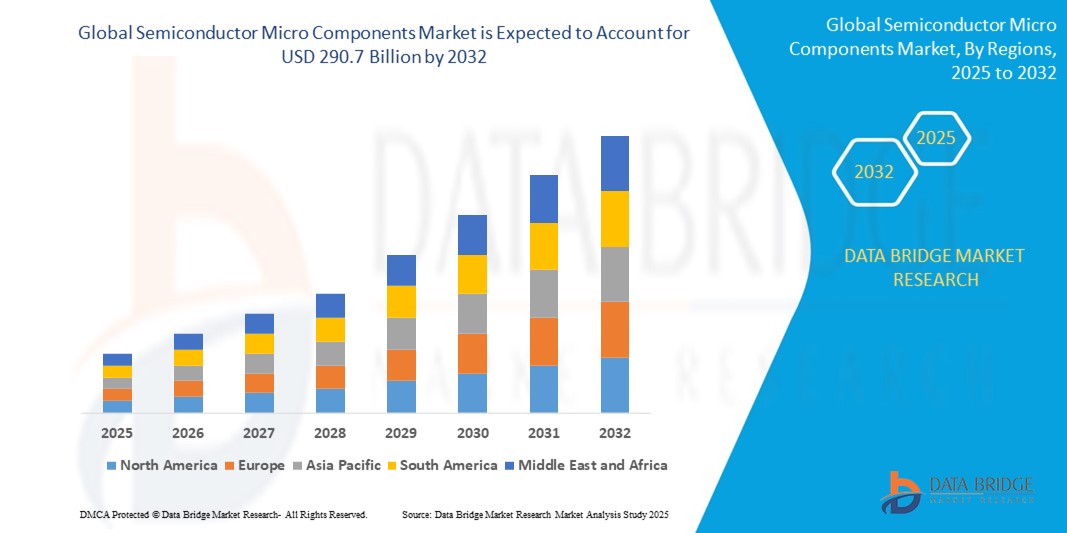
The Global Semiconductor Micro Components Market was valued at USD 175.5 billion in 2025 and is projected to reach USD 290.7 billion by 2032, growing at a CAGR of 7.48% during the forecast period.
The market’s expansion is fueled by increasing demand for intelligent electronics, the proliferation of connected devices, and the rapid adoption of automation, IoT, and AI technologies across key industries such as automotive, healthcare, consumer electronics, and industrial automation.
Semiconductor Micro Components Market Analysis
Semiconductor micro components—comprising microprocessors (MPUs), microcontrollers (MCUs), and digital signal processors (DSPs)—form the core processing units of modern electronic systems. These components power everything from smartphones and smart appliances to automotive ECUs and industrial robotics.
Rising global demand for smart and embedded systems, particularly in electric vehicles, wearables, industrial IoT, and telemedicine devices, is driving the integration of power-efficient and high-performance micro components. The shift toward electrification and edge computing is further enhancing demand for 32-bit and 64-bit MCUs with advanced real-time processing capabilities.
The emergence of AI-at-the-edge, growth in 5G infrastructure, and expansion of smart home ecosystems are accelerating the need for programmable and low-latency microprocessor units, particularly those that support real-time analytics, low power consumption, and multi-core architecture.
Asia-Pacific remains the dominant production and consumption hub, led by China, Taiwan, Japan, and South Korea, while North America and Europe are seeing increased investments in domestic chip manufacturing, R&D for automotive semiconductors, and public-private partnerships to build resilient supply chains.
Report Scope and Semiconductor Micro Components Market Segmentation
By Type : Microprocessors, Microcontrollers, Digital Signal Processors, Others.
By Architecture : 8-bit, 16-bit, 32-bit, 64-bit.
By Application : Consumer Electronics, Automotive, Industrial, Healthcare, Aerospace & Defense, IT & Telecom, Others.
By End User : OEMs, ODMs, System Integrators.
Countries Covered
North America
U.S.
Canada
Mexico
Europe
Germany
France
U.K.
Netherlands
Switzerland
Belgium
Russia
Italy
Spain
Turkey
Rest of Europe
Asia-Pacific
China
Japan
India
South Korea
Singapore
Malaysia
Australia
Thailand
Indonesia
Philippines
Rest of Asia-Pacific
Middle East and Africa
Saudi Arabia
U.A.E.
South Africa
Egypt
Israel
Rest of Middle East and Africa
South America
Brazil
Argentina
Rest of South America
Key Market Players
Intel Corporation (US)
Advanced Micro Devices, Inc. (AMD) (US)
NXP Semiconductors N.V. (Netherlands)
Qualcomm Incorporated (US)
Texas Instruments Incorporated (US)
STMicroelectronics N.V. (Switzerland)
Infineon Technologies AG (Germany)
Renesas Electronics Corporation (Japan)
Microchip Technology Inc. (US)
Analog Devices, Inc. (US)
Cypress Semiconductor Corporation (US)
Broadcom Inc. (US)
Samsung Electronics Co., Ltd. (South Korea)
Market Opportunities
Booming Electric Vehicle (EV) and Autonomous Vehicle Segment
The automotive industry's transition to electric and autonomous vehicles is creating vast opportunities for microcontroller and processor providers. These components are essential for managing battery systems, in-vehicle infotainment, ADAS, autonomous navigation, and safety control modules.
Edge Computing and AI-at-the-Edge Acceleration
The rapid growth in IoT, smart cities, and factory automation has fueled the need for real-time data processing at the edge. Semiconductor companies are investing in AI-capable MCUs and DSPs with low power consumption and high-speed analytics to support applications in industrial automation, healthcare diagnostics, and intelligent surveillance systems.
5G and High-Speed Network Infrastructure
As global 5G deployment continues, there is a growing need for micro components that can handle high-throughput signal processing, real-time communication, and ultra-low latency. This presents opportunities for chipmakers to supply DSPs and MPUs optimized for base stations, telecom switches, and network routers.
Medical Electronics and Wearables Expansion
With increasing adoption of remote patient monitoring, portable diagnostics, and smart medical wearables, demand for compact, reliable, and energy-efficient microcontrollers is rising. Vendors are targeting this niche with ultra-low-power MCUs that can operate for extended periods on minimal battery input.
Value Added Data Infosets
In addition to insights on market value, CAGR, segmentation, and regional coverage, the Global Semiconductor Micro Components Market report includes detailed evaluations of architecture-level innovations, low-power design trends, and chip integration techniques across emerging verticals such as automotive, industrial IoT, and healthcare.
The report features case studies on edge AI acceleration, functional safety in automotive-grade MCUs, and benchmarking of microcontroller performance in real-time applications. It also includes assessments of supply chain resilience, semiconductor wafer sourcing, and the impact of global chip shortage mitigation efforts on production planning and OEM partnerships.
Strategic tools such as PESTLE Analysis, Porter’s Five Forces, and policy reviews of semiconductor incentive programs in the U.S., EU, South Korea, and India are included to help investors and stakeholders navigate regulatory environments and R&D funding opportunities. The report also analyzes global IP licensing trends, fabless-foundry dynamics, and compliance frameworks for automotive and medical-grade semiconductors.
Semiconductor Micro Components Market Trends
“AI Integration, Energy Efficiency, and Advanced Node Designs Drive Innovation”
A major trend reshaping the semiconductor micro components market is the integration of AI capabilities at the chip level, particularly in microcontrollers and digital signal processors designed for edge computing. As devices become more autonomous and data-intensive, chipmakers are embedding neural processing engines, machine learning accelerators, and real-time analytics functions within compact microarchitectures.
The industry is also witnessing a strong shift toward energy-efficient and low-power design as the demand for mobile, wearable, and remote IoT applications increases. Micro components now feature sleep modes, dynamic voltage scaling, and ultra-low standby power, enabling devices to operate for extended periods on minimal energy sources.
Another key trend is the move toward advanced semiconductor process nodes, such as 7nm and 5nm fabrication, allowing for greater transistor density, better performance, and lower thermal output. Companies are leveraging FinFET, SOI (Silicon on Insulator), and chiplet-based architectures to enhance scalability and modularity across AI, automotive, and industrial domains.
The rise of RISC-V open architecture is further disrupting the microprocessor landscape, offering customizable, royalty-free alternatives to traditional instruction sets. This trend is especially relevant for startups and emerging markets looking to optimize processor IP for niche applications.
Finally, increased focus on functional safety, particularly in automotive and aerospace applications, is leading to the development of ASIL-compliant MCUs and redundant DSP architectures designed to support mission-critical systems.
Market Dynamics – Global Semiconductor Micro Components Market
Driver
“IoT Expansion, Automotive Electrification, and Embedded Intelligence Fuel Market Demand”
The explosive growth of connected devices across homes, factories, and cities is driving the adoption of microcontrollers and processors in everyday applications—from smart thermostats to predictive maintenance sensors in industrial plants. Each device requires dedicated processing power for control, communication, and edge analytics.
Automotive digitization, particularly the shift toward electric vehicles (EVs) and autonomous driving systems, is creating high-volume demand for micro components that manage battery performance, real-time vehicle sensing, infotainment systems, and safety functions.
The surge in smart healthcare—including portable diagnostics, biosignal monitoring, and remote therapy devices—is pushing manufacturers to develop miniaturized, secure, and power-optimized microcontrollers capable of supporting wireless communication and real-time analytics.
Increasing investment in industrial automation and Industry 4.0 technologies is expanding the use of DSPs and MCUs in robotics, control systems, and smart meters, supporting greater productivity, machine learning at the edge, and operational efficiency.
Restraint/Challenge
“Supply Chain Volatility, Design Complexity, and High Development Costs Pose Barriers”
The global semiconductor industry continues to face supply chain volatility, with lead times for microcontrollers and digital signal processors often exceeding 40–50 weeks due to fabrication bottlenecks, geopolitical trade tensions, and constrained wafer production capacity.
Complexity in chip design is increasing as end-use applications demand greater functionality, faster processing, and lower power usage within smaller form factors. This raises R&D costs and slows time-to-market, especially for companies entering high-reliability verticals like automotive or aerospace.
The industry also faces challenges in talent acquisition and technical training, particularly for advanced chip design, verification, and embedded software development. This talent gap adds friction to innovation and limits scalability for small to mid-size vendors.
Additionally, the cost of transitioning to smaller node technologies is extremely high, requiring multi-billion-dollar investments in foundry partnerships, EDA tools, and testing infrastructure—restricting access to next-gen production capabilities for all but the largest global firms.
The market is segmented based on type, architecture, application, and end user, reflecting the widespread deployment of micro components across consumer and industrial electronics.
• By Type
Includes microprocessors (MPUs), microcontrollers (MCUs), digital signal processors (DSPs), and others. Microcontrollers dominate the market in 2025 due to their wide use in embedded systems across automotive, home appliances, and industrial automation. Meanwhile, microprocessors are expected to witness strong demand in computing, telecom, and consumer electronics, while DSPs remain critical in multimedia processing and real-time applications like audio and radar systems.
• By Architecture
Divided into 8-bit, 16-bit, 32-bit, and 64-bit architectures. 32-bit architecture leads the market in 2025, offering a balance of performance, cost, and power consumption, especially in smart IoT devices and EV applications. 64-bit processors are gaining traction in high-end computing, edge AI, and autonomous systems requiring intensive data processing.
• By Application
Includes consumer electronics, automotive, industrial, healthcare, aerospace & defense, IT & telecom, and others. Consumer electronics holds the largest market share in 2025, driven by the high-volume production of smartphones, wearables, and smart home devices. Automotive is the fastest-growing application segment, driven by the rise of electrification, ADAS, and V2X communication.
• By End User
Segmented into OEMs (original equipment manufacturers), ODMs (original design manufacturers), and system integrators. OEMs dominate the segment due to their direct procurement of micro components for integration into end products across electronics and automotive sectors. However, system integrators and ODMs are expanding their role in supplying customized embedded solutions for industrial and consumer IoT projects.
North America remains a pivotal hub for semiconductor innovation, driven by substantial investments in R&D and a robust ecosystem of technology companies. The United States, in particular, is witnessing increased demand for micro components due to advancements in AI, IoT, and autonomous vehicles. Government initiatives, such as the CHIPS Act, aim to bolster domestic semiconductor manufacturing, reducing dependency on foreign supply chains.
Europe
Europe is focusing on enhancing its semiconductor capabilities to achieve strategic autonomy. Germany leads the region with significant investments in automotive and industrial applications of micro components. The European Union's Chips Act aims to double its global market share by 2030, fostering collaborations between governments and private entities to establish advanced fabrication facilities.
Asia-Pacific
Asia-Pacific dominates the global semiconductor micro components market, with countries like China, Taiwan, South Korea, and Japan at the forefront. These nations benefit from established manufacturing infrastructures and are investing heavily in next-generation technologies. China's focus on self-reliance in semiconductor production and South Korea's advancements in memory and logic chips contribute significantly to the region's growth.
Rest of the World
Regions such as Latin America, the Middle East, and Africa are emerging markets for semiconductor micro components. While currently limited in manufacturing capabilities, these areas are experiencing growing demand driven by digital transformation initiatives, increased smartphone penetration, and the adoption of smart technologies in various sectors.
Country-wise Insights – Global Semiconductor Micro Components Market
United States
The U.S. remains a global leader in semiconductor design and innovation, driven by tech giants like Intel, AMD, Qualcomm, and Texas Instruments. The government's CHIPS and Science Act is allocating over $50 billion to support domestic manufacturing, R&D, and workforce development. The U.S. market is seeing rapid growth in AI-optimized processors, automotive-grade MCUs, and edge computing DSPs, as demand rises from the defense, medical, and electric vehicle sectors.
China
China is aggressively investing in semiconductor self-sufficiency under its “Made in China 2025” initiative. Despite facing export restrictions, Chinese firms are scaling domestic capabilities in microcontroller production, SoC design, and AI chip development. The government continues to subsidize IC design houses, fab construction, and university research partnerships, fueling demand across consumer electronics, telecom infrastructure, and industrial IoT.
Taiwan
Taiwan is a powerhouse in semiconductor fabrication, home to TSMC, the world’s largest contract chipmaker. Taiwan leads in manufacturing advanced MPUs, 5nm and 3nm process nodes, and automotive MCUs, supplying top global customers across North America and Europe. The island nation continues to invest in foundry capacity to meet demand for micro components in AI, HPC, and mobile devices.
South Korea
South Korea, led by Samsung Electronics and SK Hynix, remains a leader in logic and memory semiconductors. The country is investing heavily in expanding microprocessor production and AI-integrated MCUs for consumer and industrial applications. Strategic government funding is supporting research in neural processing units and energy-efficient embedded systems.
Japan
Japan is a key supplier of automotive-grade microcontrollers and industrial signal processors through companies like Renesas, Rohm, and Toshiba. Japan’s strategic focus is on reliability, longevity, and functional safety compliance, especially for ADAS systems, robotics, and medical devices. Government-backed efforts are reviving domestic chip manufacturing to reduce external dependency.
Germany
Germany leads the European semiconductor market, specializing in automotive and industrial micro components. Companies like Infineon and Bosch are investing in power-efficient microcontrollers and embedded processors that meet ISO 26262 functional safety standards. Germany’s close alignment with the EU’s Chips Act is supporting capacity expansion and innovation.
India
India is an emerging player in chip design, with increasing government support for semiconductor self-reliance under the Semicon India program. India is focusing on fabless design startups, EDA partnerships, and training skilled engineers. The demand for microcontrollers and processors is rapidly growing across the automotive, industrial automation, and telecom sectors.
United Kingdom
The U.K. is strengthening its semiconductor strategy, especially in AI accelerators, RISC-V microprocessors, and quantum computing components. While it lacks large-scale fabs, the U.K. is home to innovative design firms and academic research centers, particularly in signal processing, aerospace electronics, and cybersecure embedded systems.
France
France is investing in domestic chip development through STMicroelectronics and public-private partnerships focused on automotive electronics, 5G infrastructure, and green technologies. France is contributing to the EU’s semiconductor ambitions by building out microcontroller R&D hubs and energy-efficient processor development.
Singapore
Singapore continues to serve as a semiconductor manufacturing and R&D hub in Southeast Asia. With investments from GlobalFoundries, UMC, and Infineon, Singapore is advancing in the production of automotive MCUs, embedded system-on-chip solutions, and DSPs for consumer electronics.
Semiconductor Micro Components Market Share
The global semiconductor micro components market is highly competitive, with leading players investing in advanced packaging, AI-capable chips, and low-power architectures to meet next-generation processing demands. These companies are expanding R&D in automotive-grade MCUs, edge AI chipsets, and multicore microprocessor units to support industries such as autonomous driving, smart manufacturing, and high-performance computing.
Intel Corporation (US)
Advanced Micro Devices, Inc. (AMD) (US)
NXP Semiconductors N.V. (Netherlands)
Qualcomm Incorporated (US)
Texas Instruments Incorporated (US)
STMicroelectronics N.V. (Switzerland)
Infineon Technologies AG (Germany)
Renesas Electronics Corporation (Japan)
Microchip Technology Inc. (US)
Analog Devices, Inc. (US)
Cypress Semiconductor Corporation (US)
Broadcom Inc. (US)
Samsung Electronics Co., Ltd. (South Korea)
Latest Developments in Global Semiconductor Micro Components Market
April 2025: Intel Corporation unveiled its next-generation Meteor Lake processors featuring integrated AI engines, chiplet architecture, and enhanced power efficiency for laptops and embedded systems, targeting edge computing and mobile applications.
March 2025: NXP Semiconductors launched its S32Z and S32E real-time processor families tailored for high-performance automotive zone control and electrification systems, with support for ASIL D functional safety and high-speed data handling.
February 2025: Renesas Electronics introduced a new line of RA microcontrollers designed for IoT applications, incorporating enhanced security features, ultra-low power modes, and real-time edge AI inference for smart home and industrial automation.
January 2025: AMD announced the rollout of Ryzen Embedded 8000 Series processors for industrial PCs and medical imaging systems, offering integrated RDNA graphics and AI acceleration for high-efficiency multitasking in edge environments.
December 2024: STMicroelectronics debuted its STM32U5 series of ultra-low-power MCUs with Arm Cortex-M33 cores, optimized for wearable and portable medical devices, with advanced cryptographic security and extended battery life performance.
SKU-
Get online access to the report on the World's First Market Intelligence Cloud
Interactive Data Analysis Dashboard
Company Analysis Dashboard for high growth potential opportunities
Research Analyst Access for customization & queries
Competitor Analysis with Interactive dashboard
Latest News, Updates & Trend analysis
Harness the Power of Benchmark Analysis for Comprehensive Competitor Tracking
Global Semiconductor Micro Components Market, Supply Chain Analysis and Ecosystem Framework
To support market growth and help clients navigate the impact of geopolitical shifts, DBMR has integrated in-depth supply chain analysis into its Global Semiconductor Micro Components Market research reports. This addition empowers clients to respond effectively to global changes affecting their industries. The supply chain analysis section includes detailed insights such as Global Semiconductor Micro Components Market consumption and production by country, price trend analysis, the impact of tariffs and geopolitical developments, and import and export trends by country and HSN code. It also highlights major suppliers with data on production capacity and company profiles, as well as key importers and exporters. In addition to research, DBMR offers specialized supply chain consulting services backed by over a decade of experience, providing solutions like supplier discovery, supplier risk assessment, price trend analysis, impact evaluation of inflation and trade route changes, and comprehensive market trend analysis.
Research Methodology
Data collection and base year analysis are done using data collection modules with large sample sizes. The stage includes obtaining market information or related data through various sources and strategies. It includes examining and planning all the data acquired from the past in advance. It likewise envelops the examination of information inconsistencies seen across different information sources. The market data is analysed and estimated using market statistical and coherent models. Also, market share analysis and key trend analysis are the major success factors in the market report. To know more, please request an analyst call or drop down your inquiry.
The key research methodology used by DBMR research team is data triangulation which involves data mining, analysis of the impact of data variables on the market and primary (industry expert) validation. Data models include Vendor Positioning Grid, Market Time Line Analysis, Market Overview and Guide, Company Positioning Grid, Patent Analysis, Pricing Analysis, Company Market Share Analysis, Standards of Measurement, Global versus Regional and Vendor Share Analysis. To know more about the research methodology, drop in an inquiry to speak to our industry experts.
Customization Available
Data Bridge Market Research is a leader in advanced formative research. We take pride in servicing our existing and new customers with data and analysis that match and suits their goal. The report can be customized to include price trend analysis of target brands understanding the market for additional countries (ask for the list of countries), clinical trial results data, literature review, refurbished market and product base analysis. Market analysis of target competitors can be analyzed from technology-based analysis to market portfolio strategies. We can add as many competitors that you require data about in the format and data style you are looking for. Our team of analysts can also provide you data in crude raw excel files pivot tables (Fact book) or can assist you in creating presentations from the data sets available in the report.
Claudio Rondena
Group Business Development & Strategic Marketing Director, C.O.C Farmaceutici SRL
"This morning we were involved in the first part, the data presentation of MKT analysis, selected abstract from your work. The board team was really impressed and very appreciated, as well."
David Manning - Thermo Fisher Scientific
Director, Global Strategic Accounts,
Dear Ricky, I want to thank you for the excellent market analysis (LIMS INSTALLED BASE DATA) that you and your team delivered, especially end of year on short notice.
Sachin and Shraddha captured the requirements, determined their path forward and executed quickly.
You, Sachin and Shraddha have been a pleasure to work with – very responsive, professional and thorough.
Your work is much appreciated.
Manager - Market Analytics,
Uriah D. Avila - Zeus Polymer Solutions
Thank you for all the assistance and the level of detail in the market report. We are very pleased with the results and the customization. We would like to continue to do business.
Business Development Manager,
(Pharmaceuticals Partner for Nasal Sprays) | Renaissance Lakewood LLC
DBMR was attentive and engaged while discussing the Global Nasal Spray Market. They understood what we were looking for and was able to provide some examples from the report as requested. DBMR Service team has been responsive as needed. Depending on what my colleagues were looking for, I will recommend your services and would be happy to stay connected in case we can utilize your research in the future.
Business Intelligence and Analytics,
Ipsen Biopharm Limited
We are impressed by the CENTRAL PRECOCIOUS PUBERTY (CPP) TREATMENT report - so a BIG thanks to you colleagues.
Competition Analyst,
Basler Web
I just wanted to share a quick note and let you know that you guys did a really good job. I’m glad I decided to work with you. I shall continue being associated with your company as long as we have market intelligence needs.
Marketing Director,
Buhler Group
It was indeed a good experience, would definitely recommend and come back for future prospects.
COO,
A global leader providing Drug Delivery Services
DBMR did an outstanding job on the Global Drug Delivery project, We were extremely impressed by the simple but comprehensive presentation of the study and the quality of work done. This report really helped us to access untapped opportunities across the globe.
Marketing Director,
Philips Healthcare
The study was customized to our targets and needs with well-defined milestones. We were impressed by the in-depth customization and inclusion of not only major but also minor players across the globe. The DBMR Market position grid helped us to analyze the market in different dimension which was very helpful for the team to get into the minute details.
Product manager,
Fujifilms
Thankful to the team for the amazing coordination, and helping me at the last moment with my presentation. It was indeed a comprehensive report that gave us revenue impacting solution enabling us to plan the right move.
Investor relations,
GE Healthcare
Thank you for the report, and addressing our needs in such short time. DBMR has outdone themselves in this project with such short timeframe.
Market Analyst,
Medincell
We found the results of this study compelling and will help our organization validate a market we are considering to enter. Thank you for a job well done.
Andrew - Senior Global Marketing Manager,
Medtronic (US)
I want to thank you for your help with this report – It’s been very helpful in our business planning and it well organized.
Amarildo - Manager, Global Strategic Alignment
MasterCard
We believe the work done by Data Bridge Team for our requirements in the North America Loyalty Management Market was fantastic and would love to continue working with your team moving forward.
Tor Hammer
Green Nexus LLc
Thank you for your quick response to this unfortunate circumstance. Please extend my thanks to your reach team. I will be contacting you in the future with further projects
I acknowledge the difficulty given by the very short warning for this report, and I think that its quality and your delivering time have been very satisfying.
Obviously, as a provider Data Bridge Market Research will be considered as a plus for future needs of Nippon Gases.
Yuki Kopyl (Asian Business Development Department)
UENO FOOD TECHNO INDUSTRY, LTD. (JAPAN)
Xylose report was very useful for our team. Thank you very much & hope to work with you again in the future