


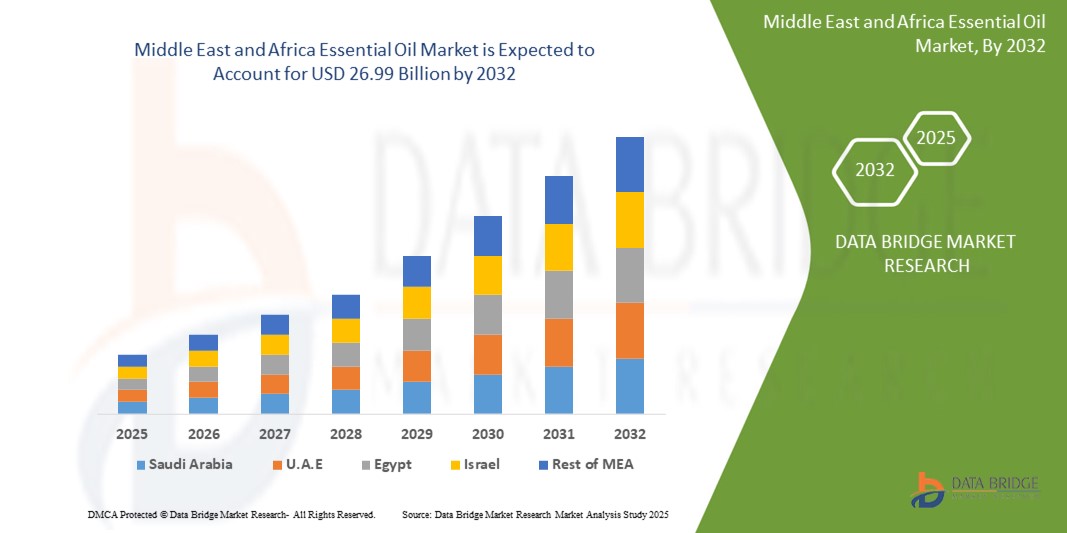
Essential Oil Market Size
- The Middle East and Africa essential oil Market size was valued at USD 7.13 billion in 2024 and is expected to reach USD 26.99 billion by 2032, at a CAGR of 18.10% during the forecast period
- Market growth is largely driven by rising disposable incomes, increasing beauty awareness, and a growing focus on personal grooming in both mature and emerging economies within the region
- In addition, the rise of digital marketing, social media influencers, and expanding e-commerce platforms have enhanced product availability and consumer education, significantly boosting market penetration across Middle Eastern and African countries
Essential Oil Market Analysis
- Essential oils in the region have transitioned from niche luxury products to everyday essentials, with consumers gravitating toward multifunctional products offering benefits such as skincare enhancement, aromatherapy, and holistic wellness. This trend is propelling product innovation and diversification
- The market is witnessing an increased preference for natural, organic, and sustainably sourced essential oils, driven by rising environmental consciousness and demand for clean-label products among consumers
- Furthermore, the adoption of technology-driven beauty solutions such as AI-enabled personalized recommendations and virtual try-ons is gaining traction, particularly among younger, digitally savvy populations, accelerating the overall market growth in the Middle East and Africa
- U.A.E. dominates the MEA essential oil market, driven by its affluent consumer base and cosmopolitan lifestyle. Consumers prioritize premium, luxury essential oils used in skincare, haircare, and aromatherapy
- South Africa is the fastest growing country in the essential oil market due to the rich biodiversity and traditional use of native plants such as rooibos, marula, and buchu, which are increasingly featured in beauty and wellness products
- The singles segment dominated the market with a revenue share of 63.7% in 2024, driven by rising consumer preference for pure, unadulterated oils used in aromatherapy, personal care, and household applications
Report Scope and Essential Oil Market Segmentation
|
Attributes |
Essential Oil Key Market Insights |
|
Segments Covered |
|
|
Countries Covered |
Middle East and Africa
|
|
Key Market Players |
|
|
Market Opportunities |
|
|
Value Added Data Infosets |
In addition to the insights on market scenarios such as market value, growth rate, segmentation, geographical coverage, and major players, the market reports curated by the Data Bridge Market Research also include in-depth expert analysis, pricing analysis, brand share analysis, consumer survey, demography analysis, supply chain analysis, value chain analysis, raw material/consumables overview, vendor selection criteria, PESTLE Analysis, Porter Analysis, and regulatory framework. |
Essential Oil Market Trends
“Increasing Demand for Wellness and Holistic Health Solutions”
- A major trend shaping the Middle East and Africa essential oil market is the rising consumer focus on wellness and holistic health, driven by increased awareness of mental well-being, stress relief, and natural therapies. Essential oils are increasingly being integrated into aromatherapy, spa treatments, and alternative medicine.
- For instance, in March 2025, a leading regional wellness brand, Sahara Aromatics, launched a new line of essential oils specifically designed for stress relief and sleep improvement, promoting natural health benefits.
- Another trend is the growing inclination towards traditional and cultural uses of essential oils, especially in countries such as Egypt and Morocco, where oils such as frankincense and argan oil have historical significance and are seeing renewed interest.
- Digital platforms and wellness influencers are playing a key role in popularizing essential oils as part of everyday self-care routines, contributing to growing consumer engagement.
- The expansion of wellness tourism and spa industries in countries such as UAE and South Africa also supports rising demand for essential oils as complementary products in relaxation and therapeutic services
- This trend is encouraging manufacturers to innovate by combining ancient wisdom with modern science to create unique blends and formulations that cater to the wellness-conscious consumer
- Overall, the emphasis on wellness and holistic health is expected to drive long-term growth in essential oils across the Middle East and Africa market
Essential Oil Market Dynamics
Driver
“Urbanization and Increasing Health Consciousness”
- Rapid urbanization across the Middle East and Africa is contributing to changing lifestyles and increased health consciousness among consumers, leading to higher demand for natural and plant-based essential oil products
- For instance, the UAE’s urban population has shown a marked increase in preference for products that support mental well-being and natural healing, boosting sales of essential oils for aromatherapy and topical use
- Increased exposure to global wellness trends through social media and international travel is also educating consumers about the benefits of essential oils in managing stress, immunity, and skin health
- Governments and private sectors in the region are promoting wellness initiatives and natural healthcare products, which further enhance market adoption
- Innovation in packaging and product delivery formats, such as roll-ons and diffusers, tailored for urban lifestyles, is making essential oils more accessible and convenient for consumers on the go
Restraint/Challenge
“Supply Chain Constraints and Regulatory Complexities”
- The Middle East and Africa essential oil Market faces significant challenges due to supply chain disruptions caused by geopolitical tensions, import restrictions, and limited local production capacity for some key raw materials
- For instance, in early 2024, delays in the import of raw plant materials from Asia impacted essential oil manufacturers in South Africa and Egypt, leading to higher prices and intermittent shortages
- The region’s complex regulatory environment, with differing standards and certification requirements across countries, poses hurdles for manufacturers aiming for market entry and compliance
- Inconsistent quality control and counterfeit products also affect consumer trust and brand reputation, necessitating greater investment in quality assurance and traceability
- Economic volatility and currency fluctuations in some countries can increase operational costs and affect consumer purchasing power, especially for premium essential oil products
- Manufacturers must navigate these challenges by optimizing supply chains, ensuring product authenticity, and working closely with regulators to harmonize standards for sustained growth in the region
Essential Oil Market Scope
The market is segmented on the basis of products, application, extraction method, and distribution channel.
By Type
On the basis of type, the essential oils market is segmented into singles and blends. The singles segment dominated the market with a revenue share of 63.7% in 2024, driven by rising consumer preference for pure, unadulterated oils used in aromatherapy, personal care, and household applications. Popular single oils such as lavender, peppermint, and tea tree continue to witness strong demand for their therapeutic benefits.
The blends segment is expected to register the fastest CAGR from 2025 to 2032, supported by increasing demand for customized solutions targeting stress relief, sleep enhancement, and wellness routines.
By Product
On the basis of product, the market includes Lavender Oil, Lemon Oil, Orange Oil, Frankincense, Chamomile Oil, Lime Oil, Rosemary, Tea Tree, Patchouli Oil, Lavandin Oil, Lemongrass Oil, Citronella Oil, Balsam, Bergamot, Mandarine Oil, Eucalyptus Oil, Clove Oil, Cedarwood Oil, Coriander Oil, Basil Oil, Cornmint Oil, Peppermint Oil, Spearmint Oil, Litsea Cubeba Oil, and others. Lavender Oil held the largest market share at 14.9% in 2024, making it the most widely used essential oil across multiple consumer categories. This dominance is primarily attributed to its versatility, gentle nature, and scientifically recognized therapeutic benefits.
By Application
On the basis of application, the market is segmented into spa and relaxation, cleaning and home, food and beverages, medical, and others. The spa and relaxation segment led the market with a share of 36.5% in 2024, attributed to rising consumer inclination towards stress relief and wellness therapies using essential oils.
The cleaning and home segment is projected to grow at the fastest rate, driven by increasing demand for natural cleaning solutions with antibacterial and aromatic benefits.
By Extraction Method
On the basis of extraction method, the market includes distillation, cold press extraction, carbon dioxide extraction, solvent extraction, and others. Distillation dominated the market in 2024 with a revenue share of 68.2%, owing to its cost-effectiveness, ability to preserve oil quality, and widespread adoption across commercial essential oil production.
The carbon dioxide extraction method is expected to witness the fastest growth due to its ability to extract high-purity oils without using heat or harmful solvents.
By Distribution Channel
On the basis of distribution channel, the market is segmented into direct and retail. The retail segment captured the largest market share in 2024 with 72.8%, supported by strong presence of specialty stores, pharmacies, and supermarkets.
The direct channel is expected to witness the fastest growth through 2032, fueled by the expansion of e-commerce, direct-to-consumer wellness brands, and rising popularity of subscription-based aromatherapy products.
Essential Oil Market Regional Analysis
- The Middle East and Africa (MEA) essential oil market accounted for a revenue share of approximately 8.13% in 2024, reflecting steady growth driven by increasing consumer inclination toward natural wellness, aromatherapy, and personal care products
- Traditional use of essential oils in the region’s cultural and religious practices supports demand, alongside rising urbanization, higher disposable incomes, and growing awareness of organic and halal-certified beauty products
- The expansion of retail infrastructure, online sales channels, and entry of global brands targeting the MEA market contribute to its evolving landscape, especially in countries such as the U.A.E., Saudi Arabia, Egypt, and South Africa
U.A.E. Essential Oil Market Insight
The U.A.E. dominates the MEA essential oil market, driven by its affluent consumer base and cosmopolitan lifestyle. Consumers prioritize premium, luxury essential oils used in skincare, haircare, and aromatherapy. The country’s booming spa and wellness industry further propels demand for high-quality natural oils, which are often incorporated into beauty treatments and home fragrance products. In addition, the U.A.E.’s focus on halal-certified and clean-label products aligns with global trends favoring natural, ethical beauty solutions. The presence of numerous international brands, combined with expanding retail and e-commerce channels, supports strong product availability and visibility.
Saudi Arabia Essential Oil Market Insight
Saudi Arabia’s essential oil market is expanding rapidly, supported by traditional cultural appreciation for fragrances and herbal remedies. The Kingdom’s Vision 2030 initiative encourages health awareness and diversification of consumer products, creating opportunities in organic personal care and wellness sectors. Young consumers are increasingly seeking natural, chemical-free beauty products, while demand for essential oils in aromatherapy and alternative medicine continues to grow. Furthermore, the government’s focus on developing non-oil sectors boosts the retail and e-commerce markets, enabling wider access to domestic and imported essential oils. Halal certifications and sustainability claims are important purchase drivers in this market.
South Africa Essential Oil Market Insight
South Africa is the fastest growing country in the essential oil market due to the rich biodiversity and traditional use of native plants such as rooibos, marula, and buchu, which are increasingly featured in beauty and wellness products. The growing urban middle class shows heightened interest in natural health solutions, including aromatherapy, massage oils, and therapeutic skincare. This demand is supported by expanding health and wellness tourism, and a rising preference for organic and ethically sourced products. Retail outlets, health stores, and e-commerce platforms have broadened distribution channels. South African consumers also emphasize sustainability and social responsibility, encouraging brands to focus on ethical sourcing and eco-friendly packaging.
Egypt Essential Oil Market Insight
Egypt’s essential oil market is grounded in a long history of traditional herbal and aromatic oil use, which remains culturally significant. Today, rising health consciousness and interest in natural beauty and wellness solutions are driving market growth. Egyptian consumers are embracing essential oils for personal care and for medicinal and household applications. Urban centers such as Cairo and Alexandria are hotspots for demand, fueled by the increasing availability of both local and international essential oil brands. The expansion of e-commerce and social media marketing also helps educate consumers and boost awareness about product benefits and usage.
Essential Oil Market Share
The essential oil industry is primarily led by well-established companies, including:
- GrainCorp (Australia)
- Malteurop (France)
- Rahr Corporation (U.S.)
- BOORTMALT (Belgium)
- Indesso (Spain)
- Lipoid GmbH (Germany)
- The Herbarie at Stoney Hill Farm, Inc. (U.S.)
- International Flavors & Fragrances Inc (Netherlands)
- Bell Flavors & Fragrances, Inc (France)
- Rutland Biodynamics Ltd (Scotland)
- Prakruti Products Pvt. Ltd (India)
- Ambe Phytoextracts Pvt. Ltd. (Austria)
- The Green Labs LLC (Netherlands)
- Berjé Inc (Italy)
- UMALAXMI BRANDS (India)
- DSM (Netherlands)
Latest Developments in Middle East and Africa Essential Oil Market
- In July 2022, doTERRA continued its global expansion by establishing operations in India, a move aligned with its strategy to strengthen its presence in regions where its essential oils are sourced, including Asia, the Pacific, the Middle East, and Africa. This strategic entry is expected to streamline its supply chain and bolster its global growth initiatives
- In July 2022, Sensient Technologies expanded its flavor portfolio by acquiring Flavor Solutions, Inc. (U.S.), thereby enhancing its capabilities in savory reaction flavors, natural shelf-life technologies, and taste modulation platforms such as sweetness enhancement and salt reduction. This acquisition supports Sensient’s aim to provide comprehensive and advanced flavor solutions to a broader market
- In September 2022, MANE KANCOR inaugurated its Innovation Center in Angamaly, dedicated to the development of cutting-edge solutions in natural shelf-life, color, culinary taste, personal care, and nutraceuticals. This facility marks a significant step in strengthening MANE KANCOR’s R&D capabilities and innovation leadership
- In February 2022, Givaudan acquired Myrissi (France) to reinforce its Fragrance & Beauty division with enhanced AI-based sensory design capabilities. The acquisition is expected to help Givaudan create more personalized and emotionally resonant fragrance experiences for consumers

- Interactive Data Analysis Dashboard
- Company Analysis Dashboard for high growth potential opportunities
- Research Analyst Access for customization & queries
- Competitor Analysis with Interactive dashboard
- Latest News, Updates & Trend analysis
- Harness the Power of Benchmark Analysis for Comprehensive Competitor Tracking
Middle East Africa Essential Oils Market, Supply Chain Analysis and Ecosystem Framework
To support market growth and help clients navigate the impact of geopolitical shifts, DBMR has integrated in-depth supply chain analysis into its Middle East Africa Essential Oils Market research reports. This addition empowers clients to respond effectively to global changes affecting their industries. The supply chain analysis section includes detailed insights such as Middle East Africa Essential Oils Market consumption and production by country, price trend analysis, the impact of tariffs and geopolitical developments, and import and export trends by country and HSN code. It also highlights major suppliers with data on production capacity and company profiles, as well as key importers and exporters. In addition to research, DBMR offers specialized supply chain consulting services backed by over a decade of experience, providing solutions like supplier discovery, supplier risk assessment, price trend analysis, impact evaluation of inflation and trade route changes, and comprehensive market trend analysis.
Data collection and base year analysis are done using data collection modules with large sample sizes. The stage includes obtaining market information or related data through various sources and strategies. It includes examining and planning all the data acquired from the past in advance. It likewise envelops the examination of information inconsistencies seen across different information sources. The market data is analysed and estimated using market statistical and coherent models. Also, market share analysis and key trend analysis are the major success factors in the market report. To know more, please request an analyst call or drop down your inquiry.
The key research methodology used by DBMR research team is data triangulation which involves data mining, analysis of the impact of data variables on the market and primary (industry expert) validation. Data models include Vendor Positioning Grid, Market Time Line Analysis, Market Overview and Guide, Company Positioning Grid, Patent Analysis, Pricing Analysis, Company Market Share Analysis, Standards of Measurement, Global versus Regional and Vendor Share Analysis. To know more about the research methodology, drop in an inquiry to speak to our industry experts.
Data Bridge Market Research is a leader in advanced formative research. We take pride in servicing our existing and new customers with data and analysis that match and suits their goal. The report can be customized to include price trend analysis of target brands understanding the market for additional countries (ask for the list of countries), clinical trial results data, literature review, refurbished market and product base analysis. Market analysis of target competitors can be analyzed from technology-based analysis to market portfolio strategies. We can add as many competitors that you require data about in the format and data style you are looking for. Our team of analysts can also provide you data in crude raw excel files pivot tables (Fact book) or can assist you in creating presentations from the data sets available in the report.













