


What is the Middle East and Africa Biocides Market Size and Growth Rate?
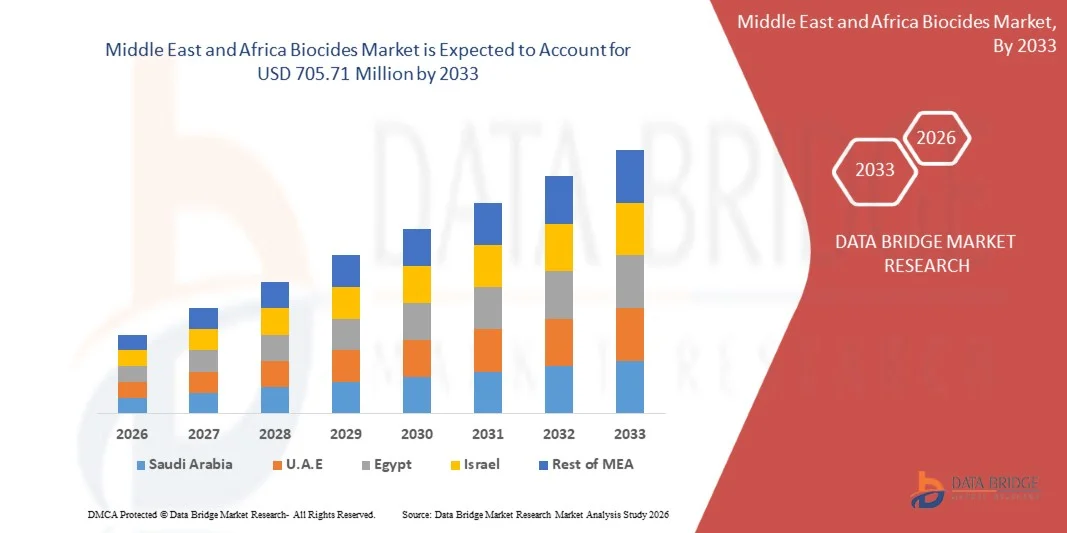
- As per Data Bridge Market Research analysis, the Middle East and Africa biocides market was valued at USD 515.66 million in 2025 and is projected to reach USD 705.71 million by 2033, growing at a CAGR of 4.00% from 2026 to 2033.
- The market is experiencing consistent growth driven by rising demand for effective microbial control solutions, expanding water treatment infrastructure, increasing industrialization, and growing applications of biocides across food and beverage, oil and gas, paints and coatings, personal care, and other industries.
- The increasing need for clean and safe water, stringent hygiene requirements, and expansion of industrial activities across the Middle East and Africa are encouraging greater adoption of biocides. Halogen compounds, organic acids, quaternary ammonium compounds, and other biocidal products are increasingly used in water treatment, industrial cooling systems, preservatives, and antimicrobial applications, supporting market expansion across the region.
Market Size & Forecast
- Global Market Value (2025): USD 515.66 Million
- Expected Market Value (2033): USD 705.71 Million
- Forecast CAGR (2026–2033): 4.00%
- Leading Country in 2025: Saudi Arabia
- Fastest Growing Country: South Africa
What are the Major Takeaways of the Middle East and Africa Biocides Market?
- Saudi Arabia dominated the Middle East and Africa biocides market with the largest revenue share of 35.7% in 2025, supported by extensive freshwater demand, desalination activities, and strong petrochemical and plastics manufacturing.
- South Africa is expected to be the fastest-growing region at a CAGR of 3.9% from 2026 to 2033, fueled by increasing demand for biocides across water treatment, industrial processes, and manufacturing applications
- The halogen compounds segment led the market with a 30.27% share in 2025, driven by extensive use in water treatment and industrial microbial-control applications.
- Nitrogen-based biocides/quaternary ammonium compounds are the fastest-growing type, projected to register a CAGR of 4.5%, reflecting the surge in demand for effective antimicrobial solutions across industrial and commercial applications.
- The preservatives segment dominated the product type category with a 60% revenue share in 2025, led by extensive use of biocides to prevent microbial deterioration in manufactured products and formulations.
- Water treatment accounted for 30% of the market share in 2025, preferred by water scarcity, desalination activity, wastewater treatment, and increasing industrial water requirements.
- The oil and gas segment is the fastest-growing application category, with a CAGR of 5.0%, driven by the strategic importance of petroleum production and processing across the Middle East.
Report Scope and Middle East and Africa Biocides Market Segmentation
|
Attributes |
Middle East and Africa Biocides Key Market Insights |
|
Segments Covered |
|
|
Countries Covered |
Middle East and Africa
|
|
Key Market Players |
|
|
Market Opportunities |
|
|
Value Added Data Infosets |
In addition to the insights on market scenarios such as market value, growth rate, segmentation, geographical coverage, and major players, the market reports curated by the Data Bridge Market Research also include import export analysis, production capacity overview, production consumption analysis, price trend analysis, climate change scenario, supply chain analysis, value chain analysis, raw material/consumables overview, vendor selection criteria, PESTLE Analysis, Porter Analysis, and regulatory framework. |
What is the Key Trend in the Middle East and Africa Biocides Market?
- The Middle East and Africa biocides market is increasingly shifting toward advanced microbial-control solutions for desalination, membrane systems, and industrial water treatment, as water scarcity and water reuse requirements intensify across the region.
- For instance, in December 2024, The National reported that researchers at NYU Abu Dhabi had manufactured the UAE’s first reverse-osmosis membrane system, highlighting the region’s increasing focus on advanced, locally developed desalination technologies to improve water-treatment efficiency.
- The expansion of reverse-osmosis and other membrane-based desalination systems is increasing demand for biocides that control biofouling, bacteria, algae, and microbial growth while protecting membrane performance and reducing cleaning requirements.
- Water-treatment operators are also adopting lower-impact and membrane-compatible biocides, as conventional disinfectants can create corrosion, handling, and discharge concerns in large-scale treatment operations.
- Digital water-quality monitoring and advanced treatment technologies are becoming increasingly important, enabling operators to monitor microbial conditions and optimize chemical dosing across complex water-treatment networks.
- For instance, in July 2025, arXiv published research on a UAE-specific artificial-intelligence framework that achieved 98% accuracy in predicting desalination performance losses and used climate data to optimize membrane operation and maintenance, demonstrating the growing use of digital technologies in regional water treatment.
- As desalination, wastewater reuse, and industrial water recycling continue expanding across the Middle East and Africa, demand for efficient, sustainable, and application-specific biocides is expected to accelerate, strengthening water treatment as a core growth area for the market.
What are the Key Drivers of the Middle East and Africa Biocides Market?
- The rapid expansion of desalination and water-treatment infrastructure is significantly increasing demand for biocides capable of controlling microbial growth, biofouling, and contamination in water-treatment and distribution systems.
- For instance, in July 2025, the Financial Times reported that Middle Eastern governments were investing billions of dollars to expand desalination infrastructure, while UAE utility TAQA planned to increase the share of its desalination capacity using reverse osmosis to 66% by 2030 from 40%, supporting continued demand for water-treatment chemicals.
- Water scarcity across the Middle East is encouraging governments and industries to increase dependence on desalinated and treated water, creating sustained requirements for antimicrobial chemicals that maintain treatment efficiency and water quality.
- Oil and gas producers are also integrating biocides into produced-water, seawater-injection, drilling-fluid, and pipeline operations to control sulfate-reducing bacteria, biofilms, and microbiologically influenced corrosion.
- For instance, in December 2025, Saudi Aramco published an Oilfield Microbiology Specialist position on its official careers site requiring the development and optimization of biocide-treatment programs, evaluation of microbial-control chemicals, and mitigation of microbiological challenges in downhole and surface oil-and-gas systems, demonstrating sustained industrial demand for biocides in the region
- The continued expansion of industrial water systems, cooling towers, petrochemical facilities, and desalination plants is therefore expected to sustain demand for oxidizing and non-oxidizing biocides across the Middle East and Africa.
Which Factors are Challenging the Growth of the Middle East and Africa Biocides Market?
- Environmental and health concerns associated with certain biocidal chemicals can restrict their application, particularly where residual chemicals may enter marine environments, wastewater streams, or other sensitive ecosystems.
- For instance, in July 2024, Water (MDPI) published a study on drinking-water quality in Saudi Arabia reporting that the country’s MEWA and SWA guidelines specify a residual chlorine range of 0.2–0.5 ppm, highlighting the need for controlled biocide dosing and compliance with drinking-water standards.
- Increasing regulatory scrutiny is encouraging manufacturers and end users to adopt safer, biodegradable, and lower-toxicity formulations, potentially increasing formulation, testing, registration, and compliance costs.
- Biocide selection is also technically challenging because excessive dosing can increase chemical consumption and environmental exposure, while insufficient dosing can allow microbial growth, biofouling, and corrosion to develop.
- For instance, in December 2022, Desalination and Water Treatment published research assessing trihalomethanes in chlorinated drinking-water sources in Saudi Arabia’s Aseer region, demonstrating concerns over disinfection by-products generated during chlorine-based treatment.
- These environmental, safety, and compliance considerations can increase operating complexity and encourage water-treatment operators to invest in more selective and environmentally compatible biocide technologies, potentially limiting adoption of conventional products.
How is the Middle East and Africa Biocides Market Segmented?
The Middle East and Africa biocides market is segmented on the basis of type, product type, application, and end user.
- By Type
On the basis of type, the Middle East and Africa biocides market is segmented into halogen compounds, organic acids, nitrogen-based biocides/quaternary ammonium compounds, metallic compounds, organosulfur compounds, phenolic biocides, and others. The halogen compounds segment dominated the market with 30.27% revenue share in 2025, supported by extensive use in water treatment and industrial microbial-control applications. Halogen compounds provide broad-spectrum antimicrobial activity and are widely established across municipal and industrial water systems. Their effectiveness in controlling bacteria, algae, and other microorganisms supports their continued utilization in desalination and water-treatment facilities. The strong presence of water-intensive industries across the Middle East further supports demand for these products. However, environmental and disinfection-by-product concerns are encouraging users to consider alternative technologies.
The nitrogen-based biocides/quaternary ammonium compounds segment is projected to register the fastest growth at 4.5% CAGR during the forecast period, supported by increasing demand for effective antimicrobial solutions across industrial and commercial applications. Quaternary ammonium compounds provide broad-spectrum activity against bacteria, fungi, and algae. Their versatility enables applications across water treatment, coatings, personal care, and industrial systems. Increasing microbial-control requirements in manufacturing and commercial facilities are creating additional opportunities for these products. Manufacturers are also developing application-specific formulations with improved performance and compatibility. Growing awareness of hygiene and microbial contamination is further supporting their adoption.
- By Product Type
On the basis of product type, the Middle East and Africa biocides market is segmented into preservatives, pest control, and others. The preservatives segment dominated the market with 60% share in 2025, supported by extensive use of biocides to prevent microbial deterioration in manufactured products and formulations. Preservatives are widely used in paints and coatings, personal care products, industrial formulations, and other water-based products. The expansion of manufacturing and construction activities is increasing demand for products requiring extended shelf stability. Food and beverage processing also creates requirements for effective preservation and microbial control. Increasing temperatures across several regional markets can further increase microbial-growth risks.
The pest control segment is projected to be the fastest-growing product category at 5.0% CAGR during the forecast period, driven by increasing agricultural activity, urbanization, and the need for effective pest-management solutions. Agricultural producers are seeking improved protection against organisms that can reduce crop productivity and quality. Urban expansion is also increasing pest-control requirements across residential, commercial, and industrial environments. Food-security initiatives are encouraging greater investment in agricultural productivity and crop protection across African markets. Growing awareness of hygiene and pest-related contamination is supporting wider commercial applications. Regulatory developments are in addition encouraging more targeted and environmentally compatible formulations.
- By Application
On the basis of application, the Middle East and Africa biocides market is segmented into water treatment, food and beverage, boilers and industrial cooling towers, personal care, wood preservation, paints and coating, HVAC, boilers, oil and gas, fuels, metal working fluids, marine industry, plastics, leather, and others. The water treatment segment dominated the market with 30% share in 2025, supported by water scarcity, desalination activity, wastewater treatment, and increasing industrial water requirements. Biocides are essential for controlling microbial growth, biofilms, algae, and bacteria in water-treatment systems. Reverse-osmosis desalination facilities require microbial-control programs to reduce biofouling and maintain membrane performance. Industrial facilities also use biocides in cooling towers, boilers, and circulating-water systems. Increasing investment in wastewater reuse and water-security infrastructure is creating additional demand.
The oil and gas segment is projected to witness the fastest growth at 5.0% CAGR during forecast period, driven by the strategic importance of petroleum production and processing across the Middle East. Biocides are used in produced-water systems, injection-water operations, pipelines, drilling fluids, and storage facilities. Microbial contamination can contribute to biofouling and microbiologically influenced corrosion, creating significant operational challenges. Expansion of mature oil fields is increasing requirements for specialized water-management and microbial-control solutions. Increasing investment in production efficiency and asset protection is further supporting demand. These factors are expected to position oil and gas as one of the fastest-growing applications for biocides.
- By End User
On the basis of end user, the Middle East and Africa biocides market is segmented into chemical, healthcare, agriculture, construction, and others. The chemical segment dominated the market with 35% share in 2025, supported by extensive biocide consumption in chemical manufacturing, industrial water systems, and product-preservation processes. Chemical manufacturers use biocides to control microbial contamination in water-based formulations and process systems. The region's established petrochemical and chemical industries, particularly in the Gulf countries, provide a substantial industrial customer base. Biocides are also used in cooling systems and process-water circuits associated with chemical manufacturing. Industrial diversification and expansion of petrochemical production are creating additional opportunities for suppliers.
The agriculture segment is expected to register the fastest growth at 5.5% CAGR during the forecast period, supported by increasing agricultural modernization, food-security initiatives, and the expansion of commercial farming. Agricultural operations require microbial and pest-control solutions to protect crops and maintain productivity. Governments across the region are investing in irrigation, protected agriculture, and technologies that improve domestic food production. Water scarcity is also encouraging the adoption of controlled and efficient agricultural systems where microbial management is important. Expansion of commercial agriculture across African countries is creating additional opportunities for biocide applications. Growing emphasis on food quality and agricultural productivity is further supporting adoption.
Which Country Holds the Largest Share of the Middle East and Africa Biocides Market?
- Saudi Arabia dominated the Middle East and Africa biocides market with the largest revenue share of 35.7% in 2025, supported by extensive freshwater demand, desalination activities, and strong petrochemical and plastics manufacturing.
- The country also benefits from substantial investments in water treatment, wastewater management, oil and gas operations, and industrial manufacturing, where biocides are widely used for microbial control. Increasing demand for reliable water supplies, expansion of desalination capacity, and continued development of chemical-intensive industries continue to strengthen Saudi Arabia's leadership position in the regional biocides market.
U.A.E. Biocides Market Insight
The U.A.E. biocides market is expected to witness rapid growth, driven by extensive desalination activities, increasing wastewater treatment, and expanding industrial infrastructure. Growing demand for reliable water supplies and advanced water-treatment technologies is supporting biocide consumption across municipal and industrial applications. In addition, the country's strong oil and gas, construction, hospitality, and manufacturing sectors are creating wider applications for microbial-control products. Increasing investments in sustainable water management and resource efficiency are further supporting regional market expansion.
South Africa Biocides Market Insight
The South Africa biocides market is witnessing consistent growth due to increasing water-treatment requirements, industrialization, and agricultural activities. Biocides are increasingly utilized in water and wastewater treatment, industrial cooling systems, paints and coatings, and agricultural applications. Moreover, growing concerns regarding water quality and microbial contamination are encouraging greater adoption of effective microbial-control solutions. Expansion of manufacturing and infrastructure development, together with increasing emphasis on water-resource management, is further contributing to market growth in South Africa.
Egypt Biocides Market Insight
The Egypt biocides market is growing rapidly, driven by increasing water-treatment requirements, population growth, agricultural activity, and industrial development. Rising demand for clean water and wastewater management is supporting the use of biocides across municipal and industrial treatment systems. Growing applications in agriculture, food and beverage processing, paints and coatings, and construction are also expanding the market opportunity. In addition, investments in water infrastructure and industrial development are strengthening demand for microbial-control products across Egypt.
Qatar Biocides Market Insight
The Qatar biocides market is expanding steadily due to increasing desalination activity, industrial development, and growing requirements for water-quality management. Biocides are used across water-treatment systems, cooling towers, oil and gas operations, and other industrial applications to control microbial contamination. The country's large energy sector provides additional demand for specialized microbial-control products in production and water-management processes. Continuous infrastructure development and increasing focus on water security are further driving biocide adoption, strengthening Qatar's position within the Middle East and Africa biocides market.
Which are the Top Companies in Middle East and Africa Biocides Market?
The Middle East and Africa biocides industry is primarily led by well-established companies, including:
- LANXESS (Germany)
- Arxada AG (Switzerland)
- BASF SE (Germany)
- Ecolab Inc. (U.S.)
- Nouryon (Netherlands)
- Clariant (Switzerland)
- Evonik Industries AG (Germany)
- Solvay (Belgium)
- Arkema (France)
- Veolia (France)
- DuPont (U.S.)
- Croda International Plc (U.K.)
- Kemira Oyj (Finland)
- Solenis (U.S.)
- Buckman (U.S.)
- THOR GmbH (Germany)
- Vink Chemicals GmbH & Co. KG (Germany)
- KURITA WATER INDUSTRIES LTD. (Japan)
- Italmatch Chemicals (Italy)
- ICL (Israel)
What are Latest Developments in Middle East and Africa Biocides Market?
- In December 2025, Saudi Aramco published an Oilfield Microbiology Specialist position describing responsibilities to design and optimize biocide-treatment programs, develop new testing methods, and conduct research into microbiological challenges, highlighting the continued development of specialized biocide technologies for oilfield applications in Saudi Arabia
- In April 2025, RXSOL published details of its industrial-water biocide solutions for Oman, highlighting applications across marine vessels and industrial facilities in Muscat, Sohar, and Salalah, reflecting increasing deployment of microbial-control chemicals in Oman's industrial water-treatment systems.
- In March 2025, RXSOL highlighted its biocide solutions specifically for reverse-osmosis treatment plants in the UAE and Oman, with products designed to eliminate bacteria, fungi, and algae and prevent biofilm formation on membranes. This is a product introduction/application announcement directly relevant to the regional water-treatment biocides market.
- In April 2024, Innoveda Chemicals published an article on biocide solutions for cooling-water systems in Sharjah, UAE, highlighting the use of biocides to control algae and bacteria, prevent fouling and corrosion, and maintain cooling-system efficiency in the region's industrial facilities.
- In March 2024, Saudi Aramco announced that it and TotalEnergies had awarded engineering, procurement, and construction contracts for the USD 11 billion Amiral complex in Jubail, Saudi Arabia, expanding a major petrochemical facility and creating additional industrial water-treatment requirements where microbial-control chemicals such as biocides are used.

- Interactive Data Analysis Dashboard
- Company Analysis Dashboard for high growth potential opportunities
- Research Analyst Access for customization & queries
- Competitor Analysis with Interactive dashboard
- Latest News, Updates & Trend analysis
- Harness the Power of Benchmark Analysis for Comprehensive Competitor Tracking
Middle East And Africa Biocides Market, Supply Chain Analysis and Ecosystem Framework
To support market growth and help clients navigate the impact of geopolitical shifts, DBMR has integrated in-depth supply chain analysis into its Middle East And Africa Biocides Market research reports. This addition empowers clients to respond effectively to global changes affecting their industries. The supply chain analysis section includes detailed insights such as Middle East And Africa Biocides Market consumption and production by country, price trend analysis, the impact of tariffs and geopolitical developments, and import and export trends by country and HSN code. It also highlights major suppliers with data on production capacity and company profiles, as well as key importers and exporters. In addition to research, DBMR offers specialized supply chain consulting services backed by over a decade of experience, providing solutions like supplier discovery, supplier risk assessment, price trend analysis, impact evaluation of inflation and trade route changes, and comprehensive market trend analysis.
Data collection and base year analysis are done using data collection modules with large sample sizes. The stage includes obtaining market information or related data through various sources and strategies. It includes examining and planning all the data acquired from the past in advance. It likewise envelops the examination of information inconsistencies seen across different information sources. The market data is analysed and estimated using market statistical and coherent models. Also, market share analysis and key trend analysis are the major success factors in the market report. To know more, please request an analyst call or drop down your inquiry.
The key research methodology used by DBMR research team is data triangulation which involves data mining, analysis of the impact of data variables on the market and primary (industry expert) validation. Data models include Vendor Positioning Grid, Market Time Line Analysis, Market Overview and Guide, Company Positioning Grid, Patent Analysis, Pricing Analysis, Company Market Share Analysis, Standards of Measurement, Global versus Regional and Vendor Share Analysis. To know more about the research methodology, drop in an inquiry to speak to our industry experts.
Data Bridge Market Research is a leader in advanced formative research. We take pride in servicing our existing and new customers with data and analysis that match and suits their goal. The report can be customized to include price trend analysis of target brands understanding the market for additional countries (ask for the list of countries), clinical trial results data, literature review, refurbished market and product base analysis. Market analysis of target competitors can be analyzed from technology-based analysis to market portfolio strategies. We can add as many competitors that you require data about in the format and data style you are looking for. Our team of analysts can also provide you data in crude raw excel files pivot tables (Fact book) or can assist you in creating presentations from the data sets available in the report.













