


What is the Middle East and Africa Skin Tightening Market Size and Growth Rate?
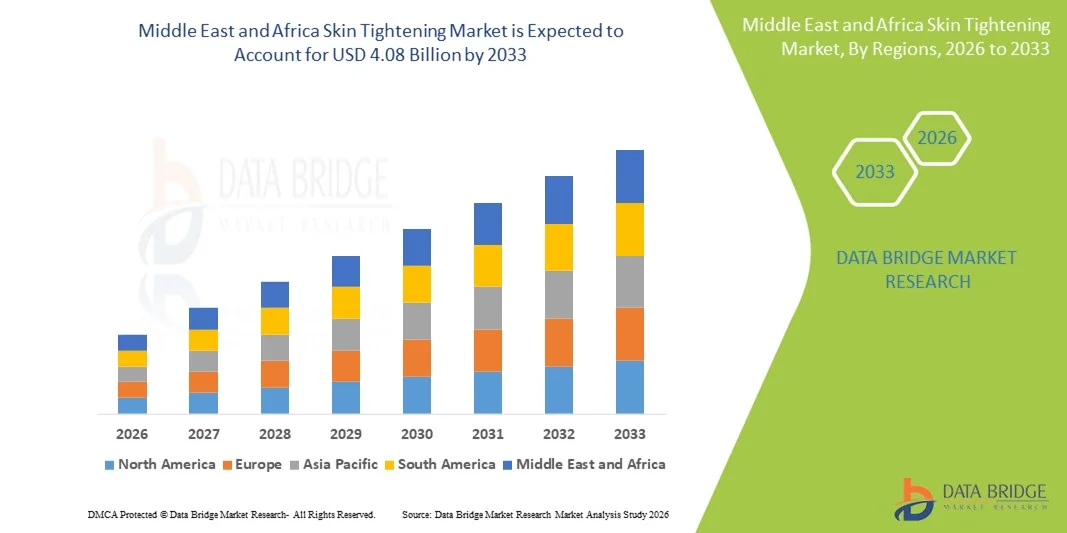
- As per Data Bridge Market Research analysis, the Middle East and Africa skin tightening market size was valued at USD 2.60 billion in 2025 and is expected to reach USD 4.08 billion by 2033, at a CAGR of 5.8% during the forecast period
- The market growth is primarily driven by the rising adoption of advanced non-invasive aesthetic procedures, increasing awareness about skin rejuvenation treatments, and growing demand for anti-aging solutions among the region’s expanding middle-class population
- Furthermore, the growing presence of medical spas, dermatology clinics, and cosmetic centers offering laser- and radiofrequency-based tightening treatments is propelling market expansion. These combined factors are accelerating the demand for safe, effective, and technology-driven skin tightening solutions, thereby significantly boosting the industry's growth
Market Size & Forecast
- Global Market Value (2025): USD 2.60 billion
- Expected Market Value (2033): USD 4.08 billion
- Forecast CAGR (2026-2033): 5.8%
What are the Major Takeaways of Middle East and Africa Skin Tightening Market?
- Skin tightening procedures, utilizing advanced technologies such as radiofrequency, ultrasound, and laser systems, are increasingly becoming integral to the aesthetic industry in the Middle East and Africa due to rising demand for non-invasive cosmetic enhancements that deliver visible rejuvenation with minimal recovery time
- The market growth is primarily driven by increasing beauty consciousness, the influence of social media trends, and the growing presence of modern dermatology clinics and medical spas offering technologically advanced skin tightening treatments
- The United Arab Emirates dominated the Middle East and Africa skin tightening market with the largest revenue share of 37.9% in 2025, attributed to its well-established aesthetic infrastructure, high disposable incomes, and strong medical tourism sector, particularly in Dubai and Abu Dhabi
- South Africa is expected to be the fastest-growing country in the market during the forecast period, driven by increasing urbanization, expanding cosmetic treatment accessibility, and rising awareness of non-surgical anti-aging solutions
- The Radio Frequency Skin Tightening segment dominated the Middle East and Africa skin tightening market with a market share of 41.2% in 2025, owing to its versatility, proven safety profile, and growing adoption for both facial and body tightening treatments
Report Scope and Middle East and Africa Skin Tightening Market Segmentation
|
Attributes |
Middle East and Africa Skin Tightening Key Market Insights |
|
Segments Covered |
|
|
Countries Covered |
Middle East and Africa
|
|
Key Market Players |
|
|
Market Opportunities |
|
|
Value Added Data Infosets |
In addition to the insights on market scenarios such as market value, growth rate, segmentation, geographical coverage, and major players, the market reports curated by the Data Bridge Market Research also include in-depth expert analysis, patient epidemiology, pipeline analysis, pricing analysis, and regulatory framework |
What is the Key Trend in the Middle East and Africa Skin Tightening Market?
Rising Demand for Non-Invasive and Technology-Driven Treatments
- A significant and accelerating trend in the Middle East and Africa skin tightening market is the increasing adoption of non-invasive technologies such as radiofrequency, ultrasound, and laser systems, which offer effective results with minimal downtime. This trend is transforming the region’s aesthetic and dermatology landscape
- For instance, Alma Lasers’ Accent Prime system is widely adopted in UAE clinics, providing combined radiofrequency and ultrasound treatments for both facial and body skin tightening with enhanced patient comfort
- Advanced devices now incorporate real-time monitoring and adjustable energy settings, allowing clinicians to optimize treatment outcomes based on individual skin types and concerns. For instance, BTL Exilis Ultra utilizes dual technology for customizable skin tightening and fat reduction, improving patient satisfaction and clinic adoption rates
- The growing integration of skin tightening devices with clinic management software and digital treatment planning tools enables more precise, repeatable, and efficient procedures, enhancing operational efficiency and patient experience
- This trend towards technologically sophisticated, safer, and more patient-friendly skin tightening procedures is redefining consumer expectations in the Middle East and Africa aesthetic market. For instance, InMode’s Morpheus8 system is gaining popularity for its minimally invasive fractional treatment combined with radiofrequency energy, meeting rising demand for effective non-surgical solutions
- The demand for advanced, user-friendly, and clinically effective skin tightening solutions is growing rapidly, especially in high-income countries and urban areas, as patients increasingly prioritize visible results with minimal downtime
Middle East and Africa Skin Tightening Market Dynamics
Driver
Increasing Beauty Consciousness and Cosmetic Awareness
- The rising beauty consciousness, social media influence, and growing awareness about aesthetic enhancements are significant drivers for the increasing adoption of skin tightening treatments in the Middle East and Africa
- For instance, in March 2025, Dubai-based Kaya Skin Clinics reported a surge in demand for non-invasive skin tightening procedures using radiofrequency devices, reflecting consumer focus on youthful appearance
- Patients are seeking procedures that offer effective anti-aging results without surgical risks, which positions non-invasive treatments as a preferred choice for both facial and body applications
- Furthermore, the expansion of modern dermatology clinics, aesthetic centers, and medical spas providing technologically advanced treatments is enhancing accessibility and boosting market growth
- Clinics are leveraging promotional campaigns, social media engagement, and patient education programs to increase awareness and adoption of skin tightening services. For instance, DermaMed Spa in South Africa launched a digital awareness initiative to educate clients on ultrasound and laser-based skin tightening procedures
- The growing urban population with higher disposable incomes and willingness to invest in aesthetic procedures continues to propel the market, making skin tightening treatments increasingly mainstream
Restraint/Challenge
High Treatment Costs and Regulatory Compliance Hurdles
- The relatively high cost of advanced skin tightening procedures and devices poses a significant challenge to market growth, particularly for price-sensitive patients in developing countries within the region
- For instance, premium radiofrequency and laser systems from companies such as Venus Concept or Alma Lasers may limit adoption among clinics with smaller patient volumes or lower-income consumers
- Regulatory compliance, including approvals for new devices and adherence to safety standards, is another barrier, as delayed certifications can restrict market entry for new technologies
- Furthermore, potential side effects such as temporary redness, swelling, or skin irritation create cautious adoption among first-time patients, impacting overall procedure frequency
- Overcoming these challenges requires clinics to offer flexible pricing, payment plans, and patient education, while device manufacturers must ensure compliance with local regulatory frameworks. For instance, South African clinics are increasingly partnering with certified distributors to provide safe and approved devices for non-invasive skin tightening
- Addressing cost and safety concerns, alongside improving awareness about minimally invasive procedures, is essential to sustain market growth and expand adoption across the Middle East and Africa
How is the Middle East and Africa Skin Tightening Market Segmented?
The market is segmented on the basis of product type, portability, treatment type, application, end user, and distribution channel.
- By Product Type
On the basis of product type, the Middle East and Africa skin tightening market is segmented into radio frequency (RF) skin tightening, laser skin tightening, and ultrasound skin tightening. The radio frequency segment dominated the market with a revenue share of 41.2% in 2025, driven by its proven safety, effectiveness across multiple skin types, and versatility for both facial and body treatments. RF devices are widely adopted in dermatology clinics and medical spas due to their minimal downtime and non-invasive nature, making them highly preferred among patients seeking anti-aging and skin rejuvenation solutions. Clinics benefit from RF devices’ ability to combine skin tightening with collagen stimulation, enhancing overall treatment outcomes. High adoption in the UAE and Saudi Arabia further solidifies RF technology as the leading segment. Its compatibility with portable and standalone devices also makes it favorable for both small clinics and large aesthetic centers. RF treatments are also popular due to their ability to provide gradual, natural-looking results with minimal patient discomfort.
The laser skin tightening segment is expected to witness the fastest CAGR of 11.5% from 2026 to 2033, driven by technological advancements such as fractional, ablative, and non-ablative lasers offering precise energy delivery for targeted treatment areas. Laser devices are increasingly used for facial lifting, wrinkle reduction, and pigmentation improvements, which fuels demand in high-income urban centers. The growing preference for visible, long-lasting results and the rising number of laser-equipped dermatology clinics contribute to the rapid growth of this segment. Clinics also favor laser systems for their ability to address multiple skin concerns simultaneously. Marketing campaigns and promotional offers further accelerate laser device adoption. Patients value the precision and faster treatment sessions offered by modern laser technologies.
- By Portability
On the basis of portability, the market is segmented into portable and standalone devices. The standalone segment dominated with a market share of 55% in 2025, due to the adoption of large, clinic-based machines that deliver high-energy treatments suitable for multiple patients per day. Standalone devices often provide advanced functionalities, including adjustable energy levels and multiple applicators, allowing dermatologists to customize treatments for facial and body applications. Their reliability and robust performance make them standard in dermatology clinics and high-end cosmetic centers across the UAE, Saudi Arabia, and South Africa. The preference for standalone devices is also supported by their longer lifespan and higher ROI for clinics investing in premium technology. Standalone devices can perform multiple treatment types, including wrinkle reduction and body contouring. Clinics rely on standalone devices to attract high-end clientele seeking professional-grade results.
The portable segment is expected to witness the fastest CAGR of 12.2% from 2026 to 2033, fueled by growing demand for at-home treatments and mobile aesthetic services. Portable devices offer convenience for patients who prefer homecare solutions and for dermatologists conducting mobile skin tightening sessions. Technological innovations in miniaturization, battery life, and ease of use are further accelerating the adoption of portable devices in urban and semi-urban regions. Portable devices are increasingly promoted through e-commerce platforms. They allow users to perform treatments in privacy, creating a growing homecare segment.
- By Treatment Type
On the basis of treatment type, the market is segmented into non-invasive and minimally invasive procedures. The non-invasive segment dominated with a market share of 61% in 2025, driven by rising patient preference for treatments that require no surgical intervention, minimal downtime, and low risk of complications. Non-invasive treatments such as RF and ultrasound are widely adopted in dermatology clinics, beauty salons, and cosmetic centers, particularly in high-income countries. Patients increasingly seek treatments that are safe, comfortable, and can be repeated for gradual improvements, which enhances the adoption of non-invasive procedures. Clinics benefit from higher patient volumes as multiple non-invasive treatments can be performed daily. Non-invasive procedures are marketed as safe for all skin types, broadening the target audience. They also contribute to higher patient satisfaction due to minimal side effects.
The minimally invasive segment is expected to witness the fastest growth at a CAGR of 10.8% from 2026 to 2033, fueled by the popularity of procedures combining microneedling with RF or laser for enhanced collagen stimulation and targeted skin lifting. Clinics offering combined minimally invasive solutions benefit from higher treatment efficacy, attracting patients who desire more noticeable results without full surgical intervention. Minimally invasive treatments are increasingly integrated into premium packages at dermatology clinics. Patients are willing to pay higher prices for advanced outcomes. This segment is growing rapidly in urban areas with a high concentration of aesthetic service providers.
- By Application
On the basis of application, the market is segmented into reduce wrinkles, face lifting, body lifting, anti-aging, and others. The face lifting segment dominated with a revenue share of 35.6% in 2025, due to high demand for facial rejuvenation treatments among aging populations and beauty-conscious consumers. Clinics and cosmetic centers extensively promote face lifting as a core service, leveraging both RF and laser technologies to deliver noticeable skin tightening results. Non-invasive face lifting procedures are particularly popular in the UAE, Saudi Arabia, and South Africa, where patients seek safe, minimally disruptive alternatives to surgical facelifts. Face lifting is often combined with anti-aging treatments to enhance overall results. Marketing campaigns emphasizing quick recovery and natural outcomes boost adoption. Clinics report repeat customers due to the satisfaction with facial lifting outcomes.
The body lifting segment is expected to witness the fastest CAGR of 12.5% from 2026 to 2033, fueled by growing awareness of aesthetic contouring procedures, rising obesity rates, and increasing disposable incomes. Non-surgical body lifting solutions appeal to consumers seeking safe and effective ways to firm sagging skin on arms, abdomen, and thighs, creating new revenue opportunities for dermatology clinics and cosmetic centers. Body lifting is often integrated into comprehensive aesthetic packages. Clinics are investing in devices optimized for multi-zone body treatments. The segment benefits from increasing fitness and wellness trends, particularly among urban professionals.
- By End User
On the basis of end user, the market is segmented into dermatology clinics, hospitals, beauty salons and cosmetic centers, and homecare. The dermatology clinics segment dominated with a market share of 47% in 2025, owing to their access to advanced devices, trained professionals, and ability to provide customized treatment plans. Clinics in high-income countries such as the UAE and Saudi Arabia are increasingly investing in multi-technology platforms to cater to growing patient demand for non-invasive skin tightening. Dermatology clinics ensure professional supervision and enhanced treatment outcomes. Clinics also provide combination treatments for face and body, increasing revenue per patient. High-end clinics emphasize safety and certified devices to attract affluent patients.
The homecare segment is expected to witness the fastest CAGR of 13% from 2026 to 2033, fueled by the increasing availability of portable skin tightening devices, online sales channels, and rising consumer interest in at-home beauty solutions. Growing awareness of safety, affordability, and convenience further drives adoption in urban and semi-urban regions. Homecare devices allow repeated treatments for gradual improvement. Companies are marketing devices with simplified instructions for safe home use. This segment benefits from growing e-commerce penetration and consumer trust in certified devices.
- By Distribution Channel
On the basis of distribution channel, the market is segmented into direct, tenders, and retail. The direct segment dominated with a market share of 52% in 2025, due to strong manufacturer-to-clinic relationships, bulk sales, and installation support provided for large standalone devices. Direct distribution ensures reliable product performance, training, and after-sales support, which is critical for dermatology clinics and high-end cosmetic centers. Direct sales also help manufacturers maintain pricing and brand positioning. Clinics often prefer direct procurement for warranty and service advantages. High-end devices are rarely sold through third-party channels, ensuring manufacturer control over usage and safety.
The retail segment is expected to witness the fastest CAGR of 12.8% from 2026 to 2033, driven by growing online and offline retail sales of portable homecare devices. Retail availability expands accessibility to price-sensitive and homecare consumers, supporting adoption in urban households and small aesthetic centers seeking cost-effective solutions. Retail sales are boosted by marketing campaigns and influencer endorsements. E-commerce platforms facilitate convenient purchase and doorstep delivery. The segment benefits from increasing brand awareness and trust in certified retail products.
Middle East and Africa Skin Tightening Market Regional Analysis
- The United Arab Emirates dominated the Middle East and Africa skin tightening market with the largest revenue share of 37.9% in 2025, attributed to its well-established aesthetic infrastructure, high disposable incomes, and strong medical tourism sector, particularly in Dubai and Abu Dhabi
- Consumers in the UAE and neighboring Gulf countries increasingly prefer non-invasive and minimally invasive treatments due to their effectiveness, minimal downtime, and ability to provide natural-looking results
- This widespread adoption is further supported by high disposable incomes, urbanization, and the presence of advanced dermatology clinics and cosmetic centers offering cutting-edge devices. Clinics in Dubai and Abu Dhabi are investing heavily in radiofrequency, laser, and ultrasound-based skin tightening technologies to meet rising demand
The UAE Skin Tightening Market Insight
The UAE skin tightening market captured the largest revenue share of 37.9% in 2025, driven by high consumer awareness of aesthetic procedures, growing disposable incomes, and a well-established medical tourism sector. Consumers increasingly prefer non-invasive and minimally invasive treatments due to their safety, minimal downtime, and effective results. The availability of advanced radiofrequency, laser, and ultrasound-based devices in dermatology clinics and cosmetic centers further propels market adoption. Dubai and Abu Dhabi serve as key hubs for aesthetic innovation, with clinics investing heavily in multi-technology platforms to cater to demand. Social media influence and beauty-conscious lifestyles are further accelerating adoption. Clinics offering premium packages and combination treatments continue to attract affluent local and international patients.
Saudi Arabia Skin Tightening Market Insight
The Saudi Arabia skin tightening market is projected to expand at a substantial CAGR during the forecast period, fueled by increasing urbanization, rising disposable incomes, and heightened beauty awareness. Consumers are increasingly seeking anti-aging and skin rejuvenation treatments to maintain youthful appearances, creating strong demand for advanced devices. The country’s expanding network of dermatology clinics, medical spas, and cosmetic centers promotes accessibility and adoption. Non-invasive procedures such as RF and laser treatments are widely preferred for their minimal downtime. Marketing campaigns and influencer-led awareness initiatives further encourage adoption. The government’s support for healthcare infrastructure and medical technology adoption also supports market growth.
South Africa Skin Tightening Market Insight
The South Africa skin tightening market is anticipated to grow at a noteworthy CAGR during the forecast period, driven by rising urbanization, growing middle-class population, and increasing awareness of cosmetic procedures. Dermatology clinics and aesthetic centers in major cities are investing in advanced technologies to meet the growing demand for facial lifting, wrinkle reduction, and body contouring treatments. Consumers are drawn to non-invasive and minimally invasive procedures due to their safety and quick recovery. Clinics are leveraging promotional offers and educational campaigns to expand the consumer base. The growing preference for aesthetic treatments among both men and women is fueling market expansion. South Africa is also emerging as a key market for homecare skin tightening devices.
Egypt Skin Tightening Market Insight
The Egypt skin tightening market is expected to expand at a considerable CAGR during the forecast period, fueled by increasing interest in cosmetic procedures among urban populations and rising disposable incomes. Clinics and cosmetic centers are adopting advanced RF and ultrasound devices to offer effective facial and body treatments. Non-invasive solutions are particularly popular due to their safety profile and minimal recovery time. Awareness campaigns and social media influence are driving consumer interest in anti-aging and skin rejuvenation treatments. The country’s developing aesthetic industry presents opportunities for domestic and international device manufacturers. Medical tourism in Egypt is also gradually contributing to demand for premium skin tightening treatments.
Which are the Top Companies in Middle East and Africa Skin Tightening Market?
The Middle East and Africa Skin Tightening industry is primarily led by well-established companies, including:
- Alma Lasers (Israel)
- Lumenis Be Ltd (Israel)
- CLASSYS Inc (South Korea)
- Sofwave (U.S.)
- AbbVie (U.S.)
- Fotona (Slovenia)
- BTL Group of Companies (Czech Republic)
- Cynosure, LLC (U.S.)
- Inmode Ltd (Israel)
- Reveal Lasers LLC (U.S.)
- Merz North America, Inc.(Germany)
- Lutronic Co., Ltd (South Korea)
- Cutera, Inc. (U.S.)
- Venus Concept (Canada)
- Hologic, Inc. (U.S.)
- Zimmer MedizinSysteme GmbH (Germany)
- El.En. S.p.A (Italy)
- Sciton Inc. (U.S.)
What are the Recent Developments in Middle East and Africa Skin Tightening Market?
- In August 2025, Este Medical Group reported that its Dubai clinic had welcomed customers from 64 countries over its first year, with skin‑tightening and body‑contouring (among other services) being highlighted as key offerings
- In November 2024, Regenerative Medical Technology Group (RMTG) announced the opening of a new clinic at the Hyatt Hotel Jumeirah, Dubai (UAE), offering advanced regenerative and aesthetic treatments including skin‑tightening procedures
- In July 2024, Heka Trading announced the launch of three new advanced aesthetic devices Geneo X, Divine Pro and triLift in the UAE via a joint event with Lumenis. These devices focus on skin rejuvenation and skin‑tightening solutions, signalling increased investment in high‑end non‑invasive treatments in the Gulf region
- In March 2024, Heka Trading announced that it would unveil its latest cutting‑edge healthcare and aesthetic products at the 23rd edition of Dubai Derma 2024 at Dubai World Trade Centre, including a comprehensive range of skin‑tightening and laser/dermal devices
- In August 2023, Sofwave ultrasound‑based skin‑tightening technology was featured at a training session in Dubai, promoting its non‑invasive lifting benefits and marking deeper penetration of advanced devices in the region
- https://mededgemea.com/new-lumenis-technologies-are-unveiled-in-uae-by-heka-trading/?u
- https://www.stocktitan.net/news/RMTG/regenerative-medical-technology-group-announces-the-opening-of-new-frx3b7tfn65m.html?
- https://www.khaleejtimes.com/lifestyle/beauty/este-medical-group-leads-health-tourism-revolution-in-dubai-with-dh40-million-investment
- https://dubaimed.com/2023/news/sofwave-superb-clinical-training/?
- https://www.zawya.com/en/press-release/companies-news/heka-trading-set-to-unveil-latest-cutting-edge-healthcare-products-and-solutions-at-dubai-derma-2024-pnozt45e?

- Interactive Data Analysis Dashboard
- Company Analysis Dashboard for high growth potential opportunities
- Research Analyst Access for customization & queries
- Competitor Analysis with Interactive dashboard
- Latest News, Updates & Trend analysis
- Harness the Power of Benchmark Analysis for Comprehensive Competitor Tracking
Data collection and base year analysis are done using data collection modules with large sample sizes. The stage includes obtaining market information or related data through various sources and strategies. It includes examining and planning all the data acquired from the past in advance. It likewise envelops the examination of information inconsistencies seen across different information sources. The market data is analysed and estimated using market statistical and coherent models. Also, market share analysis and key trend analysis are the major success factors in the market report. To know more, please request an analyst call or drop down your inquiry.
The key research methodology used by DBMR research team is data triangulation which involves data mining, analysis of the impact of data variables on the market and primary (industry expert) validation. Data models include Vendor Positioning Grid, Market Time Line Analysis, Market Overview and Guide, Company Positioning Grid, Patent Analysis, Pricing Analysis, Company Market Share Analysis, Standards of Measurement, Global versus Regional and Vendor Share Analysis. To know more about the research methodology, drop in an inquiry to speak to our industry experts.
Data Bridge Market Research is a leader in advanced formative research. We take pride in servicing our existing and new customers with data and analysis that match and suits their goal. The report can be customized to include price trend analysis of target brands understanding the market for additional countries (ask for the list of countries), clinical trial results data, literature review, refurbished market and product base analysis. Market analysis of target competitors can be analyzed from technology-based analysis to market portfolio strategies. We can add as many competitors that you require data about in the format and data style you are looking for. Our team of analysts can also provide you data in crude raw excel files pivot tables (Fact book) or can assist you in creating presentations from the data sets available in the report.













