


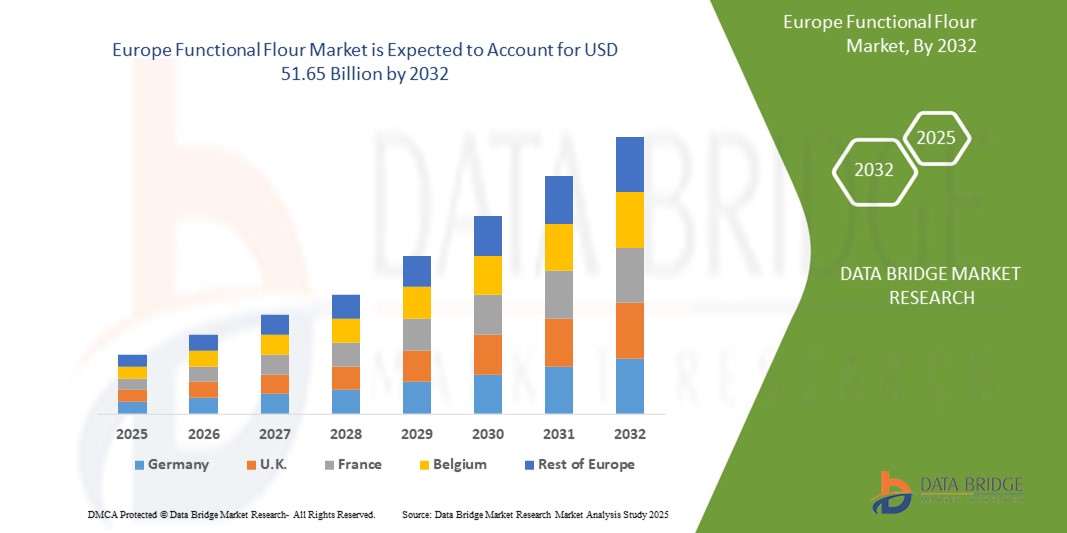
What is the Europe Functional Flour Market Size and Growth Rate?
- The Europe functional flour market size was valued at USD 37.39 billion in 2024 and is expected to reach USD 51.65 billion bsy 2032, at a CAGR of 4.12% during the forecast period
- Functional flour market is witnessing significant advancements, fueled by the integration of the latest methods and technologies. This innovation is driving its widespread use across various industries, including food and beverage
- With a focus on health-conscious consumers, the market is experiencing remarkable growth, as functional flours cater to diverse dietary needs while offering enhanced nutritional benefits and improved product quality
What are the Major Takeaways of Functional Flour Market?
- The rise in health consciousness among consumers is fueling demand for functional flours enriched with nutrients such as protein, fiber, vitamins, and minerals. These flours offer healthier alternatives to traditional options, aligning with individuals' dietary preferences and wellness goals
- For instance, almond flour, rich in protein and low in carbohydrates, is gaining popularity among health-conscious consumers seeking gluten-free and nutrient-dense alternatives for baking and cooking needs
- Germany dominated the European functional flour market with the highest revenue share of 56.36% in 2024 with the largest revenue share, driven by the country’s strong bakery and processed food sectors
- U.K. functional flour market is projected to grow at a fastest CAGR through 2032, bolstered by the rising trend of health-forward eating habits and demand for high-protein and allergen-free food solutions
- The Specialty Flour segment dominated the market with the largest revenue share of 57.3% in 2024, driven by rising consumer preference for nutritionally enriched, gluten-free, and fortified flour types
Report Scope and Functional Flour Market Segmentation
|
Attributes |
Functional Flour Key Market Insights |
|
Segments Covered |
|
|
Countries Covered |
Europe
|
|
Key Market Players |
|
|
Market Opportunities |
|
|
Value Added Data Infosets |
In addition to the insights on market scenarios such as market value, growth rate, segmentation, geographical coverage, and major players, the market reports curated by the Data Bridge Market Research also include in-depth expert analysis, pricing analysis, brand share analysis, consumer survey, demography analysis, supply chain analysis, value chain analysis, raw material/consumables overview, vendor selection criteria, PESTLE Analysis, Porter Analysis, and regulatory framework. |
What is the Key Trend in the Functional Flour Market?
“Rising Demand for Clean-Label, Nutrient-Rich Flour Alternatives”
- A major and accelerating trend in the functional flour market is the rising consumer demand for clean-label, nutrient-dense alternatives to conventional flour. As health-consciousness grows, both food manufacturers and consumers are prioritizing flours that offer enhanced functional and nutritional benefits without artificial additives
- Functional flours derived from legumes, pulses, quinoa, sorghum, and chia are gaining momentum due to their high protein, fiber, and micronutrient content, making them suitable for gluten-free and plant-based product formulations
- For instance, in May 2024, Epi Ingredients launched an additive-free butter powder, aligning with this clean-label movement and illustrating the growing preference for natural, functional ingredients in food processing
- The trend is also driven by regulatory backing and labeling transparency, encouraging food companies to reformulate their products with clean-label ingredients, including functional flours that support digestive health, sustained energy, and improved texture
- Furthermore, demand from sectors such as sports nutrition, infant formula, and bakery is reinforcing the need for flours that provide functional benefits such as enhanced viscosity, water-binding, and shelf stability
- As a result, manufacturers are increasingly investing in R&D for minimally processed, clean-label functional flours, positioning these ingredients as a crucial component of the evolving health and wellness-driven food landscape
What are the Key Drivers of Functional Flour Market?
- The growing consumer focus on health and wellness, particularly regarding digestive health, blood sugar control, and weight management, is a major driver for the increased adoption of Functional Flour in food applications
- For instance, in May 2025, Danone's Oikos brand launched a protein shake targeting users of GLP-1 medications such as Ozempic and Wegovy, signaling the demand for high-protein, fiber-rich products that support portion control and nutrient absorption
- In addition, the rising prevalence of gluten intolerance and celiac disease, along with a broader consumer shift toward gluten-free diets, is spurring the demand for flours made from alternative grains and pulses, which offer nutritional superiority and improved functional performance in recipes
- Functional flours are increasingly being incorporated into baked goods, snacks, RTE meals, and baby food, driven by their superior texturizing, binding, and nutritional properties compared to conventional wheat flour
- The market is also benefitting from growing product innovation, including high-protein, fiber-rich, and low-GI formulations aimed at athletes, elderly consumers, and children, with producers targeting specialized dietary needs and regional flavor preferences
- These factors, combined with the increasing availability of functional flours across retail and e-commerce platforms, are contributing to the steady growth of this ingredient category across global markets
Which Factor is challenging the Growth of the Functional Flour Market?
- One of the primary challenges in the functional flour market is high product cost and supply inconsistency, particularly for premium raw materials such as teff, quinoa, and amaranth, which can limit large-scale adoption, especially in cost-sensitive regions
- For instance, in October 2024, DairyX developed casein proteins using yeast strains, highlighting the ongoing shift towards sustainable and innovative protein sources—but also underscoring the cost and regulatory hurdles faced by novel ingredients in food applications
- In addition, limited consumer awareness about the health benefits and cooking applications of lesser-known functional flours can hinder their inclusion in household pantries and foodservice menus
- Manufacturers also face technical challenges in processing and formulation, such as ensuring consistency in taste, shelf life, and texture when replacing wheat flour with alternatives such as chickpea, lentil, or rice flours
- Moreover, the lack of standardized regulations or definitions around what constitutes "functional" flour can cause confusion among consumers and producers, impacting transparency and trust
- To overcome these obstacles, the industry must focus on scaling supply chains, educating consumers, and supporting research that demonstrates the health and functional advantages of these innovative flours to encourage broader market penetration
How is the Functional Flour Market Segmented?
The market is segmented on the basis of type, category, source, grade, and application.
• By Type
On the basis of type, the functional flour market is segmented into Specialty Flour and Conventional Flour. The Specialty Flour segment dominated the market with the largest revenue share of 57.3% in 2024, driven by rising consumer preference for nutritionally enriched, gluten-free, and fortified flour types. Specialty flours are widely used in health-conscious food products such as high-fiber bakery goods, protein-rich snacks, and functional beverages.
The Conventional Flour segment is anticipated to register steady growth from 2025 to 2032, supported by its continued use in traditional cooking and large-scale food processing due to cost-effectiveness and wide availability.
• By Category
On the basis of category, the functional flour market is segmented into GMO and Non-GMO. The Non-GMO segment accounted for the largest market share of 64.1% in 2024, fueled by increasing consumer demand for clean-label, organic, and natural food ingredients. Regulatory pressures and growing awareness of food safety are pushing manufacturers toward non-GMO sourcing.
The GMO segment is projected to witness moderate growth, primarily driven by its cost advantages and yield efficiency in large-scale agriculture.
• By Source
On the basis of source, the functional flour market is segmented into Cereals, Legumes, Potato, Tapioca, Chia, and Others. The Cereals segment dominated the market with a revenue share of 38.6% in 2024, owing to the widespread use of wheat, rice, and corn flours in global food applications. These flours are favored for their versatility, affordability, and established consumer acceptance.
The Legumes segment is anticipated to grow at the fastest rate through 2032, driven by its high protein content and rising popularity among plant-based and vegan product developers.
• By Grade
On the basis of grade, the functional flour market is segmented into Food Grade and Feed Grade. The Food Grade segment held the largest market revenue share of 72.8% in 2024, driven by its extensive use in the human food supply chain, including bakery, snacks, baby food, and clinical nutrition.
The Feed Grade segment is expected to grow steadily, supported by increasing livestock production and the need for fortified animal feed solutions.
• By Application
On the basis of application, the functional flour market is segmented into Bakery and Confectionery Products, Convenience Food, Sport Nutrition, Infant Formula, Meat, Poultry and Seafood, Animal Feed, Beverages, Nutritional Bar, Nutritional Supplements, and Dairy Products. The Bakery and Confectionery Products segment dominated the market with a share of 24.9% in 2024, driven by strong demand for improved texture, structure, and shelf life in breads, pastries, and sweets.
The Sport Nutrition segment is anticipated to grow at the highest CAGR from 2025 to 2032, propelled by the fitness boom and rising demand for functional, high-protein, and recovery-enhancing food products among athletes and active consumers.
Which Region Holds the Largest Share of the functional flour Market?
- Germany dominated the European functional flour market with the highest revenue share of 56.36% in 2024 with the largest revenue share, driven by the country’s strong bakery and processed food sectors
- Consumers are increasingly opting for nutritional upgrades to traditional staples, favoring products made from high-protein, low-glycemic flours
- Germany’s reputation for food innovation and its robust distribution infrastructure contribute to the wide availability and trust in Functional Flour products across health-conscious demographics
U.K. Functional Flour Market Insight
U.K. functional flour market is projected to grow at a fastest CAGR through 2032, bolstered by the rising trend of health-forward eating habits and demand for high-protein and allergen-free food solutions. A surge in plant-based diets and interest in functional ingredients is prompting both manufacturers and consumers to explore novel flour types, including legume-based and fiber-rich options. The U.K.’s dynamic foodservice industry and expansion of clean-label product lines support sustained growth in the category.
France Functional Flour Market Insight
France is witnessing steady growth in the functional flour market, underpinned by increasing interest in organic, non-GMO, and artisanal food products. Functional Flours are being integrated into traditional French baked goods and snacks to meet evolving dietary preferences without compromising flavor and texture. Supportive government policies promoting sustainable agriculture and nutrition-focused food innovation also play a key role in driving market momentum.
Which are the Top Companies in Functional Flour Market?
The functional flour industry is primarily led by well-established companies, including:
- ADM (U.S.)
- Roquette Frères (France)
- Ingredion (U.S.)
- AGRANA Beteiligungs-AG (Austria)
- Limagrain - Ingrédients (France)
- Goodmills (Austria)
- EUROGERM SAS (France)
- P&H Milling, Inc. (Canada)
- Associated British Foods plc (U.S.)
- General Mills, Inc. (U.S.)
What are the Recent Developments in Europe Functional Flour Market?
- In April 2023, Cargill's innovative product, SimPure RF, a soluble rice flour alternative to maltodextrin, showcases advancements in the functional flour market. Its high solubility and neutral flavor enhance various foods, meeting consumer demands for healthier options. This aligns with the food industry's trend towards clean label and natural ingredients
- In June 2022, The merger of EUROGERM USA and KB INGREDIENTS into EUROGERM KB LLC marks a significant move in the functional flour market. This consolidation aims to develop innovative, nutritionally enhanced baked goods, addressing the growing demand for healthier options and catering to evolving consumer preferences
- In October 2021, Cargill introduced a rice flour-based maltodextrin substitute, SimPure rice flour, offering a clean label with similar taste, texture, and functionality as maltodextrin. This versatile ingredient serves as a one-to-one replacement, reflecting Cargill's commitment to providing solutions that meet consumer demand for healthier and more natural products
- In July 2021, Ulrick & Short launched fazenda Nutrigel, a functional flour designed to improve viscosity, texture, and structure in gluten-free bakery applications. This addition to their product range addresses specific needs in the market, enhancing moisture, softness, and structure across various bakery products while catering to dietary preferences

- Interactive Data Analysis Dashboard
- Company Analysis Dashboard for high growth potential opportunities
- Research Analyst Access for customization & queries
- Competitor Analysis with Interactive dashboard
- Latest News, Updates & Trend analysis
- Harness the Power of Benchmark Analysis for Comprehensive Competitor Tracking
Table of Content
1 INTRODUCTION
1.1 OBJECTIVES OF THE STUDY
1.2 MARKET DEFINITION
1.3 OVERVIEW OF EUROPE FUNCTIONAL FLOUR MARKET
1.4 CURRENCY AND PRICING
1.5 LIMITATION
1.6 MARKETS COVERED
2 MARKET SEGMENTATION
2.1 KEY TAKEAWAYS
2.2 ARRIVING AT THE EUROPE FUNCTIONAL FLOUR MARKET SIZE
2.2.1 VENDOR POSITIONING GRID
2.2.2 TECHNOLOGY LIFE LINE CURVE
2.2.3 MARKET GUIDE
2.2.4 COMPANY POSITIONING GRID
2.2.5 COMAPANY MARKET SHARE ANALYSIS
2.2.6 MULTIVARIATE MODELLING
2.2.7 DEMAND AND SUPPLY-SIDE VARIABLES
2.2.8 CONSUMPTION TREND OF END PRODUCTS
2.2.9 TOP TO BOTTOM ANALYSIS
2.2.10 STANDARDS OF MEASUREMENT
2.2.11 VENDOR SHARE ANALYSIS
2.2.12 DATA POINTS FROM KEY PRIMARY INTERVIEWS
2.2.13 DATA POINTS FROM KEY SECONDARY DATABASES
2.3 EUROPE FUNCTIONAL FLOUR MARKET: RESEARCH SNAPSHOT
2.4 ASSUMPTIONS
3 MARKET OVERVIEW
3.1 DRIVERS
3.2 RESTRAINTS
3.3 OPPORTUNITIES
3.4 CHALLENGES
4 EXECUTIVE SUMMARY
5 PREMIUM INSIGHTS
5.1 VALUE CHAIN ANALYSIS
5.2 SUPPLY CHAIN ANALYSIS
5.3 IMPORT-EXPORT ANALYSIS
5.4 PORTER’S FIVE FORCES ANALYSIS
5.4.1 BARGAINING POWER OF SUPPLIERS
5.4.2 BARGAINING POWER OF BUYERS/CONSUMERS
5.4.3 THREAT OF NEW ENTRANTS
5.4.4 THREAT OF SUBSTITUTE PRODUCTS
5.4.5 INTENSITY OF COMPETITIVE RIVALRY
5.5 RAW MATERIAL SOURCING ANALYSIS
5.6 OVERVIEW OF TECHNOLOGICAL INNOVATIONS
5.7 INDUSTRY TRENDS AND FUTURE PERSPECTIVE
5.8 GROWTH STRATEGIES ADOPTED BY KEY MARKET PLAYERS
5.9 FACTORS INFLUENCING PURCHASING DECISION OF END-USERS
6 IMPACT OF ECONOMIC SLOW DOWN ON MARKET
6.1 IMPACT ON PRICE
6.2 IMPACT ON SUPPLY CHAIN
6.3 IMPACT ON SHIPMENT
6.4 IMPACT ON COMPANY’S STRATEGIC DECISIONS
7 REGULATORY FRAMEWORK AND GUIDELINES
8 PRICING ANALYSIS
9 PRODUCTION CAPACITY OF KEY MANUFACTURERES
10 BRAND OUTLOOK
10.1 COMPARATIVE BRAND ANALYSIS
10.2 PRODUCT VS BRAND OVERVIEW
11 SUPPLY CHAIN ANALYSIS
11.1 OVERVIEW
11.2 LOGISTIC COST SCENARIO
11.3 IMPORTANCE OF LOGISTICS SERVICE PROVIDERS
12 CLIMATE CHANGE SCENARIO
12.1 ENVIRONMENTAL CONCERNS
12.2 INDUSTRY RESPONSE
12.3 GOVERNMENT’S ROLE
12.4 ANALYST RECOMMENDATIONS
13 EUROPE FUNCTIONAL FLOUR MARKET, BY TYPE, 2018-2032, (USD MILLION) (KILO TONS)
13.1 OVERVIEW
13.2 LEGUMES
13.2.1 BEAN FLOUR
13.2.2 FAVA BEAN FLOUR & FOUR BLENDS
13.2.3 CHICKPEA FLOUR
13.2.4 PEA FLOUR
13.2.5 LENTIL FLOUR
13.2.6 SOY FLOUR
13.2.7 OTHERS
13.3 CEREALS
13.3.1 CORN FLOUR
13.3.2 BARLEY FLOUR
13.3.3 WHEAT FLOUR
13.3.4 BUCHWHEET FLOUR
13.3.5 AMARANTH FLOUR
13.3.6 TEFF FLOUR
13.3.7 RICE FLOUR
13.3.7.1. WHITE
13.3.7.2. BROWN
13.3.8 OAT FLOUR
13.3.9 MAIZE FLOUR
13.3.10 RYE FLOUR
13.3.11 QUINOA FLOUR
13.3.12 SORGHUM FLOUR
13.3.13 OTHERS
13.4 COCONUT FLOUR
13.5 ALMOND FLOUR
13.6 ARROWROOT FLOUR
13.7 TAPIOCA FLOUR
13.8 CASSAVA FLOUR
13.9 GREEN BANANA FLOUR
13.1 GRAPE SEED FLOUR
13.11 BANANA FLOUR
13.12 POTATO FLOUR
13.13 SWEET POTATO FLOUR
13.14 OTHERS
14 EUROPE FUNCTIONAL FLOUR MARKET, BY NATURE, 2018-2032, (USD MILLION)
14.1 OVERVIEW
14.2 ORGANIC
14.2.1 ORGANIC, BY FLOUR TYPE
14.2.1.1. LEGUMES
14.2.1.1.1. BEAN FLOUR
14.2.1.1.2. FAVA BEAN FLOUR & FOUR BLENDS
14.2.1.1.3. CHICKPEA FLOUR
14.2.1.1.4. PEA FLOUR
14.2.1.1.5. LENTIL FLOUR
14.2.1.1.6. SOY FLOUR
14.2.1.1.7. OTHERS
14.2.1.2. CEREALS
14.2.1.2.1. CORN FLOUR
14.2.1.2.2. BARLEY FLOUR
14.2.1.2.3. WHEAT FLOUR
14.2.1.2.4. BUCHWHEET FLOUR
14.2.1.2.5. AMARANTH FLOUR
14.2.1.2.6. TEFF FLOUR
14.2.1.2.7. RICE FLOUR
14.2.1.2.7.1 WHITE
14.2.1.2.7.2 BROWN
14.2.1.2.8. OAT FLOUR
14.2.1.2.9. MAIZE FLOUR
14.2.1.2.10. RYE FLOUR
14.2.1.2.11. QUINOA FLOUR
14.2.1.2.12. SORGHUM FLOUR
14.2.1.2.13. OTHERS
14.2.1.3. COCONUT FLOUR
14.2.1.4. ALMOND FLOUR
14.2.1.5. ARROWROOT FLOUR
14.2.1.6. TAPIOCA FLOUR
14.2.1.7. CASSAVA FLOUR
14.2.1.8. GREEN BANANA FLOUR
14.2.1.9. GRAPE SEED FLOUR
14.2.1.10. BANANA FLOUR
14.2.1.11. POTATO FLOUR
14.2.1.12. SWEET POTATO FLOUR
14.2.1.13. OTHERS
14.3 CONVENTIONAL
14.3.1 CONVENTIONAL, BY FLOUR TYPE
14.3.1.1. LEGUMES
14.3.1.1.1. BEAN FLOUR
14.3.1.1.2. FAVA BEAN FLOUR & FOUR BLENDS
14.3.1.1.3. CHICKPEA FLOUR
14.3.1.1.4. PEA FLOUR
14.3.1.1.5. LENTIL FLOUR
14.3.1.1.6. SOY FLOUR
14.3.1.1.7. OTHERS
14.3.1.2. CEREALS
14.3.1.2.1. CORN FLOUR
14.3.1.2.2. BARLEY FLOUR
14.3.1.2.3. WHEAT FLOUR
14.3.1.2.4. BUCHWHEET FLOUR
14.3.1.2.5. AMARANTH FLOUR
14.3.1.2.6. TEFF FLOUR
14.3.1.2.7. RICE FLOUR
14.3.1.2.7.1 WHITE
14.3.1.2.7.2 BROWN
14.3.1.2.8. OAT FLOUR
14.3.1.2.9. MAIZE FLOUR
14.3.1.2.10. RYE FLOUR
14.3.1.2.11. QUINOA FLOUR
14.3.1.2.12. SORGHUM FLOUR
14.3.1.2.13. OTHERS
14.3.1.3. COCONUT FLOUR
14.3.1.4. ALMOND FLOUR
14.3.1.5. ARROWROOT FLOUR
14.3.1.6. TAPIOCA FLOUR
14.3.1.7. CASSAVA FLOUR
14.3.1.8. GREEN BANANA FLOUR
14.3.1.9. GRAPE SEED FLOUR
14.3.1.10. BANANA FLOUR
14.3.1.11. POTATO FLOUR
14.3.1.12. SWEET POTATO FLOUR
14.3.1.13. OTHERS
15 EUROPE FUNCTIONAL FLOUR MARKET, BY CATEGORY, 2018-2032, (USD MILLION)
15.1 OVERVIEW
15.2 ENZYME TREATED
15.2.1 DIASTATIC
15.2.2 MALTED
15.3 GLUTEN-FREE
15.4 EXTRUDED AND PARTIALLY TRANSFORMED
15.5 PRE-GELATINIZED
15.6 PRE-COOKED
15.7 FORTIFIED
15.8 THERMALLY TREATED
15.9 SPECIALTY FLOUR
15.1 OTHERS
16 EUROPE FUNCTIONAL FLOUR MARKET, BY PROCESSING METHOD, 2018-2032, (USD MILLION)
16.1 OVERVIEW
16.2 WET PROCESSING
16.3 DRY PROCESSING
17 EUROPE FUNCTIONAL FLOUR MARKET, BY FUNCTION, 2018-2032, (USD MILLION)
17.1 OVERVIEW
17.2 THICKENING AGENT
17.3 BINDING AGENT
17.4 NUTRITIONAL ENRICHMENT
17.5 FLAVOR ENHANCEMENT
17.6 GLUTEN-FREE ALTERNATIVES
17.7 STARCH REPLACEMENT
17.8 HYDRATION IMPROVEMENT
17.9 OTHERS
18 EUROPE FUNCTIONAL FLOUR MARKET, BY APPLICATION, 2018-2032, (USD MILLION)
18.1 OVERVIEW
18.2 FOOD
18.2.1 FOOD, BY TYPE
18.2.1.1. DAIRY PRODUCTS
18.2.1.1.1. YOGHURT
18.2.1.1.2. CHEESE
18.2.1.1.3. ICE CREAM
18.2.1.1.4. BUTTER
18.2.1.1.5. OTHERS
18.2.1.2. BAKERY
18.2.1.2.1. COOKIES & BISCUITS
18.2.1.2.2. BREADS & ROLLS
18.2.1.2.3. CAKES & PASTRIES
18.2.1.2.4. DONUTS
18.2.1.2.5. MUFFINS
18.2.1.2.6. OTHERS
18.2.1.3. CONFECTIONERY
18.2.1.3.1. GUMMIES
18.2.1.3.2. HARD CANDIES
18.2.1.3.3. SUGAR CONFECTIONERY
18.2.1.3.4. HARD-BOILED SWEETS
18.2.1.3.5. MINTS
18.2.1.3.6. GUMS & JELLIES
18.2.1.3.7. CHOCOLATE
18.2.1.3.8. CHOCOLATE SYRUPS
18.2.1.3.9. CARAMELS & TOFFEES
18.2.1.3.10. OTHERS
18.2.1.4. PROCESSED FOOD
18.2.1.4.1. PASTA
18.2.1.4.2. NOODLES
18.2.1.4.3. EXTRUDED SNACKS
18.2.1.4.4. SOUPS AND SAUCES
18.2.1.4.5. OTHERS
18.2.1.5. FROZEN DESSERTS
18.2.1.5.1. GELATO
18.2.1.5.2. CUSTARD
18.2.1.5.3. OTHERS
18.2.1.6. BREAKFAST CEREALS
18.2.1.7. INFANT FORMULA
18.2.1.7.1. GROWING UP MILK
18.2.1.7.2. STANDARD INFANT FORMULA
18.2.1.7.3. FOLLOW-ON FORMULA
18.2.1.7.4. SPECIALITY FORMULA
18.2.1.7.5. OTHERS
18.2.1.8. SPORTS NUTRITION
18.2.1.8.1. SPORTS NUTRITION BAR
18.2.1.8.2. SPORTS PROTEIN POWDER
18.2.1.8.3. OTHERS
18.2.1.9. DRESSINGS AND SEASONINGS
18.2.1.10. DAIRY ALTERNATIVE FOOD
18.2.1.11. MEAT & POULTRY PRODUCTS
18.2.1.12. OTHERS
18.2.2 FOOD, BY FLOUR TYPE
18.2.2.1. LEGUMES
18.2.2.1.1. BEAN FLOUR
18.2.2.1.2. FAVA BEAN FLOUR & FOUR BLENDS
18.2.2.1.3. CHICKPEA FLOUR
18.2.2.1.4. PEA FLOUR
18.2.2.1.5. LENTIL FLOUR
18.2.2.1.6. SOY FLOUR
18.2.2.1.7. OTHERS
18.2.2.2. CEREALS
18.2.2.2.1. CORN FLOUR
18.2.2.2.2. BARLEY FLOUR
18.2.2.2.3. WHEAT FLOUR
18.2.2.2.4. BUCHWHEET FLOUR
18.2.2.2.5. AMARANTH FLOUR
18.2.2.2.6. TEFF FLOUR
18.2.2.2.7. RICE FLOUR
18.2.2.2.7.1 WHITE
18.2.2.2.7.2 BROWN
18.2.2.2.8. OAT FLOUR
18.2.2.2.9. MAIZE FLOUR
18.2.2.2.10. RYE FLOUR
18.2.2.2.11. QUINOA FLOUR
18.2.2.2.12. SORGHUM FLOUR
18.2.2.2.13. OTHERS
18.2.2.3. COCONUT FLOUR
18.2.2.4. ALMOND FLOUR
18.2.2.5. ARROWROOT FLOUR
18.2.2.6. TAPIOCA FLOUR
18.2.2.7. CASSAVA FLOUR
18.2.2.8. GREEN BANANA FLOUR
18.2.2.9. GRAPE SEED FLOUR
18.2.2.10. BANANA FLOUR
18.2.2.11. POTATO FLOUR
18.2.2.12. SWEET POTATO FLOUR
18.2.2.13. OTHERS
18.3 BEVERAGES
18.3.1 BEVERAGES, BY TYPE
18.3.1.1. PLANT-BASED YOGURT DRINKS
18.3.1.1.1. SOY
18.3.1.1.2. ALMOND
18.3.1.1.3. CASHEW
18.3.1.1.4. RICE
18.3.1.1.5. COCONUT
18.3.1.1.6. OTHERS
18.3.1.1.7. JUICES
18.3.1.2. SODA DRINKS
18.3.1.3. KOMBUCHA DRINKS
18.3.1.4. PROBIOTIC WATER
18.3.1.5. HEALTH DRINKS
18.3.1.5.1. IMMUNITY BOOSTERS
18.3.1.5.2. GUT SHOTS
18.3.1.5.3. ELECTROLYTE HYDRATION DRINKS
18.3.1.5.4. PROTEIN DRINKS
18.3.1.5.5. OTHERS
18.3.1.6. DAIRY BASED DRINKS
18.3.1.7. OTHERS
18.3.2 BEVERAGES, BY FLOUR TYPE
18.3.2.1. LEGUMES
18.3.2.1.1. BEAN FLOUR
18.3.2.1.2. FAVA BEAN FLOUR & FOUR BLENDS
18.3.2.1.3. CHICKPEA FLOUR
18.3.2.1.4. PEA FLOUR
18.3.2.1.5. LENTIL FLOUR
18.3.2.1.6. SOY FLOUR
18.3.2.1.7. OTHERS
18.3.2.2. CEREALS
18.3.2.2.1. CORN FLOUR
18.3.2.2.2. BARLEY FLOUR
18.3.2.2.3. WHEAT FLOUR
18.3.2.2.4. BUCHWHEET FLOUR
18.3.2.2.5. AMARANTH FLOUR
18.3.2.2.6. TEFF FLOUR
18.3.2.2.7. RICE FLOUR
18.3.2.2.7.1 WHITE
18.3.2.2.7.2 BROWN
18.3.2.2.8. OAT FLOUR
18.3.2.2.9. MAIZE FLOUR
18.3.2.2.10. RYE FLOUR
18.3.2.2.11. QUINOA FLOUR
18.3.2.2.12. SORGHUM FLOUR
18.3.2.2.13. OTHERS
18.3.2.3. COCONUT FLOUR
18.3.2.4. ALMOND FLOUR
18.3.2.5. ARROWROOT FLOUR
18.3.2.6. TAPIOCA FLOUR
18.3.2.7. CASSAVA FLOUR
18.3.2.8. GREEN BANANA FLOUR
18.3.2.9. GRAPE SEED FLOUR
18.3.2.10. BANANA FLOUR
18.3.2.11. POTATO FLOUR
18.3.2.12. SWEET POTATO FLOUR
18.3.2.13. OTHERS
18.4 ANIMAL FEED
18.4.1 ANIMAL FEED, BY TYPE
18.4.1.1. POULTRY
18.4.1.1.1. BROILERS
18.4.1.1.2. LAYERS
18.4.1.1.3. BREEDERS
18.4.1.1.4. CHICKS & POULTS
18.4.1.1.5. OTHERS
18.4.1.2. RUMINANTS
18.4.1.2.1. CALVES
18.4.1.2.2. DAIRY CATTLE
18.4.1.2.3. BEEF CATTLE
18.4.1.2.4. OTHERS
18.4.1.3. SWINE
18.4.1.3.1. STARTER
18.4.1.3.2. GROWER
18.4.1.3.3. SOW
18.4.1.3.4. OTHERS
18.4.1.4. PET
18.4.1.4.1. CAT
18.4.1.4.2. DOG
18.4.1.4.3. RABBIT
18.4.1.4.4. HORSE
18.4.1.4.5. MICE
18.4.1.4.6. OTHERS
18.4.1.5. AQUATIC ANIMAL
18.4.1.5.1. FISH
18.4.1.5.1.1 TILAPIA
18.4.1.5.1.2 SALMON
18.4.1.5.1.3 CARP
18.4.1.5.1.4 TROUT
18.4.1.5.1.5 OTHERS
18.4.1.5.2. CRUSTACEANS
18.4.1.5.2.1 SHRIMP
18.4.1.5.2.2 CRABS
18.4.1.5.2.3 KRILL
18.4.1.5.2.4 OTHERS
18.4.1.5.3. MOLLUSKS
18.4.1.5.3.1 OYSTERS
18.4.1.5.3.2 MUSSELS
18.4.1.5.3.3 OTHERS
18.4.1.5.4. OTHERS
18.4.2 ANIMAL FEED, BY FLOUR TYPE
18.4.2.1. LEGUMES
18.4.2.1.1. BEAN FLOUR
18.4.2.1.2. FAVA BEAN FLOUR & FOUR BLENDS
18.4.2.1.3. CHICKPEA FLOUR
18.4.2.1.4. PEA FLOUR
18.4.2.1.5. LENTIL FLOUR
18.4.2.1.6. SOY FLOUR
18.4.2.1.7. OTHERS
18.4.2.2. CEREALS
18.4.2.2.1. CORN FLOUR
18.4.2.2.2. BARLEY FLOUR
18.4.2.2.3. WHEAT FLOUR
18.4.2.2.4. BUCHWHEET FLOUR
18.4.2.2.5. AMARANTH FLOUR
18.4.2.2.6. TEFF FLOUR
18.4.2.2.7. RICE FLOUR
18.4.2.2.7.1 WHITE
18.4.2.2.7.2 BROWN
18.4.2.2.8. OAT FLOUR
18.4.2.2.9. MAIZE FLOUR
18.4.2.2.10. RYE FLOUR
18.4.2.2.11. QUINOA FLOUR
18.4.2.2.12. SORGHUM FLOUR
18.4.2.2.13. OTHERS
18.4.2.3. COCONUT FLOUR
18.4.2.4. ALMOND FLOUR
18.4.2.5. ARROWROOT FLOUR
18.4.2.6. TAPIOCA FLOUR
18.4.2.7. CASSAVA FLOUR
18.4.2.8. GREEN BANANA FLOUR
18.4.2.9. GRAPE SEED FLOUR
18.4.2.10. BANANA FLOUR
18.4.2.11. POTATO FLOUR
18.4.2.12. SWEET POTATO FLOUR
18.4.2.13. OTHERS
18.5 PERSONAL CARE AND COSMETICS
18.5.1 PERSONAL CARE AND COSMETICS, BY TYPE
18.5.1.1. FACIAL CARE PRODUCTS
18.5.1.1.1. CREAMS & LOTIONS
18.5.1.1.2. SERUMS
18.5.1.1.3. SCRUBS & MASKS
18.5.1.1.4. OTHERS
18.5.1.2. HAIR CARE PRODUCTS
18.5.1.2.1. SHAMPOO
18.5.1.2.2. CONDITIONERS
18.5.1.2.3. OTHERS
18.5.1.3. MAKE-UP PRODUCTS
18.5.1.4. SPRAY PERFUMES
18.5.1.5. BODY CARE PRODUCTS
18.5.1.6. OTHERS
18.5.2 PERSONAL CARE AND COSMETICS, BY FLOUR TYPE
18.5.2.1. LEGUMES
18.5.2.1.1. BEAN FLOUR
18.5.2.1.2. FAVA BEAN FLOUR & FOUR BLENDS
18.5.2.1.3. CHICKPEA FLOUR
18.5.2.1.4. PEA FLOUR
18.5.2.1.5. LENTIL FLOUR
18.5.2.1.6. SOY FLOUR
18.5.2.1.7. OTHERS
18.5.2.2. CEREALS
18.5.2.2.1. CORN FLOUR
18.5.2.2.2. BARLEY FLOUR
18.5.2.2.3. WHEAT FLOUR
18.5.2.2.4. BUCHWHEET FLOUR
18.5.2.2.5. AMARANTH FLOUR
18.5.2.2.6. TEFF FLOUR
18.5.2.2.7. RICE FLOUR
18.5.2.2.7.1 WHITE
18.5.2.2.7.2 BROWN
18.5.2.2.8. OAT FLOUR
18.5.2.2.9. MAIZE FLOUR
18.5.2.2.10. RYE FLOUR
18.5.2.2.11. QUINOA FLOUR
18.5.2.2.12. SORGHUM FLOUR
18.5.2.2.13. OTHERS
18.5.2.3. COCONUT FLOUR
18.5.2.4. ALMOND FLOUR
18.5.2.5. ARROWROOT FLOUR
18.5.2.6. TAPIOCA FLOUR
18.5.2.7. CASSAVA FLOUR
18.5.2.8. GREEN BANANA FLOUR
18.5.2.9. GRAPE SEED FLOUR
18.5.2.10. BANANA FLOUR
18.5.2.11. POTATO FLOUR
18.5.2.12. SWEET POTATO FLOUR
18.5.2.13. OTHERS
18.6 PHARMACEUTICALS
18.6.1 PHARMACEUTICALS, BY TYPE
18.6.1.1. GASTROINTESTINAL HEALTH
18.6.1.2. IMMUNE SYSTEM MODULATION
18.6.1.3. ALLERGY MANAGEMENT
18.6.1.4. METABOLIC DISORDERS
18.6.1.5. MENTAL HEALTH (PSYCHOBIOTICS)
18.6.1.6. CARDIOVASCULAR HEALTH
18.6.1.7. INTESTINAL DISORDERS
18.6.1.8. LACTOSE INTOLERANCE
18.6.1.9. INFLAMMATORY BOWEL DISORDERS
18.6.1.10. RESPIRATORY INFECTIONS
18.6.1.11. OBESITY
18.6.1.12. UROGENITAL INFECTIONS
18.6.1.12.1. TYPE-2 DIABETES
18.6.1.12.2. CANCER
18.6.1.13. ORAL AND DENTAL HEALTH
18.6.1.14. OTHERS
18.6.2 PHARMACEUTICALS, BY PRODUCT FORM
18.6.2.1. TABLETS
18.6.2.2. PROBIOTIC DRINKS
18.6.2.3. POWDERS
18.6.2.4. CAPSULES
18.6.2.5. OTHERS
18.6.3 PHARMACEUTICALS, BY FLOUR TYPE
18.6.3.1. LEGUMES
18.6.3.1.1. BEAN FLOUR
18.6.3.1.2. FAVA BEAN FLOUR & FOUR BLENDS
18.6.3.1.3. CHICKPEA FLOUR
18.6.3.1.4. PEA FLOUR
18.6.3.1.5. LENTIL FLOUR
18.6.3.1.6. SOY FLOUR
18.6.3.1.7. OTHERS
18.6.3.2. CEREALS
18.6.3.2.1. CORN FLOUR
18.6.3.2.2. BARLEY FLOUR
18.6.3.2.3. WHEAT FLOUR
18.6.3.2.4. BUCHWHEET FLOUR
18.6.3.2.5. AMARANTH FLOUR
18.6.3.2.6. TEFF FLOUR
18.6.3.2.7. RICE FLOUR
18.6.3.2.7.1 WHITE
18.6.3.2.7.2 BROWN
18.6.3.2.8. OAT FLOUR
18.6.3.2.9. MAIZE FLOUR
18.6.3.2.10. RYE FLOUR
18.6.3.2.11. QUINOA FLOUR
18.6.3.2.12. SORGHUM FLOUR
18.6.3.2.13. OTHERS
18.6.3.3. COCONUT FLOUR
18.6.3.4. ALMOND FLOUR
18.6.3.5. ARROWROOT FLOUR
18.6.3.6. TAPIOCA FLOUR
18.6.3.7. CASSAVA FLOUR
18.6.3.8. GREEN BANANA FLOUR
18.6.3.9. GRAPE SEED FLOUR
18.6.3.10. BANANA FLOUR
18.6.3.11. POTATO FLOUR
18.6.3.12. SWEET POTATO FLOUR
18.6.3.13. OTHERS
18.7 OTHERS
19 EUROPE FUNCTIONAL FLOUR MARKET, COMPANY LANDSCAPE
19.1 COMPANY SHARE ANALYSIS: EUROPE
19.2 MERGERS & ACQUISITIONS
19.3 NEW PRODUCT DEVELOPMENT & APPROVALS
19.4 EXPANSIONS & PARTNERSHIP
19.5 REGULATORY CHANGES
20 EUROPE FUNCTIONAL FLOUR MARKET, BY GEOGRAPHY, 2018-2032, (USD MILLION) (KILO TONS)
OVERVIEW (ALL SEGMENTATION PROVIDED ABOVE IS REPRESNTED IN THIS CHAPTER BY COUNTRY)
20.1 EUROPE
20.1.1 GERMANY
20.1.2 U.K.
20.1.3 ITALY
20.1.4 FRANCE
20.1.5 SPAIN
20.1.6 SWITZERLAND
20.1.7 NETHERLANDS
20.1.8 LUXEMBOURG
20.1.9 BELGIUM
20.1.10 RUSSIA
20.1.11 TURKEY
20.1.12 NORWAY
20.1.13 SWEDEN
20.1.14 FINLAND
20.1.15 DENMARK
20.1.16 POLAND
20.1.17 REST OF EUROPE
21 EUROPE FUNCTIONAL FLOUR MARKET, SWOT & DBMR ANALYSIS
22 EUROPE FUNCTIONAL FLOUR MARKET, COMPANY PROFILES
22.1 BOBS RED MILLS
22.1.1 COMPANY OVERVIEW
22.1.2 REVENUE ANALYSIS
22.1.3 PRODUCT PORTFOLIO
22.1.4 RECENT DEVELOPMENTS
22.2 EMIGRAIN, INC.
22.2.1 COMPANY OVERVIEW
22.2.2 REVENUE ANALYSIS
22.2.3 PRODUCT PORTFOLIO
22.2.4 RECENT DEVELOPMENTS
22.3 BUHLER GROUP
22.3.1 COMPANY OVERVIEW
22.3.2 REVENUE ANALYSIS
22.3.3 PRODUCT PORTFOLIO
22.3.4 RECENT DEVELOPMENTS
22.4 UNICORN GRAIN SPECIALTIES
22.4.1 COMPANY OVERVIEW
22.4.2 REVENUE ANALYSIS
22.4.3 PRODUCT PORTFOLIO
22.4.4 RECENT DEVELOPMENTS
22.5 INGREDION
22.5.1 COMPANY OVERVIEW
22.5.2 REVENUE ANALYSIS
22.5.3 PRODUCT PORTFOLIO
22.5.4 RECENT DEVELOPMENTS
22.6 CAREMOLI SPA
22.6.1 COMPANY OVERVIEW
22.6.2 REVENUE ANALYSIS
22.6.3 PRODUCT PORTFOLIO
22.6.4 RECENT DEVELOPMENTS
22.7 KALIZEA
22.7.1 COMPANY OVERVIEW
22.7.2 REVENUE ANALYSIS
22.7.3 PRODUCT PORTFOLIO
22.7.4 RECENT DEVELOPMENTS
22.8 ABF INGREDIENTS (A SUBSIDIARY OF ASSOCIATED BRITISH FOODS PLC)
22.8.1 COMPANY OVERVIEW
22.8.2 REVENUE ANALYSIS
22.8.3 PRODUCT PORTFOLIO
22.8.4 RECENT DEVELOPMENTS
22.9 AGRANA BETEILIGUNGS-AG
22.9.1 COMPANY OVERVIEW
22.9.2 REVENUE ANALYSIS
22.9.3 PRODUCT PORTFOLIO
22.9.4 RECENT DEVELOPMENTS
22.1 MÜHLENCHEMIE GMBH & CO.KG
22.10.1 COMPANY OVERVIEW
22.10.2 REVENUE ANALYSIS
22.10.3 PRODUCT PORTFOLIO
22.10.4 RECENT DEVELOPMENTS
22.11 LIMAGRAIN INGREDIENTSINGREDION INCORPORATED
22.11.1 COMPANY OVERVIEW
22.11.2 REVENUE ANALYSIS
22.11.3 PRODUCT PORTFOLIO
22.11.4 RECENT DEVELOPMENTS
22.12 ADM
22.12.1 COMPANY OVERVIEW
22.12.2 REVENUE ANALYSIS
22.12.3 PRODUCT PORTFOLIO
22.12.4 RECENT DEVELOPMENTS
22.13 GENERAL MILLS INC
22.13.1 COMPANY OVERVIEW
22.13.2 REVENUE ANALYSIS
22.13.3 PRODUCT PORTFOLIO
22.13.4 RECENT DEVELOPMENTS
22.14 GOODMILLS INNOVATION GMBH
22.14.1 COMPANY OVERVIEW
22.14.2 REVENUE ANALYSIS
22.14.3 PRODUCT PORTFOLIO
22.14.4 RECENT DEVELOPMENTS
22.15 BAKELS SWEDEN
22.15.1 COMPANY OVERVIEW
22.15.2 REVENUE ANALYSIS
22.15.3 PRODUCT PORTFOLIO
22.15.4 RECENT DEVELOPMENTS
22.16 CARGILL, INCORPORATED
22.16.1 COMPANY OVERVIEW
22.16.2 REVENUE ANALYSIS
22.16.3 PRODUCT PORTFOLIO
22.16.4 RECENT DEVELOPMENTS
22.17 BUNGE LIMITED
22.17.1 COMPANY OVERVIEW
22.17.2 REVENUE ANALYSIS
22.17.3 PRODUCT PORTFOLIO
22.17.4 RECENT DEVELOPMENTS
22.18 DASCA GROUP
22.18.1 COMPANY OVERVIEW
22.18.2 REVENUE ANALYSIS
22.18.3 PRODUCT PORTFOLIO
22.18.4 RECENT DEVELOPMENTS
22.19 SCOULAR COMPANY
22.19.1 COMPANY OVERVIEW
22.19.2 REVENUE ANALYSIS
22.19.3 PRODUCT PORTFOLIO
22.19.4 RECENT DEVELOPMENTS
22.2 THE HAIN CELESTIAL GROUP, INC.
22.20.1 COMPANY OVERVIEW
22.20.2 REVENUE ANALYSIS
22.20.3 PRODUCT PORTFOLIO
22.20.4 RECENT DEVELOPMENTS
22.21 SUNOPTA, INC.
22.21.1 COMPANY OVERVIEW
22.21.2 REVENUE ANALYSIS
22.21.3 PRODUCT PORTFOLIO
22.21.4 RECENT DEVELOPMENTS
22.22 PARRISH AND HEIMBECKER, LIMITED
22.22.1 COMPANY OVERVIEW
22.22.2 REVENUE ANALYSIS
22.22.3 PRODUCT PORTFOLIO
22.22.4 RECENT DEVELOPMENTS
*NOTE: THE COMPANIES PROFILED IS NOT EXHAUSTIVE LIST AND IS AS PER OUR PREVIOUS CLIENT REQUIREMENT. WE PROFILE MORE THAN 100 COMPANIES IN OUR STUDY AND HENCE THE LIST OF COMPANIES CAN BE MODIFIED OR REPLACED ON REQUEST
23 RELATED REPORTS
24 CONCLUSION
25 QUESTIONNAIRE
26 ABOUT DATA BRIDGE MARKET RESEARCH

Europe Functional Flour Market, Supply Chain Analysis and Ecosystem Framework
To support market growth and help clients navigate the impact of geopolitical shifts, DBMR has integrated in-depth supply chain analysis into its Europe Functional Flour Market research reports. This addition empowers clients to respond effectively to global changes affecting their industries. The supply chain analysis section includes detailed insights such as Europe Functional Flour Market consumption and production by country, price trend analysis, the impact of tariffs and geopolitical developments, and import and export trends by country and HSN code. It also highlights major suppliers with data on production capacity and company profiles, as well as key importers and exporters. In addition to research, DBMR offers specialized supply chain consulting services backed by over a decade of experience, providing solutions like supplier discovery, supplier risk assessment, price trend analysis, impact evaluation of inflation and trade route changes, and comprehensive market trend analysis.
Data collection and base year analysis are done using data collection modules with large sample sizes. The stage includes obtaining market information or related data through various sources and strategies. It includes examining and planning all the data acquired from the past in advance. It likewise envelops the examination of information inconsistencies seen across different information sources. The market data is analysed and estimated using market statistical and coherent models. Also, market share analysis and key trend analysis are the major success factors in the market report. To know more, please request an analyst call or drop down your inquiry.
The key research methodology used by DBMR research team is data triangulation which involves data mining, analysis of the impact of data variables on the market and primary (industry expert) validation. Data models include Vendor Positioning Grid, Market Time Line Analysis, Market Overview and Guide, Company Positioning Grid, Patent Analysis, Pricing Analysis, Company Market Share Analysis, Standards of Measurement, Global versus Regional and Vendor Share Analysis. To know more about the research methodology, drop in an inquiry to speak to our industry experts.
Data Bridge Market Research is a leader in advanced formative research. We take pride in servicing our existing and new customers with data and analysis that match and suits their goal. The report can be customized to include price trend analysis of target brands understanding the market for additional countries (ask for the list of countries), clinical trial results data, literature review, refurbished market and product base analysis. Market analysis of target competitors can be analyzed from technology-based analysis to market portfolio strategies. We can add as many competitors that you require data about in the format and data style you are looking for. Our team of analysts can also provide you data in crude raw excel files pivot tables (Fact book) or can assist you in creating presentations from the data sets available in the report.













