
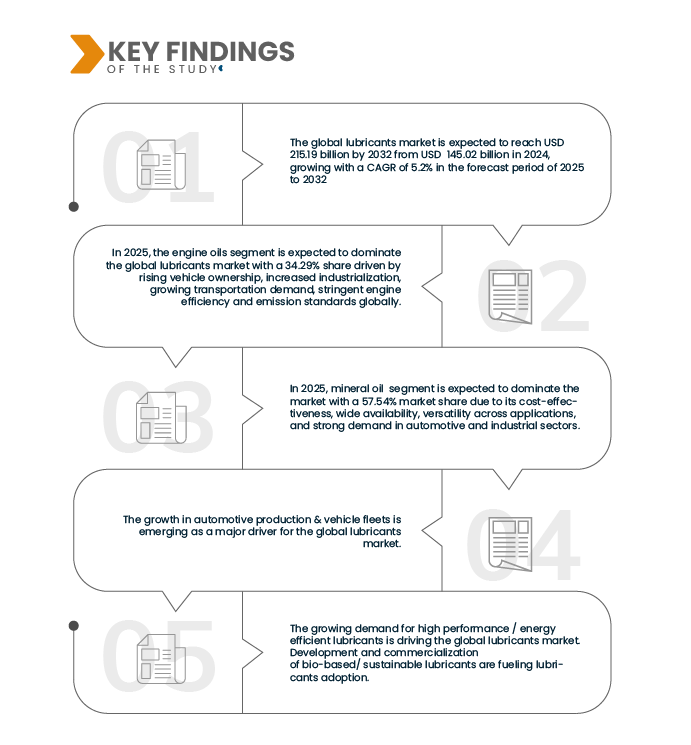
The steady rise in global automotive production and expanding vehicle fleets are major factors propelling the growth of the lubricants market. As economies recover and urbanization accelerates, demand for passenger and commercial vehicles continues to surge, particularly across emerging regions such as the Asia-Pacific, Latin America, and the Middle East. This growth directly fuels lubricant consumption, as engine oils, transmission fluids, and greases are essential for ensuring vehicle efficiency, durability, and performance. Additionally, the increasing preference for high-performance synthetic lubricants in modern engines, driven by stricter emission norms and fuel-economy standards, further supports market expansion. Fleet operators are also emphasizing regular maintenance to reduce downtime and extend vehicle life, thereby sustaining lubricant demand in both the OEM and aftermarket segments.
The increasing production of automobiles and the expansion of global vehicle fleets are major drivers of lubricant demand. Rising vehicle output, coupled with evolving engine technologies, continues to boost lubricant consumption worldwide, establishing this trend as a primary growth catalyst for the global lubricants market.
Access Full Report @ https://www.databridgemarketresearch.com/reports/global-lubricants-market
Data Bridge market research analyzes that The Global Lubricants Market is expected to reach USD 215.19 billion by 2032 from USD 145.02 billion in 2024, growing with a substantial CAGR of 5.2% in the forecast period of 2025 to 2032.
Key Findings of the Study
Rising Demand for High Performance and Energy-Efficient Lubricants
The rising complexity of modern engines and industrial machinery has significantly intensified the demand for high-performance and energy-efficient lubricants. As automotive and industrial systems operate under higher temperatures, pressures, and loads, traditional lubricants often fall short in ensuring optimal protection and performance. Advanced lubricants are therefore essential to reduce friction, improve fuel efficiency, and extend maintenance intervals, contributing to longer equipment lifespans and lower operating costs. In industries such as manufacturing, power generation, mining, and transportation, the use of specialized lubricants helps maintain reliability, minimize downtime, and enhance productivity.
Moreover, increasing regulatory pressure to reduce emissions and improve energy efficiency is accelerating the shift toward synthetic and semi-synthetic formulations. These advanced lubricants offer superior thermal stability, oxidation resistance, and wear protection compared to conventional mineral oils. Automotive OEMs are also increasingly recommending high-performance lubricants to meet the requirements of next-generation engines designed for lower carbon footprints and better fuel economy. As sustainability becomes a core business priority across industries, the demand for environmentally friendly and energy-efficient lubrication solutions continues to grow. Overall, high-performance lubricants play a pivotal role in enabling cleaner, more efficient, and sustainable industrial and automotive operations worldwide.
Report Scope and Market Segmentation
|
Report Metric
|
Details
|
|
Forecast Period
|
2025 to 2032
|
|
Base Year
|
2024
|
|
Historic Years
|
2023 (Customizable to 2018-2022)
|
|
Quantitative Units
|
Revenue in USD Billion
|
|
Segments Covered
|
By Product (Engine Oil, Hydraulic Oil, Circulation Fluids, Grease, Gear Oil,
Compressor Oil, Gas Turbine Oil, Wind Turbine Oil, Heat Transfer Oils, Rust Prevention Oils, Metalworking Fluids, Others), Base Oil (Mineral Oil, Synthetic Oil, Semi-Synthetic Oil, Bio-Based Oil, Others), Sales Channel (B2B, B2C), End-use (Automobile and Transportation, Marine, Energy & Power Generation, Metallurgy and Metal Working, Chemical Manufacturing Construction Machinery/Earthmoving, Heavy Equipment, Food Beverages, Industrial, Aerospace, Others)
|
|
Countries Covered
|
U.S., Canada, Mexico, Germany, U.K., France, Russia, Italy, Spain, Turkey, Poland, Netherlands, Switzerland, Norway, Sweden, Denmark, Finland, Belgium, and rest of Europe, China, Japan, India, Australia, South Korea, Singapore, Thailand, Philippines, Malaysia, Indonesia, Vietnam, Taiwan, New Zealand, rest of Asia-Pacific, Brazil, Argentina, and rest of South America, Saudi Arabia, U.A.E., South Africa, Egypt, Kuwait, Qatar, Oman, Bahrain, and rest of Middle East and Africa
|
|
Market Players Covered
|
|
|
Data Points Covered in the Report
|
In addition to the insights on market scenarios such as market value, growth rate, segmentation, geographical coverage, and major players, the market reports curated by the Data Bridge Market Research also include in-depth expert analysis, porter’s five force analysis, climate change scenario, technological advancements by manufacturers, production and consumption analysis, raw material coverage, supply chain analysis, value chain analysis, vendor selection criteria, and pricing analysis.
|
Segment Analysis
The Global Lubricants Market is segmented into four notable segments based on product, base oil, sales channel, end use.
- On the basis of product, the market is segmented into engine oil, hydraulic oil, circulation fluids, grease, gear oil, compressor oil, gas turbine oil, wind turbine oil, heat transfer oils, rust prevention oils, metalworking fluids, others.
In 2025, the engine oil segment is expected to dominate the market
In 2025, the engine oil segment is expected to dominate the market with a market share of 34.29% due to rising global vehicle ownership, stricter engine emission and fuel-efficiency standards, growth in commercial and light-duty fleets, adoption of high-performance engines, frequent oil changes, expanding service networks, increasing industrialization, technological advancements in synthetic lubricants, growing automotive production, and demand for premium-quality oils collectively drive the engine oil segment’s growth.
- On the basis of base oil, the market is segmented into mineral oil, synthetic oil, semi-synthetic oil, bio-based oil, others.
In 2025, the mineral oil segment is expected to dominate the market
In 2025, mineral oil segment dominates the market with a market share of 51.71% due to its cost-effectiveness, wide availability, and versatility across multiple industrial and automotive applications. The segment benefits from increasing demand in developing economies, where affordability drives consumption, along with its suitability for standard lubrication needs, easy blending properties, established supply chains, and continuous usage in manufacturing, transportation, and power generation sectors globally.
- On the basis of sales channel, the market is segmented into B2B and B2C.
In 2025, the B2B segment is expected to dominate the market
In 2025, the B2B segment is expected to dominate the market with a market share of 70.76% as industrial, automotive, marine, and manufacturing sectors continue to account for the majority of lubricant consumption. Strong partnerships between lubricant producers and OEMs, bulk purchasing advantages, consistent demand from heavy machinery operations, and expanding infrastructure projects in emerging economies further reinforce the dominance of the B2B distribution channel in the global lubricants market.
- On the basis of end use, the market is segmented into automobile and transportation, marine, energy & power generation, metallurgy and metal working, chemical manufacturing construction machinery/earthmoving, heavy equipment, food beverages, industrial, aerospace, others.
In 2025, the automobile and transportation segment is expected to dominate the market
In 2025, the automobile and transportation segment is expected to dominate the market with a market share of 39.78% as extensive lubricant consumption across passenger cars, commercial vehicles, and heavy-duty trucks. Rising global vehicle production, expanding logistics and e-commerce sectors, increasing freight transportation, and growing demand for engine and transmission oils contribute significantly. Additionally, the need for fuel-efficient, high-performance lubricants, frequent maintenance cycles, and the continuous expansion of road networks and public transport systems further boost lubricant usage within this segment worldwide.
Major Players
Shell PLC, Chevron Corporation, China National Petroleum Corporation (CNPC), PTT Public Company Limited, Eni S.p.A., among others.
Market Developments
- In August 2025, PT Lautan Luas Tbk, an integrated ingredients and solution provider, signed a Memorandum of Understanding (MoU) with PT Pertamina Lubricants to explore collaboration opportunities in the fields of specialty chemicals and lubricants. The MoU marks the beginning of a strategic partnership between the two companies to develop and supply products such as industrial lubricants, food-grade lubricants for hydraulic and gear applications, and metalworking fluids.
- In April 2025, Quaker Houghton and PETRONAS Lubricants International (PLI) announced a strategic partnership that strengthens their commitment to providing proven products, solutions, and services for key industrial sectors in Malaysia and India.
- In February, PETRONAS Lubricants International (PLI) partnered with the Dumarey Group to advance the development of engine oils specifically designed for alternative fuels and high-performance fluids tailored for new energy vehicles. This collaboration focuses on integrating connectivity and data analytics technologies to accurately predict when fluids need to be replaced, enhancing maintenance efficiency and Additionally, the vehicle performance. partnership explores innovative solutions such as developing injectors that are compatible with low-carbon fuels, supporting the broader goal of reducing carbon emissions promoting sustainability in the automotive industry.
- In February 2025, Valvoline announced that it has signed a definitive agreement to acquire Breeze Autocare from Greenbriar Equity Grou. Breeze Autocare is a strong operator of nearly 200 stores across 17 states, predominantly under the Oil Changers brand.
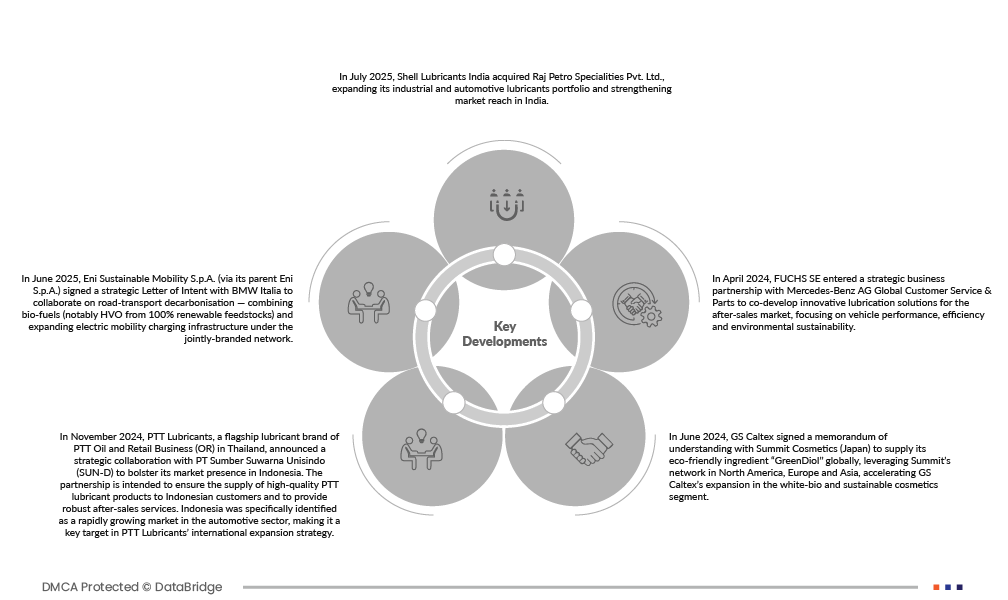
- In June 2024, GS Caltex signed a memorandum of understanding with Summit Cosmetics (Japan) to supply its eco-friendly ingredient “GreenDiol” globally, leveraging Summit’s network in North America, Europe and Asia, accelerating GS Caltex’s expansion in the white-bio and sustainable cosmetics segment.
- In April 2024, FUCHS SE entered a strategic business partnership with Mercedes-Benz AG Global Customer Service & Parts to co-develop innovative lubrication solutions for the after-sales market, focusing on vehicle performance, efficiency and environmental sustainability.
- In February 2024, Schaeffer Manufacturing Co., a St. Louis-based lubricant manufacturer, completed the acquisition of the lubricant manufacturing and packaging facility of Hicks Oils in Du Quoin, Illinois. This strategic move enhances Schaeffer's production capacity and provides redundancy to its existing manufacturing facilities. The Du Quoin plant will continue operations under Schaeffer, with all current employees retained, ensuring a seamless transition and continued service to Hicks Oils' customer base.
Regional Analysis
Geographically, the countries covered in the Global Lubricants Market report are (U.S., Canada, Mexico, Germany, U.K., France, Russia, Italy, Spain, Turkey, Poland, Netherlands, Switzerland, Norway, Sweden, Denmark, Finland, Belgium, and rest of Europe, China, Japan, India, Australia, South Korea, Singapore, Thailand, Philippines, Malaysia, Indonesia, Vietnam, Taiwan, New Zealand, rest of Asia-Pacific, Brazil, Argentina, and rest of South America, Saudi Arabia, U.A.E., South Africa, Egypt, Kuwait, Qatar, Oman, Bahrain, and rest of Middle East and Africa).
As per Data Bridge Market Research analysis:
Asia-Pacific is the dominant region in the Global Lubricants Market during the forecast period of 2025 to 2032
Asia-Pacific is expected to dominate the market due to rapid industrialization, expanding automotive production, and strong economic growth across countries such as China, India, and Japan. Increasing transportation activities, rising demand for commercial and passenger vehicles, and growth in construction and manufacturing industries further drive lubricant consumption. Additionally, favorable government policies, infrastructural investments, and expanding industrial bases strengthen the region’s leading position in the global lubricants market.
Furthermore, Asia-Pacific is expected to grow fastest during the forecast period due to rising urbanization, expanding automotive and industrial sectors, and increasing demand for high-performance synthetic lubricants. Rapid infrastructure development, technological advancements in manufacturing, and growing consumer awareness of maintenance efficiency further support the region’s sustained growth in the global lubricants market.
North America is anticipated to be the witness growth in the Global Lubricants Market
North America growth in the global lubricants market is driven by the strong presence of major automotive manufacturers, technological advancements in lubricant formulations, and increasing adoption of high-performance synthetic oils. Additionally, the expansion of industrial and transportation sectors, coupled with rising maintenance awareness and energy-efficiency initiatives, further supports regional market growth.
For more detailed information about the Global Lubricants Market report, click here – https://www.databridgemarketresearch.com/reports/global-lubricants-market










