Circumvent the Tariff challenges with an agile supply chain Consulting
Supply Chain Ecosystem Analysis now part of DBMR Reports
Global Antibody Drug Conjugates Market
Market Size in USD Billion
CAGR :
%
USD
10.77 Billion
USD
34.32 Billion
2024
2032
Forecast Period
2025 –2032
Market Size(Base Year)
USD
10.77 Billion
Market Size (Forecast Year)
USD
34.32 Billion
CAGR
%
Major Markets Players
DAIICHI SANKYO COMPANY
LIMITED
F. Hoffmann-La Roche Ltd
Gilead SciencesInc.
Astellas Pharma Inc.
Global Antibody Drug Conjugates (ADC) Market Segmentation, By Product (Enhertu, Kadcyla, Trodelvy, Polivy, Adcetris, Padcev, Besponsa, Elahere, Zylonta, Mylotarg, Tivdak, and Others), Antigen Component (HER2 Receptor, Trop-2, CD79B, CD30, Nectin 4, CD22, CD19, CD33, Tissue Factors, and Others), Antibody Component (Third Generation ADCs, Second Generation ADCs, Fourth Generation ADCs, and First Generation ADCs), Linkers Component (Cleavable Linkers and Non Cleavable Linkers), Cytotoxic Payloads or Warheads Component (DNA Damaging Agents and Microtubule Disrupting Agents), Linker Technology (Peptide Linkers, Thioether Linkers, Hydrazone Linkers, and Disulfide Linkers), Conjugation Technology (Site-Specific Conjugation and Chemical Conjugation), Indication (Breast Cancer, Blood Cancer (Leukemia, Lymphoma), Lung Cancer, Gynecological Cancer, Gastrointestinal Cancer, Genitourinary Cancer, and Others), End User (Hospitals, Specialty Center, Clinics, Ambulatory Centers, Home Healthcare, and Others), Distribution Channel (Direct Tenders, Retail Sales, and Others) – Industry Trends and Forecast to 2032
Antibody Drug Conjugates (ADC) Market Analysis
In May 2024, according to the data published by National Cancer Institute, in 2024, the U.S. is projected to see 2 million new cancer cases and 611,720 deaths. Leading cancers include breast, prostate, lung, colorectal, and melanoma. Prostate, lung, and colorectal cancers will comprise 48% of male cases, while breast, lung, and colorectal will make up 51% for women. The annual incidence rate is 440.5 per 100,000 people, with a mortality rate of 146.0 per 100,000. Among children and adolescents (0-19), 14,910 are expected to be diagnosed, with 1,590 deaths. The rising number of FDA approvals for ADCs and growing clinical trials highlight the market's potential. However, challenges such as high manufacturing costs and complex production processes may impact growth. Overall, the North American ADC market is poised for substantial development, supported by technological advancements and increasing adoption in oncology treatments.
Antibody Drug Conjugates (ADC) Market Size
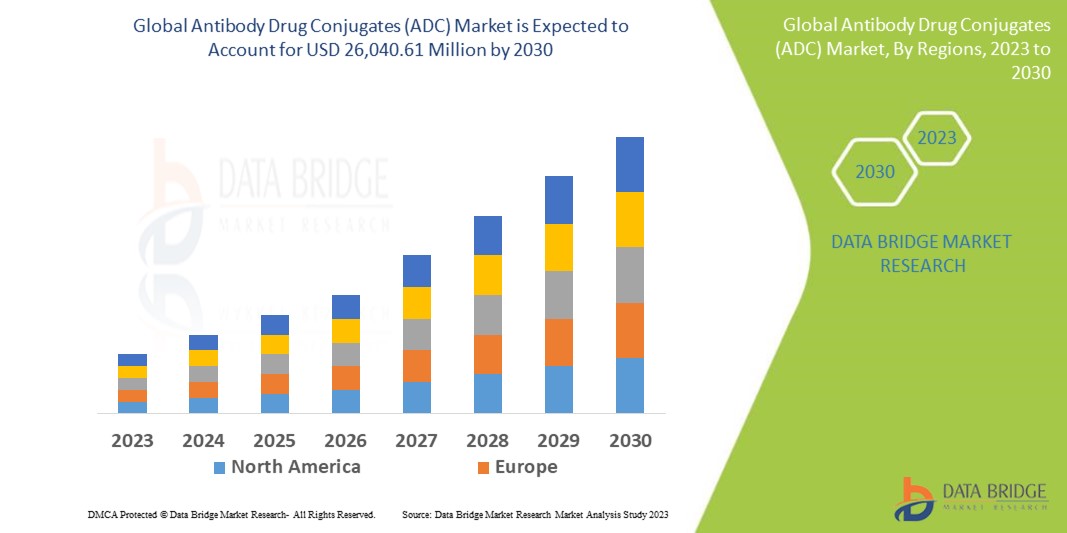
The global Antibody Drug Conjugates (ADC) size was valued at USD 10.77 billion in 2024 and is projected to reach USD 34.32 billion by 2032, with a CAGR of 15.59 % during the forecast period of 2025 to 2032. In addition to the insights on market scenarios such as market value, growth rate, segmentation, geographical coverage, and major players, the market reports curated by the Data Bridge Market Research also include depth expert analysis, patient epidemiology, pipeline analysis, pricing analysis, and regulatory framework.
Antibody Drug Conjugates (ADC) Market Trends
“Advances in Antibody-Drug Conjugate (ADC) Technology”
Advances in antibody-drug conjugate (ADC) technology are driving growth in the global ADC market by enhancing both treatment effectiveness and safety in cancer care. Key innovations trends include improved linkers for stable, precise drug delivery that targets cancer cells while sparing healthy tissue. Next-generation ADCs with optimized payloads and biomarker-driven patient selection ensure that therapies reach those who will benefit most, minimizing side effects. In addition, improved manufacturing processes are lowering production costs, increasing access, and encouraging greater investment in ADC development, all contributing to a robust pipeline and expanding market interest.
Report Scope and Antibody Drug Conjugates (ADC) Market Segmentation
Attributes
Antibody Drug Conjugates (ADC) Key Market Insights
Segments Covered
By Product: Enhertu, Kadcyla, Trodelvy, Polivy, Adcetris, Padcev, Besponsa, Elahere, Zylonta, Mylotarg, Jiydak, and Others
By Antigen Component: HER2 Receptor, Trop-2, CD79B, CD30, Nectin 4, CD22, CD19, CD33, Tissue Factors, and Others
By Antibody Component: First Generation ADCs, Second Generation ADCs, Third Generation ADCs, and Fourth Generation ADCs
By Linkers Component: Cleavable Linkers and Non-Cleavable Linkers
By Cytotoxic Payloads or Warheads Component: DNA Damaging Agents and Microtubule Disrupting Agents
By Linker Technology: Peptide Linkers, Thioether Linkers, Hydrazone Linkers, and Disulfide Linkers
By Conjugation Technology: Site-Specific Conjugation and Chemical Conjugation
By Indication: Breast Cancer, Blood Cancer (Leukemia, Lymphoma), Lung Cancer, Gynecological Cancer, Gastrointestinal Cancer, Genitourinary Cancer, and Others
By End User: Hospitals, Specialty Centers, Clinics, Ambulatory Centers, Home Healthcare, and Others
By Distribution Channel: Direct Tenders, Retail Sales, and Other
Countries Covered
U.S., Canada and Mexico in North America, Germany, France, U.K., Netherlands, Switzerland, Belgium, Russia, Italy, Spain, Turkey, Rest of Europe in Europe, China, Japan, India, South Korea, Singapore, Malaysia, Australia, Thailand, Indonesia, Philippines, Rest of Asia-Pacific (APAC) in the Asia-Pacific (APAC), Saudi Arabia, U.A.E., South Africa, Egypt, Israel, Rest of Middle East and Africa (MEA) as a part of Middle East and Africa (MEA), Brazil, Argentina and Rest of South America as part of South America
Key Market Players
DAIICHI SANKYO COMPANY, LIMITED (Japan), F. Hoffmann-La Roche Ltd (Switzerland), Gilead Sciences, Inc. (U.S.), Astellas Pharma Inc. (Japan), Takeda (Japan), Pfizer Inc. (U.S.), Abbvie (U.S.), ADC Therapeutics (Switzerland), Amgen, Inc. (California), AstraZeneca (England), Bayer (Germany), Byondis (Netherlands), EISAI INC (Japan), GSK plc (UK), Johnson & Johnson Services, Inc. (U.S.), Oxford BioTherapeutics (England), Remegen (China), Sanofi (France), and Sutra Biopharma, Inc. (U.S.)
Market Opportunities
Growing Oncology Pipeline for Antibody Drug Conjugates (ADCS)
Increasing Investment in Cancer Research
Value Added Data Infosets
In addition to the insights on market scenarios such as market value, growth rate, segmentation, geographical coverage, and major players, the market reports curated by the Data Bridge Market Research also include depth expert analysis, patient epidemiology, pipeline analysis, pricing analysis, and regulatory framework.
Antibody Drug Conjugates (ADC) Market Definition
Antibody-Drug Conjugates (ADCs) are targeted cancer therapies that combine an antibody with a potent anti-cancer drug. The antibody specifically binds to cancer cell markers, delivering the drug directly to cancer cells while minimizing impact on healthy cells. This precision reduces side effects and increases the drug’s effectiveness in treating cancer.
Antibody Drug Conjugates (ADC) Market Dynamics
Drivers
Increasing Prevalence of Cancer
The rising prevalence of cancer significantly drives the North America Antibody-Drug Conjugates (ADC) market, increasing demand for targeted, effective treatments. ADCs offer precise cancer cell targeting with reduced harm to healthy tissues by combining monoclonal antibodies with potent cytotoxic drugs. As cancer rates climb, pharmaceutical companies are investing heavily in ADC technology to meet the need for more personalized treatments, especially for challenging cancer types. This growth in the cancer patient population accelerates ADC clinical trials, regulatory approvals, and commercial launches, further advancing the ADC market.
For instance,
In February 2024, according to an article published by WHO, in 2022, there were an estimated 20 million new cancer cases and 9.7 million deaths, with 53.5 million people alive within five years of diagnosis. Lung cancer was the most common (2.5 million cases, 12.4%), followed by breast (2.3 million, 11.6%), colorectal (1.9 million, 9.6%), prostate (1.5 million, 7.3%), and stomach cancers (970,000, 4.9%). One in five people will develop cancer, with predictions of over 35 million new cases by 2050—a 77% increase. This rising incidence drives market growth for targeted cancer therapies.
The rising prevalence of cancer significantly boosts the North America ADC market by increasing the demand for targeted, effective therapies. ADCs, with their ability to deliver potent treatments directly to cancer cells while sparing healthy tissue, have gained attention as a promising solution. This growing cancer burden drives research, development, and investment in ADC technology, pushing forward new advancements and expanding the market.
Advances in Antibody-Drug Conjugate (ADC) Technology
Advances in antibody-drug conjugate (ADC) technology are driving growth in the global ADC market by enhancing both treatment effectiveness and safety in cancer care. Key innovations include improved linkers for stable, precise drug delivery that targets cancer cells while sparing healthy tissue. Next-generation ADCs with optimized payloads and biomarker-driven patient selection ensure that therapies reach those who will benefit most, minimizing side effects. Additionally, improved manufacturing processes are lowering production costs, increasing access, and encouraging greater investment in ADC development, all contributing to a robust pipeline and expanding market interest.
For instance,
In October 2023, according to the article published in Acta Pharmaceutica Sinica B, recent progress in ADC research focuses on developing safer, more potent payloads. Key advancements include stronger cytotoxic drugs, stable linkers for precise delivery, and novel payloads like DNA-damaging and immune-modulating agents. These innovations expand the therapeutic window, reducing off-target toxicity and improving effectiveness against resistant tumors, shaping next-gen ADCs.
Innovations such as enhanced linker systems and effective drug payloads improve the precision and safety of cancer treatments. Biomarker-guided strategies enhance patient targeting for optimal efficacy. Improved manufacturing techniques have made ADCs more accessible and cost-effective, attracting investment and expanding therapy options. Overall, these advancements boost ADC effectiveness and stimulate market growth and interest from the pharmaceutical industry.
Opportunities
Growing Oncology Pipeline for Antibody Drug Conjugates (ADCS)
The oncology pipeline for Antibody Drug Conjugates (ADCs) is rapidly expanding, offering significant market potential. Numerous ADC candidates are in various stages of development, driven by advancements in tumor biology and the need for targeted therapies.
Pharmaceutical and biotech companies are heavily investing in new ADCs to enhance efficacy and safety for a range of cancers, including solid tumors and hematological malignancies. Innovations in linker technology, payloads, and antibody engineering are resulting in more effective and less toxic ADCs, broadening treatment options and attracting investor interest.
For instance,
In August 2024, according to the article published by Johnson & Johnson Innovation LLC, Johnson & Johnson's growing pipeline of antibody-drug conjugate (ADC) therapeutics and active collaborations demonstrate a strong commitment to the ADC sector. Their emphasis on innovative, safe, and effective cancer treatments showcases the transformative potential of ADCs. These initiatives foster industry partnerships, enhancing development and accessibility, and creating substantial growth opportunities in the North America ADC market.
Increasing Investment in Cancer Research
Increasing investment in cancer research presents a significant opportunity for the growth of the global antibody-drug conjugate (ADC) market. As governments, private organizations, and philanthropic entities prioritize effective cancer treatments, this funding becomes essential for advancing innovative ADC therapies.
These investments allow researchers to deepen their understanding of tumor biology and the mechanisms of drug action, which is critical for developing more targeted and effective ADCs. Additionally, enhanced funding facilitates larger and more diverse clinical trials, improving insights into patient responses and accelerating the evaluation and approval processes for promising ADC candidates.
For Instance,
In October 2024, according to the article published in UKRI, Innovate UK and OLS are investing USD 5.19 million in six projects under the advancing precision medicines competition, part of the Life Sciences Vision Cancer Mission. This significant funding underscores the growing commitment to cancer research and development. Such investments pave the way for innovative therapies, including antibody-drug conjugates (ADCs), creating a valuable opportunity for growth in the global ADC market.
Restraints/Challenges
High Development Cost & Manufacturing Complexities
The extensive investment needed for research—including innovative linker design, selecting cytotoxic agents, and optimizing conjugation techniques—substantially increases costs. The intricate manufacturing process requires precise drug-antibody attachment and rigorous quality control, further driving up expenses. In addition, specialized facilities and equipment needed for safe and efficient production add financial burdens, making it difficult for smaller biotech firms to pursue ADC development and limiting larger companies to a few projects at a time. As a result, while ADCs offer promising targeted cancer therapies, these issues restrict market growth and the introduction of new treatments.
For instance,
In July 2024, according to the article published by Journal of Antibody Drug Conjugates, Bristol Myers Squibb (BMS) made an upfront payment of USD 800 million to license Systimmune's EGFR x HER3 bispecific ADC, BL-B01D1 (Zalontamab brengitecan), currently in Phase 1 in the US and Phase 3 in China. While BL-B01D1 shows promising safety and efficacy in heavily pretreated metastatic solid tumors, the high investment costs are a concern. In addition, developing bispecific ADCs presents challenges, such as selecting the appropriate antibody format, which often requires creating two stable cell lines. This complexity increases manufacturing costs and complicates assay development
High development costs and manufacturing complexities significantly hinder the growth of the North America antibody-drug conjugates (ADC) market. The substantial financial investment required for research and the intricate manufacturing processes contribute to elevated production expenses. This complexity not only necessitates rigorous quality control measures but also demands specialized facilities and equipment, further straining resources. As a result, smaller biotech companies may be discouraged from entering the market, while even larger firms may limit their ADC initiatives.
Safety and Toxicity Issues of Antibody Drug Conjugates
Safety and toxicity concerns are major restraints on the growth of the global Antibody Drug Conjugates (ADC) market. Despite their design to target cancer cells, ADCs can adversely affect healthy tissues due to their potent cytotoxic payloads, leading to systemic toxicity and side effects such as neutropenia and organ-specific toxicities. Additionally, unpredictable immune responses may cause allergic reactions or immunogenicity, limiting their use in certain patient populations. The risk of off-target effects, where ADCs impact non-cancerous cells with similar antigens, further complicates treatment.
For instance,
In June 2021, according to the news release published by Elsevier, off-target toxicities are a major cause of dose-limiting side effects in antibody-drug conjugates (ADCs), primarily due to linker-drug instability and premature payload release. This narrow therapeutic index necessitates thorough safety assessments during preclinical and clinical stages. Improving testing methods and understanding safety profiles are crucial for optimizing ADCs' therapeutic potential.
Safety and toxicity concerns present major challenges for the global ADC market, as potent cytotoxic agents can lead to severe side effects, including blood disorders and organ-specific toxicities. The risk of immune reactions and off-target effects complicates their safe use, necessitating rigorous clinical testing and regulatory oversight.
This market report provides details of new recent developments, trade regulations, import-export analysis, production analysis, value chain optimization, market share, impact of domestic and localized market players, analyses opportunities in terms of emerging revenue pockets, changes in market regulations, strategic market growth analysis, market size, category market growths, application niches and dominance, product approvals, product launches, geographic expansions, technological innovations in the market. To gain more info on the market contact Data Bridge Market Research for an Analyst Brief, our team will help you take an informed market decision to achieve market growth.
Antibody Drug Conjugates (ADC) Market Scope
The market is segmented on the basis of product, antigen component, antibody component, linkers component, cytotoxic payloads or warheads component, linker technology, conjugation technology, indication, end user, and distribution channel. The growth amongst these segments will help you analyse meagre growth segments in the industries and provide the users with a valuable market overview and market insights to help them make strategic decisions for identifying core market applications.
Product
Enhertu
Kadcyla
Podelvy
Adcetris
Padcev
Besponsa
Elahere
Zylonta
Mylotarg
Tivdak
Others
Antigen Component
HER2 Receptor
Trop-2
Cd79b
Cd30
Nectin 4
Cd22
Cd19
Cd33
Tissue Factors
Others
Antibody Component
Third Generation ADCs
Second Generation ADCs
Fourth Generation ADCs
First Generation ADCs
Linkers Component
Cleavable Linkers
Peptide Based
Acid Sensitive or Acid Labile
Glutathione Sensitive Disulfide
Non Cleavable Linkers
Cytotoxic Payloads or Warheads Component
DNA Damaging Agents
Camptothecin
Calicheamicin
Pyrrolobenzodiazepines
Microtubule Disrupting Agents
Auristatin
Maytansinoids
Linker Technology
Peptide Linkers
Thioether Linkers
Hydrazone Linkers
Disulfide Linkers
Conjugation Technology
Site-Specific Conjugation
Chemical Conjugation
Indication
Breast Cancer
Blood Cancer (Leukemia, Lymphoma)
Lung Cancer
Gynecological Cancer
Gastrointestinal Cancer
Genitourinary Cancer
Others
End User
Hospitals
Specialty center
Clinics
Ambulatory centers
Home healthcare
Others
Distribution Channel
Direct tenders
Retail sales
Hospital pharmacy
Retail pharmacy
Online pharmacy
Others
Antibody Drug Conjugates (ADC) Market Regional Analysis
The market is analysed and market size insights and trends are provided by country, product, antigen component, antibody component, linkers component, cytotoxic payloads or warheads component, linker technology, conjugation technology, indication, end user, and distribution channel as referenced above.
The countries covered in the market report are U.S., Canada and Mexico in North America, Germany, France, U.K., Netherlands, Switzerland, Belgium, Russia, Italy, Spain, Turkey, Rest of Europe in Europe, China, Japan, India, South Korea, Singapore, Malaysia, Australia, Thailand, Indonesia, Philippines, Rest of Asia-Pacific (APAC) in the Asia-Pacific (APAC), Saudi Arabia, U.A.E., South Africa, Egypt, Israel, Rest of Middle East and Africa (MEA) as a part of Middle East and Africa (MEA), Brazil, Argentina and Rest of South America as part of South America.
North America is expected to dominate the market due to its advanced healthcare infrastructure, high demand for innovative medical devices, and a strong focus on quality and patient care.
North America is expected to be the fastest growing due to increasing adoption of advanced healthcare technologies, rising chronic disease prevalence, and a growing emphasis on cost-effective long-term vascular access solutions.
The country section of the report also provides individual market impacting factors and changes in regulation in the market domestically that impacts the current and future trends of the market. Data points such as down-stream and upstream value chain analysis, technical trends and porter's five forces analysis, case studies are some of the pointers used to forecast the market scenario for individual countries. Also, the presence and availability of global brands and their challenges faced due to large or scarce competition from local and domestic brands, impact of domestic tariffs and trade routes are considered while providing forecast analysis of the country data.
Antibody Drug Conjugates (ADC) Market Share
The market competitive landscape provides details by competitor. Details included are company overview, company financials, revenue generated, market potential, investment in research and development, new market initiatives, global presence, production sites and facilities, production capacities, company strengths and weaknesses, product launch, product width and breadth, application dominance. The above data points provided are only related to the companies' focus related to market.
Antibody Drug Conjugates (ADC) Market Leaders Operating in the Market Are:
Daiichi Sankyo Company, Limited (Japan)
F. Hoffmann-La Roche Ltd (Genentech) (Switzerland)
Gilead Sciences, Inc. (U.S.)
Astellas Pharma Inc. (Japan)
Takeda (Japan)
Pfizer Inc. (U.S.)
Abbvie (U.S.)
ADC Therapeutics (Switzerland)
Amgen, Inc. (U.S.)
AstraZeneca (U.K.)
Bayer (Germany)
Byondis (Netherlands)
EISAI INC (Japan)
GSK plc (U.K.)
Johnson & Johnson Services, Inc. (U.S.)
Oxford Big Therapeutics (U.K.)
Remegen (China)
Sanofi (France)
Sutra Biopharma (U.S.)
Latest Developments in Antibody Drug Conjugates (ADC) Market
In October 2024, Daiichi Sankyo and AstraZeneca's ENHERTU has received conditional approval in China as the first HER2-directed therapy for adult patients with HER2 mutant metastatic non-small cell lung cancer (NSCLC). This approval, based on positive results from the DESTINY-Lung02 and DESTINY-Lung05 studies, highlights ENHERTU's efficacy in previously treated patients. This marks the fourth indication for ENHERTU in China across various tumor types, enhancing the companies' oncology portfolio and addressing a significant unmet need in lung cancer treatment
In August 2024, Bayer and NextRNA Therapeutics have announced a collaboration and license agreement to develop small molecule therapeutics targeting long non-coding RNAs (lncRNAs) in oncology, offering a novel approach to disrupt lncRNA-RBP interactions in disease treatment
In March 2023, Roche announced its collaboration with Eli Lilly to develop the Elecsys Amyloid Plasma Panel. This innovative blood test aimed to facilitate earlier Alzheimer’s diagnosis, addressing significant barriers and improving access to timely treatments for patients
In January 2022, Roche launched the cobas pulse system, an innovative handheld blood glucose management device. It combined advanced digital capabilities with user-friendly design, simplifying workflows for healthcare professionals and enhancing patient care in various settings
SKU-
Get online access to the report on the World's First Market Intelligence Cloud
Interactive Data Analysis Dashboard
Company Analysis Dashboard for high growth potential opportunities
Research Analyst Access for customization & queries
Competitor Analysis with Interactive dashboard
Latest News, Updates & Trend analysis
Harness the Power of Benchmark Analysis for Comprehensive Competitor Tracking
Research Methodology
Data collection and base year analysis are done using data collection modules with large sample sizes. The stage includes obtaining market information or related data through various sources and strategies. It includes examining and planning all the data acquired from the past in advance. It likewise envelops the examination of information inconsistencies seen across different information sources. The market data is analysed and estimated using market statistical and coherent models. Also, market share analysis and key trend analysis are the major success factors in the market report. To know more, please request an analyst call or drop down your inquiry.
The key research methodology used by DBMR research team is data triangulation which involves data mining, analysis of the impact of data variables on the market and primary (industry expert) validation. Data models include Vendor Positioning Grid, Market Time Line Analysis, Market Overview and Guide, Company Positioning Grid, Patent Analysis, Pricing Analysis, Company Market Share Analysis, Standards of Measurement, Global versus Regional and Vendor Share Analysis. To know more about the research methodology, drop in an inquiry to speak to our industry experts.
Customization Available
Data Bridge Market Research is a leader in advanced formative research. We take pride in servicing our existing and new customers with data and analysis that match and suits their goal. The report can be customized to include price trend analysis of target brands understanding the market for additional countries (ask for the list of countries), clinical trial results data, literature review, refurbished market and product base analysis. Market analysis of target competitors can be analyzed from technology-based analysis to market portfolio strategies. We can add as many competitors that you require data about in the format and data style you are looking for. Our team of analysts can also provide you data in crude raw excel files pivot tables (Fact book) or can assist you in creating presentations from the data sets available in the report.
Claudio Rondena
Group Business Development & Strategic Marketing Director, C.O.C Farmaceutici SRL
"This morning we were involved in the first part, the data presentation of MKT analysis, selected abstract from your work. The board team was really impressed and very appreciated, as well."
David Manning - Thermo Fisher Scientific
Director, Global Strategic Accounts,
Dear Ricky, I want to thank you for the excellent market analysis (LIMS INSTALLED BASE DATA) that you and your team delivered, especially end of year on short notice.
Sachin and Shraddha captured the requirements, determined their path forward and executed quickly.
You, Sachin and Shraddha have been a pleasure to work with – very responsive, professional and thorough.
Your work is much appreciated.
Manager - Market Analytics,
Uriah D. Avila - Zeus Polymer Solutions
Thank you for all the assistance and the level of detail in the market report. We are very pleased with the results and the customization. We would like to continue to do business.
Business Development Manager,
(Pharmaceuticals Partner for Nasal Sprays) | Renaissance Lakewood LLC
DBMR was attentive and engaged while discussing the Global Nasal Spray Market. They understood what we were looking for and was able to provide some examples from the report as requested. DBMR Service team has been responsive as needed. Depending on what my colleagues were looking for, I will recommend your services and would be happy to stay connected in case we can utilize your research in the future.
Business Intelligence and Analytics,
Ipsen Biopharm Limited
We are impressed by the CENTRAL PRECOCIOUS PUBERTY (CPP) TREATMENT report - so a BIG thanks to you colleagues.
Competition Analyst,
Basler Web
I just wanted to share a quick note and let you know that you guys did a really good job. I’m glad I decided to work with you. I shall continue being associated with your company as long as we have market intelligence needs.
Marketing Director,
Buhler Group
It was indeed a good experience, would definitely recommend and come back for future prospects.
COO,
A global leader providing Drug Delivery Services
DBMR did an outstanding job on the Global Drug Delivery project, We were extremely impressed by the simple but comprehensive presentation of the study and the quality of work done. This report really helped us to access untapped opportunities across the globe.
Marketing Director,
Philips Healthcare
The study was customized to our targets and needs with well-defined milestones. We were impressed by the in-depth customization and inclusion of not only major but also minor players across the globe. The DBMR Market position grid helped us to analyze the market in different dimension which was very helpful for the team to get into the minute details.
Product manager,
Fujifilms
Thankful to the team for the amazing coordination, and helping me at the last moment with my presentation. It was indeed a comprehensive report that gave us revenue impacting solution enabling us to plan the right move.
Investor relations,
GE Healthcare
Thank you for the report, and addressing our needs in such short time. DBMR has outdone themselves in this project with such short timeframe.
Market Analyst,
Medincell
We found the results of this study compelling and will help our organization validate a market we are considering to enter. Thank you for a job well done.
Andrew - Senior Global Marketing Manager,
Medtronic (US)
I want to thank you for your help with this report – It’s been very helpful in our business planning and it well organized.
Amarildo - Manager, Global Strategic Alignment
MasterCard
We believe the work done by Data Bridge Team for our requirements in the North America Loyalty Management Market was fantastic and would love to continue working with your team moving forward.
Tor Hammer
Green Nexus LLc
Thank you for your quick response to this unfortunate circumstance. Please extend my thanks to your reach team. I will be contacting you in the future with further projects
I acknowledge the difficulty given by the very short warning for this report, and I think that its quality and your delivering time have been very satisfying.
Obviously, as a provider Data Bridge Market Research will be considered as a plus for future needs of Nippon Gases.
Yuki Kopyl (Asian Business Development Department)
UENO FOOD TECHNO INDUSTRY, LTD. (JAPAN)
Xylose report was very useful for our team. Thank you very much & hope to work with you again in the future