Global Bio-Based Succinic Acid Market Segmentation, By Application (BDO, Polyester Polyols, Plasticizers, PBS/PBST, Alkyd Resins, and Others), End-Use Industry (Industrial, Food & Beverage, Paints and Coatings, Pharmaceutical, Cosmetics and Others) – Industry Trends and Forecast to 2032
Bio-Based Succinic Acid Market Analysis
The bio-based succinic acid market is experiencing significant growth due to increasing demand for sustainable and eco-friendly chemical alternatives. Bio-based succinic acid, derived from renewable resources such as glucose, offers an environmentally friendly substitute to petroleum-based succinic acid in various industries, including plastics, pharmaceuticals, food additives, and cosmetics. The market is driven by rising environmental concerns and government regulations that promote the adoption of renewable chemicals to reduce carbon footprints. Advancements in production technologies have played a crucial role in the market’s expansion. Innovations in fermentation processes and biotechnology have led to more cost-effective and efficient production of bio-based succinic acid. Companies are increasingly investing in scalable production methods, reducing production costs and improving yields. In addition, advancements in the use of bio-based succinic acid in applications such as bio-polymers and biodegradable plastics are opening up new market opportunities, driven by consumer demand for sustainable products.
The bio-based succinic acid market is expected to continue its upward trajectory as more industries embrace sustainability and renewable materials. North America and Europe are currently the leading markets, while Asia-Pacific is anticipated to be the fastest-growing region.
Bio-Based Succinic Acid Market Size
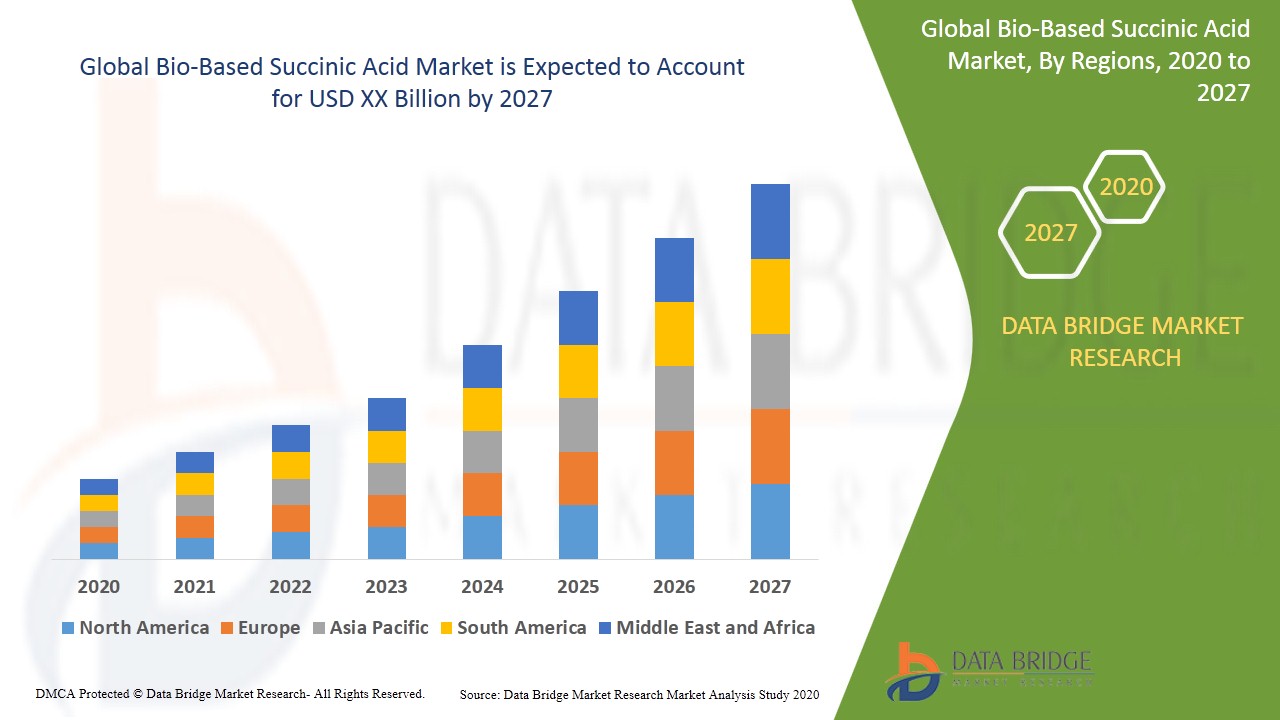
The global bio-based succinic acid market size was valued at USD 260.24 million in 2024 and is projected to reach USD 1069.47 million by 2032, with a CAGR of 6.80 % during the forecast period of 2025 to 2032. In addition to the insights on market scenarios such as market value, growth rate, segmentation, geographical coverage, and major players, the market reports curated by the Data Bridge Market Research also include in-depth expert analysis, pricing analysis, brand share analysis, consumer survey, demography analysis, supply chain analysis, value chain analysis, raw material/consumables overview, vendor selection criteria, PESTLE Analysis, Porter Analysis, and regulatory framework.
Bio-Based Succinic Acid Market Trends
“Growing Adoption of Sustainable Production Methods”
A key trend in the bio-based succinic acid market is the growing adoption of sustainable production methods driven by advancements in fermentation technology and biotechnology. This trend is enabling companies to produce bio-based succinic acid more efficiently and cost-effectively, aligning with increasing demand for eco-friendly and renewable chemicals. For instance, Reverdia, a prominent player in the market, uses a cutting-edge fermentation process to produce succinic acid from renewable feedstocks, reducing reliance on petrochemical derivatives. As industries such as plastics and biopolymers seek to meet sustainability targets, bio-based succinic acid has become a key ingredient in biodegradable plastics and bio-based polymers. This shift helps reduce the carbon footprint and supports circular economy principles. The growing focus on environmental impact and resource efficiency presents a market opportunity, as companies strive to replace petroleum-based chemicals with more sustainable, bio-based alternatives in various industrial applications.
Report Scope and Bio-Based Succinic Acid Market Segmentation
Attributes
Bio-Based Succinic Acid Key Market Insights
Segments Covered
By Application: BDO, Polyester Polyols, Plasticizers, PBS/PBST, Alkyd Resins, and Others
By End-Use Industry: Industrial, Food and Beverage, Paints & Coatings, Pharmaceutical, Cosmetics and Others
Countries Covered
U.S., Canada and Mexico in North America, Germany, France, U.K., Netherlands, Switzerland, Belgium, Russia, Italy, Spain, Turkey, Rest of Europe in Europe, China, Japan, India, South Korea, Singapore, Malaysia, Australia, Thailand, Indonesia, Philippines, Rest of Asia-Pacific (APAC) in the Asia-Pacific (APAC), Saudi Arabia, U.A.E, South Africa, Egypt, Israel, Rest of Middle East and Africa (MEA) as a part of Middle East and Africa (MEA), Brazil, Argentina and Rest of South America as part of South America
Key Market Players
BioAmber (Canada), Myraint (U.S.), DSM (Netherlands), MITSUI & CO., LTD. (Japan), Mitsubishi Chemical Group Corporation (Japan), BASF (Germany), Roquette Frères (France), Corbion N.V. (Netherlands), Reverdia (Netherlands), PTTGC Innovation America Corporation (U.S.), Succinity GmbH (Germany), NIPPON SHOKUBAI CO., LTD. (Japan), Anhui Lixing Chemical Co., Ltd. (China), Kawasaki Kasei Chemicals Ltd. (Japan), and Hexin Chemical Industry CO., Ltd. (China)
Market Opportunities
Increasing Demand for Bio-Based Products
Increasing Advancements in Biotechnology
Value Added Data Infosets
In addition to the insights on market scenarios such as market value, growth rate, segmentation, geographical coverage, and major players, the market reports curated by the Data Bridge Market Research also include in-depth expert analysis, pricing analysis, brand share analysis, consumer survey, demography analysis, supply chain analysis, value chain analysis, raw material/consumables overview, vendor selection criteria, PESTLE Analysis, Porter Analysis, and regulatory framework
Bio-Based Succinic Acid Market Definition
Bio-based succinic acid is a sustainable, renewable organic acid produced from biomass sources such as glucose, corn, or sugarcane through fermentation processes. Unlike traditional succinic acid, which is derived from petroleum-based feedstocks, bio-based succinic acid is considered an eco-friendly alternative, offering a reduced environmental impact and a lower carbon footprint.
Bio-Based Succinic Acid Market Dynamics
Drivers
Sustainability and Environmental Concerns
Increasing awareness about the environmental impact of petrochemical-based products is a major driver of the bio-based succinic acid market. Industries across sectors are recognizing the need to transition to sustainable alternatives that reduce their carbon footprint and align with green chemistry principles. Bio-based succinic acid, produced from renewable resources such as corn and sugarcane, offers an eco-friendly solution compared to conventional petroleum-based succinic acid. For instance, companies such as Reverdia utilize fermentation processes to produce bio-based succinic acid, contributing to lower greenhouse gas emissions and reducing dependence on fossil fuels. As global consumers and corporations increasingly prioritize sustainability, the demand for bio-based chemicals continues to rise, presenting a significant market opportunity for bio-based succinic acid in industries such as plastics, biopolymers, and cosmetics.
Increasing Stringent Environmental Regulations
Stringent environmental regulations and policies promoting the use of renewable chemicals are driving the adoption of bio-based succinic acid across various industries. Governments around the world are implementing regulations that encourage the shift towards more sustainable and eco-friendly chemical alternatives. For instance, in Europe, regulations such as the REACH (Registration, Evaluation, Authorisation and Restriction of Chemicals) program have prompted the chemical industry to explore renewable options. Governments also offer incentives for adopting bio-based alternatives, which further stimulate the demand for bio-based succinic acid. In the U.S., initiatives such as the Biomass Research and Development Act support the research and development of bio-based chemicals, which further boost the market for sustainable chemical products such as succinic acid. These regulatory frameworks foster innovation and position bio-based succinic acid as a key player in the transition towards greener industrial processes, making it a strong market driver.
Opportunities
Increasing Demand for Bio-Based Products
The growing demand for biodegradable plastics, bio-polymers, and other sustainable products is significantly boosting the market for bio-based succinic acid. As industries such as plastics, pharmaceuticals, and food additives shift towards more eco-friendly solutions, bio-based succinic acid serves as a crucial ingredient in the production of biodegradable plastics and bio-based polymers. For instance, bio-based succinic acid is a key component in the production of polybutylene succinate (PBS), a biodegradable polymer used in packaging materials and agricultural films. As consumers become more environmentally conscious and companies seek to comply with stricter sustainability regulations, the demand for products made from bio-based chemicals continues to rise. This trend represents a significant market opportunity for bio-based succinic acid producers, as industries increasingly prioritize sustainable alternatives to traditional, petroleum-based chemicals in their products and manufacturing processes.
Increasing Advancements in Biotechnology
Innovations in fermentation technology and biotechnology have played a key role in enhancing the production of bio-based succinic acid, making it more efficient and cost-effective. Advances in microbial fermentation processes, which use renewable feedstocks such as glucose or corn, have improved yields and lowered production costs, enabling bio-based succinic acid to compete with its petroleum-based counterpart. Companies such as Reverdia and Succinity have pioneered cutting-edge fermentation methods that significantly reduce the energy and resources required for production. These advancements help scale up production and make bio-based succinic acid more affordable, which in turn boosts its adoption in various industries. As biotechnology continues to evolve, the bio-based succinic acid market is expected to experience rapid growth, creating market opportunities for businesses to capitalize on the increasing demand for sustainable chemical solutions in products ranging from plastics to food packaging.
Restraints/Challenges
High Production Costs
One of the significant challenges in the bio-based succinic acid market is the high production costs associated with its manufacturing. The process typically involves complex fermentation methods, which require specialized raw materials such as renewable biomass (e.g., corn or sugarcane) and advanced infrastructure, including bioreactors and processing facilities. These requirements make bio-based succinic acid significantly more expensive to produce compared to its petrochemical-derived counterparts. For instance, producing bio-based succinic acid from renewable feedstocks often involves higher operational costs related to the fermentation process and biomass supply chains. The need for continuous investment in specialized technologies and the relatively small scale of production further exacerbate the cost issue. As a result, bio-based succinic acid struggles to compete with petrochemical-derived succinic acid, which benefits from lower production costs due to economies of scale and well-established production techniques. This high production cost creates a market challenge for bio-based succinic acid producers, limiting their ability to penetrate broader markets and scale their operations.
Competition from Petrochemical Industry
The bio-based succinic acid market faces strong competition from the well-established petrochemical industry, which currently dominates the global succinic acid production market. Petrochemical-derived succinic acid is cheaper and more readily available because the processes for extracting it from petroleum have been optimized over decades, resulting in highly efficient and low-cost production methods. This dominance in cost-effectiveness presents a major barrier for bio-based succinic acid producers trying to compete on price. For instance, companies in the bio-based succinic acid sector must overcome the challenge of producing a competitive product at a comparable or lower cost than petrochemical-derived succinic acid to attract large-scale industries. While bio-based alternatives are more sustainable, they often come with higher production costs due to the need for renewable raw materials and specialized processing technologies. This creates a competitive disadvantage for bio-based succinic acid, limiting its adoption despite the increasing demand for eco-friendly alternatives in industries such as automotive and packaging.
This market report provides details of new recent developments, trade regulations, import-export analysis, production analysis, value chain optimization, market share, impact of domestic and localized market players, analyses opportunities in terms of emerging revenue pockets, changes in market regulations, strategic market growth analysis, market size, category market growths, application niches and dominance, product approvals, product launches, geographic expansions, technological innovations in the market. To gain more info on the market contact Data Bridge Market Research for an Analyst Brief, our team will help you take an informed market decision to achieve market growth.
Impact and Current Market Scenario of Raw Material Shortage and Shipping Delays
Data Bridge Market Research offers a high-level analysis of the market and delivers information by keeping in account the impact and current market environment of raw material shortage and shipping delays. This translates into assessing strategic possibilities, creating effective action plans, and assisting businesses in making important decisions.
Apart from the standard report, we also offer in-depth analysis of the procurement level from forecasted shipping delays, distributor mapping by region, commodity analysis, production analysis, price mapping trends, sourcing, category performance analysis, supply chain risk management solutions, advanced benchmarking, and other services for procurement and strategic support.
Expected Impact of Economic Slowdown on the Pricing and Availability of Products
When economic activity slows, industries begin to suffer. The forecasted effects of the economic downturn on the pricing and accessibility of the products are taken into account in the market insight reports and intelligence services provided by DBMR. With this, our clients can typically keep one step ahead of their competitors, project their sales and revenue, and estimate their profit and loss expenditures.
Bio-Based Succinic Acid Market Scope
The market is segmented on the basis of application and end-use industry. The growth amongst these segments will help you analyze meagre growth segments in the industries and provide the users with a valuable market overview and market insights to help them make strategic decisions for identifying core market applications.
Application
BDO (Butanediol)
Polyester Polyols
Plasticizers
PBS/PBST
Alkyd Resins
Others
End-Use Industry
Industrial
Food & Beverage
Paints & Coatings
Pharmaceutical
Cosmetics
Others
Bio-Based Succinic Acid Market Regional Analysis
The market is analysed and market size insights and trends are provided by country, application, and end-use industry as referenced above.
The countries covered in the market report are U.S., Canada, Mexico in North America, Germany, Sweden, Poland, Denmark, Italy, U.K., France, Spain, Netherland, Belgium, Switzerland, Turkey, Russia, Rest of Europe in Europe, Japan, China, India, South Korea, New Zealand, Vietnam, Australia, Singapore, Malaysia, Thailand, Indonesia, Philippines, Rest of Asia-Pacific (APAC) in Asia-Pacific (APAC), Brazil, Argentina, Rest of South America as a part of South America, U.A.E, Saudi Arabia, Oman, Qatar, Kuwait, South Africa, Rest of Middle East and Africa (MEA) as a part of Middle East and Africa (MEA)
Europe is dominating the bio-based succinic acid during the forecast period from 2025 to 2032. The region's stringent carbon footprint regulations have driven significant demand for sustainable alternatives, such as bio-based succinic acid, in various sectors of chemical production. These regulations encourage the adoption of eco-friendly chemicals, contributing to the increased use of bio-based succinic acid in industries such as plastics, pharmaceuticals, and bio-polymers. As sustainability becomes a key priority, Europe’s commitment to reducing carbon emissions supports the continued growth of this market segment.
Asia-Pacific is the fastest-growing market for bio-based succinic acid in the coming years. The region's rapid industrialization, coupled with increasing demand for sustainable alternatives in sectors such as plastics, food packaging, and cosmetics, is driving this growth. Governments in countries such as China and India are also implementing policies to promote eco-friendly production, further boosting the demand for bio-based succinic acid. As businesses in Asia-Pacific seek to align with global sustainability trends, the market for bio-based succinic acid is expected to experience substantial expansion.
The country section of the report also provides individual market impacting factors and changes in regulation in the market domestically that impacts the current and future trends of the market. Data points such as down-stream and upstream value chain analysis, technical trends and porter's five forces analysis, case studies are some of the pointers used to forecast the market scenario for individual countries. Also, the presence and availability of global brands and their challenges faced due to large or scarce competition from local and domestic brands, impact of domestic tariffs and trade routes are considered while providing forecast analysis of the country data.
Bio-Based Succinic Acid Market Share
The market competitive landscape provides details by competitor. Details included are company overview, company financials, revenue generated, market potential, investment in research and development, new market initiatives, global presence, production sites and facilities, production capacities, company strengths and weaknesses, product launch, product width and breadth, application dominance. The above data points provided are only related to the companies' focus related to market.
Bio-Based Succinic Acid Market Leaders Operating in the Market Are:
BioAmber (Canada)
Myraint (U.S.)
DSM (Netherlands)
MITSUI & CO., LTD. (Japan)
Mitsubishi Chemical Group Corporation (Japan)
BASF (Germany)
Roquette Frères (France)
Corbion N.V. (Netherlands)
Reverdia (Netherlands)
PTTGC Innovation America Corporation (U.S.)
Succinity GmbH (Germany)
NIPPON SHOKUBAI CO., LTD. (Japan)
Anhui Lixing Chemical Co., Ltd. (China)
Kawasaki Kasei Chemicals Ltd. (Japan)
Hexin Chemical Industry CO., Ltd. (China)
Latest Developments in Bio-Based Succinic Acid Market
In September 2024, specialty chemical company Lygos entered into a partnership with fermentation and biotechnology firm CJ BIO to produce and supply commercial quantities of biobased chemicals. The two companies have signed a Memorandum of Understanding (MOU) to formalize the collaboration
In December 2022, Mitsubishi Chemical Group, in collaboration with Chukyo Yushi Co., Ltd., developed a biodegradable and compostable dispersion solution using BioPBS, a plant-derived biodegradable polymer. This polymer is produced from succinic acid sourced from natural resources and 1,4-butanediol
In August 2022, Technip Energies acquired DSM's Biosuccinium Technology, enabling the production of bio-sourced and fully biodegradable polymers. This method utilizes patented bio-polymer technologies to create bio-based succinic acid (bio-SAc), a key feedstock for manufacturing polybutylene succinate
In June 2022, NIPPON SHOKUBAI CO., LTD. raised the price of succinic acid by USD 0.5/kg (JPY 50/kg)
In June 2021, Roquette Frères received the U.S. Department of Agriculture (USDA) certified Bio-based Product Label for their BIOSUCCINIUM product
SKU-
Get online access to the report on the World's First Market Intelligence Cloud
Interactive Data Analysis Dashboard
Company Analysis Dashboard for high growth potential opportunities
Research Analyst Access for customization & queries
Competitor Analysis with Interactive dashboard
Latest News, Updates & Trend analysis
Harness the Power of Benchmark Analysis for Comprehensive Competitor Tracking
Global Bio Based Succinic Acid Market, Supply Chain Analysis and Ecosystem Framework
To support market growth and help clients navigate the impact of geopolitical shifts, DBMR has integrated in-depth supply chain analysis into its Global Bio Based Succinic Acid Market research reports. This addition empowers clients to respond effectively to global changes affecting their industries. The supply chain analysis section includes detailed insights such as Global Bio Based Succinic Acid Market consumption and production by country, price trend analysis, the impact of tariffs and geopolitical developments, and import and export trends by country and HSN code. It also highlights major suppliers with data on production capacity and company profiles, as well as key importers and exporters. In addition to research, DBMR offers specialized supply chain consulting services backed by over a decade of experience, providing solutions like supplier discovery, supplier risk assessment, price trend analysis, impact evaluation of inflation and trade route changes, and comprehensive market trend analysis.
Research Methodology
Data collection and base year analysis are done using data collection modules with large sample sizes. The stage includes obtaining market information or related data through various sources and strategies. It includes examining and planning all the data acquired from the past in advance. It likewise envelops the examination of information inconsistencies seen across different information sources. The market data is analysed and estimated using market statistical and coherent models. Also, market share analysis and key trend analysis are the major success factors in the market report. To know more, please request an analyst call or drop down your inquiry.
The key research methodology used by DBMR research team is data triangulation which involves data mining, analysis of the impact of data variables on the market and primary (industry expert) validation. Data models include Vendor Positioning Grid, Market Time Line Analysis, Market Overview and Guide, Company Positioning Grid, Patent Analysis, Pricing Analysis, Company Market Share Analysis, Standards of Measurement, Global versus Regional and Vendor Share Analysis. To know more about the research methodology, drop in an inquiry to speak to our industry experts.
Customization Available
Data Bridge Market Research is a leader in advanced formative research. We take pride in servicing our existing and new customers with data and analysis that match and suits their goal. The report can be customized to include price trend analysis of target brands understanding the market for additional countries (ask for the list of countries), clinical trial results data, literature review, refurbished market and product base analysis. Market analysis of target competitors can be analyzed from technology-based analysis to market portfolio strategies. We can add as many competitors that you require data about in the format and data style you are looking for. Our team of analysts can also provide you data in crude raw excel files pivot tables (Fact book) or can assist you in creating presentations from the data sets available in the report.
Claudio Rondena
Group Business Development & Strategic Marketing Director, C.O.C Farmaceutici SRL
"This morning we were involved in the first part, the data presentation of MKT analysis, selected abstract from your work. The board team was really impressed and very appreciated, as well."
David Manning - Thermo Fisher Scientific
Director, Global Strategic Accounts,
Dear Ricky, I want to thank you for the excellent market analysis (LIMS INSTALLED BASE DATA) that you and your team delivered, especially end of year on short notice.
Sachin and Shraddha captured the requirements, determined their path forward and executed quickly.
You, Sachin and Shraddha have been a pleasure to work with – very responsive, professional and thorough.
Your work is much appreciated.
Manager - Market Analytics,
Uriah D. Avila - Zeus Polymer Solutions
Thank you for all the assistance and the level of detail in the market report. We are very pleased with the results and the customization. We would like to continue to do business.
Business Development Manager,
(Pharmaceuticals Partner for Nasal Sprays) | Renaissance Lakewood LLC
DBMR was attentive and engaged while discussing the Global Nasal Spray Market. They understood what we were looking for and was able to provide some examples from the report as requested. DBMR Service team has been responsive as needed. Depending on what my colleagues were looking for, I will recommend your services and would be happy to stay connected in case we can utilize your research in the future.
Business Intelligence and Analytics,
Ipsen Biopharm Limited
We are impressed by the CENTRAL PRECOCIOUS PUBERTY (CPP) TREATMENT report - so a BIG thanks to you colleagues.
Competition Analyst,
Basler Web
I just wanted to share a quick note and let you know that you guys did a really good job. I’m glad I decided to work with you. I shall continue being associated with your company as long as we have market intelligence needs.
Marketing Director,
Buhler Group
It was indeed a good experience, would definitely recommend and come back for future prospects.
COO,
A global leader providing Drug Delivery Services
DBMR did an outstanding job on the Global Drug Delivery project, We were extremely impressed by the simple but comprehensive presentation of the study and the quality of work done. This report really helped us to access untapped opportunities across the globe.
Marketing Director,
Philips Healthcare
The study was customized to our targets and needs with well-defined milestones. We were impressed by the in-depth customization and inclusion of not only major but also minor players across the globe. The DBMR Market position grid helped us to analyze the market in different dimension which was very helpful for the team to get into the minute details.
Product manager,
Fujifilms
Thankful to the team for the amazing coordination, and helping me at the last moment with my presentation. It was indeed a comprehensive report that gave us revenue impacting solution enabling us to plan the right move.
Investor relations,
GE Healthcare
Thank you for the report, and addressing our needs in such short time. DBMR has outdone themselves in this project with such short timeframe.
Market Analyst,
Medincell
We found the results of this study compelling and will help our organization validate a market we are considering to enter. Thank you for a job well done.
Andrew - Senior Global Marketing Manager,
Medtronic (US)
I want to thank you for your help with this report – It’s been very helpful in our business planning and it well organized.
Amarildo - Manager, Global Strategic Alignment
MasterCard
We believe the work done by Data Bridge Team for our requirements in the North America Loyalty Management Market was fantastic and would love to continue working with your team moving forward.
Tor Hammer
Green Nexus LLc
Thank you for your quick response to this unfortunate circumstance. Please extend my thanks to your reach team. I will be contacting you in the future with further projects
I acknowledge the difficulty given by the very short warning for this report, and I think that its quality and your delivering time have been very satisfying.
Obviously, as a provider Data Bridge Market Research will be considered as a plus for future needs of Nippon Gases.
Yuki Kopyl (Asian Business Development Department)
UENO FOOD TECHNO INDUSTRY, LTD. (JAPAN)
Xylose report was very useful for our team. Thank you very much & hope to work with you again in the future