Global Cell Culture Market Segmentation, By Product (Equipment, Consumables, Sera and Media), Application (Drug Discovery, Biopharmaceuticals, Tissue Culture and Engineering, Vaccine Production, Gene Therapy and Others), End-User (Pharmaceutical & Biotechnology Companies, Hospitals & Diagnostic Laboratories, Research and Academic Institutes and Other) – Industry Trends and Forecast to 2032
Global Cell Culture Market Analysis
The global cell culture market is experiencing substantial growth, fueled by advancements in biotechnology, pharmaceuticals, and healthcare sectors. The increasing need for biopharmaceuticals, tissue engineering, and vaccine production is driving this expansion. Cell culture technologies are crucial in drug discovery, diagnostics, and therapeutic research, supporting the development of treatments for chronic diseases, cancer, and genetic disorders.
This growth is also supported by the rising demand for personalized medicine, stem cell research, and 3D cell cultures. As the healthcare industry continues to explore innovative cell-based therapies and biotechnological solutions, cell culture has become an essential tool in medical advancements. With ongoing investments in research and development, the market is expected to continue evolving, enabling breakthroughs in various fields such as regenerative medicine and targeted therapies.
Cell Culture Market Size
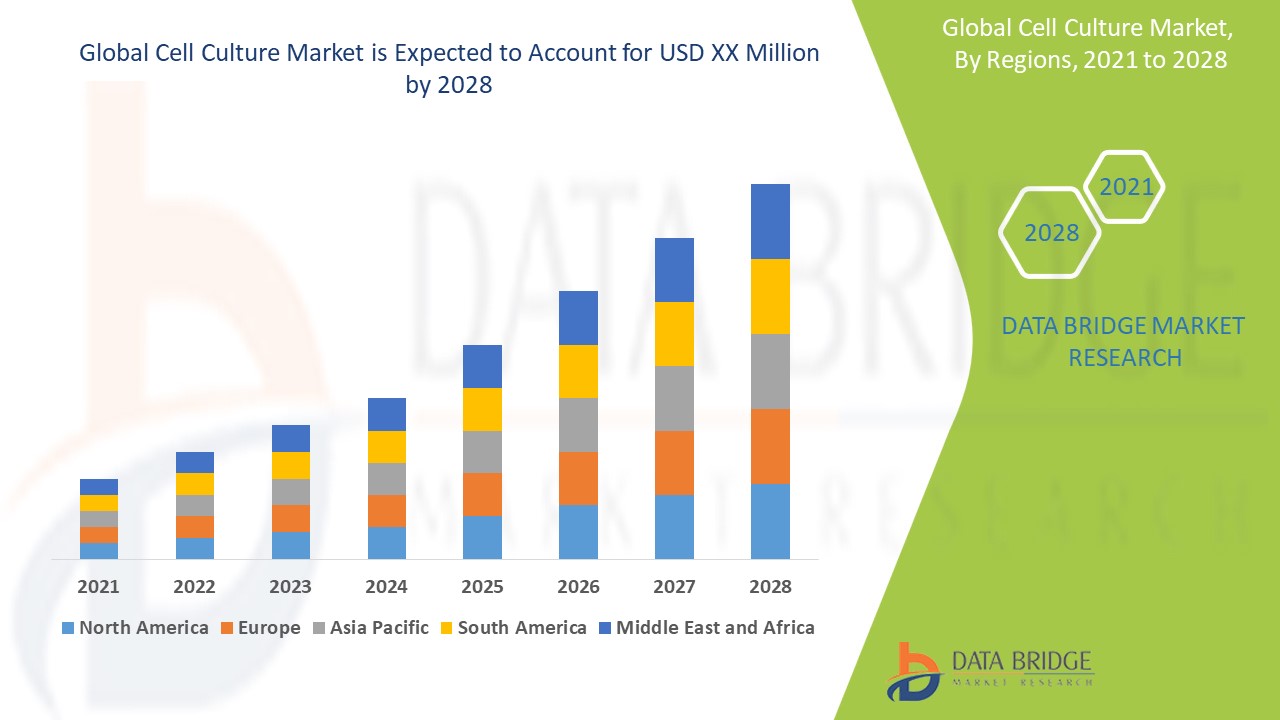
The global cell culture market size was valued at USD 30.44 billion in 2024 and is projected to reach USD 70.72 billion by 2032, with a CAGR of 11.11% during the forecast period of 2025 to 2032. In addition to the insights on market scenarios such as market value, growth rate, segmentation, geographical coverage, and major players, the market reports curated by the Data Bridge Market Research also include depth expert analysis, patient epidemiology, pipeline analysis, pricing analysis, and regulatory framework.
Cell Culture Market Trends
The cell culture market is experiencing several key trends. Advancements in 3D cell culture and organ-on-a-chip technologies are revolutionizing research, offering more accurate models for drug testing and disease studies. There's a growing focus on personalized medicine, pushing demand for tailored cell therapies and precision treatments. The rise in biopharmaceutical production and regenerative medicine is also contributing to market growth. In addition, the increasing adoption of automated and high-throughput systems is enhancing productivity in cell culture processes. Collaborations between biotech companies and research institutions are accelerating innovation. Moreover, the integration of artificial intelligence and machine learning in cell culture applications is driving efficiency and discovery, fostering continued market expansion.
Report Scope and Cell Culture Market Segmentation
Attributes
Cell Culture Key Market Insights
Segments Covered
By Product: Equipment, Consumables, Sera, and Media
By Application: Drug Discovery, Biopharmaceuticals, Tissue Culture and Engineering, Vaccine Production, Gene Therapy, and Others
By End User:Pharmaceutical & Biotechnology Companies, Hospitals & Diagnostic Laboratories, Research & Academic Institutes, and Other
Countries Covered
U.S., Canada, and Mexico in North America, Germany, France, U.K., Netherlands, Switzerland, Belgium, Russia, Italy, Spain, Turkey, Rest of Europe in Europe, China, Japan, India, South Korea, Singapore, Malaysia, Australia, Thailand, Indonesia, Philippines, Rest of Asia-Pacific (APAC) in the Asia-Pacific (APAC), Saudi Arabia, U.A.E., South Africa, Egypt, Israel, Rest of Middle East and Africa (MEA) as a part of Middle East and Africa (MEA), Brazil, Argentina and Rest of South America as part of South America
Key Market Players
Thermo Fisher Scientific (U.S.), Lonza Group (Switzerland), Merck KGaA (Germany), Becton, Dickinson and Company (U.S.), GE Healthcare (US), Sartorius AG (Germany), Corning Incorporated (U.S.), Eppendorf AG (Germany), Fujifilm Irvine Scientific (Japan), Agilent Technologies (U.S.), CELLINK (Sweden), Bio-Rad Laboratories (U.S.), Invitrogen (U.S.), Samsung Biologics (South Korea), Danaher Corporation (U.S.), Waters Corporation (U.S.), VWR International (U.S.), Promega Corporation (U.S.), JSR Corporation (Japan), Stemcell Technologies (Canada).
Market Opportunities
Personalized Medicine and Cell-Based Therapies
Biopharmaceutical Production
Value Added Data Infosets
In addition to the insights on market scenarios such as market value, growth rate, segmentation, geographical coverage, and major players, the market reports curated by the Data Bridge Market Research also include depth expert analysis, patient epidemiology, pipeline analysis, pricing analysis, and regulatory framework.
Cell Culture Market Definition
Cell culture is the process of growing and maintaining cells under controlled conditions outside their natural environment, typically in a laboratory. These cells can be derived from plants, animals, or humans and are grown in a nutrient-rich medium that provides essential growth factors. Cell culture is widely used in research, biotechnology, medicine, and drug development for applications such as vaccine production, cancer studies, and regenerative medicine.
Cell Culture Market Dynamics
Drivers
Increasing Demand for Biopharmaceuticals
The rising global need for biopharmaceuticals, including vaccines, monoclonal antibodies, and gene therapies, is significantly driving the growth of the cell culture market. Biopharmaceuticals offer targeted and effective treatment options for various diseases, including cancer, autoimmune disorders, and infectious diseases. Cell culture systems are indispensable in the production of these biologics, as they provide an optimized environment for cell growth, replication, and modification. The COVID-19 pandemic underscored the importance of large-scale cell culture applications, particularly in vaccine production, where technologies like mammalian cell culture played a crucial role in rapidly developing and manufacturing mRNA and protein-based vaccines.
Advancements in Personalized Medicine
The increasing focus on personalized medicine is fueling advancements in cell culture technologies, enabling the development of patient-specific treatments. As therapies become more tailored to an individual’s genetic and molecular profile, cell culture plays a vital role in expanding and modifying cells for therapeutic use. In regenerative medicine and gene therapies, such as CAR-T cell therapy for cancer, patient-derived cells are cultured, engineered, and reintroduced into the body for precise treatment. These technologies require highly controlled cell culture conditions to ensure cell viability, potency, and safety, making advanced cell culture systems essential for the success of personalized medical approaches.
Opportunities
Personalized Medicine and Cell-Based Therapies
The increasing demand for personalized medicine offers a significant opportunity in the cell culture market. As treatments become more tailored to individual genetic profiles, the need for advanced cell culture systems is expanding. Cell-based therapies, such as CAR-T cell therapy for cancer, depend on efficient cell culture techniques for growing and modifying cells for patient-specific treatments. The adoption of these therapies is accelerating due to their effectiveness in treating conditions previously resistant to conventional methods. This shift toward personalized medicine is expected to drive continuous growth in cell culture technologies, supporting the development of customized therapeutic solutions.
Biopharmaceutical Production
The growing emphasis on biologics, vaccines, and biosimilars presents a major opportunity for the cell culture market. Cell culture systems are vital in the production of biologics, including vaccines, which have seen significant demand due to global health needs. With the continued rise in biologic therapies for diseases such as cancer and autoimmune disorders, the demand for cell culture technologies will remain high. This trend is amplified by the increasing production of vaccines and therapies for conditions that require precise and scalable cell culture systems, positioning cell culture as an essential technology in biopharmaceutical manufacturing.
Restraints/Challenges
High Cost of Cell Culture Technologies
The expense associated with advanced cell culture systems can limit accessibility, particularly for smaller biotech companies or research institutions. Such as, the cost of purchasing bioreactors and high-quality culture media for large-scale production of biologics can reach millions of dollars. The significant investment required for maintaining these systems, along with the specialized skills needed to operate them, can be a financial strain. This challenge is evident in emerging biotech firms that struggle to compete with larger, well-funded companies.
Contamination and Quality Control Issues:
Contamination in cell cultures can lead to inconsistent results, affecting the reliability of research outcomes and the quality of pharmaceutical products. An instance of this challenge can be seen with the contamination of cell lines in vaccine production. Such as, during the development of a therapeutic protein, contamination by bacteria or fungi could compromise the entire batch, leading to delays and increased production costs. Rigorous quality control measures and contamination prevention protocols are essential, yet they add complexity and operational costs, hindering efficient scaling in commercial production.
This market report provides details of new recent developments, trade regulations, import-export analysis, production analysis, value chain optimization, market share, impact of domestic and localized market players, analyses opportunities in terms of emerging revenue pockets, changes in market regulations, strategic market growth analysis, market size, category market growths, application niches and dominance, product approvals, product launches, geographic expansions, technological innovations in the market. To gain more info on the market contact Data Bridge Market Research for an Analyst Brief, our team will help you take an informed market decision to achieve market growth.
Cell Culture Market Scope
The market is segmented on the basis of product, application, end user. The growth amongst these segments will help you analyse meagre growth segments in the industries and provide the users with a valuable market overview and market insights to help them make strategic decisions for identifying core market applications.
Product
Equipment
Centrifuges
Culture Systems/Bioreactors
Biosafety Equipment
Cryostorage Equipment
Pipetting Instruments
Incubators
Cell Culture Vessels
Others
Consumables
Reagents
Growth Factors & Cytokines
Albumin
Protease inhibitor
Thrombin
Attachment Factors
Amino Acids
Sera
Fetal Bovine Serum (FBS)
Others
Media
Chemically Defined
Classical Media
Lysogeny Broth
Serum Free
Protein Free
Specialty Media
Application
Drug Discovery
Biopharmaceuticals
Monoclonal antibodies
Vaccines production
Other therapeutic proteins
Tissue Culture and Engineering
Cell and gene therapy
Other tissue engineering & regenerative medicine applications
Vaccine Production
Gene Therapy
Others
End User
Pharmaceutical & Biotechnology Companies
Hospitals & Diagnostic Laboratories
Research & Academic Institutes
Other
Cell Culture Market Regional Analysis
The market is analysed and market size insights and trends are provided by country, product, application, end user as referenced above.
The countries covered in the market report are U.S., Canada, Mexico in North America, Germany, Sweden, Poland, Denmark, Italy, U.K., France, Spain, Netherland, Belgium, Switzerland, Turkey, Russia, Rest of Europe in Europe, Japan, China, India, South Korea, New Zealand, Vietnam, Australia, Singapore, Malaysia, Thailand, Indonesia, Philippines, Rest of Asia-Pacific (APAC) in Asia-Pacific (APAC), Brazil, Argentina, Rest of South America as a part of South America, U.A.E, Saudi Arabia, Oman, Qatar, Kuwait, South Africa, Rest of Middle East and Africa (MEA) as a part of Middle East and Africa (MEA).
North America is expected to dominate the cell culture market due to several key factors. The region is home to major biotechnology, pharmaceutical, and healthcare companies, which are driving the demand for cell culture technologies in drug discovery, vaccine production, and biologics manufacturing. The U.S., in particular, leads in biopharmaceutical production, with extensive use of cell culture systems in the development of biologics, including monoclonal antibodies, insulin, and therapeutic proteins.
The increasing focus on personalized medicine and cell-based therapies, such as CAR-T cell treatments, further contributes to the region’s market dominance. In addition, North America benefits from strong research and development investments, cutting-edge healthcare infrastructure, and supportive regulatory frameworks that foster innovation in cell culture technologies. The region also experiences a high rate of adoption of advanced cell culture models, including 3D cultures and organ-on-a-chip technologies, which enhance drug testing and disease research. These factors position North America to maintain a leading role in the global cell culture market
The country section of the report also provides individual market impacting factors and changes in regulation in the market domestically that impacts the current and future trends of the market. Data points such as down-stream and upstream value chain analysis, technical trends and porter's five forces analysis, case studies are some of the pointers used to forecast the market scenario for individual countries. Also, the presence and availability of global brands and their challenges faced due to large or scarce competition from local and domestic brands, impact of domestic tariffs and trade routes are considered while providing forecast analysis of the country data.
Cell Culture Market Share
The market competitive landscape provides details by competitor. Details included are company overview, company financials, revenue generated, market potential, investment in research and development, new market initiatives, global presence, production sites and facilities, production capacities, company strengths and weaknesses, product launch, product width and breadth, application dominance. The above data points provided are only related to the companies' focus related to market.
Cell Culture Market Leaders Operating in the Market Are:
Thermo Fisher Scientific (U.S.)
Lonza Group (Switzerland)
Merck KGaA (Germany),
Becton, Dickinson and Company (U.S.)
GE Healthcare (U.S.)
Sartorius AG (Germany)
Corning Incorporated (U.S.)
Eppendorf AG (Germany)
Fujifilm Irvine Scientific (Japan)
Agilent Technologies (U.S.)
CELLINK (Sweden)
Bio-Rad Laboratories (U.S.)
Invitrogen (U.S.)
Samsung Biologics (South Korea)
Danaher Corporation (U.S.)
Waters Corporation (U.S.)
VWR International (U.S.)
Promega Corporation (U.S.)
JSR Corporation (Japan)
Stemcell Technologies (Canada)
Latest Developments in Cell Culture Market
In January 2025, Terumo announces that Carter Blood care has become the first U.S. blood center to complete the transition to automated whole blood processing using Terumo's Reveos Automated Blood Processing System with Lumia Software. This innovative system automates the separation of whole blood into platelets, plasma, and red blood cells, improving the efficiency and accuracy of the process. By reducing the traditional 20+ steps to a single centrifugation cycle, the system enhances blood donation and processing, helping address critical platelet shortages. This milestone demonstrates Terumo’s commitment to advancing automation in the blood collection industry, with plans to expand the use of this technology in additional U.S. blood centers in the future
In November 2024, Agilent Technologies has introduced a new organizational structure designed to enhance its market-focused strategy, with particular emphasis on the Life Sciences and Diagnostics Markets Group. This group will focus on advancing cell-based solutions in diagnostics, therapeutic development, and research, enabling Agilent to better serve the growing demand for cell biology and cellular analysis technologies. By re-aligning its business units, Agilent aims to accelerate innovation in areas such as single-cell analysis, genomics, and cell-based assays, supporting breakthroughs in cell therapies and drug discovery. This restructuring positions Agilent to lead in cell-focused technologies and further drive growth in life sciences
In March 2024, Merck KGaA, Darmstadt, Germany, has announced an investment of more than €300 million to create a cutting-edge Life Science Research Center, with a strong focus on cell-based research. This new center will explore advanced technologies in cell biology, which play a key role in drug discovery, development, and production. The facility will serve as a hub for breakthrough research in cell therapies, regenerative medicine, and cellular diagnostics
In October 2023, Thermo Fisher Scientific introduced the Gibco CTS Detachable Dynabeads with an active release mechanism. This innovative product allows for the controlled, active release of magnetic beads from target cells at any point during the process. It utilizes a competitive binding mechanism to detach the beads, providing greater flexibility in T-cell isolation, activation, and purification. This technology enables enhanced control over cell activation and ensures higher purity and yield of T-cells, which are crucial in cell therapies such as T-cell and gene therapies. It also shortens the manufacturing process and preserves early memory T-cell phenotypes, which are associated with higher efficacy in therapeutic treatments
In July 2023, Lonza launched the TheraPRO CHO Media System, a new cell culture platform aimed at improving productivity and protein quality in therapeutic protein manufacturing. This system is designed to optimize the production of monoclonal antibodies and supports GS-CHO cell lines. It is scalable from cell line development to bioprocess manufacturing, offering significant performance improvements. The TheraPRO system delivers high viable cell concentrations and more than double the protein titer compared to existing solutions, helping reduce time-to-market. In addition, it simplifies media preparation and is supported by Lonza’s technical expertise for troubleshooting and regulatory guidance
SKU-
Get online access to the report on the World's First Market Intelligence Cloud
Interactive Data Analysis Dashboard
Company Analysis Dashboard for high growth potential opportunities
Research Analyst Access for customization & queries
Competitor Analysis with Interactive dashboard
Latest News, Updates & Trend analysis
Harness the Power of Benchmark Analysis for Comprehensive Competitor Tracking
Research Methodology
Data collection and base year analysis are done using data collection modules with large sample sizes. The stage includes obtaining market information or related data through various sources and strategies. It includes examining and planning all the data acquired from the past in advance. It likewise envelops the examination of information inconsistencies seen across different information sources. The market data is analysed and estimated using market statistical and coherent models. Also, market share analysis and key trend analysis are the major success factors in the market report. To know more, please request an analyst call or drop down your inquiry.
The key research methodology used by DBMR research team is data triangulation which involves data mining, analysis of the impact of data variables on the market and primary (industry expert) validation. Data models include Vendor Positioning Grid, Market Time Line Analysis, Market Overview and Guide, Company Positioning Grid, Patent Analysis, Pricing Analysis, Company Market Share Analysis, Standards of Measurement, Global versus Regional and Vendor Share Analysis. To know more about the research methodology, drop in an inquiry to speak to our industry experts.
Customization Available
Data Bridge Market Research is a leader in advanced formative research. We take pride in servicing our existing and new customers with data and analysis that match and suits their goal. The report can be customized to include price trend analysis of target brands understanding the market for additional countries (ask for the list of countries), clinical trial results data, literature review, refurbished market and product base analysis. Market analysis of target competitors can be analyzed from technology-based analysis to market portfolio strategies. We can add as many competitors that you require data about in the format and data style you are looking for. Our team of analysts can also provide you data in crude raw excel files pivot tables (Fact book) or can assist you in creating presentations from the data sets available in the report.
Claudio Rondena
Group Business Development & Strategic Marketing Director, C.O.C Farmaceutici SRL
"This morning we were involved in the first part, the data presentation of MKT analysis, selected abstract from your work. The board team was really impressed and very appreciated, as well."
David Manning - Thermo Fisher Scientific
Director, Global Strategic Accounts,
Dear Ricky, I want to thank you for the excellent market analysis (LIMS INSTALLED BASE DATA) that you and your team delivered, especially end of year on short notice.
Sachin and Shraddha captured the requirements, determined their path forward and executed quickly.
You, Sachin and Shraddha have been a pleasure to work with – very responsive, professional and thorough.
Your work is much appreciated.
Manager - Market Analytics,
Uriah D. Avila - Zeus Polymer Solutions
Thank you for all the assistance and the level of detail in the market report. We are very pleased with the results and the customization. We would like to continue to do business.
Business Development Manager,
(Pharmaceuticals Partner for Nasal Sprays) | Renaissance Lakewood LLC
DBMR was attentive and engaged while discussing the Global Nasal Spray Market. They understood what we were looking for and was able to provide some examples from the report as requested. DBMR Service team has been responsive as needed. Depending on what my colleagues were looking for, I will recommend your services and would be happy to stay connected in case we can utilize your research in the future.
Business Intelligence and Analytics,
Ipsen Biopharm Limited
We are impressed by the CENTRAL PRECOCIOUS PUBERTY (CPP) TREATMENT report - so a BIG thanks to you colleagues.
Competition Analyst,
Basler Web
I just wanted to share a quick note and let you know that you guys did a really good job. I’m glad I decided to work with you. I shall continue being associated with your company as long as we have market intelligence needs.
Marketing Director,
Buhler Group
It was indeed a good experience, would definitely recommend and come back for future prospects.
COO,
A global leader providing Drug Delivery Services
DBMR did an outstanding job on the Global Drug Delivery project, We were extremely impressed by the simple but comprehensive presentation of the study and the quality of work done. This report really helped us to access untapped opportunities across the globe.
Marketing Director,
Philips Healthcare
The study was customized to our targets and needs with well-defined milestones. We were impressed by the in-depth customization and inclusion of not only major but also minor players across the globe. The DBMR Market position grid helped us to analyze the market in different dimension which was very helpful for the team to get into the minute details.
Product manager,
Fujifilms
Thankful to the team for the amazing coordination, and helping me at the last moment with my presentation. It was indeed a comprehensive report that gave us revenue impacting solution enabling us to plan the right move.
Investor relations,
GE Healthcare
Thank you for the report, and addressing our needs in such short time. DBMR has outdone themselves in this project with such short timeframe.
Market Analyst,
Medincell
We found the results of this study compelling and will help our organization validate a market we are considering to enter. Thank you for a job well done.
Andrew - Senior Global Marketing Manager,
Medtronic (US)
I want to thank you for your help with this report – It’s been very helpful in our business planning and it well organized.
Amarildo - Manager, Global Strategic Alignment
MasterCard
We believe the work done by Data Bridge Team for our requirements in the North America Loyalty Management Market was fantastic and would love to continue working with your team moving forward.
Tor Hammer
Green Nexus LLc
Thank you for your quick response to this unfortunate circumstance. Please extend my thanks to your reach team. I will be contacting you in the future with further projects
I acknowledge the difficulty given by the very short warning for this report, and I think that its quality and your delivering time have been very satisfying.
Obviously, as a provider Data Bridge Market Research will be considered as a plus for future needs of Nippon Gases.
Yuki Kopyl (Asian Business Development Department)
UENO FOOD TECHNO INDUSTRY, LTD. (JAPAN)
Xylose report was very useful for our team. Thank you very much & hope to work with you again in the future