Circumvent the Tariff challenges with an agile supply chain Consulting
Supply Chain Ecosystem Analysis now part of DBMR Reports
Global Protective Fabric Market
Market Size in USD Billion
CAGR :
%
USD
6.95 Billion
USD
9.20 Billion
2024
2032
Forecast Period
2025 –2032
Market Size(Base Year)
USD
6.95 Billion
Market Size (Forecast Year)
USD
9.20 Billion
CAGR
%
Major Markets Players
TEIJIN LIMITED
W. L. Gore & Associates Inc.
DowDuPont
3M
Milliken & Company
Global Protective Fabric Market Segmentation, By Raw Material (Aramid, PBI, Polyamide, Cotton Fibers, Polyolefin, Polyesters, Others), Product Type (Fire and Heat-Resistant, Chemical Resistant, UV Resistant, Ballistic and Mechanical Resistant, Cold Resistant), End User (Building and Construction, Firefighting, Oil and Gas, Healthcare, Law Enforcement and Military, Others) - Industry Trends and Forecast to 2032
Protective Fabric Market Size
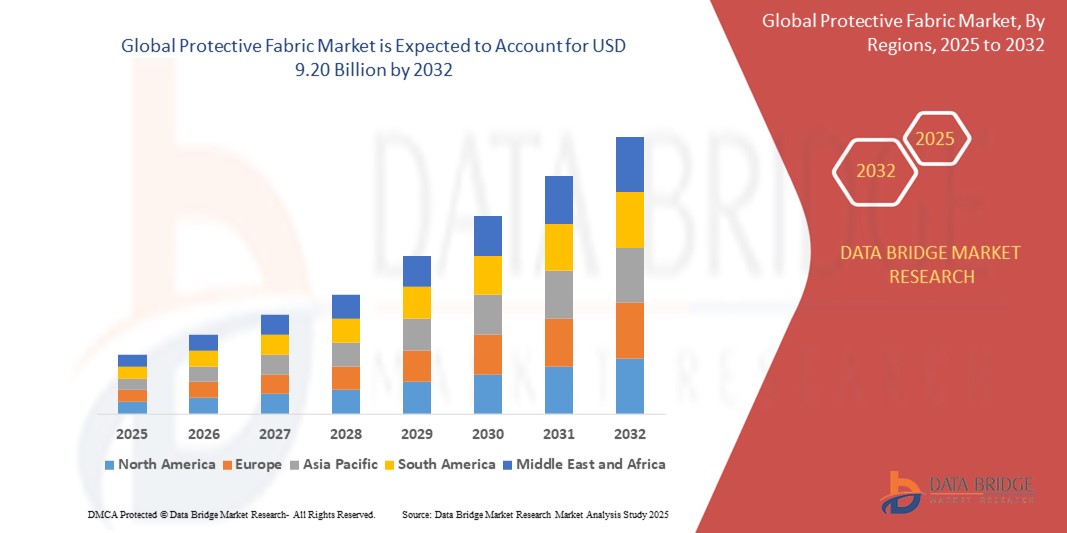
The Global Protective Fabric Market size was valued at USD 6.95 billion in 2024 and is expected to reach USD 9.20 billion by 2032, at a CAGR of 4.50% during the forecast period
Growth is driven by considerably due to the increasing adoption across various domains to ensure safety. also, the protective fabrics are also largely being adopted for utilities such as rainwear is also acting as a key determinant favoring the growth.
The major factor accountable for the growth of the market is the rapidly rising industrialization and infrastructure development and rising commercialization of their products in developed countries. Besides this, the high growth in personal protection equipment and protective clothing industries across the world is also flourishing the protective fabric market's growth
Protective Fabric Market Analysis
The increasing demand from the emerging regions and increasing demand for specialty fabrics will further offer a variety of growth opportunities for the protective fabric market.
Also, the strict Regulations pertaining to the personnel's safety in developed economies are also highly impacting the growth of the protective fabric market in the forecast.
Asia-Pacific is expected to dominate the global protective fabric market with a 35% share, driven by rapid industrialization, growing construction and manufacturing sectors, and increased investments in worker safety across countries like China, India, and Southeast Asia.
North America is forecasted to be the fastest-growing region with a CAGR of 5.1%, driven by rising industrial safety standards, defense modernization programs, and technological advancements in thermal, ballistic, and chemical-resistant textiles.
In 2024, Aramid dominates the protective fabric market due to its exceptional heat resistance, strength, and widespread use in defense and firefighting, holding over 35% market share globally. Its durability, flame resistance, and performance in extreme environments make it the preferred choice across multiple high-risk industries, sustaining its leadership.
Report Scope and Protective Fabric Market Segmentation
Attributes
Protective Fabric Key Market Insights
Segments Covered
By Raw Material: Aramid, PBI, Polyamide, Cotton Fibers, Polyolefin, Polyesters, Others
Product Type: Fire and Heat-Resistant, Chemical Resistant, UV Resistant, Ballistic and Mechanical Resistant, Cold Resistant
End User: Building and Construction, Firefighting, Oil and Gas, Healthcare, Law Enforcement and Military,Others
Countries Covered
North America
U.S.
Canada
Mexico
Europe
Germany
France
U.K.
Netherlands
Switzerland
Belgium
Russia
Italy
Spain
Turkey
Rest of Europe
Asia-Pacific
China
Japan
India
South Korea
Singapore
Malaysia
Australia
Thailand
Indonesia
Philippines
Rest of Asia-Pacific
Middle East and Africa
Saudi Arabia
U.A.E.
South Africa
Egypt
Israel
Rest of Middle East and Africa
South America
Brazil
Argentina
Rest of South America
Key Market Players
TEIJIN LIMITED (Japan)
W. L. Gore & Associates Inc. (U.S.)
DowDuPont (U.S.)
3M (U.S.)
Milliken & Company (U.S.)
Lakeland Inc. (U.S.)
Cetriko S.L. (Spain)
Glen Raven Inc. (U.S.)
Klopman International (Italy)
DUNHAM Rubber & Belting Corporation (U.S.)
Kolon Industries, Inc. (South Korea)
Shawmut Corporation LLC (U.S.)
CS Hyde Company (U.S.)
Tex Tech Industries (U.S.)
FABRI-TECH COMPONENTS Inc. (U.S.)
William J. Dixon, Inc. (U.S.)
Burlington Safety Laboratory Inc. (U.S.)
APEX MILLS (U.S.)
Jason Mills, LLC (U.S.)
Swift Textile Metalizing LLC (U.S.)
Market Opportunities
Rising Demand from Emerging Economies
Technological Advancements in Smart Protective Fabrics
Value Added Data Infosets
In addition to the insights on market scenarios such as market value, growth rate, segmentation, geographical coverage, and major players, the market reports curated by the Data Bridge Market Research also include in-depth expert analysis, pricing analysis, brand share analysis, consumer survey, demography analysis, supply chain analysis, value chain analysis, raw material/consumables overview, vendor selection criteria, PESTLE Analysis, Porter Analysis, and regulatory framework.
Protective Fabric Market Trends
“Rising Focus on Sustainable and Eco-Friendly Protective Fabrics”
Traditional protective fabrics, often made from synthetic fibers like aramid and polyester, face rising environmental concerns due to non-biodegradability and high carbon footprints.
In response, global sustainability regulations and corporate ESG commitments are driving demand for recyclable, bio-based, and low-impact protective materials.
For instance,
The European Union’s Green Deal and REACH regulations emphasize sustainable textile production and reduced environmental impact.
Manufacturers are investing in protective fabrics made from recycled PET, organic cotton, bio-polyesters, and plant-based aramids, aligning with green certifications.
These sustainable materials are increasingly used in healthcare, military uniforms, and industrial PPE, where both safety and sustainability are key requirements.
Growing consumer and industry demand for eco-conscious PPE is pushing brands to prioritize circular design, biodegradable options, and lower-emission production methods.
Protective Fabric Market Dynamics
Driver
“Rising Workplace Safety Regulations and Industrial Expansion”
Stringent worker safety regulations in sectors such as oil & gas, construction, firefighting, and manufacturing are driving the demand for advanced protective fabrics that offer heat, chemical, and mechanical resistance.
Regulatory bodies such as OSHA (U.S.), EU-OSHA, and ISO are mandating the use of certified personal protective equipment (PPE), including flame-retardant and arc-resistant fabrics.
Rapid industrialization in emerging economies like India, China, and Brazil is expanding the scope of protective fabric use across new infrastructure, energy, and production facilities.
Employers are increasingly investing in protective workwear to reduce injuries, boost worker confidence, and comply with insurance and labor laws.
For instance,
The Indian Ministry of Labour launched new safety codes, pushing industries to adopt protective clothing compliant with national and global safety standards.
Restraint/Challenge
“High Cost and Complex Manufacturing of Advanced Protective Fabrics”
High-performance protective fabrics like aramid, PBI, and carbon fiber blends require complex and costly production processes involving specialty chemicals and precision engineering.
The high initial investment in R&D, machinery, and certification testing acts as a barrier for new entrants and limits affordability for SMEs.
Price sensitivity in developing regions reduces adoption, especially where safety awareness and enforcement remain weak.
Volatility in raw material prices, particularly for petroleum-based fibers, impacts overall cost predictability and profit margins.
Protective Fabric Market Scope
The market is segmented on the basis of raw material, product type and end user.
By raw material
On the basis of raw material, the protective fabric market is segmented into aramid, PBI, polyamide, cotton fibers, polyolefin, polyesters and others. In 2024, Aramid dominates the protective fabric market due to its exceptional heat resistance, strength, and widespread use in defense and firefighting, holding over 35% market share globally. Its durability, flame resistance, and performance in extreme environments make it the preferred choice across multiple high-risk industries, sustaining its leadership.
In 2024, Polyolefin is the fastest growing segment with a CAGR of over 8%, driven by rising demand for lightweight, chemical-resistant, and cost-effective fabrics in industrial and medical applications. Increased use in cleanrooms, protective clothing, and packaging enhances its growth, especially in emerging economies focused on worker safety and hygiene.
By product type
On the basis of product type, the protective fabric market is segmented into fire and heat-resistant, chemical resistant, UV resistant, ballistic and mechanical resistant and cold resistant. The fire and heat-resistant segment dominates the protective fabric market due to stringent safety regulations and high demand from firefighting, military, and industrial sectors. Its critical role in thermal protection drives widespread adoption and consistent market leadership.
The chemical resistant segment is the fastest growing, driven by rising industrialization and demand from chemical, pharmaceutical, and oil & gas sectors. Growing worker safety concerns and stricter regulations are accelerating its adoption across both developed and developing regions.
By end user
On the basis of end user, the protective fabric market is segmented into building and construction, firefighting, oil and gas, healthcare, law enforcement and military and others. The firefighting segment leads the market due to the essential use of protective fabrics to ensure thermal insulation, flame resistance, and durability. Strict safety standards and continuous investments in protective gear boost consistent demand in this sector.
The healthcare segment is the fastest growing, propelled by increased focus on hygiene, infection control, and safety post-COVID-19. Rising use of protective fabrics in gowns, drapes, and other medical textiles is fueling rapid market expansion globally.
Protective Fabric Market Regional Analysis
Asia-Pacific is expected to dominate the global protective fabric market with a 35% share, driven by rapid industrialization, growing construction and manufacturing sectors, and increased investments in worker safety across countries like China, India, and Southeast Asia.
The region’s dominance is reinforced by a large labor-intensive workforce exposed to occupational hazards, boosting demand for protective clothing in oil & gas, mining, and chemical industries.
Additionally, government mandates and foreign investments in industrial safety equipment are accelerating adoption of high-performance protective fabrics in PPE applications.
China Protective Fabric Market Insight
China leads Asia-Pacific with a 38% revenue share in 2025, supported by expansive construction, automotive, and industrial sectors, coupled with strict enforcement of workplace safety regulations and rising export-oriented PPE manufacturing.
India Protective Fabric Market Insight
India is projected to record the highest CAGR of 6.9%, fueled by urban infrastructure growth, increasing safety compliance in oil & gas, and government initiatives under programs like "Make in India" promoting domestic PPE production.
Europe Protective Fabric Market Insight
Europe's market is shaped by strict safety standards, high awareness of worker protection, and widespread use in chemical, military, and manufacturing sectors—especially in Germany, France, and the Netherlands.
U.K. Protective Fabric Market Insight
The U.K. market is driven by demand for sustainable, flame-retardant fabrics, innovation in lightweight military textiles, and domestic production aligned with the nation’s focus on defense and high-tech textile advancements.
Germany Protective Fabric Market Insight
Germany leads Europe in technical textile innovation, with a strong base in automotive, defense, and industrial manufacturing. R&D in high-strength, multifunctional fabrics supports continued market growth in premium protective wear.
North America Protective Fabric Market Insight
North America is forecasted to be the fastest-growing region with a CAGR of 5.1%, driven by rising industrial safety standards, defense modernization programs, and technological advancements in thermal, ballistic, and chemical-resistant textiles.
U.S. Protective Fabric Market Insight
In 2025, The U.S., holding 35% of the North American market in 2025, benefits from a strong defense sector, high PPE usage in oil & gas and construction, and continuous innovation in aramid and PBI-based protective fabric technologies.
Protective Fabric Market Share
The Protective Fabric industry is primarily led by well-established companies, including:
TEIJIN LIMITED (Japan)
W. L. Gore & Associates Inc. (U.S.)
DowDuPont (U.S.)
3M (U.S.)
Milliken & Company (U.S.)
Lakeland Inc. (U.S.)
Cetriko S.L. (Spain)
Glen Raven Inc. (U.S.)
Klopman International (Italy)
DUNHAM Rubber & Belting Corporation (U.S.)
Kolon Industries, Inc. (South Korea)
Shawmut Corporation LLC (U.S.)
CS Hyde Company (U.S.)
Tex Tech Industries (U.S.)
FABRI-TECH COMPONENTS Inc. (U.S.)
William J. Dixon, Inc. (U.S.)
Burlington Safety Laboratory Inc. (U.S.)
APEX MILLS (U.S.)
Jason Mills, LLC (U.S.)
Swift Textile Metalizing LLC (U.S.)
Latest Developments in Global Protective Fabric Market
In May 2025, DuPont announced a major investment to expand its Nomex® aramid fiber production in Spain, aimed at meeting the rising global demand for flame-resistant protective fabrics in firefighting, military, and industrial sectors, reinforcing its position as a global leader in high-performance textiles.
In April 2025, Teijin Limited launched a bio-based aramid fabric under its Teijinconex® brand. Derived from renewable raw materials, the fabric maintains high heat and flame resistance while reducing carbon footprint, aligning with global sustainability goals in protective clothing and PPE markets.
In March 2025, Milliken & Company acquired the PPE business of Fire-Dex, strengthening its position in the North American firefighting protective gear segment. The acquisition expands Milliken’s technical textile portfolio and enhances its access to fire-resistant fabric technology and distribution channels.
In February 2025, W. L. Gore & Associates introduced a new lightweight Gore-Tex protective fabric with enhanced breathability and abrasion resistance for industrial and tactical uniforms. The innovation supports extended wear comfort in hot environments without compromising safety or durability.
In January 2025, Kolon Industries collaborated with Hyundai Rotem to develop smart protective military fabrics integrated with sensors for real-time monitoring of soldier health and environment. This innovation marks a step forward in merging protective textiles with wearable tech for defense applications.
SKU-
Get online access to the report on the World's First Market Intelligence Cloud
Interactive Data Analysis Dashboard
Company Analysis Dashboard for high growth potential opportunities
Research Analyst Access for customization & queries
Competitor Analysis with Interactive dashboard
Latest News, Updates & Trend analysis
Harness the Power of Benchmark Analysis for Comprehensive Competitor Tracking
Global Protective Fabric Market, Supply Chain Analysis and Ecosystem Framework
To support market growth and help clients navigate the impact of geopolitical shifts, DBMR has integrated in-depth supply chain analysis into its Global Protective Fabric Market research reports. This addition empowers clients to respond effectively to global changes affecting their industries. The supply chain analysis section includes detailed insights such as Global Protective Fabric Market consumption and production by country, price trend analysis, the impact of tariffs and geopolitical developments, and import and export trends by country and HSN code. It also highlights major suppliers with data on production capacity and company profiles, as well as key importers and exporters. In addition to research, DBMR offers specialized supply chain consulting services backed by over a decade of experience, providing solutions like supplier discovery, supplier risk assessment, price trend analysis, impact evaluation of inflation and trade route changes, and comprehensive market trend analysis.
Research Methodology
Data collection and base year analysis are done using data collection modules with large sample sizes. The stage includes obtaining market information or related data through various sources and strategies. It includes examining and planning all the data acquired from the past in advance. It likewise envelops the examination of information inconsistencies seen across different information sources. The market data is analysed and estimated using market statistical and coherent models. Also, market share analysis and key trend analysis are the major success factors in the market report. To know more, please request an analyst call or drop down your inquiry.
The key research methodology used by DBMR research team is data triangulation which involves data mining, analysis of the impact of data variables on the market and primary (industry expert) validation. Data models include Vendor Positioning Grid, Market Time Line Analysis, Market Overview and Guide, Company Positioning Grid, Patent Analysis, Pricing Analysis, Company Market Share Analysis, Standards of Measurement, Global versus Regional and Vendor Share Analysis. To know more about the research methodology, drop in an inquiry to speak to our industry experts.
Customization Available
Data Bridge Market Research is a leader in advanced formative research. We take pride in servicing our existing and new customers with data and analysis that match and suits their goal. The report can be customized to include price trend analysis of target brands understanding the market for additional countries (ask for the list of countries), clinical trial results data, literature review, refurbished market and product base analysis. Market analysis of target competitors can be analyzed from technology-based analysis to market portfolio strategies. We can add as many competitors that you require data about in the format and data style you are looking for. Our team of analysts can also provide you data in crude raw excel files pivot tables (Fact book) or can assist you in creating presentations from the data sets available in the report.
Claudio Rondena
Group Business Development & Strategic Marketing Director, C.O.C Farmaceutici SRL
"This morning we were involved in the first part, the data presentation of MKT analysis, selected abstract from your work. The board team was really impressed and very appreciated, as well."
David Manning - Thermo Fisher Scientific
Director, Global Strategic Accounts,
Dear Ricky, I want to thank you for the excellent market analysis (LIMS INSTALLED BASE DATA) that you and your team delivered, especially end of year on short notice.
Sachin and Shraddha captured the requirements, determined their path forward and executed quickly.
You, Sachin and Shraddha have been a pleasure to work with – very responsive, professional and thorough.
Your work is much appreciated.
Manager - Market Analytics,
Uriah D. Avila - Zeus Polymer Solutions
Thank you for all the assistance and the level of detail in the market report. We are very pleased with the results and the customization. We would like to continue to do business.
Business Development Manager,
(Pharmaceuticals Partner for Nasal Sprays) | Renaissance Lakewood LLC
DBMR was attentive and engaged while discussing the Global Nasal Spray Market. They understood what we were looking for and was able to provide some examples from the report as requested. DBMR Service team has been responsive as needed. Depending on what my colleagues were looking for, I will recommend your services and would be happy to stay connected in case we can utilize your research in the future.
Business Intelligence and Analytics,
Ipsen Biopharm Limited
We are impressed by the CENTRAL PRECOCIOUS PUBERTY (CPP) TREATMENT report - so a BIG thanks to you colleagues.
Competition Analyst,
Basler Web
I just wanted to share a quick note and let you know that you guys did a really good job. I’m glad I decided to work with you. I shall continue being associated with your company as long as we have market intelligence needs.
Marketing Director,
Buhler Group
It was indeed a good experience, would definitely recommend and come back for future prospects.
COO,
A global leader providing Drug Delivery Services
DBMR did an outstanding job on the Global Drug Delivery project, We were extremely impressed by the simple but comprehensive presentation of the study and the quality of work done. This report really helped us to access untapped opportunities across the globe.
Marketing Director,
Philips Healthcare
The study was customized to our targets and needs with well-defined milestones. We were impressed by the in-depth customization and inclusion of not only major but also minor players across the globe. The DBMR Market position grid helped us to analyze the market in different dimension which was very helpful for the team to get into the minute details.
Product manager,
Fujifilms
Thankful to the team for the amazing coordination, and helping me at the last moment with my presentation. It was indeed a comprehensive report that gave us revenue impacting solution enabling us to plan the right move.
Investor relations,
GE Healthcare
Thank you for the report, and addressing our needs in such short time. DBMR has outdone themselves in this project with such short timeframe.
Market Analyst,
Medincell
We found the results of this study compelling and will help our organization validate a market we are considering to enter. Thank you for a job well done.
Andrew - Senior Global Marketing Manager,
Medtronic (US)
I want to thank you for your help with this report – It’s been very helpful in our business planning and it well organized.
Amarildo - Manager, Global Strategic Alignment
MasterCard
We believe the work done by Data Bridge Team for our requirements in the North America Loyalty Management Market was fantastic and would love to continue working with your team moving forward.
Tor Hammer
Green Nexus LLc
Thank you for your quick response to this unfortunate circumstance. Please extend my thanks to your reach team. I will be contacting you in the future with further projects
I acknowledge the difficulty given by the very short warning for this report, and I think that its quality and your delivering time have been very satisfying.
Obviously, as a provider Data Bridge Market Research will be considered as a plus for future needs of Nippon Gases.
Yuki Kopyl (Asian Business Development Department)
UENO FOOD TECHNO INDUSTRY, LTD. (JAPAN)
Xylose report was very useful for our team. Thank you very much & hope to work with you again in the future